 Add to Chrome
 Add to Firefox
 Add to Edge
Kimi K3: Open Frontier Intelligence
Jul 27, 2026
We introduce Kimi K3, a 2.8T parameter Mixture-of-Experts model with 104 billion activated parameters, native vision capabilities, and a 1-million-token context window. Kimi K3 is built on Kimi Delta Attention and Attention Residuals, which improve information flow across sequence length and model depth. Together with Stable LatentMoE, which effectively activates 16 of 896 routed experts per token, and refined training and data recipes, these advances yield an approximately 2.5x improvement in overall scaling efficiency over Kimi K2. Post-training highlights reinforcement learning across general, agentic, and coding domains and multiple reasoning-effort levels, enabling compositional generalization and robust long-horizon execution. At 2.8T scale, Kimi K3 is supported by infrastructure advances in multiple areas: algorithm-system co-design for KDA, perfectly balanced expert-parallel training with efficient memory management, million-token agentic RL with persistent rollout and sandbox states, and deployment innovations. Extensive evaluations show that Kimi K3 achieves frontier-level performance across long-horizon coding, agentic, knowledge, reasoning, and vision tasks. While its overall performance still trails the most powerful proprietary models, namely Claude Fable 5 and GPT-5.6 Sol, Kimi K3 consistently outperforms other open and proprietary models evaluated in our suite. We release the full Kimi K3 model weights to facilitate future research and accelerate the broader deployment and adoption of frontier intelligence.

PerceptionBench: Evaluating Atomic Visual Perception in Multimodal Large Language Models
Jul 27, 2026We introduce PerceptionBench, a benchmark specifically designed to evaluate the atomic visual perception capabilities of Multimodal Large Language Models (MLLMs). Existing benchmarks often fail to isolate perception: holistic evaluations conflate perceptual errors with failures in reasoning or domain knowledge, while application-driven benchmarks only cover narrow, fragmented domains shaped by heuristic designs. To address these limitations, PerceptionBench adopts a bottom-up approach: by diagnosing the earliest failure points in the responses of frontier MLLMs across 42 existing benchmarks, we construct an error taxonomy whose perception branch defines ten atomic perceptual capabilities. Guided by this taxonomy, we construct 3,000 verified questions with short, unambiguous answers, each isolating a single capability, with difficulty stemming from perception rather than reasoning or knowledge. Benchmark results across sixteen frontier MLLMs reveal that atomic perception remains largely unsolved---no model reaches 60\% accuracy, perception-related hallucination is the weakest capability on average, and similar overall scores conceal sharply divergent capability profiles. PerceptionBench thus provides a capability-level standard for measuring and diagnosing the visual perception boundaries of MLLMs.
Attention Residuals
Mar 16, 2026Residual connections with PreNorm are standard in modern LLMs, yet they accumulate all layer outputs with fixed unit weights. This uniform aggregation causes uncontrolled hidden-state growth with depth, progressively diluting each layer's contribution. We propose Attention Residuals (AttnRes), which replaces this fixed accumulation with softmax attention over preceding layer outputs, allowing each layer to selectively aggregate earlier representations with learned, input-dependent weights. To address the memory and communication overhead of attending over all preceding layer outputs for large-scale model training, we introduce Block AttnRes, which partitions layers into blocks and attends over block-level representations, reducing the memory footprint while preserving most of the gains of full AttnRes. Combined with cache-based pipeline communication and a two-phase computation strategy, Block AttnRes becomes a practical drop-in replacement for standard residual connections with minimal overhead. Scaling law experiments confirm that the improvement is consistent across model sizes, and ablations validate the benefit of content-dependent depth-wise selection. We further integrate AttnRes into the Kimi Linear architecture (48B total / 3B activated parameters) and pre-train on 1.4T tokens, where AttnRes mitigates PreNorm dilution, yielding more uniform output magnitudes and gradient distribution across depth, and improves downstream performance across all evaluated tasks.
GUI-CEval: A Hierarchical and Comprehensive Chinese Benchmark for Mobile GUI Agents
Mar 16, 2026Recent progress in Multimodal Large Language Models (MLLMs) has enabled mobile GUI agents capable of visual perception, cross-modal reasoning, and interactive control. However, existing benchmarks are largely English-centric and fail to capture the linguistic and interaction characteristics of the Chinese mobile ecosystem. They also focus on isolated skills such as GUI grounding or offline agent, lacking a unified and fine-grained framework to assess the full capability chain from perception to execution. To address this gap, we introduce GUI-CEval, the first comprehensive benchmark for Chinese mobile GUI agents, built entirely on physical device environments. GUI-CEval spans 201 mainstream apps across four device types and adopts a two-level structure that evaluates both atomic abilities and realistic application-level performance along five dimensions: perception, planning, reflection, execution, and evaluation. All data are collected and verified through multi-stage manual processes to ensure authenticity and reproducibility. Extensive experiments on 20 representative MLLMs and multi-agent systems show that while models such as Qwen2.5-VL and UI-TARS perform competitively, most MLLMs still exhibit clear weaknesses in reflective decision-making and post-action self-evaluation, limiting their reliability in real-world interactions. We hope GUI-CEval provides a comprehensive and interpretable benchmark to guide capability diagnosis and advance the development of Chinese mobile GUI agents.
Kimi K2.5: Visual Agentic Intelligence
Feb 02, 2026We introduce Kimi K2.5, an open-source multimodal agentic model designed to advance general agentic intelligence. K2.5 emphasizes the joint optimization of text and vision so that two modalities enhance each other. This includes a series of techniques such as joint text-vision pre-training, zero-vision SFT, and joint text-vision reinforcement learning. Building on this multimodal foundation, K2.5 introduces Agent Swarm, a self-directed parallel agent orchestration framework that dynamically decomposes complex tasks into heterogeneous sub-problems and executes them concurrently. Extensive evaluations show that Kimi K2.5 achieves state-of-the-art results across various domains including coding, vision, reasoning, and agentic tasks. Agent Swarm also reduces latency by up to $4.5\times$ over single-agent baselines. We release the post-trained Kimi K2.5 model checkpoint to facilitate future research and real-world applications of agentic intelligence.
WorldVQA: Measuring Atomic World Knowledge in Multimodal Large Language Models
Jan 28, 2026We introduce WorldVQA, a benchmark designed to evaluate the atomic visual world knowledge of Multimodal Large Language Models (MLLMs). Unlike current evaluations, which often conflate visual knowledge retrieval with reasoning, WorldVQA decouples these capabilities to strictly measure "what the model memorizes." The benchmark assesses the atomic capability of grounding and naming visual entities across a stratified taxonomy, spanning from common head-class objects to long-tail rarities. We expect WorldVQA to serve as a rigorous test for visual factuality, thereby establishing a standard for assessing the encyclopedic breadth and hallucination rates of current and next-generation frontier models.
Towards Pixel-Level VLM Perception via Simple Points Prediction
Jan 27, 2026We present SimpleSeg, a strikingly simple yet highly effective approach to endow Multimodal Large Language Models (MLLMs) with native pixel-level perception. Our method reframes segmentation as a simple sequence generation problem: the model directly predicts sequences of points (textual coordinates) delineating object boundaries, entirely within its language space. To achieve high fidelity, we introduce a two-stage SF$\to$RL training pipeline, where Reinforcement Learning with an IoU-based reward refines the point sequences to accurately match ground-truth contours. We find that the standard MLLM architecture possesses a strong, inherent capacity for low-level perception that can be unlocked without any specialized architecture. On segmentation benchmarks, SimpleSeg achieves performance that is comparable to, and often surpasses, methods relying on complex, task-specific designs. This work lays out that precise spatial understanding can emerge from simple point prediction, challenging the prevailing need for auxiliary components and paving the way for more unified and capable VLMs. Homepage: https://simpleseg.github.io/
BabyVision: Visual Reasoning Beyond Language
Jan 10, 2026While humans develop core visual skills long before acquiring language, contemporary Multimodal LLMs (MLLMs) still rely heavily on linguistic priors to compensate for their fragile visual understanding. We uncovered a crucial fact: state-of-the-art MLLMs consistently fail on basic visual tasks that humans, even 3-year-olds, can solve effortlessly. To systematically investigate this gap, we introduce BabyVision, a benchmark designed to assess core visual abilities independent of linguistic knowledge for MLLMs. BabyVision spans a wide range of tasks, with 388 items divided into 22 subclasses across four key categories. Empirical results and human evaluation reveal that leading MLLMs perform significantly below human baselines. Gemini3-Pro-Preview scores 49.7, lagging behind 6-year-old humans and falling well behind the average adult score of 94.1. These results show despite excelling in knowledge-heavy evaluations, current MLLMs still lack fundamental visual primitives. Progress in BabyVision represents a step toward human-level visual perception and reasoning capabilities. We also explore solving visual reasoning with generation models by proposing BabyVision-Gen and automatic evaluation toolkit. Our code and benchmark data are released at https://github.com/UniPat-AI/BabyVision for reproduction.
HyperVL: An Efficient and Dynamic Multimodal Large Language Model for Edge Devices
Dec 16, 2025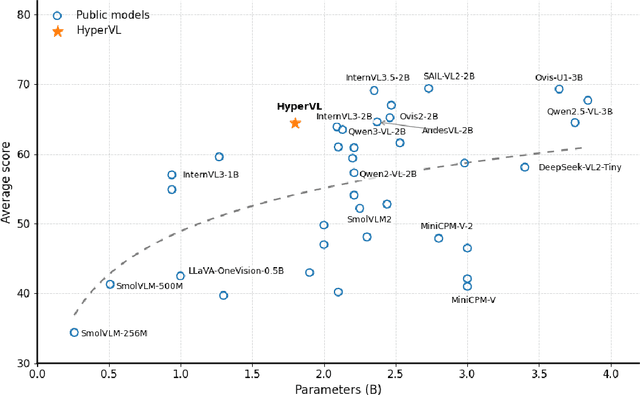

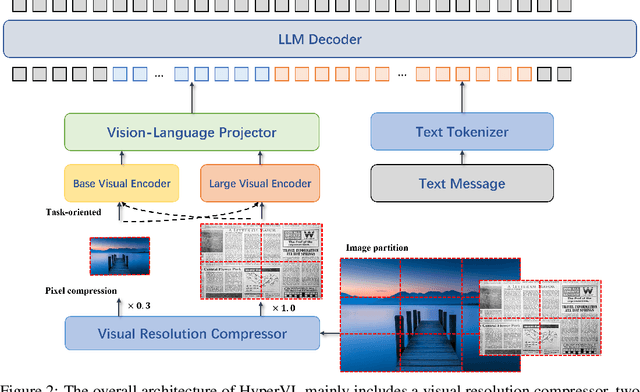
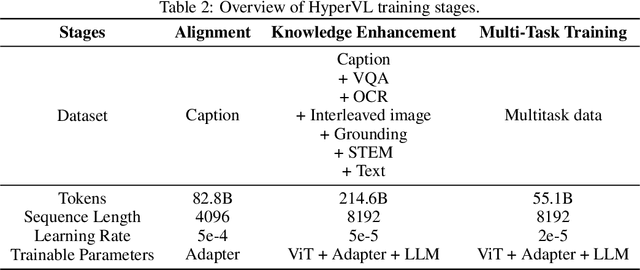
Current multimodal large lanauge models possess strong perceptual and reasoning capabilities, however high computational and memory requirements make them difficult to deploy directly on on-device environments. While small-parameter models are progressively endowed with strong general capabilities, standard Vision Transformer (ViT) encoders remain a critical bottleneck, suffering from excessive latency and memory consumption when processing high-resolution inputs.To address these challenges, we introduce HyperVL, an efficient multimodal large language model tailored for on-device inference. HyperVL adopts an image-tiling strategy to cap peak memory usage and incorporates two novel techniques: (1) a Visual Resolution Compressor (VRC) that adaptively predicts optimal encoding resolutions to eliminate redundant computation, and (2) Dual Consistency Learning (DCL), which aligns multi-scale ViT encoders within a unified framework, enabling dynamic switching between visual branches under a shared LLM. Extensive experiments demonstrate that HyperVL achieves state-of-the-art performance among models of comparable size across multiple benchmarks. Furthermore, it significantly significantly reduces latency and power consumption on real mobile devices, demonstrating its practicality for on-device multimodal inference.
Physics-Constrained Diffusion Reconstruction with Posterior Correction for Quantitative and Fast PET Imaging
Aug 20, 2025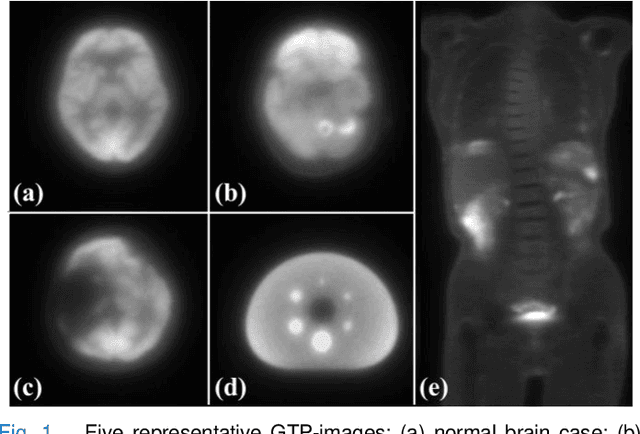
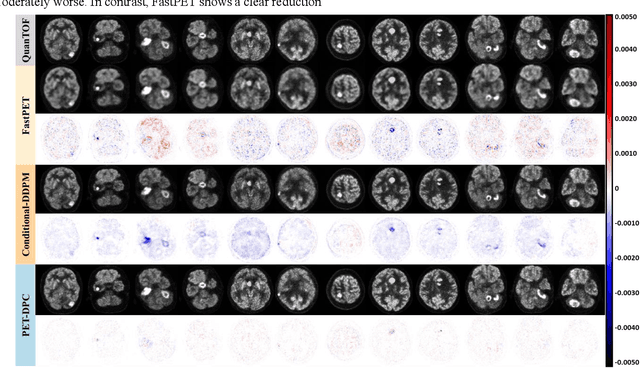
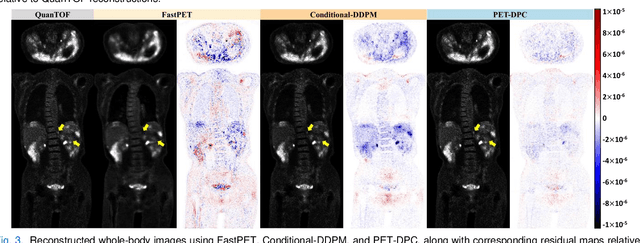
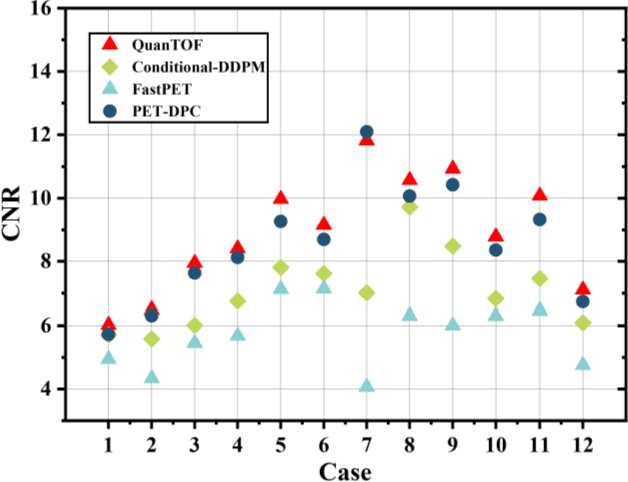
Deep learning-based reconstruction of positron emission tomography(PET) data has gained increasing attention in recent years. While these methods achieve fast reconstruction,concerns remain regarding quantitative accuracy and the presence of artifacts,stemming from limited model interpretability,data driven dependence, and overfitting risks.These challenges have hindered clinical adoption.To address them,we propose a conditional diffusion model with posterior physical correction (PET-DPC) for PET image reconstruction. An innovative normalization procedure generates the input Geometric TOF Probabilistic Image (GTP-image),while physical information is incorporated during the diffusion sampling process to perform posterior scatter,attenuation,and random corrections. The model was trained and validated on 300 brain and 50 whole-body PET datasets,a physical phantom,and 20 simulated brain datasets. PET-DPC produced reconstructions closely aligned with fully corrected OSEM images,outperforming end-to-end deep learning models in quantitative metrics and,in some cases, surpassing traditional iterative methods. The model also generalized well to out-of-distribution(OOD) data. Compared to iterative methods,PET-DPC reduced reconstruction time by 50% for brain scans and 85% for whole-body scans. Ablation studies confirmed the critical role of posterior correction in implementing scatter and attenuation corrections,enhancing reconstruction accuracy. Experiments with physical phantoms further demonstrated PET-DPC's ability to preserve background uniformity and accurately reproduce tumor-to-background intensity ratios. Overall,these results highlight PET-DPC as a promising approach for rapid, quantitatively accurate PET reconstruction,with strong potential to improve clinical imaging workflows.