 Add to Chrome
 Add to Firefox
 Add to Edge
VisionLLM v2: An End-to-End Generalist Multimodal Large Language Model for Hundreds of Vision-Language Tasks
Jun 12, 2024
We present VisionLLM v2, an end-to-end generalist multimodal large model (MLLM) that unifies visual perception, understanding, and generation within a single framework. Unlike traditional MLLMs limited to text output, VisionLLM v2 significantly broadens its application scope. It excels not only in conventional visual question answering (VQA) but also in open-ended, cross-domain vision tasks such as object localization, pose estimation, and image generation and editing. To this end, we propose a new information transmission mechanism termed "super link", as a medium to connect MLLM with task-specific decoders. It not only allows flexible transmission of task information and gradient feedback between the MLLM and multiple downstream decoders but also effectively resolves training conflicts in multi-tasking scenarios. In addition, to support the diverse range of tasks, we carefully collected and combed training data from hundreds of public vision and vision-language tasks. In this way, our model can be joint-trained end-to-end on hundreds of vision language tasks and generalize to these tasks using a set of shared parameters through different user prompts, achieving performance comparable to task-specific models. We believe VisionLLM v2 will offer a new perspective on the generalization of MLLMs.

GUI Odyssey: A Comprehensive Dataset for Cross-App GUI Navigation on Mobile Devices
Jun 12, 2024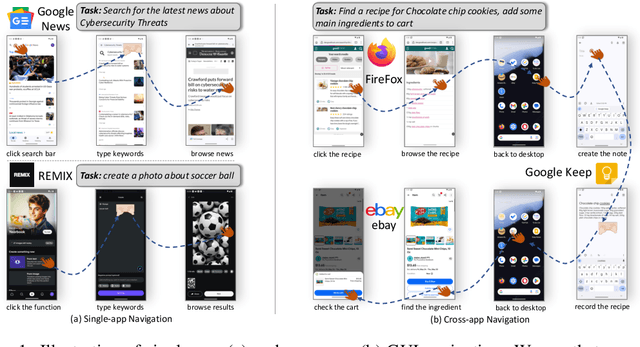

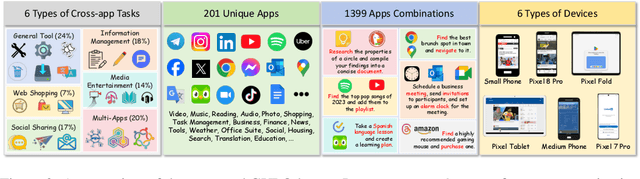

Smartphone users often navigate across multiple applications (apps) to complete tasks such as sharing content between social media platforms. Autonomous Graphical User Interface (GUI) navigation agents can enhance user experience in communication, entertainment, and productivity by streamlining workflows and reducing manual intervention. However, prior GUI agents often trained with datasets comprising simple tasks that can be completed within a single app, leading to poor performance in cross-app navigation. To address this problem, we introduce GUI Odyssey, a comprehensive dataset for training and evaluating cross-app navigation agents. GUI Odyssey consists of 7,735 episodes from 6 mobile devices, spanning 6 types of cross-app tasks, 201 apps, and 1.4K app combos. Leveraging GUI Odyssey, we developed OdysseyAgent, a multimodal cross-app navigation agent by fine-tuning the Qwen-VL model with a history resampling module. Extensive experiments demonstrate OdysseyAgent's superior accuracy compared to existing models. For instance, OdysseyAgent surpasses fine-tuned Qwen-VL and zero-shot GPT-4V by 1.44\% and 55.49\% in-domain accuracy, and 2.29\% and 48.14\% out-of-domain accuracy on average. The dataset and code will be released in \url{https://github.com/OpenGVLab/GUI-Odyssey}.
Needle In A Multimodal Haystack
Jun 11, 2024With the rapid advancement of multimodal large language models (MLLMs), their evaluation has become increasingly comprehensive. However, understanding long multimodal content, as a foundational ability for real-world applications, remains underexplored. In this work, we present Needle In A Multimodal Haystack (MM-NIAH), the first benchmark specifically designed to systematically evaluate the capability of existing MLLMs to comprehend long multimodal documents. Our benchmark includes three types of evaluation tasks: multimodal retrieval, counting, and reasoning. In each task, the model is required to answer the questions according to different key information scattered throughout the given multimodal document. Evaluating the leading MLLMs on MM-NIAH, we observe that existing models still have significant room for improvement on these tasks, especially on vision-centric evaluation. We hope this work can provide a platform for further research on long multimodal document comprehension and contribute to the advancement of MLLMs. Code and benchmark are released at https://github.com/OpenGVLab/MM-NIAH.
Autoregressive Model Beats Diffusion: Llama for Scalable Image Generation
Jun 10, 2024


We introduce LlamaGen, a new family of image generation models that apply original ``next-token prediction'' paradigm of large language models to visual generation domain. It is an affirmative answer to whether vanilla autoregressive models, e.g., Llama, without inductive biases on visual signals can achieve state-of-the-art image generation performance if scaling properly. We reexamine design spaces of image tokenizers, scalability properties of image generation models, and their training data quality. The outcome of this exploration consists of: (1) An image tokenizer with downsample ratio of 16, reconstruction quality of 0.94 rFID and codebook usage of 97% on ImageNet benchmark. (2) A series of class-conditional image generation models ranging from 111M to 3.1B parameters, achieving 2.18 FID on ImageNet 256x256 benchmarks, outperforming the popular diffusion models such as LDM, DiT. (3) A text-conditional image generation model with 775M parameters, from two-stage training on LAION-COCO and high aesthetics quality images, demonstrating competitive performance of visual quality and text alignment. (4) We verify the effectiveness of LLM serving frameworks in optimizing the inference speed of image generation models and achieve 326% - 414% speedup. We release all models and codes to facilitate open-source community of visual generation and multimodal foundation models.
Uncovering Limitations of Large Language Models in Information Seeking from Tables
Jun 06, 2024Tables are recognized for their high information density and widespread usage, serving as essential sources of information. Seeking information from tables (TIS) is a crucial capability for Large Language Models (LLMs), serving as the foundation of knowledge-based Q&A systems. However, this field presently suffers from an absence of thorough and reliable evaluation. This paper introduces a more reliable benchmark for Table Information Seeking (TabIS). To avoid the unreliable evaluation caused by text similarity-based metrics, TabIS adopts a single-choice question format (with two options per question) instead of a text generation format. We establish an effective pipeline for generating options, ensuring their difficulty and quality. Experiments conducted on 12 LLMs reveal that while the performance of GPT-4-turbo is marginally satisfactory, both other proprietary and open-source models perform inadequately. Further analysis shows that LLMs exhibit a poor understanding of table structures, and struggle to balance between TIS performance and robustness against pseudo-relevant tables (common in retrieval-augmented systems). These findings uncover the limitations and potential challenges of LLMs in seeking information from tables. We release our data and code to facilitate further research in this field.
Learning Manipulation by Predicting Interaction
Jun 01, 2024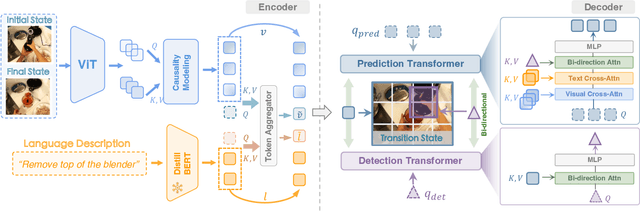
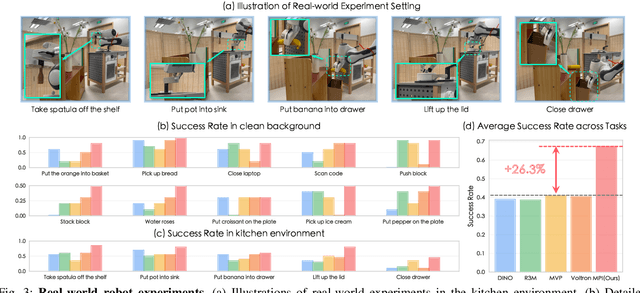
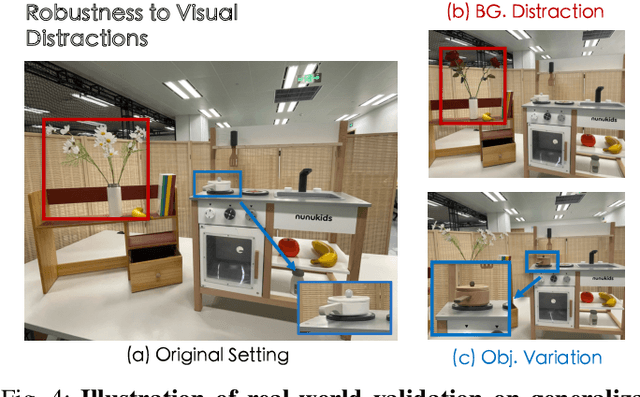
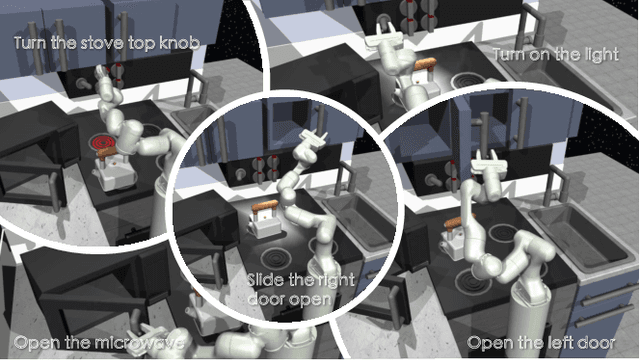
Representation learning approaches for robotic manipulation have boomed in recent years. Due to the scarcity of in-domain robot data, prevailing methodologies tend to leverage large-scale human video datasets to extract generalizable features for visuomotor policy learning. Despite the progress achieved, prior endeavors disregard the interactive dynamics that capture behavior patterns and physical interaction during the manipulation process, resulting in an inadequate understanding of the relationship between objects and the environment. To this end, we propose a general pre-training pipeline that learns Manipulation by Predicting the Interaction (MPI) and enhances the visual representation.Given a pair of keyframes representing the initial and final states, along with language instructions, our algorithm predicts the transition frame and detects the interaction object, respectively. These two learning objectives achieve superior comprehension towards "how-to-interact" and "where-to-interact". We conduct a comprehensive evaluation of several challenging robotic tasks.The experimental results demonstrate that MPI exhibits remarkable improvement by 10% to 64% compared with previous state-of-the-art in real-world robot platforms as well as simulation environments. Code and checkpoints are publicly shared at https://github.com/OpenDriveLab/MPI.
Diagnosing the Compositional Knowledge of Vision Language Models from a Game-Theoretic View
May 27, 2024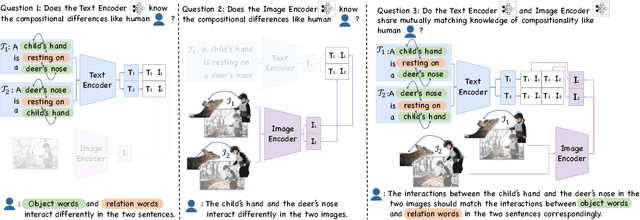
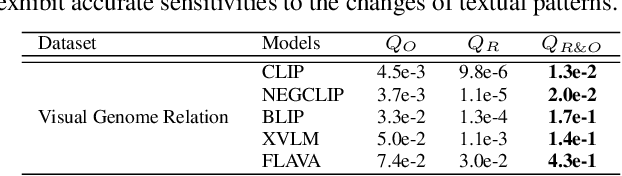
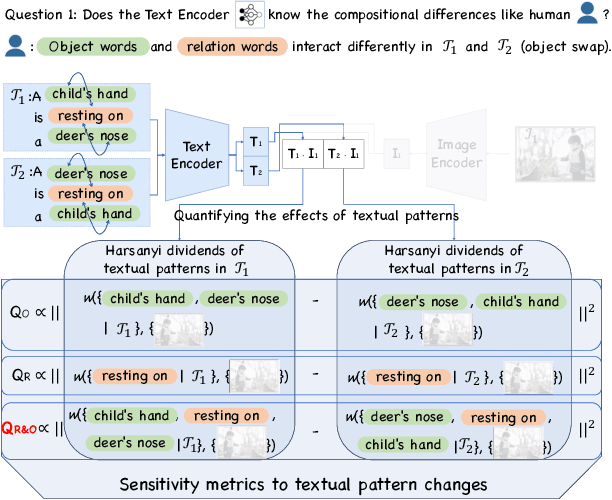
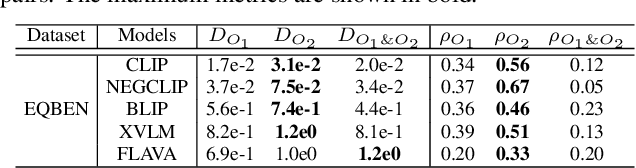
Compositional reasoning capabilities are usually considered as fundamental skills to characterize human perception. Recent studies show that current Vision Language Models (VLMs) surprisingly lack sufficient knowledge with respect to such capabilities. To this end, we propose to thoroughly diagnose the composition representations encoded by VLMs, systematically revealing the potential cause for this weakness. Specifically, we propose evaluation methods from a novel game-theoretic view to assess the vulnerability of VLMs on different aspects of compositional understanding, e.g., relations and attributes. Extensive experimental results demonstrate and validate several insights to understand the incapabilities of VLMs on compositional reasoning, which provide useful and reliable guidance for future studies. The deliverables will be updated at https://vlms-compositionality-gametheory.github.io/.
Part123: Part-aware 3D Reconstruction from a Single-view Image
May 27, 2024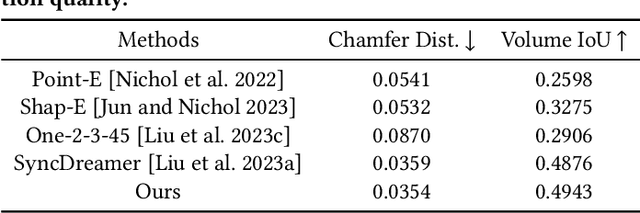
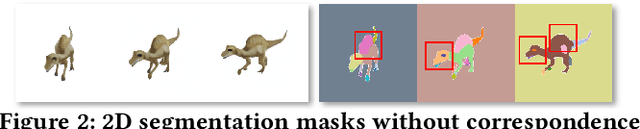


Recently, the emergence of diffusion models has opened up new opportunities for single-view reconstruction. However, all the existing methods represent the target object as a closed mesh devoid of any structural information, thus neglecting the part-based structure, which is crucial for many downstream applications, of the reconstructed shape. Moreover, the generated meshes usually suffer from large noises, unsmooth surfaces, and blurry textures, making it challenging to obtain satisfactory part segments using 3D segmentation techniques. In this paper, we present Part123, a novel framework for part-aware 3D reconstruction from a single-view image. We first use diffusion models to generate multiview-consistent images from a given image, and then leverage Segment Anything Model (SAM), which demonstrates powerful generalization ability on arbitrary objects, to generate multiview segmentation masks. To effectively incorporate 2D part-based information into 3D reconstruction and handle inconsistency, we introduce contrastive learning into a neural rendering framework to learn a part-aware feature space based on the multiview segmentation masks. A clustering-based algorithm is also developed to automatically derive 3D part segmentation results from the reconstructed models. Experiments show that our method can generate 3D models with high-quality segmented parts on various objects. Compared to existing unstructured reconstruction methods, the part-aware 3D models from our method benefit some important applications, including feature-preserving reconstruction, primitive fitting, and 3D shape editing.
UDKAG: Augmenting Large Vision-Language Models with Up-to-Date Knowledge
May 23, 2024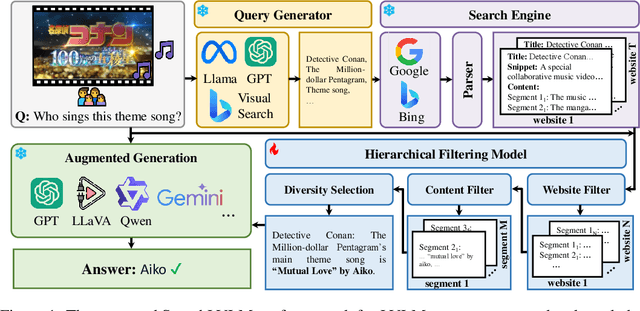
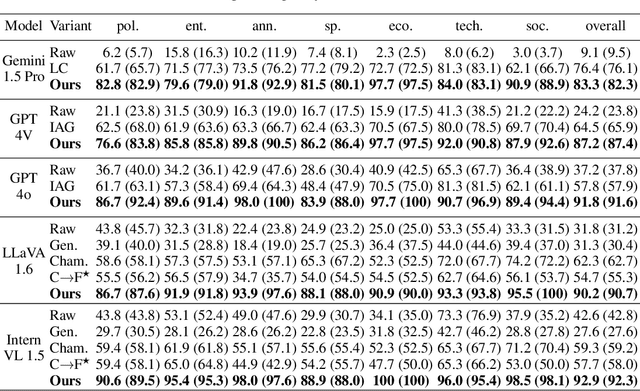
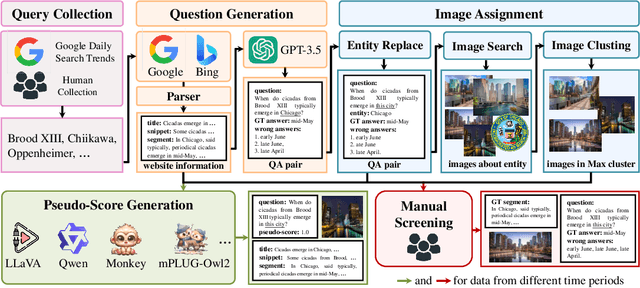
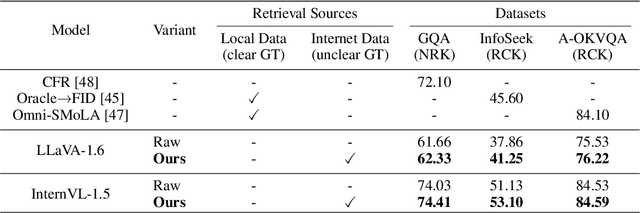
Large vision-language models (LVLMs) are ignorant of the up-to-date knowledge, such as LLaVA series, because they cannot be updated frequently due to the large amount of resources required, and therefore fail in many cases. For example, if a LVLM was released on January 2024, and it wouldn't know the detailed plot of the new movie Dune 2, which wasn't released until February 2024. To solve the problem, a promising solution is to provide LVLMs with up-to-date knowledge via internet search during inference, i.e., internet-augmented generation (IAG), which is already integrated in some closed-source commercial LVLMs such as GPT-4V. However, the specific mechanics underpinning them remain a mystery. In this paper, we propose a plug-and-play framework, for augmenting existing LVLMs in handling visual question answering (VQA) about up-to-date knowledge, dubbed UDKAG. A hierarchical filtering model is trained to effectively and efficiently find the most helpful content from the websites returned by a search engine to prompt LVLMs with up-to-date knowledge. To train the model and evaluate our framework's performance, we propose a pipeline to automatically generate news-related VQA samples to construct a dataset, dubbed UDK-VQA. A multi-model voting mechanism is introduced to label the usefulness of website/content for VQA samples to construct the training set. Experimental results demonstrate the effectiveness of our framework, outperforming GPT-4V by about 25% in accuracy.
AnalogCoder: Analog Circuit Design via Training-Free Code Generation
May 23, 2024
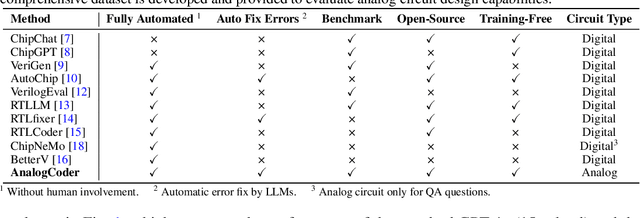


Analog circuit design is a significant task in modern chip technology, focusing on the selection of component types, connectivity, and parameters to ensure proper circuit functionality. Despite advances made by Large Language Models (LLMs) in digital circuit design, the complexity and scarcity of data in analog circuitry pose significant challenges. To mitigate these issues, we introduce AnalogCoder, the first training-free LLM agent for designing analog circuits through Python code generation. Firstly, AnalogCoder incorporates a feedback-enhanced flow with tailored domain-specific prompts, enabling the automated and self-correcting design of analog circuits with a high success rate. Secondly, it proposes a circuit tool library to archive successful designs as reusable modular sub-circuits, simplifying composite circuit creation. Thirdly, extensive experiments on a benchmark designed to cover a wide range of analog circuit tasks show that AnalogCoder outperforms other LLM-based methods. It has successfully designed 20 circuits, 5 more than standard GPT-4o. We believe AnalogCoder can significantly improve the labor-intensive chip design process, enabling non-experts to design analog circuits efficiently. Codes and the benchmark are provided at https://github.com/anonyanalog/AnalogCoder.