 Add to Chrome
 Add to Firefox
 Add to Edge
Bernini: Latent Semantic Planning for Video Diffusion
May 21, 2026
Multimodal large language models (MLLMs) and diffusion models have each reached remarkable maturity: MLLMs excel at reasoning over heterogeneous multimodal inputs with strong semantic grounding, while diffusion models synthesize images and videos with photorealistic fidelity. We argue that these two families can be unified through a simple division of labor: MLLMs perform semantic planning, while diffusion models render pixels from high-level semantic guidance and low-level visual features. Building on this idea, we propose Bernini, a unified framework for video generation and editing. An MLLM-based planner predicts the target semantic representation directly in the ViT embedding space, and a DiT-based renderer synthesizes pixels conditioned on this plan, augmented by text features and, for editing, source VAE features for detail preservation. Because semantics serve as the interface, the planner and renderer can be trained separately and only lightly co-trained, preserving the pretrained strengths of both components while keeping training efficient. To better handle multiple visual inputs, we introduce Segment-Aware 3D Rotary Positional Embedding (SA-3D RoPE), and further incorporate chain-of-thought reasoning in the planner to better transfer understanding into generation. Bernini achieves state-of-the-art performance across a wide range of video generation and editing benchmarks, with the MLLM's pretrained understanding translating into strong generalization on challenging editing tasks.

Guiding Distribution Matching Distillation with Gradient-Based Reinforcement Learning
Apr 21, 2026Diffusion distillation, exemplified by Distribution Matching Distillation (DMD), has shown great promise in few-step generation but often sacrifices quality for sampling speed. While integrating Reinforcement Learning (RL) into distillation offers potential, a naive fusion of these two objectives relies on suboptimal raw sample evaluation. This sample-based scoring creates inherent conflicts with the distillation trajectory and produces unreliable rewards due to the noisy nature of early-stage generation. To overcome these limitations, we propose GDMD, a novel framework that redefines the reward mechanism by prioritizing distillation gradients over raw pixel outputs as the primary signal for optimization. By reinterpreting the DMD gradients as implicit target tensors, our framework enables existing reward models to directly evaluate the quality of distillation updates. This gradient-level guidance functions as an adaptive weighting that synchronizes the RL policy with the distillation objective, effectively neutralizing optimization divergence. Empirical results show that GDMD sets a new SOTA for few-step generation. Specifically, our 4-step models outperform the quality of their multi-step teacher and substantially exceed previous DMDR results in GenEval and human-preference metrics, exhibiting strong scalability potential.
Generative Refinement Networks for Visual Synthesis
Apr 14, 2026While diffusion models dominate the field of visual generation, they are computationally inefficient, applying a uniform computational effort regardless of different complexity. In contrast, autoregressive (AR) models are inherently complexity-aware, as evidenced by their variable likelihoods, but are often hindered by lossy discrete tokenization and error accumulation. In this work, we introduce Generative Refinement Networks (GRN), a next-generation visual synthesis paradigm to address these issues. At its core, GRN addresses the discrete tokenization bottleneck through a theoretically near-lossless Hierarchical Binary Quantization (HBQ), achieving a reconstruction quality comparable to continuous counterparts. Built upon HBQ's latent space, GRN fundamentally upgrades AR generation with a global refinement mechanism that progressively perfects and corrects artworks -- like a human artist painting. Besides, GRN integrates an entropy-guided sampling strategy, enabling complexity-aware, adaptive-step generation without compromising visual quality. On the ImageNet benchmark, GRN establishes new records in image reconstruction (0.56 rFID) and class-conditional image generation (1.81 gFID). We also scale GRN to more challenging text-to-image and text-to-video generation, delivering superior performance on an equivalent scale. We release all models and code to foster further research on GRN.
Dual-End Consistency Model
Feb 11, 2026The slow iterative sampling nature remains a major bottleneck for the practical deployment of diffusion and flow-based generative models. While consistency models (CMs) represent a state-of-the-art distillation-based approach for efficient generation, their large-scale application is still limited by two key issues: training instability and inflexible sampling. Existing methods seek to mitigate these problems through architectural adjustments or regularized objectives, yet overlook the critical reliance on trajectory selection. In this work, we first conduct an analysis on these two limitations: training instability originates from loss divergence induced by unstable self-supervised term, whereas sampling inflexibility arises from error accumulation. Based on these insights and analysis, we propose the Dual-End Consistency Model (DE-CM) that selects vital sub-trajectory clusters to achieve stable and effective training. DE-CM decomposes the PF-ODE trajectory and selects three critical sub-trajectories as optimization targets. Specifically, our approach leverages continuous-time CMs objectives to achieve few-step distillation and utilizes flow matching as a boundary regularizer to stabilize the training process. Furthermore, we propose a novel noise-to-noisy (N2N) mapping that can map noise to any point, thereby alleviating the error accumulation in the first step. Extensive experimental results show the effectiveness of our method: it achieves a state-of-the-art FID score of 1.70 in one-step generation on the ImageNet 256x256 dataset, outperforming existing CM-based one-step approaches.
ALIVE: Animate Your World with Lifelike Audio-Video Generation
Feb 09, 2026Video generation is rapidly evolving towards unified audio-video generation. In this paper, we present ALIVE, a generation model that adapts a pretrained Text-to-Video (T2V) model to Sora-style audio-video generation and animation. In particular, the model unlocks the Text-to-Video&Audio (T2VA) and Reference-to-Video&Audio (animation) capabilities compared to the T2V foundation models. To support the audio-visual synchronization and reference animation, we augment the popular MMDiT architecture with a joint audio-video branch which includes TA-CrossAttn for temporally-aligned cross-modal fusion and UniTemp-RoPE for precise audio-visual alignment. Meanwhile, a comprehensive data pipeline consisting of audio-video captioning, quality control, etc., is carefully designed to collect high-quality finetuning data. Additionally, we introduce a new benchmark to perform a comprehensive model test and comparison. After continue pretraining and finetuning on million-level high-quality data, ALIVE demonstrates outstanding performance, consistently outperforming open-source models and matching or surpassing state-of-the-art commercial solutions. With detailed recipes and benchmarks, we hope ALIVE helps the community develop audio-video generation models more efficiently. Official page: https://github.com/FoundationVision/Alive.
NextFlow: Unified Sequential Modeling Activates Multimodal Understanding and Generation
Jan 05, 2026We present NextFlow, a unified decoder-only autoregressive transformer trained on 6 trillion interleaved text-image discrete tokens. By leveraging a unified vision representation within a unified autoregressive architecture, NextFlow natively activates multimodal understanding and generation capabilities, unlocking abilities of image editing, interleaved content and video generation. Motivated by the distinct nature of modalities - where text is strictly sequential and images are inherently hierarchical - we retain next-token prediction for text but adopt next-scale prediction for visual generation. This departs from traditional raster-scan methods, enabling the generation of 1024x1024 images in just 5 seconds - orders of magnitude faster than comparable AR models. We address the instabilities of multi-scale generation through a robust training recipe. Furthermore, we introduce a prefix-tuning strategy for reinforcement learning. Experiments demonstrate that NextFlow achieves state-of-the-art performance among unified models and rivals specialized diffusion baselines in visual quality.
InfinityStar: Unified Spacetime AutoRegressive Modeling for Visual Generation
Nov 06, 2025We introduce InfinityStar, a unified spacetime autoregressive framework for high-resolution image and dynamic video synthesis. Building on the recent success of autoregressive modeling in both vision and language, our purely discrete approach jointly captures spatial and temporal dependencies within a single architecture. This unified design naturally supports a variety of generation tasks such as text-to-image, text-to-video, image-to-video, and long interactive video synthesis via straightforward temporal autoregression. Extensive experiments demonstrate that InfinityStar scores 83.74 on VBench, outperforming all autoregressive models by large margins, even surpassing some diffusion competitors like HunyuanVideo. Without extra optimizations, our model generates a 5s, 720p video approximately 10x faster than leading diffusion-based methods. To our knowledge, InfinityStar is the first discrete autoregressive video generator capable of producing industrial level 720p videos. We release all code and models to foster further research in efficient, high-quality video generation.
HLLM-Creator: Hierarchical LLM-based Personalized Creative Generation
Aug 25, 2025AI-generated content technologies are widely used in content creation. However, current AIGC systems rely heavily on creators' inspiration, rarely generating truly user-personalized content. In real-world applications such as online advertising, a single product may have multiple selling points, with different users focusing on different features. This underscores the significant value of personalized, user-centric creative generation. Effective personalized content generation faces two main challenges: (1) accurately modeling user interests and integrating them into the content generation process while adhering to factual constraints, and (2) ensuring high efficiency and scalability to handle the massive user base in industrial scenarios. Additionally, the scarcity of personalized creative data in practice complicates model training, making data construction another key hurdle. We propose HLLM-Creator, a hierarchical LLM framework for efficient user interest modeling and personalized content generation. During inference, a combination of user clustering and a user-ad-matching-prediction based pruning strategy is employed to significantly enhance generation efficiency and reduce computational overhead, making the approach suitable for large-scale deployment. Moreover, we design a data construction pipeline based on chain-of-thought reasoning, which generates high-quality, user-specific creative titles and ensures factual consistency despite limited personalized data. This pipeline serves as a critical foundation for the effectiveness of our model. Extensive experiments on personalized title generation for Douyin Search Ads show the effectiveness of HLLM-Creator. Online A/B test shows a 0.476% increase on Adss, paving the way for more effective and efficient personalized generation in industrial scenarios. Codes for academic dataset are available at https://github.com/bytedance/HLLM.
DetailFlow: 1D Coarse-to-Fine Autoregressive Image Generation via Next-Detail Prediction
May 27, 2025This paper presents DetailFlow, a coarse-to-fine 1D autoregressive (AR) image generation method that models images through a novel next-detail prediction strategy. By learning a resolution-aware token sequence supervised with progressively degraded images, DetailFlow enables the generation process to start from the global structure and incrementally refine details. This coarse-to-fine 1D token sequence aligns well with the autoregressive inference mechanism, providing a more natural and efficient way for the AR model to generate complex visual content. Our compact 1D AR model achieves high-quality image synthesis with significantly fewer tokens than previous approaches, i.e. VAR/VQGAN. We further propose a parallel inference mechanism with self-correction that accelerates generation speed by approximately 8x while reducing accumulation sampling error inherent in teacher-forcing supervision. On the ImageNet 256x256 benchmark, our method achieves 2.96 gFID with 128 tokens, outperforming VAR (3.3 FID) and FlexVAR (3.05 FID), which both require 680 tokens in their AR models. Moreover, due to the significantly reduced token count and parallel inference mechanism, our method runs nearly 2x faster inference speed compared to VAR and FlexVAR. Extensive experimental results demonstrate DetailFlow's superior generation quality and efficiency compared to existing state-of-the-art methods.
VC-LLM: Automated Advertisement Video Creation from Raw Footage using Multi-modal LLMs
Apr 08, 2025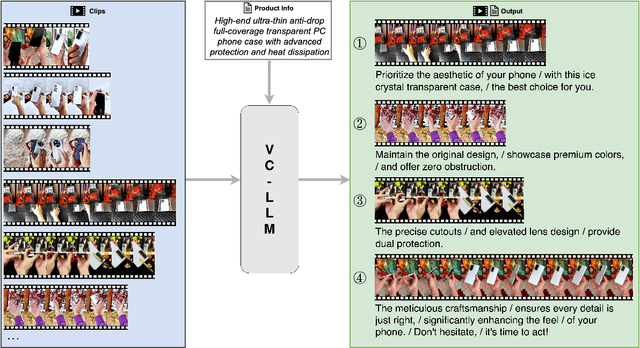
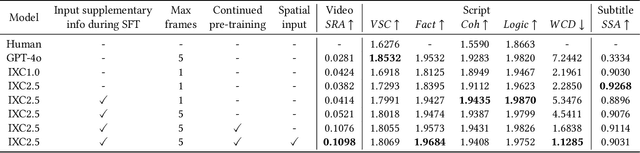
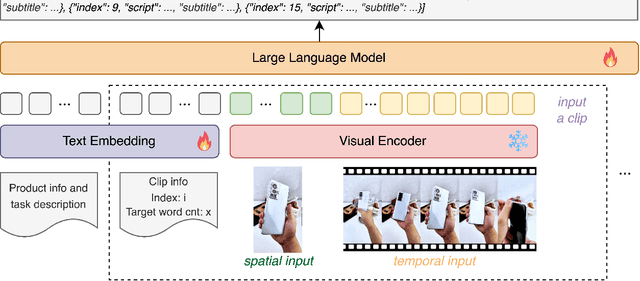

As short videos have risen in popularity, the role of video content in advertising has become increasingly significant. Typically, advertisers record a large amount of raw footage about the product and then create numerous different short-form advertisement videos based on this raw footage. Creating such videos mainly involves editing raw footage and writing advertisement scripts, which requires a certain level of creative ability. It is usually challenging to create many different video contents for the same product, and manual efficiency is often low. In this paper, we present VC-LLM, a framework powered by Large Language Models for the automatic creation of high-quality short-form advertisement videos. Our approach leverages high-resolution spatial input and low-resolution temporal input to represent video clips more effectively, capturing both fine-grained visual details and broader temporal dynamics. In addition, during training, we incorporate supplementary information generated by rewriting the ground truth text, ensuring that all key output information can be directly traced back to the input, thereby reducing model hallucinations. We also designed a benchmark to evaluate the quality of the created videos. Experiments show that VC-LLM based on GPT-4o can produce videos comparable to those created by humans. Furthermore, we collected numerous high-quality short advertisement videos to create a pre-training dataset and manually cleaned a portion of the data to construct a high-quality fine-tuning dataset. Experiments indicate that, on the benchmark, the VC-LLM based on fine-tuned LLM can produce videos with superior narrative logic compared to those created by the VC-LLM based on GPT-4o.