 Add to Chrome
 Add to Firefox
 Add to Edge
WebWeaver: Structuring Web-Scale Evidence with Dynamic Outlines for Open-Ended Deep Research
Sep 16, 2025
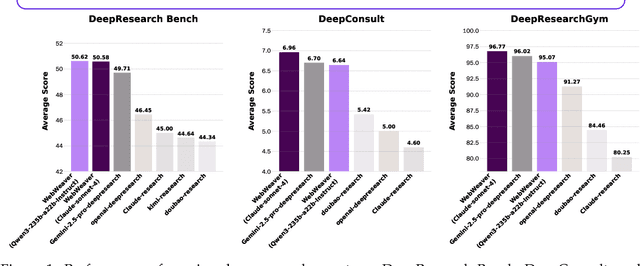
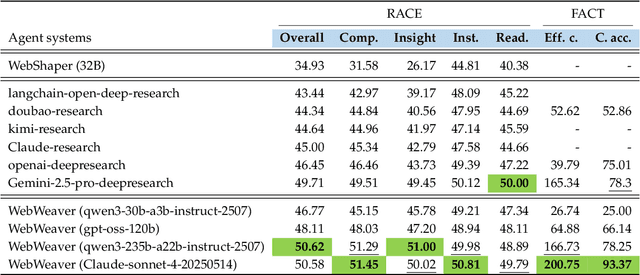
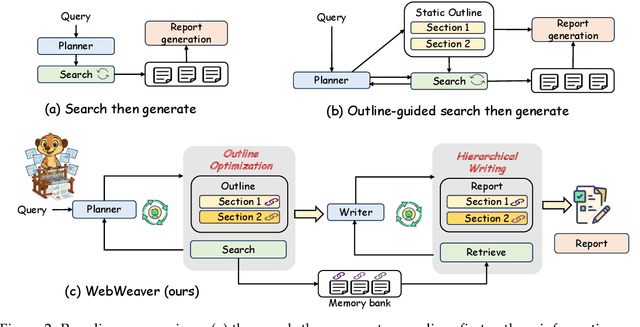
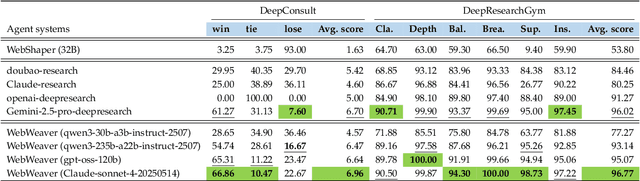
This paper tackles open-ended deep research (OEDR), a complex challenge where AI agents must synthesize vast web-scale information into insightful reports. Current approaches are plagued by dual-fold limitations: static research pipelines that decouple planning from evidence acquisition and one-shot generation paradigms that easily suffer from long-context failure issues like "loss in the middle" and hallucinations. To address these challenges, we introduce WebWeaver, a novel dual-agent framework that emulates the human research process. The planner operates in a dynamic cycle, iteratively interleaving evidence acquisition with outline optimization to produce a comprehensive, source-grounded outline linking to a memory bank of evidence. The writer then executes a hierarchical retrieval and writing process, composing the report section by section. By performing targeted retrieval of only the necessary evidence from the memory bank for each part, it effectively mitigates long-context issues. Our framework establishes a new state-of-the-art across major OEDR benchmarks, including DeepResearch Bench, DeepConsult, and DeepResearchGym. These results validate our human-centric, iterative methodology, demonstrating that adaptive planning and focused synthesis are crucial for producing high-quality, reliable, and well-structured reports.

Towards General Agentic Intelligence via Environment Scaling
Sep 16, 2025Advanced agentic intelligence is a prerequisite for deploying Large Language Models in practical, real-world applications. Diverse real-world APIs demand precise, robust function-calling intelligence, which needs agents to develop these capabilities through interaction in varied environments. The breadth of function-calling competence is closely tied to the diversity of environments in which agents are trained. In this work, we scale up environments as a step towards advancing general agentic intelligence. This gives rise to two central challenges: (i) how to scale environments in a principled manner, and (ii) how to effectively train agentic capabilities from experiences derived through interactions with these environments. To address these, we design a scalable framework that automatically constructs heterogeneous environments that are fully simulated, systematically broadening the space of function-calling scenarios. We further adapt a two-phase agent fine-tuning strategy: first endowing agents with fundamental agentic capabilities, then specializing them for domain-specific contexts. Extensive experiments on agentic benchmarks, tau-bench, tau2-Bench, and ACEBench, demonstrate that our trained model, AgentScaler, significantly enhances the function-calling capability of models.
Memp: Exploring Agent Procedural Memory
Aug 08, 2025Large Language Models (LLMs) based agents excel at diverse tasks, yet they suffer from brittle procedural memory that is manually engineered or entangled in static parameters. In this work, we investigate strategies to endow agents with a learnable, updatable, and lifelong procedural memory. We propose Memp that distills past agent trajectories into both fine-grained, step-by-step instructions and higher-level, script-like abstractions, and explore the impact of different strategies for Build, Retrieval, and Update of procedural memory. Coupled with a dynamic regimen that continuously updates, corrects, and deprecates its contents, this repository evolves in lockstep with new experience. Empirical evaluation on TravelPlanner and ALFWorld shows that as the memory repository is refined, agents achieve steadily higher success rates and greater efficiency on analogous tasks. Moreover, procedural memory built from a stronger model retains its value: migrating the procedural memory to a weaker model yields substantial performance gains.
WebSailor: Navigating Super-human Reasoning for Web Agent
Jul 03, 2025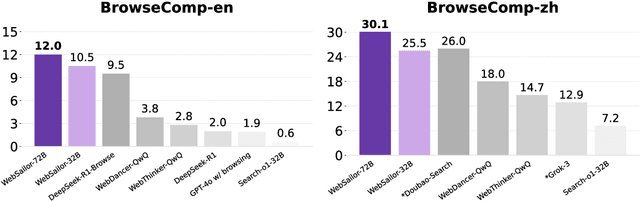
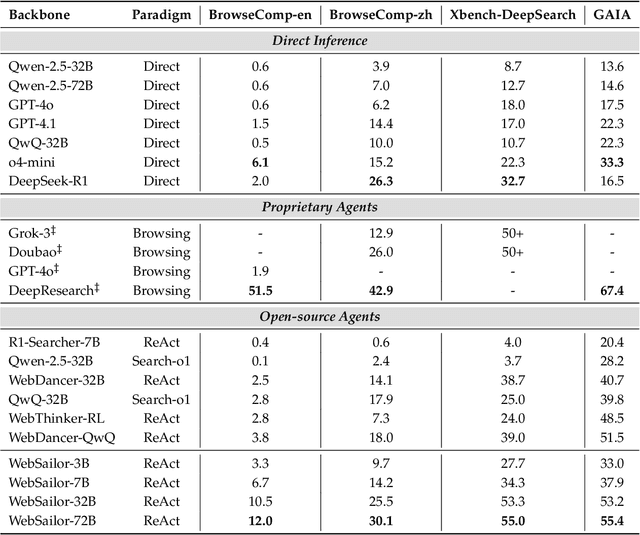
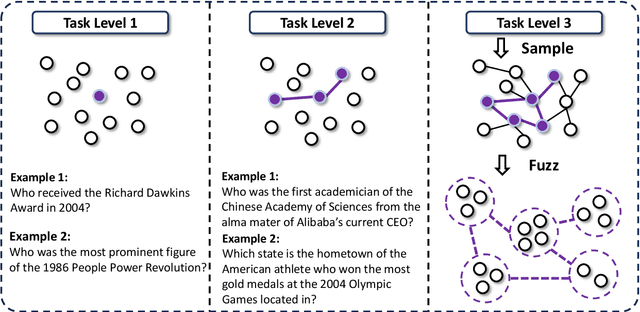

Transcending human cognitive limitations represents a critical frontier in LLM training. Proprietary agentic systems like DeepResearch have demonstrated superhuman capabilities on extremely complex information-seeking benchmarks such as BrowseComp, a feat previously unattainable. We posit that their success hinges on a sophisticated reasoning pattern absent in open-source models: the ability to systematically reduce extreme uncertainty when navigating vast information landscapes. Based on this insight, we introduce WebSailor, a complete post-training methodology designed to instill this crucial capability. Our approach involves generating novel, high-uncertainty tasks through structured sampling and information obfuscation, RFT cold start, and an efficient agentic RL training algorithm, Duplicating Sampling Policy Optimization (DUPO). With this integrated pipeline, WebSailor significantly outperforms all opensource agents in complex information-seeking tasks, matching proprietary agents' performance and closing the capability gap.
DynamicBench: Evaluating Real-Time Report Generation in Large Language Models
Jun 26, 2025Traditional benchmarks for large language models (LLMs) typically rely on static evaluations through storytelling or opinion expression, which fail to capture the dynamic requirements of real-time information processing in contemporary applications. To address this limitation, we present DynamicBench, a benchmark designed to evaluate the proficiency of LLMs in storing and processing up-to-the-minute data. DynamicBench utilizes a dual-path retrieval pipeline, integrating web searches with local report databases. It necessitates domain-specific knowledge, ensuring accurate responses report generation within specialized fields. By evaluating models in scenarios that either provide or withhold external documents, DynamicBench effectively measures their capability to independently process recent information or leverage contextual enhancements. Additionally, we introduce an advanced report generation system adept at managing dynamic information synthesis. Our experimental results confirm the efficacy of our approach, with our method achieving state-of-the-art performance, surpassing GPT4o in document-free and document-assisted scenarios by 7.0% and 5.8%, respectively. The code and data will be made publicly available.
Qwen3 Embedding: Advancing Text Embedding and Reranking Through Foundation Models
Jun 05, 2025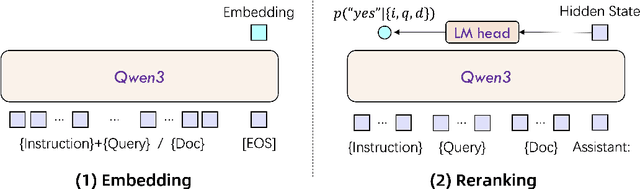
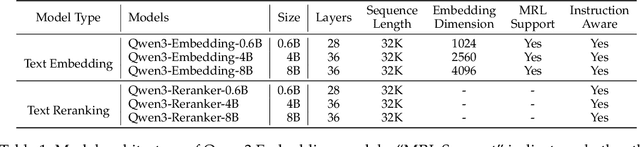

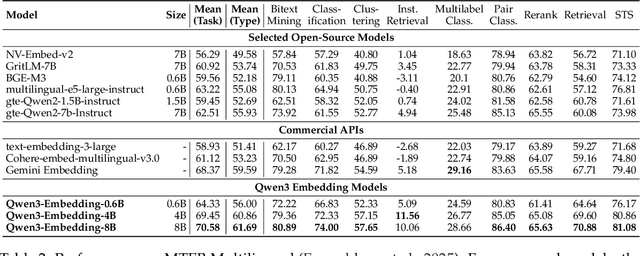
In this work, we introduce the Qwen3 Embedding series, a significant advancement over its predecessor, the GTE-Qwen series, in text embedding and reranking capabilities, built upon the Qwen3 foundation models. Leveraging the Qwen3 LLMs' robust capabilities in multilingual text understanding and generation, our innovative multi-stage training pipeline combines large-scale unsupervised pre-training with supervised fine-tuning on high-quality datasets. Effective model merging strategies further ensure the robustness and adaptability of the Qwen3 Embedding series. During the training process, the Qwen3 LLMs serve not only as backbone models but also play a crucial role in synthesizing high-quality, rich, and diverse training data across multiple domains and languages, thus enhancing the training pipeline. The Qwen3 Embedding series offers a spectrum of model sizes (0.6B, 4B, 8B) for both embedding and reranking tasks, addressing diverse deployment scenarios where users can optimize for either efficiency or effectiveness. Empirical evaluations demonstrate that the Qwen3 Embedding series achieves state-of-the-art results across diverse benchmarks. Notably, it excels on the multilingual evaluation benchmark MTEB for text embedding, as well as in various retrieval tasks, including code retrieval, cross-lingual retrieval and multilingual retrieval. To facilitate reproducibility and promote community-driven research and development, the Qwen3 Embedding models are publicly available under the Apache 2.0 license.
EvolveSearch: An Iterative Self-Evolving Search Agent
May 28, 2025The rapid advancement of large language models (LLMs) has transformed the landscape of agentic information seeking capabilities through the integration of tools such as search engines and web browsers. However, current mainstream approaches for enabling LLM web search proficiency face significant challenges: supervised fine-tuning struggles with data production in open-search domains, while RL converges quickly, limiting their data utilization efficiency. To address these issues, we propose EvolveSearch, a novel iterative self-evolution framework that combines SFT and RL to enhance agentic web search capabilities without any external human-annotated reasoning data. Extensive experiments on seven multi-hop question-answering (MHQA) benchmarks demonstrate that EvolveSearch consistently improves performance across iterations, ultimately achieving an average improvement of 4.7\% over the current state-of-the-art across seven benchmarks, opening the door to self-evolution agentic capabilities in open web search domains.
VRAG-RL: Empower Vision-Perception-Based RAG for Visually Rich Information Understanding via Iterative Reasoning with Reinforcement Learning
May 28, 2025Effectively retrieving, reasoning and understanding visually rich information remains a challenge for RAG methods. Traditional text-based methods cannot handle visual-related information. On the other hand, current vision-based RAG approaches are often limited by fixed pipelines and frequently struggle to reason effectively due to the insufficient activation of the fundamental capabilities of models. As RL has been proven to be beneficial for model reasoning, we introduce VRAG-RL, a novel RL framework tailored for complex reasoning across visually rich information. With this framework, VLMs interact with search engines, autonomously sampling single-turn or multi-turn reasoning trajectories with the help of visual perception tokens and undergoing continual optimization based on these samples. Our approach highlights key limitations of RL in RAG domains: (i) Prior Multi-modal RAG approaches tend to merely incorporate images into the context, leading to insufficient reasoning token allocation and neglecting visual-specific perception; and (ii) When models interact with search engines, their queries often fail to retrieve relevant information due to the inability to articulate requirements, thereby leading to suboptimal performance. To address these challenges, we define an action space tailored for visually rich inputs, with actions including cropping and scaling, allowing the model to gather information from a coarse-to-fine perspective. Furthermore, to bridge the gap between users' original inquiries and the retriever, we employ a simple yet effective reward that integrates query rewriting and retrieval performance with a model-based reward. Our VRAG-RL optimizes VLMs for RAG tasks using specially designed RL strategies, aligning the model with real-world applications. The code is available at \hyperlink{https://github.com/Alibaba-NLP/VRAG}{https://github.com/Alibaba-NLP/VRAG}.
WebDancer: Towards Autonomous Information Seeking Agency
May 28, 2025Addressing intricate real-world problems necessitates in-depth information seeking and multi-step reasoning. Recent progress in agentic systems, exemplified by Deep Research, underscores the potential for autonomous multi-step research. In this work, we present a cohesive paradigm for building end-to-end agentic information seeking agents from a data-centric and training-stage perspective. Our approach consists of four key stages: (1) browsing data construction, (2) trajectories sampling, (3) supervised fine-tuning for effective cold start, and (4) reinforcement learning for enhanced generalisation. We instantiate this framework in a web agent based on the ReAct, WebDancer. Empirical evaluations on the challenging information seeking benchmarks, GAIA and WebWalkerQA, demonstrate the strong performance of WebDancer, achieving considerable results and highlighting the efficacy of our training paradigm. Further analysis of agent training provides valuable insights and actionable, systematic pathways for developing more capable agentic models. The codes and demo will be released in https://github.com/Alibaba-NLP/WebAgent.
MaskSearch: A Universal Pre-Training Framework to Enhance Agentic Search Capability
May 27, 2025Retrieval-Augmented Language Models (RALMs) represent a classic paradigm where models enhance generative capabilities using external knowledge retrieved via a specialized module. Recent advancements in Agent techniques enable Large Language Models (LLMs) to autonomously utilize tools for retrieval, planning, and reasoning. While existing training-based methods show promise, their agentic abilities are limited by inherent characteristics of the task-specific data used during training. To further enhance the universal search capability of agents, we propose a novel pre-training framework, MaskSearch. In the pre-training stage, we introduce the Retrieval Augmented Mask Prediction (RAMP) task, where the model learns to leverage search tools to fill masked spans on a large number of pre-training data, thus acquiring universal retrieval and reasoning capabilities for LLMs. After that, the model is trained on downstream tasks to achieve further improvement. We apply both Supervised Fine-tuning (SFT) and Reinforcement Learning (RL) for training. For SFT, we combine agent-based and distillation-based methods to generate training data, starting with a multi-agent system consisting of a planner, rewriter, observer, and followed by a self-evolving teacher model. While for RL, we employ DAPO as the training framework and adopt a hybrid reward system consisting of answer rewards and format rewards. Additionally, we introduce a curriculum learning approach that allows the model to learn progressively from easier to more challenging instances based on the number of masked spans. We evaluate the effectiveness of our framework in the scenario of open-domain multi-hop question answering. Through extensive experiments, we demonstrate that MaskSearch significantly enhances the performance of LLM-based search agents on both in-domain and out-of-domain downstream tasks.