 Add to Chrome
 Add to Firefox
 Add to Edge
VisDocAgentBench: Benchmarking Agents for Visually Rich Document Retrieval
Aug 18, 2026
Visually rich documents encode relevance through language, layout, structured visual elements, and corpus context, yet retrieval is typically evaluated by one-shot query--page matching. Agentic-search benchmarks usually score downstream question answering or report generation, leaving document ranking under iterative evidence acquisition underexplored. We introduce VisDocAgentBench, a closed-corpus benchmark comparing static and agentic retrieval under a shared ranked-output contract. It contains 2,375 pages from 100 documents and 120 unique-target queries balanced across direct, one-bridge, and two-bridge evidence structures. Relation-preserving construction yields semantic, relational, and visual queries, followed by full-document review and hard-negative validation. A strong late-interaction visual retriever reaches 97.50% Recall@1 on direct items but 2.50% on two-bridge items, exposing the limits of query--target matching when relevance depends on corpus context. Agents recover much of this loss, but planner choice and retrieval representation remain decisive. Every planner performs better with visual retrieval, whose best R@1 reaches 67.50% versus 37.50% for OCR-text. Ablations identify iterative search and page inspection as consequential capabilities, and providing the complete support context improves ranking on both routes. Trace analysis localizes the remaining losses to target discovery, candidate examination, and evidence-role integration. These findings motivate retrieval agents that combine modality-preserving discovery with evidence-directed verification.

UEmbed: Unified Sparse and Dense Multimodal Embeddings
Aug 03, 2026Sparse retrieval underpins modern search systems, from web search to retrieval-augmented generation. Existing work has introduced Learned Sparse Retrieval (LSR) to push beyond exact lexical matching toward richer semantics. Yet LSR has so far remained tied to encoder-style bidirectional architectures, and its extension to multimodal settings still relies heavily on auxiliary cross-modal modules. To address these limitations, we introduce UEmbed (Unified Embedding), a decoder-only multimodal embedding model that produces both sparse lexical and dense representations in one causal forward pass. UEmbed appends N learnable special tokens to the input and partitions the vocabulary into N disjoint subsets. Each token's causal hidden state predicts sparse weights over its assigned subset, and the N subsets are concatenated into the full sparse vector. Trained on public data, we release UEmbed at 2B, 4B, and 9B scales. UEmbed-9B reaches 71.8 (dense) and 71.0 (sparse) on MMEB-v2, outperforming multimodal embedding models trained on publicly available data (e.g., RzenEmbed). On BEIR, UEmbed also remains competitive with strong dense and sparse baselines. Furthermore, we demonstrate the practical utility of UEmbed across three dimensions: effectiveness, efficiency, and agentic applications. Overall, UEmbed offers a new paradigm: it unifies dense and sparse embeddings in one model, while further extending sparse retrieval to unify text and multimodal inputs.
CORE-Bench: A Comprehensive Benchmark for Code Retrieval in the Era of Agentic Coding
Jun 10, 2026Code retrieval is becoming central to coding agents, but agentic coding requires more than matching a natural-language query to an isolated snippet. Given a user request, a coding agent needs to navigate a concrete repository state, locate relevant files and functions, gather supporting context, and filter similar in-repository distractors. Existing code retrieval benchmarks mainly evaluate docstring-to-function or snippet-level matching, thereby missing this requirement-driven repository search problem. To address this gap, we introduce CORE-Bench, a comprehensive benchmark for code retrieval in the era of agentic coding. CORE-Bench evaluates code retrieval ability at three levels: code understanding, issue-to-edit localization, and broader context retrieval. Built from curated code-search tasks and SWE-bench-series instances, CORE-Bench contains over 180K queries and 106K broader-context relevance labels. Experiments with representative embedding models show a sharp drop from traditional code search to code retrieval in agentic coding settings. Simple supervised fine-tuning of existing embedding models significantly improves performance in this setting, suggesting substantial room for further progress.
LaSER: Internalizing Explicit Reasoning into Latent Space for Dense Retrieval
Mar 02, 2026LLMs have fundamentally transformed dense retrieval, upgrading backbones from discriminative encoders to generative architectures. However, a critical disconnect remains: while LLMs possess strong reasoning capabilities, current retrievers predominantly utilize them as static encoders, leaving their potential for complex reasoning unexplored. To address this, existing approaches typically adopt rewrite-then-retrieve pipelines to generate explicit CoT rationales before retrieval. However, this incurs prohibitive latency. In this paper, we propose LaSER, a novel self-distillation framework that internalizes explicit reasoning into the latent space of dense retrievers. Operating on a shared LLM backbone, LaSER introduces a dual-view training mechanism: an Explicit view that explicitly encodes ground-truth reasoning paths, and a Latent view that performs implicit latent thinking. To bridge the gap between these views, we design a multi-grained alignment strategy. Beyond standard output alignment, we introduce a trajectory alignment mechanism that synchronizes the intermediate latent states of the latent path with the semantic progression of the explicit reasoning segments. This allows the retriever to think silently and effectively without autoregressive text generation. Extensive experiments on both in-domain and out-of-domain reasoning-intensive benchmarks demonstrate that LaSER significantly outperforms state-of-the-art baselines. Furthermore, analyses across diverse backbones and model scales validate the robustness of our approach, confirming that our unified learning framework is essential for eliciting effective latent thinking. Our method successfully combines the reasoning depth of explicit CoT pipelines with the inference efficiency of standard dense retrievers.
DiffuRank: Effective Document Reranking with Diffusion Language Models
Feb 13, 2026Recent advances in large language models (LLMs) have inspired new paradigms for document reranking. While this paradigm better exploits the reasoning and contextual understanding capabilities of LLMs, most existing LLM-based rerankers rely on autoregressive generation, which limits their efficiency and flexibility. In particular, token-by-token decoding incurs high latency, while the fixed left-to-right generation order causes early prediction errors to propagate and is difficult to revise. To address these limitations, we explore the use of diffusion language models (dLLMs) for document reranking and propose DiffuRank, a reranking framework built upon dLLMs. Unlike autoregressive models, dLLMs support more flexible decoding and generation processes that are not constrained to a left-to-right order, and enable parallel decoding, which may lead to improved efficiency and controllability. Specifically, we investigate three reranking strategies based on dLLMs: (1) a pointwise approach that uses dLLMs to estimate the relevance of each query-document pair; (2) a logit-based listwise approach that prompts dLLMs to jointly assess the relevance of multiple documents and derives ranking lists directly from model logits; and (3) a permutation-based listwise approach that adapts the canonical decoding process of dLLMs to the reranking tasks. For each approach, we design corresponding training methods to fully exploit the advantages of dLLMs. We evaluate both zero-shot and fine-tuned reranking performance on multiple benchmarks. Experimental results show that dLLMs achieve performance comparable to, and in some cases exceeding, that of autoregressive LLMs with similar model sizes. These findings demonstrate the promise of diffusion-based language models as a compelling alternative to autoregressive architectures for document reranking.
Rethinking Composed Image Retrieval Evaluation: A Fine-Grained Benchmark from Image Editing
Jan 22, 2026Composed Image Retrieval (CIR) is a pivotal and complex task in multimodal understanding. Current CIR benchmarks typically feature limited query categories and fail to capture the diverse requirements of real-world scenarios. To bridge this evaluation gap, we leverage image editing to achieve precise control over modification types and content, enabling a pipeline for synthesizing queries across a broad spectrum of categories. Using this pipeline, we construct EDIR, a novel fine-grained CIR benchmark. EDIR encompasses 5,000 high-quality queries structured across five main categories and fifteen subcategories. Our comprehensive evaluation of 13 multimodal embedding models reveals a significant capability gap; even state-of-the-art models (e.g., RzenEmbed and GME) struggle to perform consistently across all subcategories, highlighting the rigorous nature of our benchmark. Through comparative analysis, we further uncover inherent limitations in existing benchmarks, such as modality biases and insufficient categorical coverage. Furthermore, an in-domain training experiment demonstrates the feasibility of our benchmark. This experiment clarifies the task challenges by distinguishing between categories that are solvable with targeted data and those that expose intrinsic limitations of current model architectures.
Qwen3-VL-Embedding and Qwen3-VL-Reranker: A Unified Framework for State-of-the-Art Multimodal Retrieval and Ranking
Jan 08, 2026In this report, we introduce the Qwen3-VL-Embedding and Qwen3-VL-Reranker model series, the latest extensions of the Qwen family built on the Qwen3-VL foundation model. Together, they provide an end-to-end pipeline for high-precision multimodal search by mapping diverse modalities, including text, images, document images, and video, into a unified representation space. The Qwen3-VL-Embedding model employs a multi-stage training paradigm, progressing from large-scale contrastive pre-training to reranking model distillation, to generate semantically rich high-dimensional vectors. It supports Matryoshka Representation Learning, enabling flexible embedding dimensions, and handles inputs up to 32k tokens. Complementing this, Qwen3-VL-Reranker performs fine-grained relevance estimation for query-document pairs using a cross-encoder architecture with cross-attention mechanisms. Both model series inherit the multilingual capabilities of Qwen3-VL, supporting more than 30 languages, and are released in $\textbf{2B}$ and $\textbf{8B}$ parameter sizes to accommodate diverse deployment requirements. Empirical evaluations demonstrate that the Qwen3-VL-Embedding series achieves state-of-the-art results across diverse multimodal embedding evaluation benchmarks. Specifically, Qwen3-VL-Embedding-8B attains an overall score of $\textbf{77.8}$ on MMEB-V2, ranking first among all models (as of January 8, 2025). This report presents the architecture, training methodology, and practical capabilities of the series, demonstrating their effectiveness on various multimodal retrieval tasks, including image-text retrieval, visual question answering, and video-text matching.
Towards Universal Video Retrieval: Generalizing Video Embedding via Synthesized Multimodal Pyramid Curriculum
Oct 31, 2025The prevailing video retrieval paradigm is structurally misaligned, as narrow benchmarks incentivize correspondingly limited data and single-task training. Therefore, universal capability is suppressed due to the absence of a diagnostic evaluation that defines and demands multi-dimensional generalization. To break this cycle, we introduce a framework built on the co-design of evaluation, data, and modeling. First, we establish the Universal Video Retrieval Benchmark (UVRB), a suite of 16 datasets designed not only to measure performance but also to diagnose critical capability gaps across tasks and domains. Second, guided by UVRB's diagnostics, we introduce a scalable synthesis workflow that generates 1.55 million high-quality pairs to populate the semantic space required for universality. Finally, we devise the Modality Pyramid, a curriculum that trains our General Video Embedder (GVE) by explicitly leveraging the latent interconnections within our diverse data. Extensive experiments show GVE achieves state-of-the-art zero-shot generalization on UVRB. In particular, our analysis reveals that popular benchmarks are poor predictors of general ability and that partially relevant retrieval is a dominant but overlooked scenario. Overall, our co-designed framework provides a practical path to escape the limited scope and advance toward truly universal video retrieval.
$\text{E}^2\text{Rank}$: Your Text Embedding can Also be an Effective and Efficient Listwise Reranker
Oct 26, 2025Text embedding models serve as a fundamental component in real-world search applications. By mapping queries and documents into a shared embedding space, they deliver competitive retrieval performance with high efficiency. However, their ranking fidelity remains limited compared to dedicated rerankers, especially recent LLM-based listwise rerankers, which capture fine-grained query-document and document-document interactions. In this paper, we propose a simple yet effective unified framework $\text{E}^2\text{Rank}$, means Efficient Embedding-based Ranking (also means Embedding-to-Rank), which extends a single text embedding model to perform both high-quality retrieval and listwise reranking through continued training under a listwise ranking objective, thereby achieving strong effectiveness with remarkable efficiency. By applying cosine similarity between the query and document embeddings as a unified ranking function, the listwise ranking prompt, which is constructed from the original query and its candidate documents, serves as an enhanced query enriched with signals from the top-K documents, akin to pseudo-relevance feedback (PRF) in traditional retrieval models. This design preserves the efficiency and representational quality of the base embedding model while significantly improving its reranking performance. Empirically, $\textrm{E}^2\text{Rank}$ achieves state-of-the-art results on the BEIR reranking benchmark and demonstrates competitive performance on the reasoning-intensive BRIGHT benchmark, with very low reranking latency. We also show that the ranking training process improves embedding performance on the MTEB benchmark. Our findings indicate that a single embedding model can effectively unify retrieval and reranking, offering both computational efficiency and competitive ranking accuracy.
Qwen3 Embedding: Advancing Text Embedding and Reranking Through Foundation Models
Jun 05, 2025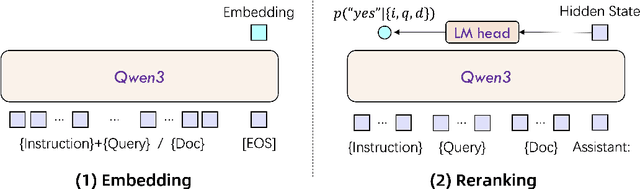
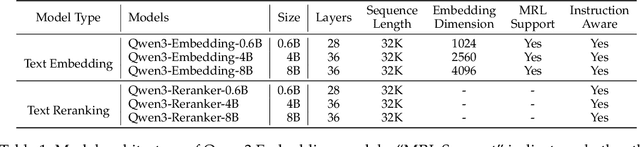

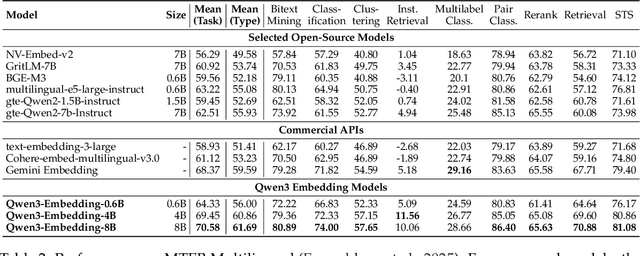
In this work, we introduce the Qwen3 Embedding series, a significant advancement over its predecessor, the GTE-Qwen series, in text embedding and reranking capabilities, built upon the Qwen3 foundation models. Leveraging the Qwen3 LLMs' robust capabilities in multilingual text understanding and generation, our innovative multi-stage training pipeline combines large-scale unsupervised pre-training with supervised fine-tuning on high-quality datasets. Effective model merging strategies further ensure the robustness and adaptability of the Qwen3 Embedding series. During the training process, the Qwen3 LLMs serve not only as backbone models but also play a crucial role in synthesizing high-quality, rich, and diverse training data across multiple domains and languages, thus enhancing the training pipeline. The Qwen3 Embedding series offers a spectrum of model sizes (0.6B, 4B, 8B) for both embedding and reranking tasks, addressing diverse deployment scenarios where users can optimize for either efficiency or effectiveness. Empirical evaluations demonstrate that the Qwen3 Embedding series achieves state-of-the-art results across diverse benchmarks. Notably, it excels on the multilingual evaluation benchmark MTEB for text embedding, as well as in various retrieval tasks, including code retrieval, cross-lingual retrieval and multilingual retrieval. To facilitate reproducibility and promote community-driven research and development, the Qwen3 Embedding models are publicly available under the Apache 2.0 license.