 Add to Chrome
 Add to Firefox
 Add to Edge
EditSR: Enhancing Neural Symbolic Regression via Edit-based Rectification
Jun 06, 2026
Neural symbolic regression models improve inference efficiency by shifting structural search to pretraining, but their one-pass autoregressive decoding is prone to error accumulation, which may lead to generating structurally incorrect expressions, especially in complex expression generation scenarios. Existing rectification strategies can alleviate this issue, but they often depend on restarting global search, thereby weakening the efficiency advantage of neural models, and remain susceptible to error accumulation. In this paper, we propose EditSR, a two-layer framework that combines a neural symbolic regression model in the first layer with an edit-based Rectifier in the second layer to achieve efficient prediction and post-hoc rectification. Instead of restarting the global search, we maintain rectification efficiency by pretraining the Rectifier. Specifically, we formulate the rectification process as a step-by-step state-transition chain starting from an incorrect expression, and develop a state-transition algorithm to construct supervised rectification chains for training the Rectifier. To ensure syntactic validity throughout rectification, each edit action is restricted to a syntactically valid space so that every edited expression remains parseable. In addition, because each edit decision is conditioned on the current state rather than the history, the Rectifier allows errors made in earlier steps to be rectified by subsequent edits, thereby reducing the risk of error accumulation. Extensive experiments and ablation studies show that EditSR substantially improves symbolic structure recovery with limited extra cost, with more pronounced gains on complex expressions, where one-pass autoregressive decoding is more susceptible to error accumulation.

Weak-PDE-Net: Discovering Open-Form PDEs via Differentiable Symbolic Networks and Weak Formulation
Mar 24, 2026Discovering governing Partial Differential Equations (PDEs) from sparse and noisy data is a challenging issue in data-driven scientific computing. Conventional sparse regression methods often suffer from two major limitations: (i) the instability of numerical differentiation under sparse and noisy data, and (ii) the restricted flexibility of a pre-defined candidate library. We propose Weak-PDE-Net, an end-to-end differentiable framework that can robustly identify open-form PDEs. Weak-PDE-Net consists of two interconnected modules: a forward response learner and a weak-form PDE generator. The learner embeds learnable Gaussian kernels within a lightweight MLP, serving as a surrogate model that adaptively captures system dynamics from sparse observations. Meanwhile, the generator integrates a symbolic network with an integral module to construct weak-form PDEs, avoiding explicit numerical differentiation and improving robustness to noise. To relax the constraints of the pre-defined library, we leverage Differentiable Neural Architecture Search strategy during training to explore the functional space, which enables the efficient discovery of open-form PDEs. The capability of Weak-PDE-Net in multivariable systems discovery is further enhanced by incorporating Galilean Invariance constraints and symmetry equivariance hypotheses to ensure physical consistency. Experiments on several challenging PDE benchmarks demonstrate that Weak-PDE-Net accurately recovers governing equations, even under highly sparse and noisy observations.
CollabKG: A Learnable Human-Machine-Cooperative Information Extraction Toolkit for (Event) Knowledge Graph Construction
Jul 03, 2023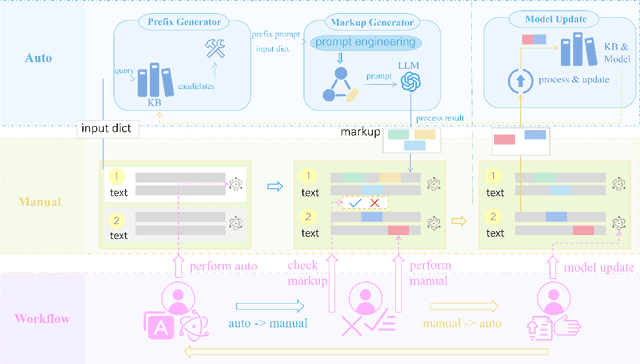
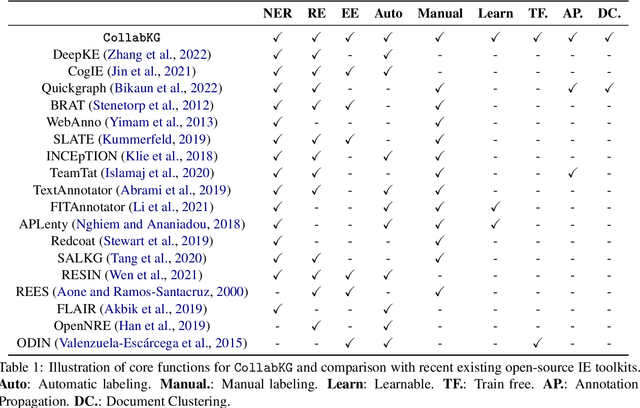
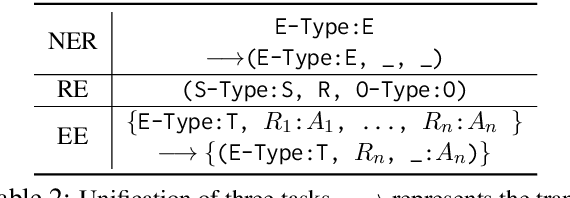
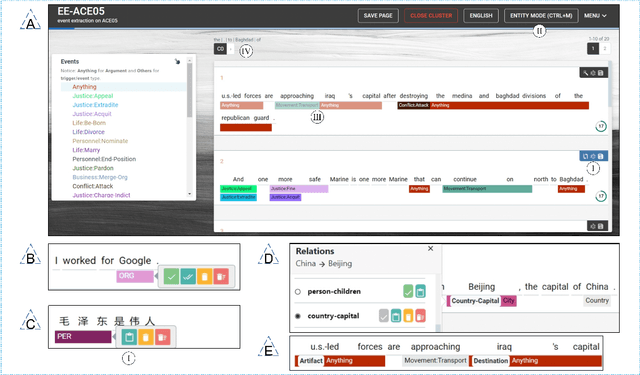
In order to construct or extend entity-centric and event-centric knowledge graphs (KG and EKG), the information extraction (IE) annotation toolkit is essential. However, existing IE toolkits have several non-trivial problems, such as not supporting multi-tasks, not supporting automatic updates. In this work, we present CollabKG, a learnable human-machine-cooperative IE toolkit for KG and EKG construction. Specifically, for the multi-task issue, CollabKG unifies different IE subtasks, including named entity recognition (NER), entity-relation triple extraction (RE), and event extraction (EE), and supports both KG and EKG. Then, combining advanced prompting-based IE technology, the human-machine-cooperation mechanism with LLMs as the assistant machine is presented which can provide a lower cost as well as a higher performance. Lastly, owing to the two-way interaction between the human and machine, CollabKG with learning ability allows self-renewal. Besides, CollabKG has several appealing features (e.g., customization, training-free, propagation, etc.) that make the system powerful, easy-to-use, and high-productivity. We holistically compare our toolkit with other existing tools on these features. Human evaluation quantitatively illustrates that CollabKG significantly improves annotation quality, efficiency, and stability simultaneously.
Zero-Shot Information Extraction via Chatting with ChatGPT
Feb 20, 2023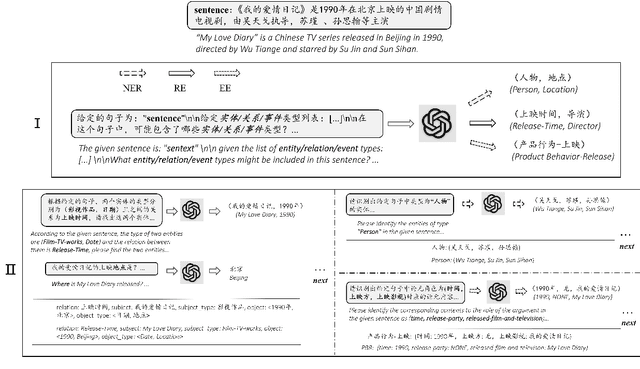
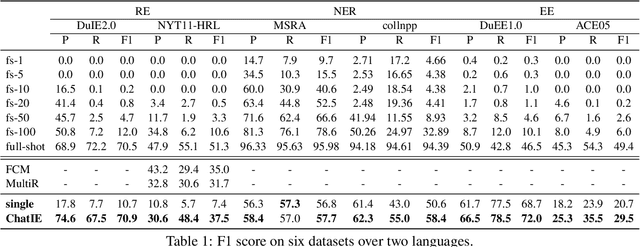
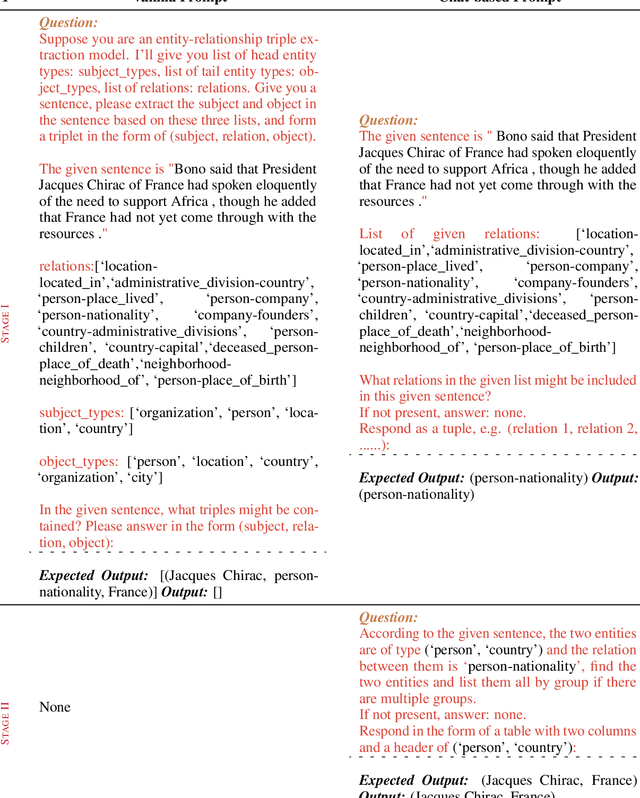
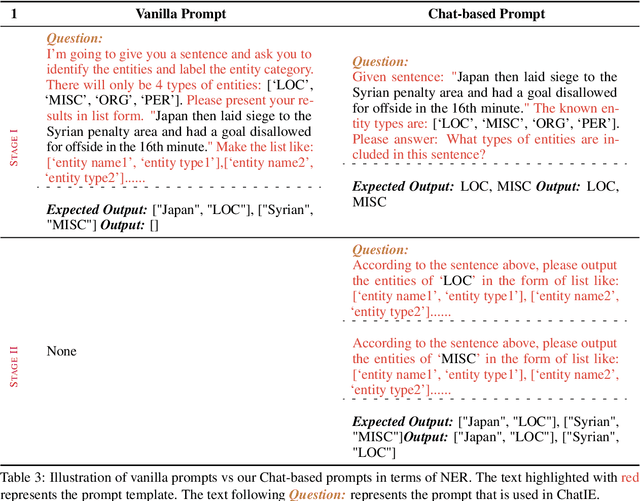
Zero-shot information extraction (IE) aims to build IE systems from the unannotated text. It is challenging due to involving little human intervention. Challenging but worthwhile, zero-shot IE reduces the time and effort that data labeling takes. Recent efforts on large language models (LLMs, e.g., GPT-3, ChatGPT) show promising performance on zero-shot settings, thus inspiring us to explore prompt-based methods. In this work, we ask whether strong IE models can be constructed by directly prompting LLMs. Specifically, we transform the zero-shot IE task into a multi-turn question-answering problem with a two-stage framework (ChatIE). With the power of ChatGPT, we extensively evaluate our framework on three IE tasks: entity-relation triple extract, named entity recognition, and event extraction. Empirical results on six datasets across two languages show that ChatIE achieves impressive performance and even surpasses some full-shot models on several datasets (e.g., NYT11-HRL). We believe that our work could shed light on building IE models with limited resources.