 Add to Chrome
 Add to Firefox
 Add to Edge
S$^4$R: Selective Sampling, Subspaces, and Sparse Reconstruction for Compressed Long-Context KV Caching
Aug 01, 2026
The growth of context window lengths in Large Language Models (LLMs) significantly enhances their long-context capabilities but incurs prohibitive memory costs due to the Key-Value (KV) cache. Although low-rank compression of KV cache is a promising remedy, existing methods face a dilemma: offline approaches depend on external calibration data, whereas online approaches incur substantial compute for full-prompt decomposition and reconstruction. In this paper, we propose S$^4$R, which builds low-rank subspaces from selectively sampled tokens and computes attention over a sparsely reconstructed KV representation. S$^4$R uses prompt-aware initialization to build initial key/value bases from a representative prompt subset, trading off calibration-data dependence against prefilling cost. Because fully reconstructing the cache at every decoding step is prohibitively expensive and hurts throughput, we further adopt sparse reconstruction to retain only informative positions during decoding. Extensive experiments on LongBench and RULER with Llama and Qwen model families show that S$^4$R achieves up to 5$\times$ KV compression with near full-cache accuracy, combining the efficiency of fixed compression with the adaptability of prompt-dependent methods.

Evolution-Aware MSA Reasoning for Subsampling via Factor Graphs
Jul 24, 2026Multiple Sequence Alignments (MSAs) provide protein language models with explicit evolutionary context, but their large depth makes subsampling unavoidable under limited token budgets. Existing strategies, including random selection, identity-based filtering, and diversity-driven sampling, are effective heuristics, yet provide limited control over the evolutionary signals retained in the subset. In this work, we recast MSA subsampling as an explicit optimization problem, where key evolutionary measures, including query identity and diversity, are treated as controllable objectives. Building on this view, we introduce AP-REASONER, an Affinity-Propagation-based factor-graph approach. With evolution-aware unary factors, exemplar-consistency factors, and two control knobs, AP-REASONER performs factor-graph reasoning through message passing to infer a fixed-budget MSA subset. Experiments on long-range contact prediction and conformational ensemble prediction show that AP-REASONER outperforms baseline subsamplers on structure-sensitive downstream tasks and enables controllable recovery of alternative protein conformations. These results highlight the value of modeling MSA subsampling as a controllable optimization problem, where factor-graph reasoning offers an effective alternative to heuristic selection.
Hierarchical Sparse Attention Done Right: Toward Infinite Context Modeling
Jul 03, 2026Scaling modern large language models (LLMs) to long contexts is limited by the quadratic computation cost, and poor length extrapolation of dense attention. Chunk-wise sparse attention offers a promising alternative, but all existing methods fall short of full attention because of their inaccurate chunk selection. We propose Hierarchical Landmark Sparse (HiLS) Attention, a chunk-wise sparse attention mechanism that learns chunk selection end-to-end under the language-modeling (LM) loss. HiLS factorizes attention hierarchically: each query performs attention independently with each retrieved chunk to extract chunk-specific information, and the resulting outputs are fused according to chunk retrieval scores. By incorporating retrieval scores into the forward attention computation, HiLS optimizes them directly with the LM loss, enabling end-to-end retrieval learning and native sparse training. Experimental results show that HiLS-Attention achieves performance comparable to, and in some cases better than, full attention at in-domain context lengths. Meanwhile, HiLS-Attention extrapolates more than $64\times$ the training context length with 90% retrieval accuracy, far beyond full attention. Moreover, existing full-attention models can be converted to HiLS-Attention with lightweight continued pretraining, preserving in-domain performance while acquiring ultra-long-context extrapolation. Together with its sparse KV access and computation, HiLS-Attention breaks the usual efficiency-performance trade-off, enabling long-context LLMs that are both more efficient and more effective on general long-context tasks than their full-attention counterparts.
Does Traversal Order Matter? A Systematic Study of Tree Traversal Methods in Transformer Grammars
Jun 15, 2026Transformer Grammars (TGs) enhance language modeling by incorporating syntactic tree structures. Despite the potentially significant impact on model performance of how syntactic trees are linearized in TGs, existing studies rely solely on Depth-First Traversal (DFT) for linearization. In this paper, we expand the traversal design space by exploring Breadth-First Traversal (BFT) and a novel hybrid traversal strategy, Production-Rule Traversal (PRT), which combines the structural lookahead of BFT with the early lexical generation of DFT. We integrate these traversal methods with varying tree configurations and masking strategies, and empirically evaluate their performance on language modeling, syntactic generalization and summarization. We reveal the inherent trade-offs between nested composition and global lookahead, providing actionable recommendations for designing task-aware Transformer Grammars.
GRKV: Global Regression for Training-Free KV Cache Compression in Long-Context LLMs
May 29, 2026Large language models (LLMs) with extended context lengths rely on the key-value (KV) cache to support attention over prior tokens. However, maintaining the KV cache incurs substantial memory overhead, motivating KV-cache compression methods that enforce a fixed budget through eviction and merging. Modern eviction methods increasingly adopt span-based retention because preserving contiguous spans is empirically effective and better preserves semantic coherence. Yet, when combined with post-eviction merging, span-based retention concentrates merges onto a small set of span-boundary carrier tokens, producing a highly imbalanced merge pattern that exacerbates over-merging and increases information loss. To address this imbalance, we propose GRKV (Global Regression for KV Cache), a training-free KV-cache merging method that directly minimizes the discrepancy between compressed-cache and full-cache attention outputs. GRKV uses ridge-regression-based merge steps to distribute information from evicted tokens across retained tokens, while regularizing the updates to prevent over-smoothing. Across the LongBench and RULER long-context benchmarks, GRKV is the only merging method that improves overall performance with minimal overhead.
Scaling Probabilistic Transformer via Efficient Cross-Scale Hyperparameter Transfer
Apr 28, 2026Probabilistic Transformer (PT), a white-box probabilistic model for contextual word representation, has demonstrated substantial similarity to standard Transformers in both computational structure and downstream task performance on small models and small to medium sized datasets. However, PT is less robust to hyperparameter choices than standard Transformers, making it harder to scale efficiently. In this work, we follow Maximal Update Parametrization (muP) to rescale PT's parameters, so that hyperparameters optimized on small models can be transferred to larger models without additional tuning. With this approach, we successfully scale PT to models with up to 0.4B parameters. Experiments show that PT consistently outperforms standard transformer under the same parameter budget on Masked Language Modeling (MLM) tasks. We hope this work will contribute to the practical deployment of probabilistic models at substantially larger scales in the future.
YOCO++: Enhancing YOCO with KV Residual Connections for Efficient LLM Inference
Apr 15, 2026Cross-layer key-value (KV) compression has been found to be effective in efficient inference of large language models (LLMs). Although they reduce the memory consumption of the KV cache, such methods usually introduce non-negligible performance degradation. In this work, we aim to enhance the performance of YOCO, a cross-layer KV compression method that shares the KVs of the middle layer with the top-half layers. We propose YOCO++, an enhanced YOCO that incorporates a weighted residual connection between the KVs of each bottom-half layer and the bottom layer. Compared to YOCO, YOCO++ increases model capacity while maintaining the same training and inference efficiency. Our experiments show that YOCO++ achieves state-of-the-art performance among the cross-layer KV compression methods at a 50% KV cache compression rate, outperforming the standard Transformer.
Efficient Multimodal Planning Agent for Visual Question-Answering
Jan 28, 2026Visual Question-Answering (VQA) is a challenging multimodal task that requires integrating visual and textual information to generate accurate responses. While multimodal Retrieval-Augmented Generation (mRAG) has shown promise in enhancing VQA systems by providing more evidence on both image and text sides, the default procedure that addresses VQA queries, especially the knowledge-intensive ones, often relies on multi-stage pipelines of mRAG with inherent dependencies. To mitigate the inefficiency limitations while maintaining VQA task performance, this paper proposes a method that trains a multimodal planning agent, dynamically decomposing the mRAG pipeline to solve the VQA task. Our method optimizes the trade-off between efficiency and effectiveness by training the agent to intelligently determine the necessity of each mRAG step. In our experiments, the agent can help reduce redundant computations, cutting search time by over 60\% compared to existing methods and decreasing costly tool calls. Meanwhile, experiments demonstrate that our method outperforms all baselines, including a Deep Research agent and a carefully designed prompt-based method, on average over six various datasets. Code will be released.
EvolveSearch: An Iterative Self-Evolving Search Agent
May 28, 2025The rapid advancement of large language models (LLMs) has transformed the landscape of agentic information seeking capabilities through the integration of tools such as search engines and web browsers. However, current mainstream approaches for enabling LLM web search proficiency face significant challenges: supervised fine-tuning struggles with data production in open-search domains, while RL converges quickly, limiting their data utilization efficiency. To address these issues, we propose EvolveSearch, a novel iterative self-evolution framework that combines SFT and RL to enhance agentic web search capabilities without any external human-annotated reasoning data. Extensive experiments on seven multi-hop question-answering (MHQA) benchmarks demonstrate that EvolveSearch consistently improves performance across iterations, ultimately achieving an average improvement of 4.7\% over the current state-of-the-art across seven benchmarks, opening the door to self-evolution agentic capabilities in open web search domains.
Random Long-Context Access for Mamba via Hardware-aligned Hierarchical Sparse Attention
Apr 23, 2025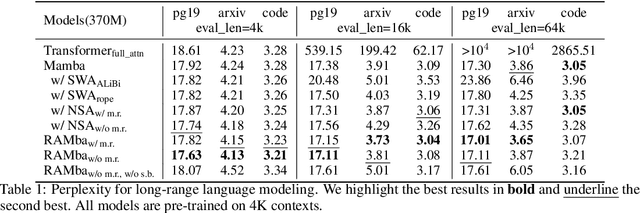
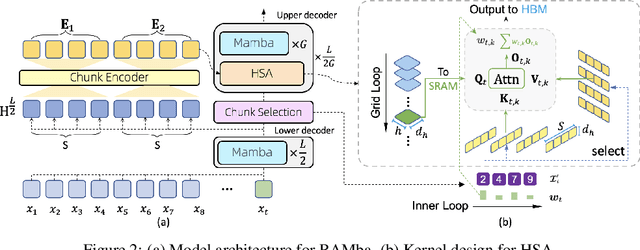
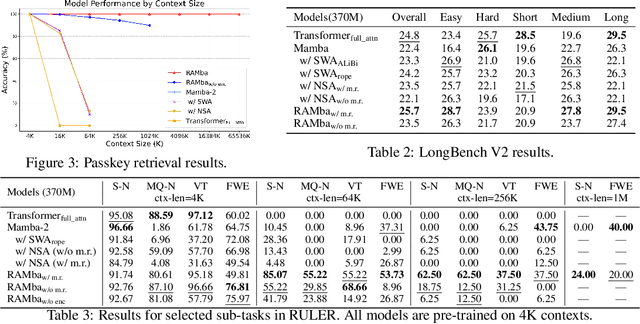
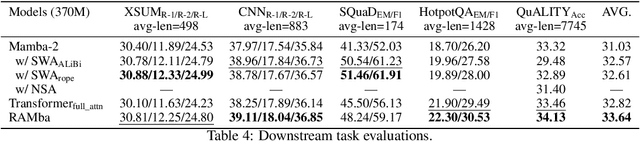
A key advantage of Recurrent Neural Networks (RNNs) over Transformers is their linear computational and space complexity enables faster training and inference for long sequences. However, RNNs are fundamentally unable to randomly access historical context, and simply integrating attention mechanisms may undermine their efficiency advantages. To overcome this limitation, we propose \textbf{H}ierarchical \textbf{S}parse \textbf{A}ttention (HSA), a novel attention mechanism that enhances RNNs with long-range random access flexibility while preserving their merits in efficiency and length generalization. HSA divides inputs into chunks, selecting the top-$k$ chunks and hierarchically aggregates information. The core innovation lies in learning token-to-chunk relevance based on fine-grained token-level information inside each chunk. This approach enhances the precision of chunk selection across both in-domain and out-of-domain context lengths. To make HSA efficient, we further introduce a hardware-aligned kernel design. By combining HSA with Mamba, we introduce RAMba, which achieves perfect accuracy in passkey retrieval across 64 million contexts despite pre-training on only 4K-length contexts, and significant improvements on various downstream tasks, with nearly constant memory footprint. These results show RAMba's huge potential in long-context modeling.