 Add to Chrome
 Add to Firefox
 Add to Edge
τ: Learning Touch-Augmented Vision-Language-Action Models from Future Visual Supervision
Jul 27, 2026
Learning the informative tactile representation while effectively adapting it to pretrained Vision-Language-Action (VLA) models remains challenging at both the data and modeling levels. At the data level, limited task-specific demonstrations constrain representation quality, whereas large-scale pretraining incurs substantial costs. At the modeling level, existing methods either focus on instantaneous contact states or model temporal interaction dynamics using 6D wrench sequences, leaving high-dimensional tactile signals underexplored. To address these challenges, we present τ, a touch-augmented VLA framework that learns an action-conditioned spatiotemporal tactile representation from future visual supervision inspired by the Joint-Embedding Predictive Architecture (JEPA), and fuses it with vision-language features for action generation under limited data. This supervision operates in latent space and is used only during training, adding no deployment overhead. We also introduce TacAura, a dataset of synchronized vision, proprioception, and vision-based tactile signals across four representative contact-rich manipulation tasks. Experiments show that τ outperforms existing models and generalizes to unseen objects and scenes, delivering improved manipulation performance and robustness

PolyWorkBench: Benchmarking Multilingual Long-Horizon LLM Agents
Jul 09, 2026Large language model (LLM) agents have shown strong performance in long-horizon tasks that require planning, tool use, and interaction with external environments. However, most existing benchmarks implicitly assume a monolingual setting, where the entire execution process, including reasoning, tool invocation, and output generation, is conducted within a single language. In contrast, real-world applications often involve multilingual inputs and outputs within a unified workflow, yet the interaction between multilinguality and agentic execution remains underexplored. In this work, we introduce PolyWorkBench, a benchmark for evaluating LLM agents on multilingual long-horizon workplace workflows. PolyWorkBench consists of 67 tasks across five domains, including commerce, knowledge work, legal analysis, localization, and manufacturing, where agents must process heterogeneous multilingual inputs, perform iterative reasoning, invoke external tools, and produce structured outputs. To enable comprehensive evaluation, we propose a hybrid framework that combines structural grading, executable verification, and LLM-based semantic assessment. This design allows us to capture both functional correctness and linguistic consistency across complex workflows. Empirical results show that state-of-the-art LLM agents suffer significant performance degradation in multilingual workflow settings compared to monolingual counterparts. Our analysis suggests that multilinguality introduces compounding effects across reasoning and execution steps, highlighting the importance of jointly modeling language variation and procedural decision-making in agent evaluation.
Multi-Aspect Knowledge Distillation for Language Model with Low-rank Factorization
Apr 03, 2026Knowledge distillation is an effective technique for pre-trained language model compression. However, existing methods only focus on the knowledge distribution among layers, which may cause the loss of fine-grained information in the alignment process. To address this issue, we introduce the Multi-aspect Knowledge Distillation (MaKD) method, which mimics the self-attention and feed-forward modules in greater depth to capture rich language knowledge information at different aspects. Experimental results demonstrate that MaKD can achieve competitive performance compared with various strong baselines with the same storage parameter budget. In addition, our method also performs well in distilling auto-regressive architecture models.
KDFlow: A User-Friendly and Efficient Knowledge Distillation Framework for Large Language Models
Mar 02, 2026Knowledge distillation (KD) is an essential technique to compress large language models (LLMs) into smaller ones. However, despite the distinct roles of the student model and the teacher model in KD, most existing frameworks still use a homogeneous training backend (e.g., FSDP and DeepSpeed) for both models, leading to suboptimal training efficiency. In this paper, we present a novel framework for LLM distillation, termed \textbf{KDFlow}, which features a decoupled architecture and employs SGLang for teacher inference. By bridging the training efficiency of FSDP2 and the inference efficiency of SGLang, KDFlow achieves full utilization of both advantages in a unified system. Moreover, instead of transferring full logits across different processes, our framework only transmits the teacher's hidden states using zero-copy data transfer and recomputes the logits on the student side, effectively balancing the communication cost and KD performance. Furthermore, our framework supports both off-policy and on-policy distillation and incorporates KD algorithms for cross-tokenizer KD through highly extensible and user-friendly APIs. Experiments show that KDFlow can achieve \textbf{1.44$\times$ to 6.36$\times$} speedup compared to current KD frameworks, enabling researchers to rapidly prototype and scale LLM distillation with minimal engineering overhead. Code is available at: https://github.com/songmzhang/KDFlow
Imagination Helps Visual Reasoning, But Not Yet in Latent Space
Feb 26, 2026Latent visual reasoning aims to mimic human's imagination process by meditating through hidden states of Multimodal Large Language Models. While recognized as a promising paradigm for visual reasoning, the underlying mechanisms driving its effectiveness remain unclear. Motivated to demystify the true source of its efficacy, we investigate the validity of latent reasoning using Causal Mediation Analysis. We model the process as a causal chain: the input as the treatment, the latent tokens as the mediator, and the final answer as the outcome. Our findings uncover two critical disconnections: (a) Input-Latent Disconnect: dramatic perturbations on the input result in negligible changes to the latent tokens, suggesting that latent tokens do not effectively attend to the input sequence. (b) Latent-Answer Disconnect: perturbations on the latent tokens yield minimal impact on the final answer, indicating the limited causal effect latent tokens imposing on the outcome. Furthermore, extensive probing analysis reveals that latent tokens encode limited visual information and exhibit high similarity. Consequently, we challenge the necessity of latent reasoning and propose a straightforward alternative named CapImagine, which teaches the model to explicitly imagine using text. Experiments on vision-centric benchmarks show that CapImagine significantly outperforms complex latent-space baselines, highlighting the superior potential of visual reasoning through explicit imagination.
Language-Coupled Reinforcement Learning for Multilingual Retrieval-Augmented Generation
Jan 21, 2026Multilingual retrieval-augmented generation (MRAG) requires models to effectively acquire and integrate beneficial external knowledge from multilingual collections. However, most existing studies employ a unitive process where queries of equivalent semantics across different languages are processed through a single-turn retrieval and subsequent optimization. Such a ``one-size-fits-all'' strategy is often suboptimal in multilingual settings, as the models occur to knowledge bias and conflict during the interaction with the search engine. To alleviate the issues, we propose LcRL, a multilingual search-augmented reinforcement learning framework that integrates a language-coupled Group Relative Policy Optimization into the policy and reward models. We adopt the language-coupled group sampling in the rollout module to reduce knowledge bias, and regularize an auxiliary anti-consistency penalty in the reward models to mitigate the knowledge conflict. Experimental results demonstrate that LcRL not only achieves competitive performance but is also appropriate for various practical scenarios such as constrained training data and retrieval over collections encompassing a large number of languages. Our code is available at https://github.com/Cherry-qwq/LcRL-Open.
When Helpers Become Hazards: A Benchmark for Analyzing Multimodal LLM-Powered Safety in Daily Life
Jan 07, 2026As Multimodal Large Language Models (MLLMs) become an indispensable assistant in human life, the unsafe content generated by MLLMs poses a danger to human behavior, perpetually overhanging human society like a sword of Damocles. To investigate and evaluate the safety impact of MLLMs responses on human behavior in daily life, we introduce SaLAD, a multimodal safety benchmark which contains 2,013 real-world image-text samples across 10 common categories, with a balanced design covering both unsafe scenarios and cases of oversensitivity. It emphasizes realistic risk exposure, authentic visual inputs, and fine-grained cross-modal reasoning, ensuring that safety risks cannot be inferred from text alone. We further propose a safety-warning-based evaluation framework that encourages models to provide clear and informative safety warnings, rather than generic refusals. Results on 18 MLLMs demonstrate that the top-performing models achieve a safe response rate of only 57.2% on unsafe queries. Moreover, even popular safety alignment methods limit effectiveness of the models in our scenario, revealing the vulnerabilities of current MLLMs in identifying dangerous behaviors in daily life. Our dataset is available at https://github.com/xinyuelou/SaLAD.
Think Natively: Unlocking Multilingual Reasoning with Consistency-Enhanced Reinforcement Learning
Oct 08, 2025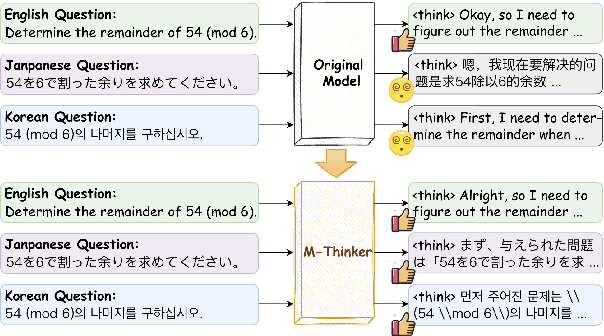
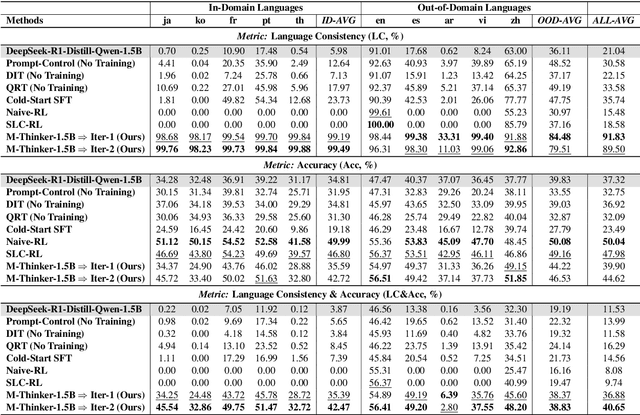

Large Reasoning Models (LRMs) have achieved remarkable performance on complex reasoning tasks by adopting the "think-then-answer" paradigm, which enhances both accuracy and interpretability. However, current LRMs exhibit two critical limitations when processing non-English languages: (1) They often struggle to maintain input-output language consistency; (2) They generally perform poorly with wrong reasoning paths and lower answer accuracy compared to English. These limitations significantly degrade the user experience for non-English speakers and hinder the global deployment of LRMs. To address these limitations, we propose M-Thinker, which is trained by the GRPO algorithm that involves a Language Consistency (LC) reward and a novel Cross-lingual Thinking Alignment (CTA) reward. Specifically, the LC reward defines a strict constraint on the language consistency between the input, thought, and answer. Besides, the CTA reward compares the model's non-English reasoning paths with its English reasoning path to transfer its own reasoning capability from English to non-English languages. Through an iterative RL procedure, our M-Thinker-1.5B/7B models not only achieve nearly 100% language consistency and superior performance on two multilingual benchmarks (MMATH and PolyMath), but also exhibit excellent generalization on out-of-domain languages.
Boosting Data Utilization for Multilingual Dense Retrieval
Sep 11, 2025Multilingual dense retrieval aims to retrieve relevant documents across different languages based on a unified retriever model. The challenge lies in aligning representations of different languages in a shared vector space. The common practice is to fine-tune the dense retriever via contrastive learning, whose effectiveness highly relies on the quality of the negative sample and the efficacy of mini-batch data. Different from the existing studies that focus on developing sophisticated model architecture, we propose a method to boost data utilization for multilingual dense retrieval by obtaining high-quality hard negative samples and effective mini-batch data. The extensive experimental results on a multilingual retrieval benchmark, MIRACL, with 16 languages demonstrate the effectiveness of our method by outperforming several existing strong baselines.
CM-Align: Consistency-based Multilingual Alignment for Large Language Models
Sep 10, 2025Current large language models (LLMs) generally show a significant performance gap in alignment between English and other languages. To bridge this gap, existing research typically leverages the model's responses in English as a reference to select the best/worst responses in other languages, which are then used for Direct Preference Optimization (DPO) training. However, we argue that there are two limitations in the current methods that result in noisy multilingual preference data and further limited alignment performance: 1) Not all English responses are of high quality, and using a response with low quality may mislead the alignment for other languages. 2) Current methods usually use biased or heuristic approaches to construct multilingual preference pairs. To address these limitations, we design a consistency-based data selection method to construct high-quality multilingual preference data for improving multilingual alignment (CM-Align). Specifically, our method includes two parts: consistency-guided English reference selection and cross-lingual consistency-based multilingual preference data construction. Experimental results on three LLMs and three common tasks demonstrate the effectiveness and superiority of our method, which further indicates the necessity of constructing high-quality preference data.