 Add to Chrome
 Add to Firefox
 Add to Edge
StepAudio 2.5 Technical Report
May 22, 2026
Unified audio-language modeling has emerged as a prominent trend in modern speech systems, promising to bring the reasoning capabilities of large language models to auditory tasks. However, existing unified foundations often struggle to match the depth of specialized systems across automatic speech recognition (ASR), text-to-speech synthesis (TTS), and realtime spoken interaction. Bridging this gap remains an open challenge. This report presents StepAudio 2.5, a unified audio-language foundation model that matches or exceeds specialized systems across all three capabilities. Rather than treating these tasks as architecturally distinct, we operate on the premise that once text and audio share a multimodal representational space, task specialization becomes a matter of operational regimes: data construction, optimization targets, and decoding constraints. Guided by this insight, we advance the post-training paradigm from standard supervised learning to task-tailored Reinforcement Learning from Human Feedback (RLHF), using it as the primary mechanism to define complex optimization targets. We leverage this RLHF-centric alignment, alongside specialized decoding, to shape a shared backbone into three distinct operational modes. Concretely, the ASR branch advances transcription efficiency via verifiable multi-token decoding; the TTS branch achieves controllable, expressive synthesis through preference-based RLHF and context-rich supervision; and the Realtime branch realizes low-latency, persona-consistent dialogue via generative reward modeling within an RLHF framework. On standard benchmarks, StepAudio 2.5 achieves state-of-the-art results across ASR, TTS, and Realtime, demonstrating that a singular audio-language foundation can successfully internalize the distinct deployment objectives of speech understanding, generation, and live interaction.

Uncovering Latent Pathological Signatures in Pulmonary CT via Cross-Window Knowledge Distillation
May 12, 2026Multi-window CT imaging captures complementary pathological information across anatomical structures of differing densities, yet existing deep learning methods fuse representations only at later stages, missing cross-density interactions. We propose a cross-window knowledge distillation framework in which student encoders learn latent clinical priors from a teacher trained on the most informative window. Evaluated retrospectively on three cohorts - COPD-CT-DF (n=719), RSNA PE (n=1,433), and an in-house CTEPD dataset (n=161) - distillation improved per-window AUC by 10.1-16.5 percentage points on COPD-CT-DF (0.75-0.81 to 0.90-0.94; all P<0.001), with ensemble AUC reaching 0.9960. Similar gains were observed on RSNA PE (0.80-0.83 to 0.90-0.92) and CTEPD (AUC 0.7481 vs. 0.6264). Cross-window distillation internalises pathological signatures invisible to supervised approaches, offering a generalisable solution for multi-window pulmonary CT analysis.
Memento-Skills: Let Agents Design Agents
Mar 19, 2026We introduce \emph{Memento-Skills}, a generalist, continually-learnable LLM agent system that functions as an \emph{agent-designing agent}: it autonomously constructs, adapts, and improves task-specific agents through experience. The system is built on a memory-based reinforcement learning framework with \emph{stateful prompts}, where reusable skills (stored as structured markdown files) serve as persistent, evolving memory. These skills encode both behaviour and context, enabling the agent to carry forward knowledge across interactions. Starting from simple elementary skills (like Web search and terminal operations), the agent continually improves via the \emph{Read--Write Reflective Learning} mechanism introduced in \emph{Memento~2}~\cite{wang2025memento2}. In the \emph{read} phase, a behaviour-trainable skill router selects the most relevant skill conditioned on the current stateful prompt; in the \emph{write} phase, the agent updates and expands its skill library based on new experience. This closed-loop design enables \emph{continual learning without updating LLM parameters}, as all adaptation is realised through the evolution of externalised skills and prompts. Unlike prior approaches that rely on human-designed agents, Memento-Skills enables a generalist agent to \emph{design agents end-to-end} for new tasks. Through iterative skill generation and refinement, the system progressively improves its own capabilities. Experiments on the \emph{General AI Assistants} benchmark and \emph{Humanity's Last Exam} demonstrate sustained gains, achieving 26.2\% and 116.2\% relative improvements in overall accuracy, respectively. Code is available at https://github.com/Memento-Teams/Memento-Skills.
Step 3.5 Flash: Open Frontier-Level Intelligence with 11B Active Parameters
Feb 11, 2026We introduce Step 3.5 Flash, a sparse Mixture-of-Experts (MoE) model that bridges frontier-level agentic intelligence and computational efficiency. We focus on what matters most when building agents: sharp reasoning and fast, reliable execution. Step 3.5 Flash pairs a 196B-parameter foundation with 11B active parameters for efficient inference. It is optimized with interleaved 3:1 sliding-window/full attention and Multi-Token Prediction (MTP-3) to reduce the latency and cost of multi-round agentic interactions. To reach frontier-level intelligence, we design a scalable reinforcement learning framework that combines verifiable signals with preference feedback, while remaining stable under large-scale off-policy training, enabling consistent self-improvement across mathematics, code, and tool use. Step 3.5 Flash demonstrates strong performance across agent, coding, and math tasks, achieving 85.4% on IMO-AnswerBench, 86.4% on LiveCodeBench-v6 (2024.08-2025.05), 88.2% on tau2-Bench, 69.0% on BrowseComp (with context management), and 51.0% on Terminal-Bench 2.0, comparable to frontier models such as GPT-5.2 xHigh and Gemini 3.0 Pro. By redefining the efficiency frontier, Step 3.5 Flash provides a high-density foundation for deploying sophisticated agents in real-world industrial environments.
Step-DeepResearch Technical Report
Dec 24, 2025As LLMs shift toward autonomous agents, Deep Research has emerged as a pivotal metric. However, existing academic benchmarks like BrowseComp often fail to meet real-world demands for open-ended research, which requires robust skills in intent recognition, long-horizon decision-making, and cross-source verification. To address this, we introduce Step-DeepResearch, a cost-effective, end-to-end agent. We propose a Data Synthesis Strategy Based on Atomic Capabilities to reinforce planning and report writing, combined with a progressive training path from agentic mid-training to SFT and RL. Enhanced by a Checklist-style Judger, this approach significantly improves robustness. Furthermore, to bridge the evaluation gap in the Chinese domain, we establish ADR-Bench for realistic deep research scenarios. Experimental results show that Step-DeepResearch (32B) scores 61.4% on Scale AI Research Rubrics. On ADR-Bench, it significantly outperforms comparable models and rivals SOTA closed-source models like OpenAI and Gemini DeepResearch. These findings prove that refined training enables medium-sized models to achieve expert-level capabilities at industry-leading cost-efficiency.
Step-GUI Technical Report
Dec 19, 2025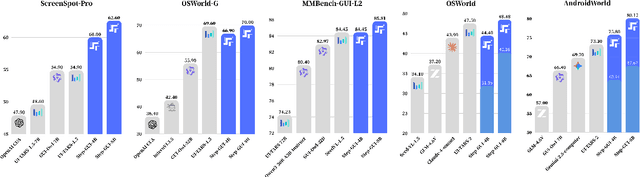
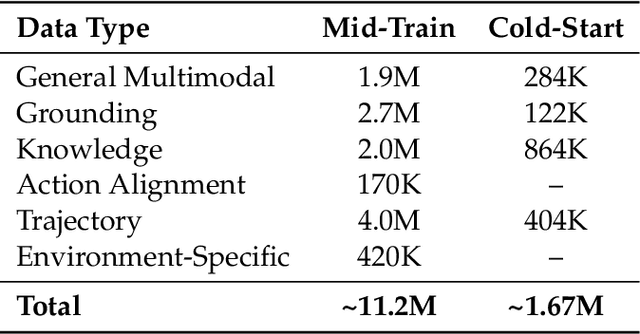
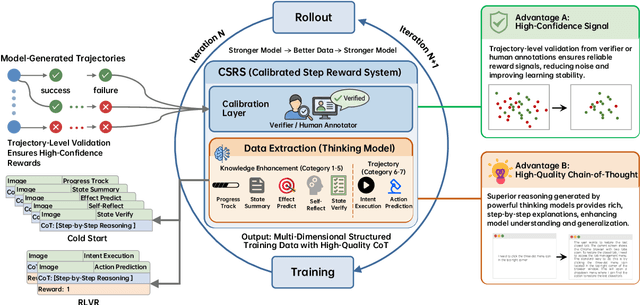
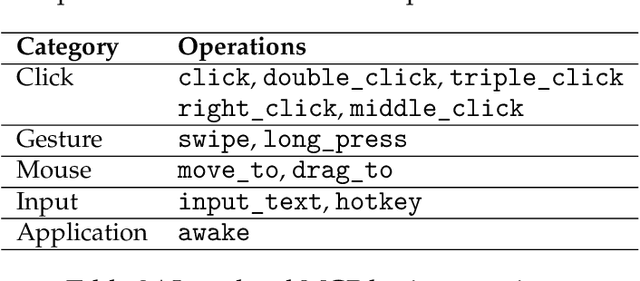
Recent advances in multimodal large language models unlock unprecedented opportunities for GUI automation. However, a fundamental challenge remains: how to efficiently acquire high-quality training data while maintaining annotation reliability? We introduce a self-evolving training pipeline powered by the Calibrated Step Reward System, which converts model-generated trajectories into reliable training signals through trajectory-level calibration, achieving >90% annotation accuracy with 10-100x lower cost. Leveraging this pipeline, we introduce Step-GUI, a family of models (4B/8B) that achieves state-of-the-art GUI performance (8B: 80.2% AndroidWorld, 48.5% OSWorld, 62.6% ScreenShot-Pro) while maintaining robust general capabilities. As GUI agent capabilities improve, practical deployment demands standardized interfaces across heterogeneous devices while protecting user privacy. To this end, we propose GUI-MCP, the first Model Context Protocol for GUI automation with hierarchical architecture that combines low-level atomic operations and high-level task delegation to local specialist models, enabling high-privacy execution where sensitive data stays on-device. Finally, to assess whether agents can handle authentic everyday usage, we introduce AndroidDaily, a benchmark grounded in real-world mobile usage patterns with 3146 static actions and 235 end-to-end tasks across high-frequency daily scenarios (8B: static 89.91%, end-to-end 52.50%). Our work advances the development of practical GUI agents and demonstrates strong potential for real-world deployment in everyday digital interactions.
Step-Audio 2 Technical Report
Jul 24, 2025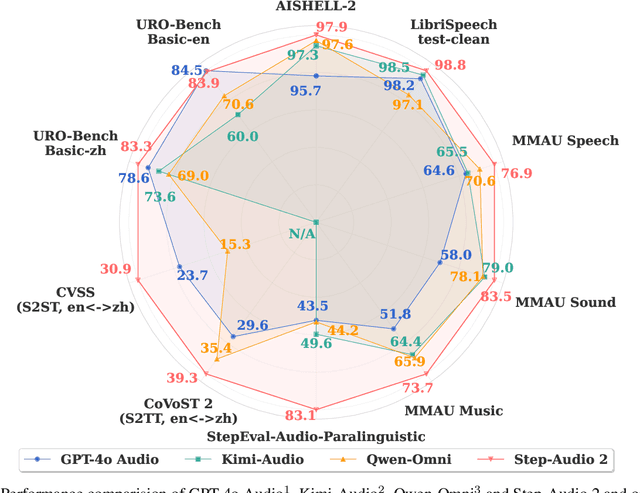
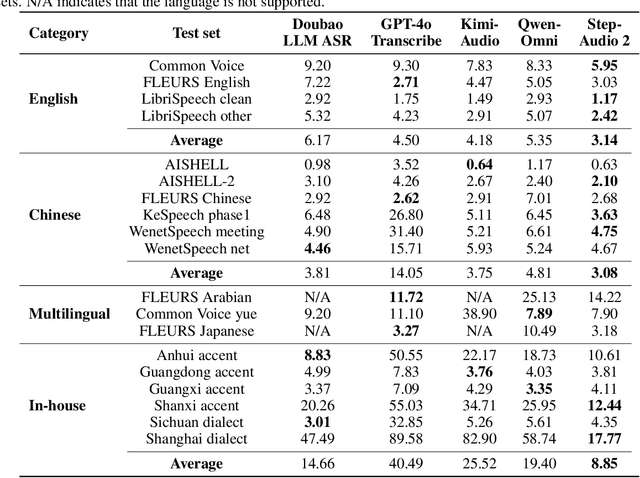
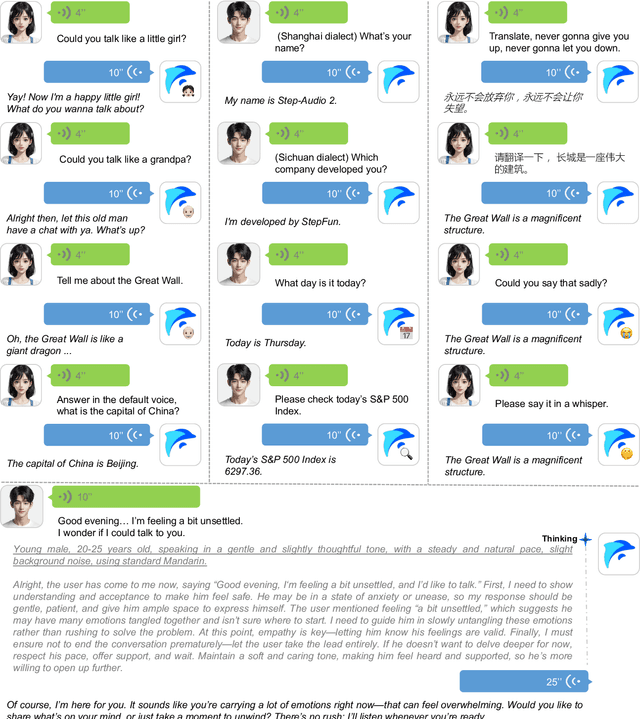
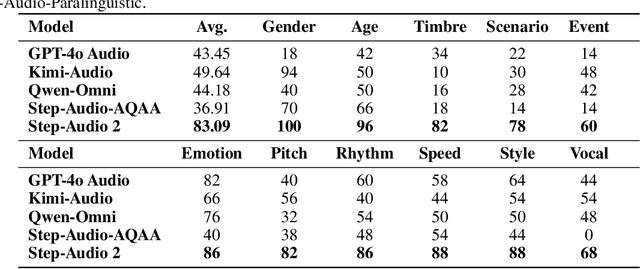
This paper presents Step-Audio 2, an end-to-end multi-modal large language model designed for industry-strength audio understanding and speech conversation. By integrating a latent audio encoder and reasoning-centric reinforcement learning (RL), Step-Audio 2 achieves promising performance in automatic speech recognition (ASR) and audio understanding. To facilitate genuine end-to-end speech conversation, Step-Audio 2 incorporates the generation of discrete audio tokens into language modeling, significantly enhancing its responsiveness to paralinguistic information such as speaking styles and emotions. To effectively leverage the rich textual and acoustic knowledge in real-world data, Step-Audio 2 integrates retrieval-augmented generation (RAG) and is able to call external tools such as web search to mitigate hallucination and audio search to switch timbres. Trained on millions of hours of speech and audio data, Step-Audio 2 delivers intelligence and expressiveness across diverse conversational scenarios. Evaluation results demonstrate that Step-Audio 2 achieves state-of-the-art performance on various audio understanding and conversational benchmarks compared to other open-source and commercial solutions. Please visit https://github.com/stepfun-ai/Step-Audio2 for more information.
Step-Audio: Unified Understanding and Generation in Intelligent Speech Interaction
Feb 18, 2025Real-time speech interaction, serving as a fundamental interface for human-machine collaboration, holds immense potential. However, current open-source models face limitations such as high costs in voice data collection, weakness in dynamic control, and limited intelligence. To address these challenges, this paper introduces Step-Audio, the first production-ready open-source solution. Key contributions include: 1) a 130B-parameter unified speech-text multi-modal model that achieves unified understanding and generation, with the Step-Audio-Chat version open-sourced; 2) a generative speech data engine that establishes an affordable voice cloning framework and produces the open-sourced lightweight Step-Audio-TTS-3B model through distillation; 3) an instruction-driven fine control system enabling dynamic adjustments across dialects, emotions, singing, and RAP; 4) an enhanced cognitive architecture augmented with tool calling and role-playing abilities to manage complex tasks effectively. Based on our new StepEval-Audio-360 evaluation benchmark, Step-Audio achieves state-of-the-art performance in human evaluations, especially in terms of instruction following. On open-source benchmarks like LLaMA Question, shows 9.3% average performance improvement, demonstrating our commitment to advancing the development of open-source multi-modal language technologies. Our code and models are available at https://github.com/stepfun-ai/Step-Audio.
Learning Generalizable Models via Disentangling Spurious and Enhancing Potential Correlations
Jan 11, 2024Domain generalization (DG) intends to train a model on multiple source domains to ensure that it can generalize well to an arbitrary unseen target domain. The acquisition of domain-invariant representations is pivotal for DG as they possess the ability to capture the inherent semantic information of the data, mitigate the influence of domain shift, and enhance the generalization capability of the model. Adopting multiple perspectives, such as the sample and the feature, proves to be effective. The sample perspective facilitates data augmentation through data manipulation techniques, whereas the feature perspective enables the extraction of meaningful generalization features. In this paper, we focus on improving the generalization ability of the model by compelling it to acquire domain-invariant representations from both the sample and feature perspectives by disentangling spurious correlations and enhancing potential correlations. 1) From the sample perspective, we develop a frequency restriction module, guiding the model to focus on the relevant correlations between object features and labels, thereby disentangling spurious correlations. 2) From the feature perspective, the simple Tail Interaction module implicitly enhances potential correlations among all samples from all source domains, facilitating the acquisition of domain-invariant representations across multiple domains for the model. The experimental results show that Convolutional Neural Networks (CNNs) or Multi-Layer Perceptrons (MLPs) with a strong baseline embedded with these two modules can achieve superior results, e.g., an average accuracy of 92.30% on Digits-DG.
USFM: A Universal Ultrasound Foundation Model Generalized to Tasks and Organs towards Label Efficient Image Analysis
Jan 02, 2024
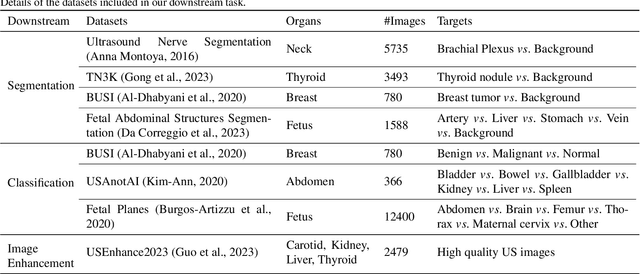
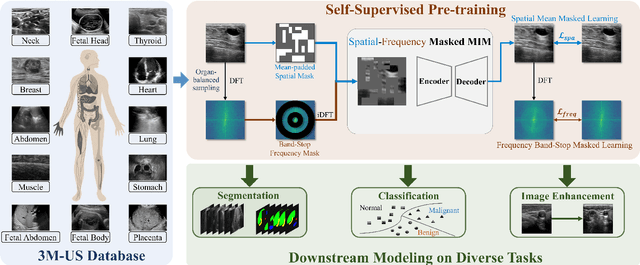
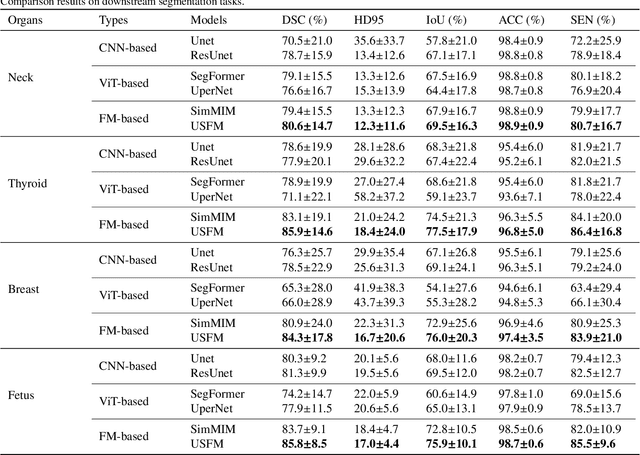
Inadequate generality across different organs and tasks constrains the application of ultrasound (US) image analysis methods in smart healthcare. Building a universal US foundation model holds the potential to address these issues. Nevertheless, the development of such foundational models encounters intrinsic challenges in US analysis, i.e., insufficient databases, low quality, and ineffective features. In this paper, we present a universal US foundation model, named USFM, generalized to diverse tasks and organs towards label efficient US image analysis. First, a large-scale Multi-organ, Multi-center, and Multi-device US database was built, comprehensively containing over two million US images. Organ-balanced sampling was employed for unbiased learning. Then, USFM is self-supervised pre-trained on the sufficient US database. To extract the effective features from low-quality US images, we proposed a spatial-frequency dual masked image modeling method. A productive spatial noise addition-recovery approach was designed to learn meaningful US information robustly, while a novel frequency band-stop masking learning approach was also employed to extract complex, implicit grayscale distribution and textural variations. Extensive experiments were conducted on the various tasks of segmentation, classification, and image enhancement from diverse organs and diseases. Comparisons with representative US image analysis models illustrate the universality and effectiveness of USFM. The label efficiency experiments suggest the USFM obtains robust performance with only 20% annotation, laying the groundwork for the rapid development of US models in clinical practices.