 Add to Chrome
 Add to Firefox
 Add to Edge
ToolGate: Token-Efficient Pre-Call Control for Tool-Augmented Vision-Language Agents
Jun 02, 2026
Tool-augmented vision-language agents can acquire external perceptual evidence through OCR, detection, segmentation, and other tools, but executing every proposed tool call is costly and sometimes unnecessary. We study the pre-call control problem: after a ReAct-style VLM agent proposes a perceptual tool call, should the call be executed, or skipped before its output enters the context? Across five benchmarks, we find that the baseline agent exhibits poor local selectivity: helpful and harmful calls occur at similar rates (11.8% vs. 9.9%), while most calls do not change the immediate forced-answer prediction. We introduce ToolGate, a lightweight external controller that predicts execute/skip decisions from trajectory text and simple structural features. Across two Qwen3-VL backbones, ToolGate reduces token cost to 64-69% of the unrestricted ReAct baseline while preserving average accuracy in cross-domain settings. With matched-domain trajectory training on Qwen3-VL-30B, it further improves average accuracy by 1.65 points. These results show that tool-augmented VLM agents benefit not only from better perceptual tools, but also from explicit control over when tool outputs are worth paying for.

Hölder Policy Optimisation
May 12, 2026Group Relative Policy Optimisation (GRPO) enhances large language models by estimating advantages across a group of sampled trajectories. However, mapping these trajectory-level advantages to policy updates requires aggregating token-level probabilities within each sequence. Relying on a fixed aggregation mechanism for this step fundamentally limits the algorithm's adaptability. Empirically, we observe a critical trade-off: certain fixed aggregations frequently suffer from training collapse, while others fail to yield satisfactory performance. To resolve this, we propose \textbf{HölderPO}, a generalised policy optimisation framework unifying token-level probability aggregation via the Hölder mean. By explicitly modulating the parameter $p$, our framework provides continuous control over the trade-off between gradient concentration and variance bounds. Theoretically, we prove that a larger $p$ concentrates the gradient to amplify sparse learning signals, whereas a smaller $p$ strictly bounds gradient variance. Because no static configuration can universally resolve this concentration-stability trade-off, we instantiate the framework with a dynamic annealing algorithm that progressively schedules $p$ across the training lifecycle. Extensive evaluations demonstrate superior stability and convergence over existing baselines. Specifically, our approach achieves a state-of-the-art average accuracy of $54.9\%$ across multiple mathematical benchmarks, yielding a substantial $7.2\%$ relative gain over standard GRPO and secures an exceptional $93.8\%$ success rate on ALFWorld.
Memento-Skills: Let Agents Design Agents
Mar 19, 2026We introduce \emph{Memento-Skills}, a generalist, continually-learnable LLM agent system that functions as an \emph{agent-designing agent}: it autonomously constructs, adapts, and improves task-specific agents through experience. The system is built on a memory-based reinforcement learning framework with \emph{stateful prompts}, where reusable skills (stored as structured markdown files) serve as persistent, evolving memory. These skills encode both behaviour and context, enabling the agent to carry forward knowledge across interactions. Starting from simple elementary skills (like Web search and terminal operations), the agent continually improves via the \emph{Read--Write Reflective Learning} mechanism introduced in \emph{Memento~2}~\cite{wang2025memento2}. In the \emph{read} phase, a behaviour-trainable skill router selects the most relevant skill conditioned on the current stateful prompt; in the \emph{write} phase, the agent updates and expands its skill library based on new experience. This closed-loop design enables \emph{continual learning without updating LLM parameters}, as all adaptation is realised through the evolution of externalised skills and prompts. Unlike prior approaches that rely on human-designed agents, Memento-Skills enables a generalist agent to \emph{design agents end-to-end} for new tasks. Through iterative skill generation and refinement, the system progressively improves its own capabilities. Experiments on the \emph{General AI Assistants} benchmark and \emph{Humanity's Last Exam} demonstrate sustained gains, achieving 26.2\% and 116.2\% relative improvements in overall accuracy, respectively. Code is available at https://github.com/Memento-Teams/Memento-Skills.
Machines acquire scientific taste from institutional traces
Mar 17, 2026Artificial intelligence matches or exceeds human performance on tasks with verifiable answers, from protein folding to Olympiad mathematics. Yet the capacity that most governs scientific advance is not reasoning but taste: the ability to judge which untested ideas deserve pursuit, exercised daily by editors and funders but never successfully articulated, taught, or automated. Here we show that fine-tuning language models on journal publication decisions recovers evaluative judgment inaccessible to both frontier models and human expertise. Using a held-out benchmark of research pitches in management spanning four quality tiers, we find that eleven frontier models, spanning major proprietary and open architectures, barely exceed chance, averaging 31% accuracy. Panels of journal editors and editorial board members reach 42% by majority vote. Fine-tuned models trained on years of publication records each surpass every frontier model and expert panel, with the best single model achieving 59%. These models exhibit calibrated confidence, reaching 100% accuracy on their highest-confidence predictions, and transfer this evaluative signal to untrained pairwise comparisons and one-sentence summaries. The mechanism generalizes: models trained on economics publication records achieve 70% accuracy. Scientific taste was not missing from AI's reach; it was deposited in the institutional record, waiting to be extracted. These results provide a scalable mechanism to triage the expanding volume of scientific production across disciplines where quality resists formal verification.
AgentCPM-Explore: Realizing Long-Horizon Deep Exploration for Edge-Scale Agents
Feb 06, 2026While Large Language Model (LLM)-based agents have shown remarkable potential for solving complex tasks, existing systems remain heavily reliant on large-scale models, leaving the capabilities of edge-scale models largely underexplored. In this paper, we present the first systematic study on training agentic models at the 4B-parameter scale. We identify three primary bottlenecks hindering the performance of edge-scale models: catastrophic forgetting during Supervised Fine-Tuning (SFT), sensitivity to reward signal noise during Reinforcement Learning (RL), and reasoning degradation caused by redundant information in long-context scenarios. To address the issues, we propose AgentCPM-Explore, a compact 4B agent model with high knowledge density and strong exploration capability. We introduce a holistic training framework featuring parameter-space model fusion, reward signal denoising, and contextual information refinement. Through deep exploration, AgentCPM-Explore achieves state-of-the-art (SOTA) performance among 4B-class models, matches or surpasses 8B-class SOTA models on four benchmarks, and even outperforms larger-scale models such as Claude-4.5-Sonnet or DeepSeek-v3.2 in five benchmarks. Notably, AgentCPM-Explore achieves 97.09% accuracy on GAIA text-based tasks under pass@64. These results provide compelling evidence that the bottleneck for edge-scale models is not their inherent capability ceiling, but rather their inference stability. Based on our well-established training framework, AgentCPM-Explore effectively unlocks the significant, yet previously underestimated, potential of edge-scale models.
OpenR: An Open Source Framework for Advanced Reasoning with Large Language Models
Oct 12, 2024
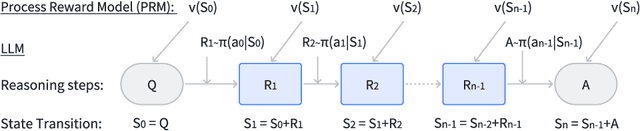
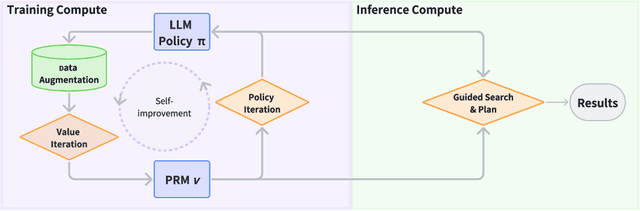
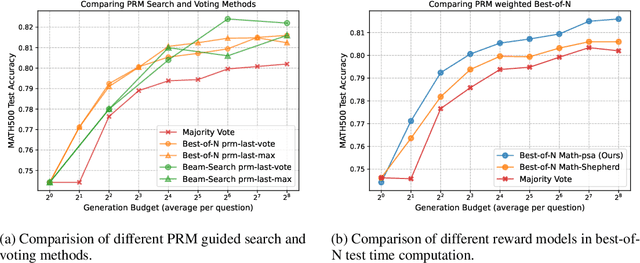
In this technical report, we introduce OpenR, an open-source framework designed to integrate key components for enhancing the reasoning capabilities of large language models (LLMs). OpenR unifies data acquisition, reinforcement learning training (both online and offline), and non-autoregressive decoding into a cohesive software platform. Our goal is to establish an open-source platform and community to accelerate the development of LLM reasoning. Inspired by the success of OpenAI's o1 model, which demonstrated improved reasoning abilities through step-by-step reasoning and reinforcement learning, OpenR integrates test-time compute, reinforcement learning, and process supervision to improve reasoning in LLMs. Our work is the first to provide an open-source framework that explores the core techniques of OpenAI's o1 model with reinforcement learning, achieving advanced reasoning capabilities beyond traditional autoregressive methods. We demonstrate the efficacy of OpenR by evaluating it on the MATH dataset, utilising publicly available data and search methods. Our initial experiments confirm substantial gains, with relative improvements in reasoning and performance driven by test-time computation and reinforcement learning through process reward models. The OpenR framework, including code, models, and datasets, is accessible at https://openreasoner.github.io.
Looking Ahead to Avoid Being Late: Solving Hard-Constrained Traveling Salesman Problem
Mar 08, 2024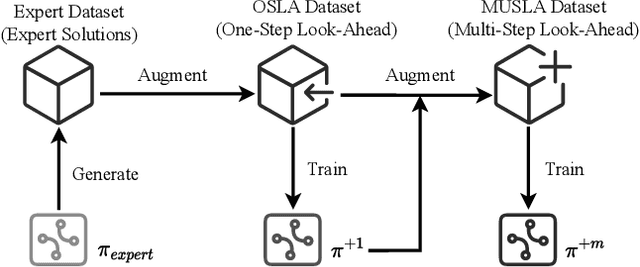
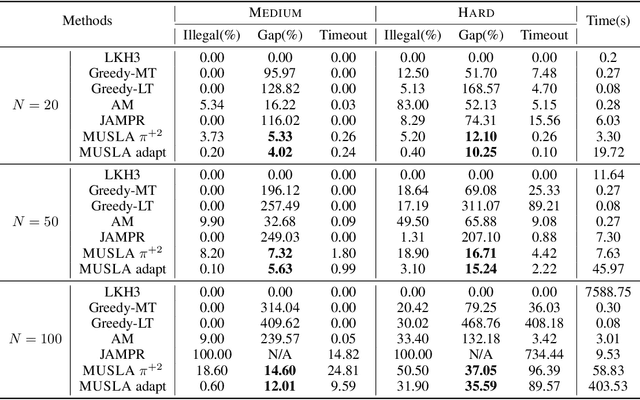
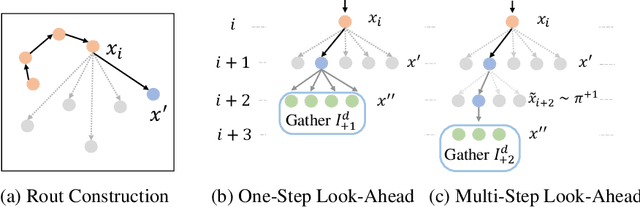
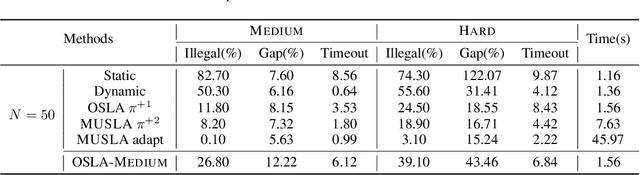
Many real-world problems can be formulated as a constrained Traveling Salesman Problem (TSP). However, the constraints are always complex and numerous, making the TSPs challenging to solve. When the number of complicated constraints grows, it is time-consuming for traditional heuristic algorithms to avoid illegitimate outcomes. Learning-based methods provide an alternative to solve TSPs in a soft manner, which also supports GPU acceleration to generate solutions quickly. Nevertheless, the soft manner inevitably results in difficulty solving hard-constrained problems with learning algorithms, and the conflicts between legality and optimality may substantially affect the optimality of the solution. To overcome this problem and to have an effective solution against hard constraints, we proposed a novel learning-based method that uses looking-ahead information as the feature to improve the legality of TSP with Time Windows (TSPTW) solutions. Besides, we constructed TSPTW datasets with hard constraints in order to accurately evaluate and benchmark the statistical performance of various approaches, which can serve the community for future research. With comprehensive experiments on diverse datasets, MUSLA outperforms existing baselines and shows generalizability potential.