 Add to Chrome
 Add to Firefox
 Add to Edge
Behavior-Invariant Task Representation Learning with Transformer-based World Models for Offline Meta-Reinforcement Learning
May 30, 2026
Offline meta-reinforcement learning leverages static datasets to enable agents to generalize to unseen environments by combining offline efficiency with meta-learning adaptability, yet it faces key challenges from context and policy distribution shifts. These issues hinder agents from adapting to online environments, and are further exacerbated under sparse-reward settings. As a result, agents often become trapped in an inherent pattern dilemma, failing to achieve robust generalization. In this work, we propose a novel framework that integrates information-theoretic task representation learning with a Transformer-based stochastic world model. Our approach extracts task-defining latent variables that are invariant to behavior policy, thereby effectively mitigating the context distribution shift. To further handle policy shift and model exploitation, we apply a conservative value penalty to imagination-based rollouts, preventing the policy from exploiting model inaccuracies while maintaining robust adaptation. Extensive evaluations demonstrate that our method outperforms state-of-the-art approaches, with superior stability and generalization under out-of-distribution and sparse-reward settings.

Memento-Skills: Let Agents Design Agents
Mar 19, 2026We introduce \emph{Memento-Skills}, a generalist, continually-learnable LLM agent system that functions as an \emph{agent-designing agent}: it autonomously constructs, adapts, and improves task-specific agents through experience. The system is built on a memory-based reinforcement learning framework with \emph{stateful prompts}, where reusable skills (stored as structured markdown files) serve as persistent, evolving memory. These skills encode both behaviour and context, enabling the agent to carry forward knowledge across interactions. Starting from simple elementary skills (like Web search and terminal operations), the agent continually improves via the \emph{Read--Write Reflective Learning} mechanism introduced in \emph{Memento~2}~\cite{wang2025memento2}. In the \emph{read} phase, a behaviour-trainable skill router selects the most relevant skill conditioned on the current stateful prompt; in the \emph{write} phase, the agent updates and expands its skill library based on new experience. This closed-loop design enables \emph{continual learning without updating LLM parameters}, as all adaptation is realised through the evolution of externalised skills and prompts. Unlike prior approaches that rely on human-designed agents, Memento-Skills enables a generalist agent to \emph{design agents end-to-end} for new tasks. Through iterative skill generation and refinement, the system progressively improves its own capabilities. Experiments on the \emph{General AI Assistants} benchmark and \emph{Humanity's Last Exam} demonstrate sustained gains, achieving 26.2\% and 116.2\% relative improvements in overall accuracy, respectively. Code is available at https://github.com/Memento-Teams/Memento-Skills.
Learning Task Belief Similarity with Latent Dynamics for Meta-Reinforcement Learning
Jun 24, 2025Meta-reinforcement learning requires utilizing prior task distribution information obtained during exploration to rapidly adapt to unknown tasks. The efficiency of an agent's exploration hinges on accurately identifying the current task. Recent Bayes-Adaptive Deep RL approaches often rely on reconstructing the environment's reward signal, which is challenging in sparse reward settings, leading to suboptimal exploitation. Inspired by bisimulation metrics, which robustly extracts behavioral similarity in continuous MDPs, we propose SimBelief-a novel meta-RL framework via measuring similarity of task belief in Bayes-Adaptive MDP (BAMDP). SimBelief effectively extracts common features of similar task distributions, enabling efficient task identification and exploration in sparse reward environments. We introduce latent task belief metric to learn the common structure of similar tasks and incorporate it into the specific task belief. By learning the latent dynamics across task distributions, we connect shared latent task belief features with specific task features, facilitating rapid task identification and adaptation. Our method outperforms state-of-the-art baselines on sparse reward MuJoCo and panda-gym tasks.
Memory Sequence Length of Data Sampling Impacts the Adaptation of Meta-Reinforcement Learning Agents
Jun 18, 2024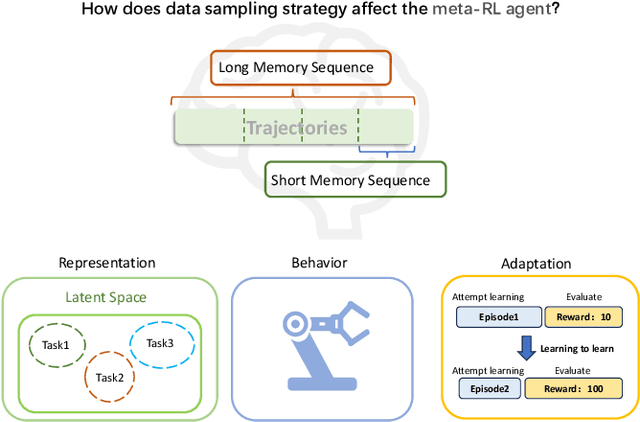
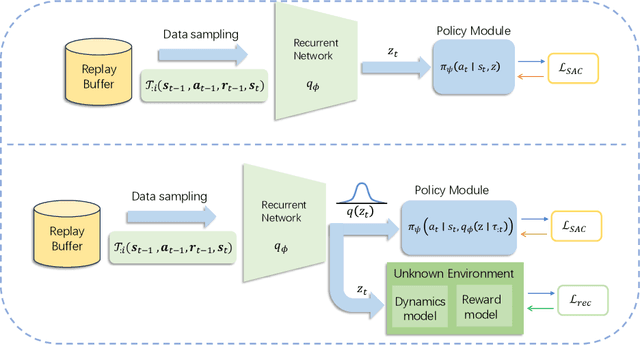
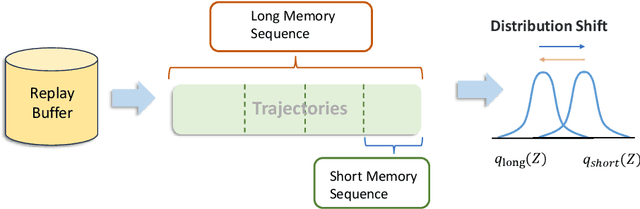
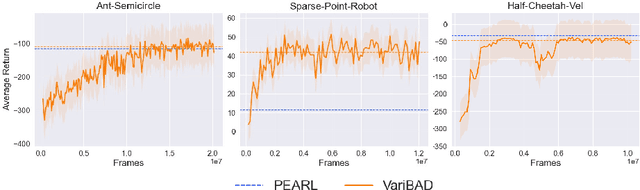
Fast adaptation to new tasks is extremely important for embodied agents in the real world. Meta-reinforcement learning (meta-RL) has emerged as an effective method to enable fast adaptation in unknown environments. Compared to on-policy meta-RL algorithms, off-policy algorithms rely heavily on efficient data sampling strategies to extract and represent the historical trajectories. However, little is known about how different data sampling methods impact the ability of meta-RL agents to represent unknown environments. Here, we investigate the impact of data sampling strategies on the exploration and adaptability of meta-RL agents. Specifically, we conducted experiments with two types of off-policy meta-RL algorithms based on Thompson sampling and Bayes-optimality theories in continuous control tasks within the MuJoCo environment and sparse reward navigation tasks. Our analysis revealed the long-memory and short-memory sequence sampling strategies affect the representation and adaptive capabilities of meta-RL agents. We found that the algorithm based on Bayes-optimality theory exhibited more robust and better adaptability than the algorithm based on Thompson sampling, highlighting the importance of appropriate data sampling strategies for the agent's representation of an unknown environment, especially in the case of sparse rewards.