 Add to Chrome
 Add to Firefox
 Add to Edge
JSGS: JPEG State-Guided Supervision for 3D Gaussian Splatting from Mixed-Quality Views
Aug 09, 2026
Standard 3D Gaussian Splatting (3DGS) assumes that every input image faithfully samples scene radiance. However, mixed-quality JPEG images violate this assumption because compression-induced blocking and ringing artifacts can corrupt updates to Gaussians shared across views. To address this problem, we propose JPEG State-Guided Supervision for 3D Gaussian Splatting from Mixed-Quality Views (JSGS). JSGS uses luminance and chrominance quantization tables stored in each JPEG file to construct a view-specific JPEG observation operator. This operator encodes and decodes each rendered view for domain-matched comparison with the corresponding decoded input image. The luminance quantization table supplies continuous weights within a fixed middle frequency band. A loss in the low frequency band anchors coarse structure, while the weighted middle frequency loss redistributes supervision among the selected DCT coordinates. The resulting block disagreement also guides the Gaussian Controller to regularize small primitives with high opacity in disagreement regions. Across seven scenes and three mixed-quality schedules, JSGS achieves the lowest mean LPIPS and the highest mean SSIM under every schedule while rendering at approximately 150 FPS. Code: https://github.com/Jayden-Cui/JSGS.

JoyAI-Video-Edit: Real-Time Open-Ended Video Editing with Autoregressive Diffusion
Aug 04, 2026Real-time video editing requires low-latency causal generation with bounded computational resources while preserving source fidelity and long-term temporal consistency. We present JoyAI-Video-Edit, a 16B-parameter autoregressive diffusion framework for real-time, open-ended video editing without access to future frames or a predefined video duration. Our method combines chunk-wise autoregressive adaptation, Source-Anchored Distribution Matching Distillation (SA-DMD), and Long-Horizon Autoregressive Distillation to reduce train--inference mismatch, preserve source fidelity during two-step generation, and mitigate accumulated temporal drift. Extensive automatic and human evaluations show that JoyAI-Video-Edit substantially outperforms existing streaming editors and remains competitive with strong offline systems on both short and long videos. The complete system achieves end-to-end 720p video editing at approximately 30 FPS on a single Nvidia B200 GPU. Code is available at https://github.com/jd-opensource/JoyAI-Video-Edit.
AXIS: A Growable Community-Driven Data Engine for Scalable Robot Manipulation
Jul 23, 2026Learning effective robot manipulation policies requires diverse, high-quality demonstrations, yet existing data pipelines are often difficult to scale because they rely on specialized hardware, centralized operators, or fixed task suites. We present AXIS, a growable community-driven data engine and benchmark for scalable robot learning, which enables browser-based teleoperation for large-scale demonstration collection, automatically generates and validates new manipulation tasks, and transforms community-collected demonstrations into training-ready data through automated success checking, quality filtering, trajectory smoothing, and visual and physics-based augmentation. The AXIS dataset currently contains 207 diverse tasks and 50K+ trajectories. Meanwhile, AXIS organizes data into task snapshots and evaluates policies with a systematic held-out protocol. We compare vision-language-action (VLA) policies under a unified AXIS evaluation suite and analyze scaling behavior across different data volumes. Continual pretraining on AXIS substantially improves the overall success rate of $π_{0.5}$ by 5.8%, outperforms the model pretrained on RoboCasa365 by 37.3%, and exhibits consistent scaling with increasing data volume, with the largest gains observed under layout, sensor-noise, and camera perturbations.
Attribute Inference from Interactive Targeted Ads
Jun 13, 2026Targeted advertising systems can pair audiences selected by advertisers with ad units that expose visible user actions. When an interaction remains linked to the campaign that elicited it, the advertiser may receive an observation tied to a user rather than only an aggregate report. We model that channel as a noisy oracle for attribute inference. The model separates targeting predicates, exposure, interaction, and disclosure. These boundaries capture the gap between eligibility and delivery, and the gap between interaction and advertiser visibility. We build a reproducible benchmark using synthetic populations calibrated with public data, each with known sensitive labels. A generated campaign semantics layer provides topic variants and response priors. The simulator generates the ground truth, event traces, disclosed observations, and metrics. The evaluation compares Bayesian, supervised, positive and unlabeled, and adaptive attacks under common campaign and disclosure definitions. The final evaluation uses four topic variants, seven simulator seeds, and two interaction settings. Repeated campaigns with identity exposure produce measurable but bounded inference signal. At $160$ campaigns, Bayesian and supervised attacks reach about $0.64$ AUC in the main setting and about $0.65$ AUC in the higher interaction setting. Disclosure policy is the strongest control. Aggregate reporting removes the evaluated oracle input tied to users. Type filtering and randomized disclosure reduce the released signal. The result is a model, artifact, and defense evaluation method for privacy in interactive targeted advertising. The code is available at https://github.com/P-HOW/Interactive-Ad-Oracle.
Fishbone: From One 3D Asset to a Million Controllable Edits
May 24, 2026Large-scale controllable 3D assets are critical for computer graphics, embodied AI, robotics, and interactive content creation, yet creating diverse 3D assets remains challenging due to the high cost of manual modeling and rigging. Shape deformation offers a natural way to generate variations from existing meshes, but existing data-driven methods often rely on sparse user inputs, while parametric editing frameworks require manually designed control structures and category-specific configurations. Inspired by natural creatures, where a central spine governs global shape and cross-sectional ribs control local variation, we introduce Fishbone, a unified rib-spine representation for general shapes that supports controllable parametric mesh deformation, reduced-space dynamics, and animation. Given an input mesh, Fishbone computes a geodesic scalar field with an adaptive heat method, extracts iso-contours as cross-sectional ribs, constructs a smooth geometry-aware spine through rib centers, and associates surface vertices with nearby rib and spine structures using Gaussian-weighted skinning. The resulting representation enables real-time and predictable deformation: ribs control local profiles such as thickness, orientation, and cross-sectional variation, while the spine controls global bending, twisting, and stretching. The same structure also supports reduced-space simulation and keyframe animation. We further construct Fishbone-136K by augmenting Hunyuan3D with rib-spine structures, and demonstrate applications in controllable 3D generation, deformation-based data augmentation for robot learning, interactive mesh editing, and agentic generation. Experiments demonstrate the effectiveness, efficiency, and versatility of the proposed framework.
Condition Matters in Full-head 3D GANs
Feb 06, 2026Conditioning is crucial for stable training of full-head 3D GANs. Without any conditioning signal, the model suffers from severe mode collapse, making it impractical to training. However, a series of previous full-head 3D GANs conventionally choose the view angle as the conditioning input, which leads to a bias in the learned 3D full-head space along the conditional view direction. This is evident in the significant differences in generation quality and diversity between the conditional view and non-conditional views of the generated 3D heads, resulting in global incoherence across different head regions. In this work, we propose to use view-invariant semantic feature as the conditioning input, thereby decoupling the generative capability of 3D heads from the viewing direction. To construct a view-invariant semantic condition for each training image, we create a novel synthesized head image dataset. We leverage FLUX.1 Kontext to extend existing high-quality frontal face datasets to a wide range of view angles. The image clip feature extracted from the frontal view is then used as a shared semantic condition across all views in the extended images, ensuring semantic alignment while eliminating directional bias. This also allows supervision from different views of the same subject to be consolidated under a shared semantic condition, which accelerates training and enhances the global coherence of the generated 3D heads. Moreover, as GANs often experience slower improvements in diversity once the generator learns a few modes that successfully fool the discriminator, our semantic conditioning encourages the generator to follow the true semantic distribution, thereby promoting continuous learning and diverse generation. Extensive experiments on full-head synthesis and single-view GAN inversion demonstrate that our method achieves significantly higher fidelity, diversity, and generalizability.
Large Video Planner Enables Generalizable Robot Control
Dec 17, 2025


General-purpose robots require decision-making models that generalize across diverse tasks and environments. Recent works build robot foundation models by extending multimodal large language models (MLLMs) with action outputs, creating vision-language-action (VLA) systems. These efforts are motivated by the intuition that MLLMs' large-scale language and image pretraining can be effectively transferred to the action output modality. In this work, we explore an alternative paradigm of using large-scale video pretraining as a primary modality for building robot foundation models. Unlike static images and language, videos capture spatio-temporal sequences of states and actions in the physical world that are naturally aligned with robotic behavior. We curate an internet-scale video dataset of human activities and task demonstrations, and train, for the first time at a foundation-model scale, an open video model for generative robotics planning. The model produces zero-shot video plans for novel scenes and tasks, which we post-process to extract executable robot actions. We evaluate task-level generalization through third-party selected tasks in the wild and real-robot experiments, demonstrating successful physical execution. Together, these results show robust instruction following, strong generalization, and real-world feasibility. We release both the model and dataset to support open, reproducible video-based robot learning. Our website is available at https://www.boyuan.space/large-video-planner/.
ViSA: 3D-Aware Video Shading for Real-Time Upper-Body Avatar Creation
Dec 09, 2025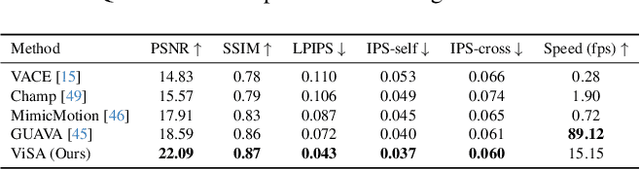
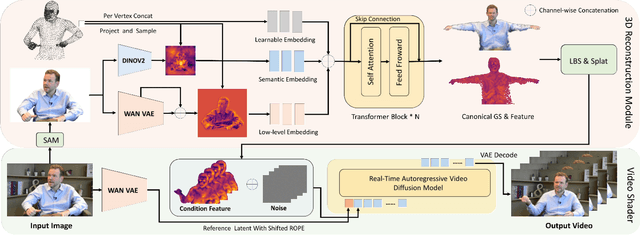
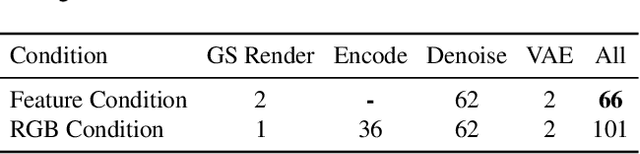
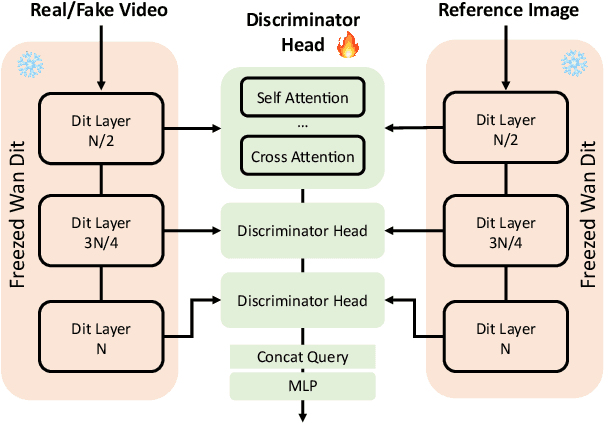
Generating high-fidelity upper-body 3D avatars from one-shot input image remains a significant challenge. Current 3D avatar generation methods, which rely on large reconstruction models, are fast and capable of producing stable body structures, but they often suffer from artifacts such as blurry textures and stiff, unnatural motion. In contrast, generative video models show promising performance by synthesizing photorealistic and dynamic results, but they frequently struggle with unstable behavior, including body structural errors and identity drift. To address these limitations, we propose a novel approach that combines the strengths of both paradigms. Our framework employs a 3D reconstruction model to provide robust structural and appearance priors, which in turn guides a real-time autoregressive video diffusion model for rendering. This process enables the model to synthesize high-frequency, photorealistic details and fluid dynamics in real time, effectively reducing texture blur and motion stiffness while preventing the structural inconsistencies common in video generation methods. By uniting the geometric stability of 3D reconstruction with the generative capabilities of video models, our method produces high-fidelity digital avatars with realistic appearance and dynamic, temporally coherent motion. Experiments demonstrate that our approach significantly reduces artifacts and achieves substantial improvements in visual quality over leading methods, providing a robust and efficient solution for real-time applications such as gaming and virtual reality. Project page: https://lhyfst.github.io/visa
PF-LHM: 3D Animatable Avatar Reconstruction from Pose-free Articulated Human Images
Jun 16, 2025Reconstructing an animatable 3D human from casually captured images of an articulated subject without camera or human pose information is a practical yet challenging task due to view misalignment, occlusions, and the absence of structural priors. While optimization-based methods can produce high-fidelity results from monocular or multi-view videos, they require accurate pose estimation and slow iterative optimization, limiting scalability in unconstrained scenarios. Recent feed-forward approaches enable efficient single-image reconstruction but struggle to effectively leverage multiple input images to reduce ambiguity and improve reconstruction accuracy. To address these challenges, we propose PF-LHM, a large human reconstruction model that generates high-quality 3D avatars in seconds from one or multiple casually captured pose-free images. Our approach introduces an efficient Encoder-Decoder Point-Image Transformer architecture, which fuses hierarchical geometric point features and multi-view image features through multimodal attention. The fused features are decoded to recover detailed geometry and appearance, represented using 3D Gaussian splats. Extensive experiments on both real and synthetic datasets demonstrate that our method unifies single- and multi-image 3D human reconstruction, achieving high-fidelity and animatable 3D human avatars without requiring camera and human pose annotations. Code and models will be released to the public.
NOVA3D: Normal Aligned Video Diffusion Model for Single Image to 3D Generation
Jun 09, 2025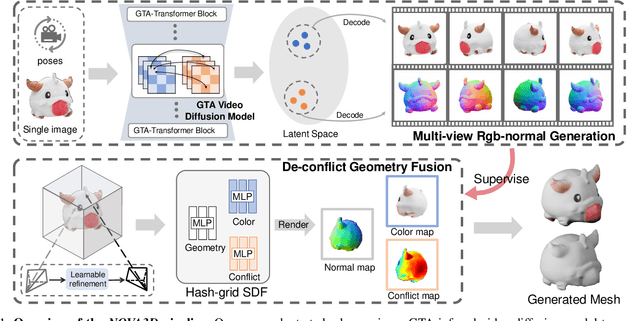
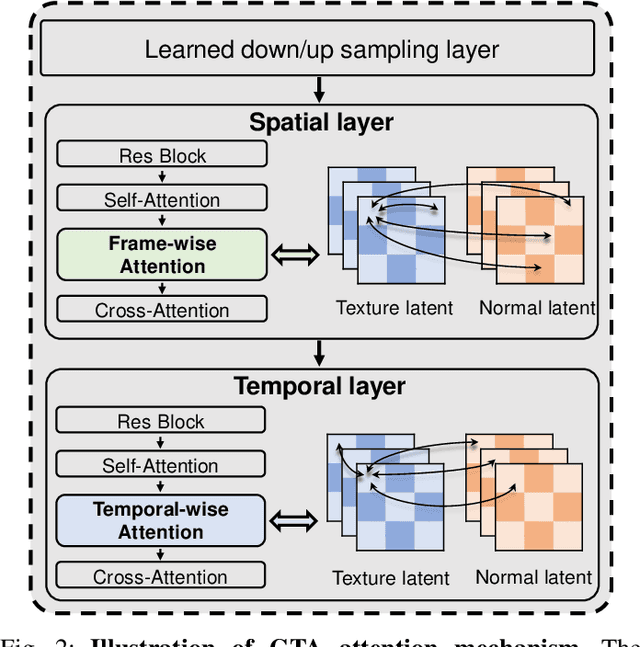
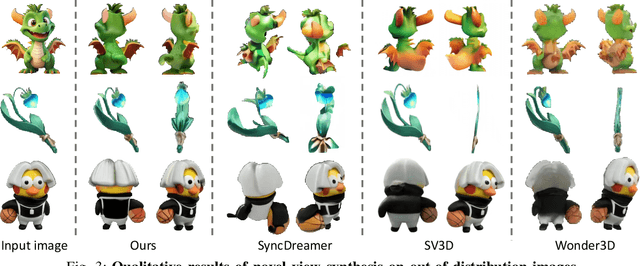
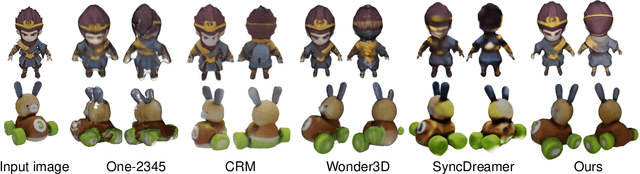
3D AI-generated content (AIGC) has made it increasingly accessible for anyone to become a 3D content creator. While recent methods leverage Score Distillation Sampling to distill 3D objects from pretrained image diffusion models, they often suffer from inadequate 3D priors, leading to insufficient multi-view consistency. In this work, we introduce NOVA3D, an innovative single-image-to-3D generation framework. Our key insight lies in leveraging strong 3D priors from a pretrained video diffusion model and integrating geometric information during multi-view video fine-tuning. To facilitate information exchange between color and geometric domains, we propose the Geometry-Temporal Alignment (GTA) attention mechanism, thereby improving generalization and multi-view consistency. Moreover, we introduce the de-conflict geometry fusion algorithm, which improves texture fidelity by addressing multi-view inaccuracies and resolving discrepancies in pose alignment. Extensive experiments validate the superiority of NOVA3D over existing baselines.