 Add to Chrome
 Add to Firefox
 Add to Edge
PlayWorld: Learning Robot World Models from Autonomous Play
Mar 11, 2026
Action-conditioned video models offer a promising path to building general-purpose robot simulators that can improve directly from data. Yet, despite training on large-scale robot datasets, current state-of-the-art video models still struggle to predict physically consistent robot-object interactions that are crucial in robotic manipulation. To close this gap, we present PlayWorld, a simple, scalable, and fully autonomous pipeline for training high-fidelity video world simulators from interaction experience. In contrast to prior approaches that rely on success-biased human demonstrations, PlayWorld is the first system capable of learning entirely from unsupervised robot self-play, enabling naturally scalable data collection while capturing complex, long-tailed physical interactions essential for modeling realistic object dynamics. Experiments across diverse manipulation tasks show that PlayWorld generates high-quality, physically consistent predictions for contact-rich interactions that are not captured by world models trained on human-collected data. We further demonstrate the versatility of PlayWorld in enabling fine-grained failure prediction and policy evaluation, with up to 40% improvements over human-collected data. Finally, we demonstrate how PlayWorld enables reinforcement learning in the world model, improving policy performance by 65% in success rates when deployed in the real world.

LAP: Language-Action Pre-Training Enables Zero-shot Cross-Embodiment Transfer
Feb 15, 2026A long-standing goal in robotics is a generalist policy that can be deployed zero-shot on new robot embodiments without per-embodiment adaptation. Despite large-scale multi-embodiment pre-training, existing Vision-Language-Action models (VLAs) remain tightly coupled to their training embodiments and typically require costly fine-tuning. We introduce Language-Action Pre-training (LAP), a simple recipe that represents low-level robot actions directly in natural language, aligning action supervision with the pre-trained vision-language model's input-output distribution. LAP requires no learned tokenizer, no costly annotation, and no embodiment-specific architectural design. Based on LAP, we present LAP-3B, which to the best of our knowledge is the first VLA to achieve substantial zero-shot transfer to previously unseen robot embodiments without any embodiment-specific fine-tuning. Across multiple novel robots and manipulation tasks, LAP-3B attains over 50% average zero-shot success, delivering roughly a 2x improvement over the strongest prior VLAs. We further show that LAP enables efficient adaptation and favorable scaling, while unifying action prediction and VQA in a shared language-action format that yields additional gains through co-training.
Video Generation Models in Robotics -- Applications, Research Challenges, Future Directions
Jan 12, 2026Video generation models have emerged as high-fidelity models of the physical world, capable of synthesizing high-quality videos capturing fine-grained interactions between agents and their environments conditioned on multi-modal user inputs. Their impressive capabilities address many of the long-standing challenges faced by physics-based simulators, driving broad adoption in many problem domains, e.g., robotics. For example, video models enable photorealistic, physically consistent deformable-body simulation without making prohibitive simplifying assumptions, which is a major bottleneck in physics-based simulation. Moreover, video models can serve as foundation world models that capture the dynamics of the world in a fine-grained and expressive way. They thus overcome the limited expressiveness of language-only abstractions in describing intricate physical interactions. In this survey, we provide a review of video models and their applications as embodied world models in robotics, encompassing cost-effective data generation and action prediction in imitation learning, dynamics and rewards modeling in reinforcement learning, visual planning, and policy evaluation. Further, we highlight important challenges hindering the trustworthy integration of video models in robotics, which include poor instruction following, hallucinations such as violations of physics, and unsafe content generation, in addition to fundamental limitations such as significant data curation, training, and inference costs. We present potential future directions to address these open research challenges to motivate research and ultimately facilitate broader applications, especially in safety-critical settings.
Online Resynthesis of High-Level Collaborative Tasks for Robots with Changing Capabilities
Sep 09, 2024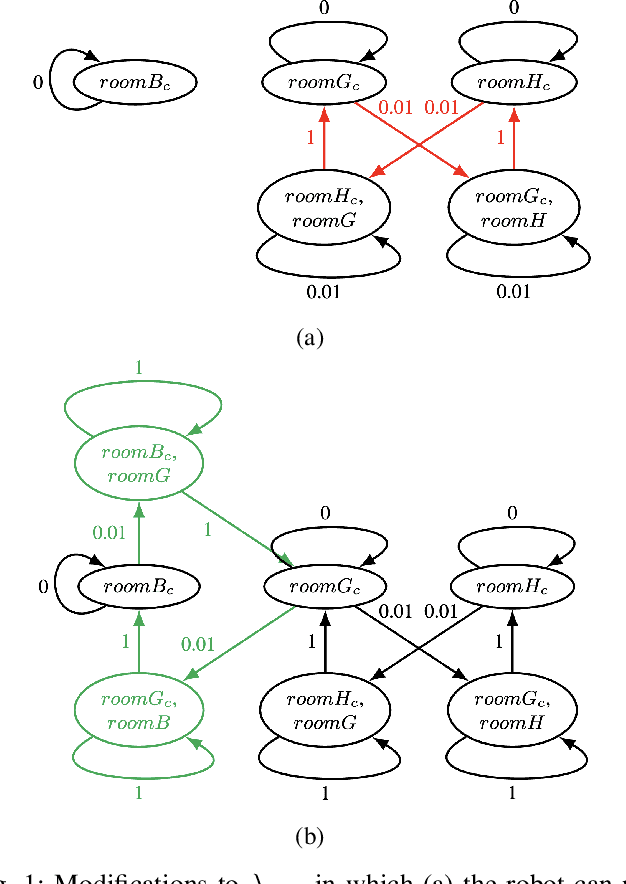
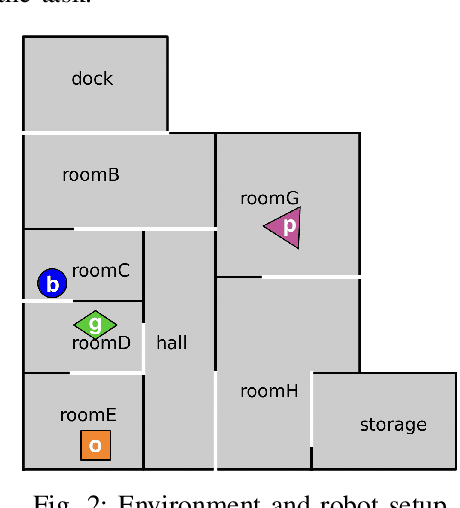
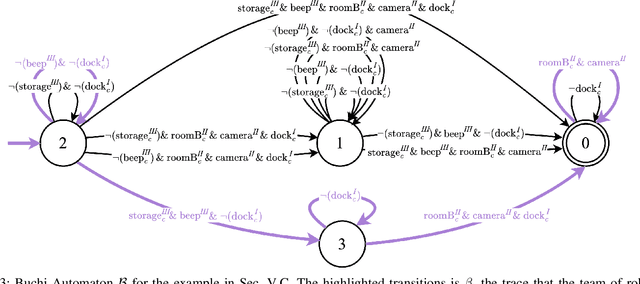
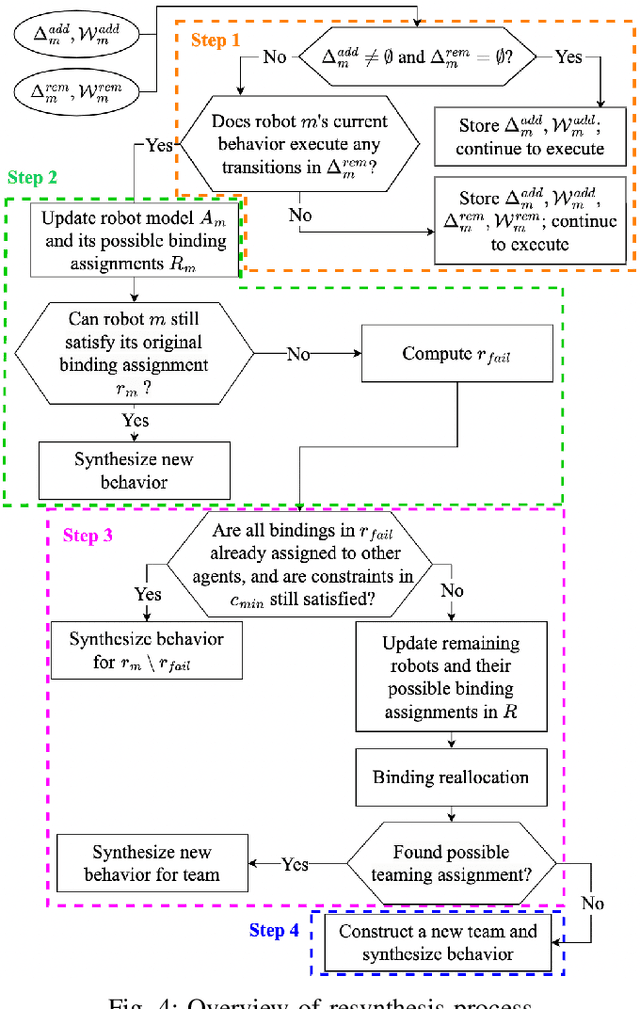
Given a collaborative high-level task and a team of heterogeneous robots and behaviors to satisfy it, this work focuses on the challenge of automatically, at runtime, adjusting the individual robot behaviors such that the task is still satisfied, when robots encounter changes to their abilities--either failures or additional actions they can perform. We consider tasks encoded in LTL^\psi and minimize global teaming reassignments (and as a result, local resynthesis) when robots' capabilities change. We also increase the expressivity of LTL^\psi by including additional types of constraints on the overall teaming assignment that the user can specify, such as the minimum number of robots required for each assignment. We demonstrate the framework in a simulated warehouse scenario.
Continuous Execution of High-Level Collaborative Tasks for Heterogeneous Robot Teams
Jun 26, 2024


We propose a control synthesis framework for a heterogeneous multi-robot system to satisfy collaborative tasks, where actions may take varying duration of time to complete. We encode tasks using the discrete logic LTL^\psi, which uses the concept of bindings to interleave robot actions and express information about relationship between specific task requirements and robot assignments. We present a synthesis approach to automatically generate a teaming assignment and corresponding discrete behavior that is correct-by-construction for continuous execution, while also implementing synchronization policies to ensure collaborative portions of the task are satisfied. We demonstrate our approach on a physical multi-robot system.