 Add to Chrome
 Add to Firefox
 Add to Edge
MolmoB0T: Large-Scale Simulation Enables Zero-Shot Manipulation
Mar 17, 2026
A prevailing view in robot learning is that simulation alone is not enough; effective sim-to-real transfer is widely believed to require at least some real-world data collection or task-specific fine-tuning to bridge the gap between simulated and physical environments. We challenge that assumption. With sufficiently large-scale and diverse simulated synthetic training data, we show that zero-shot transfer to the real world is not only possible, but effective for both static and mobile manipulation. We introduce MolmoBot-Engine, a fully open-source pipeline for procedural data generation across robots, tasks, and diverse simulated environments in MolmoSpaces. With it, we release MolmoBot-Data, a dataset of 1.8 million expert trajectories for articulated object manipulation and pick-and-place tasks. We train three policy classes: MolmoBot, a Molmo2-based multi-frame vision-language model with a flow-matching action head; MolmoBot-Pi0, which replicates the $π_0$ architecture to enable direct comparison; and MolmoBot-SPOC, a lightweight policy suitable for edge deployment and amenable to RL fine-tuning. We evaluate on two robotic platforms: the Franka FR3 for tabletop manipulation tasks and the Rainbow Robotics RB-Y1 mobile manipulator for door opening, drawer manipulation, cabinet interaction, and mobile pick-and-place. Without any real-world fine-tuning, our policies achieve zero-shot transfer to unseen objects and environments. On tabletop pick-and-place, MolmoBot achieves a success rate of 79.2% in real world evaluations across 4 settings, outperforming $π_{0.5}$ at 39.2%. Our results demonstrate that procedural environment generation combined with diverse articulated assets can produce robust manipulation policies that generalize broadly to the real world. Technical Blog: https://allenai.org/blog/molmobot-robot-manipulation

MolmoSpaces: A Large-Scale Open Ecosystem for Robot Navigation and Manipulation
Feb 11, 2026Deploying robots at scale demands robustness to the long tail of everyday situations. The countless variations in scene layout, object geometry, and task specifications that characterize real environments are vast and underrepresented in existing robot benchmarks. Measuring this level of generalization requires infrastructure at a scale and diversity that physical evaluation alone cannot provide. We introduce MolmoSpaces, a fully open ecosystem to support large-scale benchmarking of robot policies. MolmoSpaces consists of over 230k diverse indoor environments, ranging from handcrafted household scenes to procedurally generated multiroom houses, populated with 130k richly annotated object assets, including 48k manipulable objects with 42M stable grasps. Crucially, these environments are simulator-agnostic, supporting popular options such as MuJoCo, Isaac, and ManiSkill. The ecosystem supports the full spectrum of embodied tasks: static and mobile manipulation, navigation, and multiroom long-horizon tasks requiring coordinated perception, planning, and interaction across entire indoor environments. We also design MolmoSpaces-Bench, a benchmark suite of 8 tasks in which robots interact with our diverse scenes and richly annotated objects. Our experiments show MolmoSpaces-Bench exhibits strong sim-to-real correlation (R = 0.96, \r{ho} = 0.98), confirm newer and stronger zero-shot policies outperform earlier versions in our benchmarks, and identify key sensitivities to prompt phrasing, initial joint positions, and camera occlusion. Through MolmoSpaces and its open-source assets and tooling, we provide a foundation for scalable data generation, policy training, and benchmark creation for robot learning research.
Jacta: A Versatile Planner for Learning Dexterous and Whole-body Manipulation
Aug 02, 2024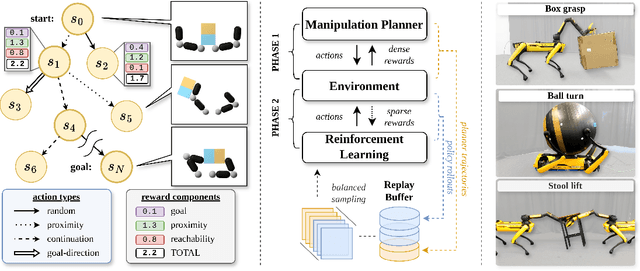
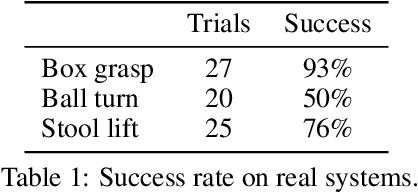
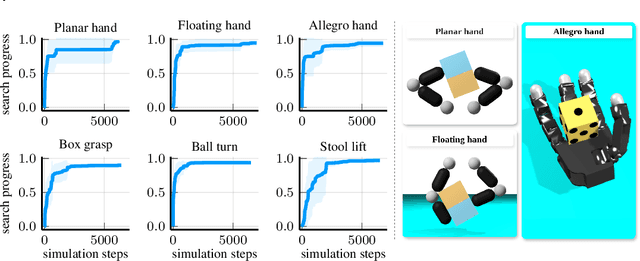
Robotic manipulation is challenging due to discontinuous dynamics, as well as high-dimensional state and action spaces. Data-driven approaches that succeed in manipulation tasks require large amounts of data and expert demonstrations, typically from humans. Existing manipulation planners are restricted to specific systems and often depend on specialized algorithms for using demonstration. Therefore, we introduce a flexible motion planner tailored to dexterous and whole-body manipulation tasks. Our planner creates readily usable demonstrations for reinforcement learning algorithms, eliminating the need for additional training pipeline complexities. With this approach, we can efficiently learn policies for complex manipulation tasks, where traditional reinforcement learning alone only makes little progress. Furthermore, we demonstrate that learned policies are transferable to real robotic systems for solving complex dexterous manipulation tasks.