 Add to Chrome
 Add to Firefox
 Add to Edge
Efficient Multi-Camera Tokenization with Triplanes for End-to-End Driving
Jun 13, 2025
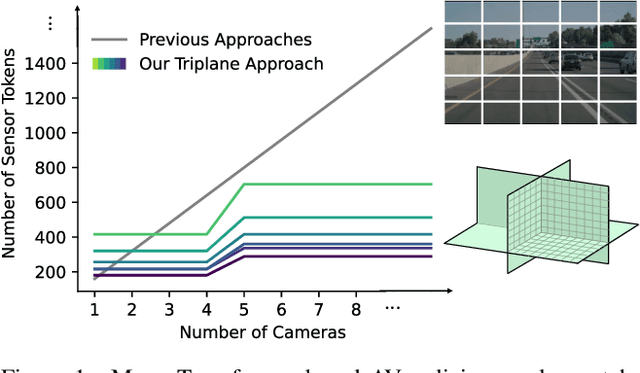
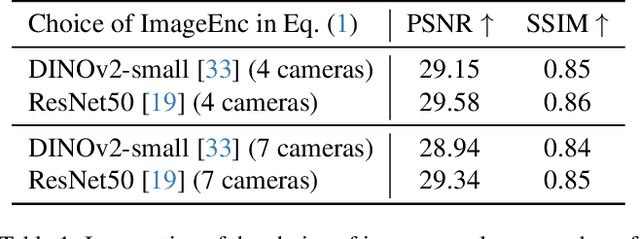
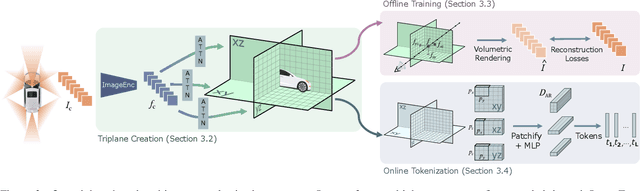
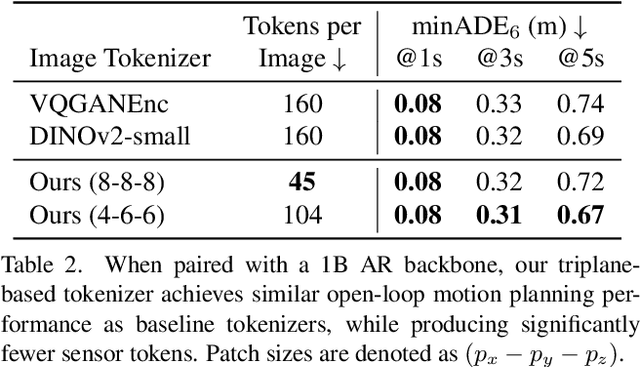
Autoregressive Transformers are increasingly being deployed as end-to-end robot and autonomous vehicle (AV) policy architectures, owing to their scalability and potential to leverage internet-scale pretraining for generalization. Accordingly, tokenizing sensor data efficiently is paramount to ensuring the real-time feasibility of such architectures on embedded hardware. To this end, we present an efficient triplane-based multi-camera tokenization strategy that leverages recent advances in 3D neural reconstruction and rendering to produce sensor tokens that are agnostic to the number of input cameras and their resolution, while explicitly accounting for their geometry around an AV. Experiments on a large-scale AV dataset and state-of-the-art neural simulator demonstrate that our approach yields significant savings over current image patch-based tokenization strategies, producing up to 72% fewer tokens, resulting in up to 50% faster policy inference while achieving the same open-loop motion planning accuracy and improved offroad rates in closed-loop driving simulations.

Foundation Models in Autonomous Driving: A Survey on Scenario Generation and Scenario Analysis
Jun 13, 2025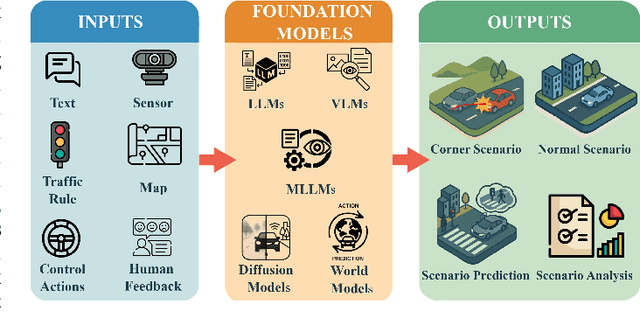
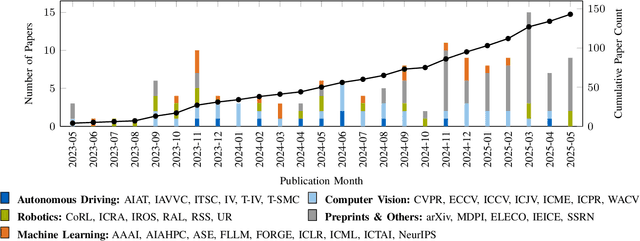
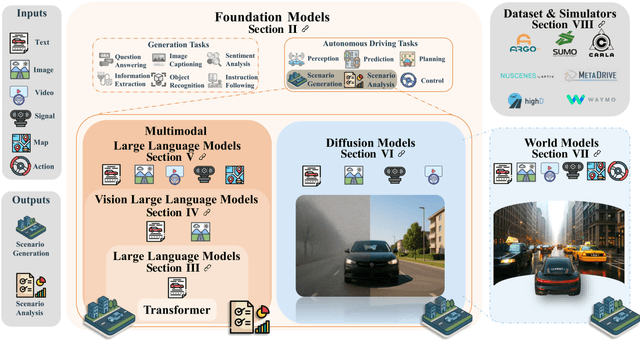
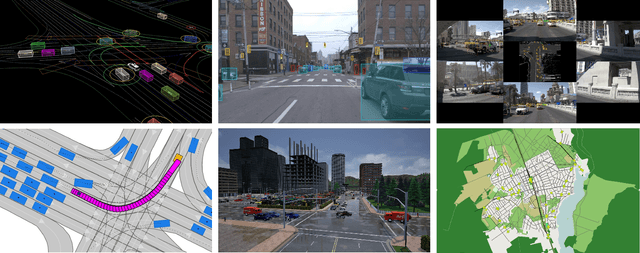
For autonomous vehicles, safe navigation in complex environments depends on handling a broad range of diverse and rare driving scenarios. Simulation- and scenario-based testing have emerged as key approaches to development and validation of autonomous driving systems. Traditional scenario generation relies on rule-based systems, knowledge-driven models, and data-driven synthesis, often producing limited diversity and unrealistic safety-critical cases. With the emergence of foundation models, which represent a new generation of pre-trained, general-purpose AI models, developers can process heterogeneous inputs (e.g., natural language, sensor data, HD maps, and control actions), enabling the synthesis and interpretation of complex driving scenarios. In this paper, we conduct a survey about the application of foundation models for scenario generation and scenario analysis in autonomous driving (as of May 2025). Our survey presents a unified taxonomy that includes large language models, vision-language models, multimodal large language models, diffusion models, and world models for the generation and analysis of autonomous driving scenarios. In addition, we review the methodologies, open-source datasets, simulation platforms, and benchmark challenges, and we examine the evaluation metrics tailored explicitly to scenario generation and analysis. Finally, the survey concludes by highlighting the open challenges and research questions, and outlining promising future research directions. All reviewed papers are listed in a continuously maintained repository, which contains supplementary materials and is available at https://github.com/TUM-AVS/FM-for-Scenario-Generation-Analysis.
SkillBlender: Towards Versatile Humanoid Whole-Body Loco-Manipulation via Skill Blending
Jun 11, 2025Humanoid robots hold significant potential in accomplishing daily tasks across diverse environments thanks to their flexibility and human-like morphology. Recent works have made significant progress in humanoid whole-body control and loco-manipulation leveraging optimal control or reinforcement learning. However, these methods require tedious task-specific tuning for each task to achieve satisfactory behaviors, limiting their versatility and scalability to diverse tasks in daily scenarios. To that end, we introduce SkillBlender, a novel hierarchical reinforcement learning framework for versatile humanoid loco-manipulation. SkillBlender first pretrains goal-conditioned task-agnostic primitive skills, and then dynamically blends these skills to accomplish complex loco-manipulation tasks with minimal task-specific reward engineering. We also introduce SkillBench, a parallel, cross-embodiment, and diverse simulated benchmark containing three embodiments, four primitive skills, and eight challenging loco-manipulation tasks, accompanied by a set of scientific evaluation metrics balancing accuracy and feasibility. Extensive simulated experiments show that our method significantly outperforms all baselines, while naturally regularizing behaviors to avoid reward hacking, resulting in more accurate and feasible movements for diverse loco-manipulation tasks in our daily scenarios. Our code and benchmark will be open-sourced to the community to facilitate future research. Project page: https://usc-gvl.github.io/SkillBlender-web/.
Reproducibility in the Control of Autonomous Mobility-on-Demand Systems
Jun 09, 2025Autonomous Mobility-on-Demand (AMoD) systems, powered by advances in robotics, control, and Machine Learning (ML), offer a promising paradigm for future urban transportation. AMoD offers fast and personalized travel services by leveraging centralized control of autonomous vehicle fleets to optimize operations and enhance service performance. However, the rapid growth of this field has outpaced the development of standardized practices for evaluating and reporting results, leading to significant challenges in reproducibility. As AMoD control algorithms become increasingly complex and data-driven, a lack of transparency in modeling assumptions, experimental setups, and algorithmic implementation hinders scientific progress and undermines confidence in the results. This paper presents a systematic study of reproducibility in AMoD research. We identify key components across the research pipeline, spanning system modeling, control problems, simulation design, algorithm specification, and evaluation, and analyze common sources of irreproducibility. We survey prevalent practices in the literature, highlight gaps, and propose a structured framework to assess and improve reproducibility. Specifically, concrete guidelines are offered, along with a "reproducibility checklist", to support future work in achieving replicable, comparable, and extensible results. While focused on AMoD, the principles and practices we advocate generalize to a broader class of cyber-physical systems that rely on networked autonomy and data-driven control. This work aims to lay the foundation for a more transparent and reproducible research culture in the design and deployment of intelligent mobility systems.
Pseudo-Simulation for Autonomous Driving
Jun 04, 2025Existing evaluation paradigms for Autonomous Vehicles (AVs) face critical limitations. Real-world evaluation is often challenging due to safety concerns and a lack of reproducibility, whereas closed-loop simulation can face insufficient realism or high computational costs. Open-loop evaluation, while being efficient and data-driven, relies on metrics that generally overlook compounding errors. In this paper, we propose pseudo-simulation, a novel paradigm that addresses these limitations. Pseudo-simulation operates on real datasets, similar to open-loop evaluation, but augments them with synthetic observations generated prior to evaluation using 3D Gaussian Splatting. Our key idea is to approximate potential future states the AV might encounter by generating a diverse set of observations that vary in position, heading, and speed. Our method then assigns a higher importance to synthetic observations that best match the AV's likely behavior using a novel proximity-based weighting scheme. This enables evaluating error recovery and the mitigation of causal confusion, as in closed-loop benchmarks, without requiring sequential interactive simulation. We show that pseudo-simulation is better correlated with closed-loop simulations (R^2=0.8) than the best existing open-loop approach (R^2=0.7). We also establish a public leaderboard for the community to benchmark new methodologies with pseudo-simulation. Our code is available at https://github.com/autonomousvision/navsim.
RealDrive: Retrieval-Augmented Driving with Diffusion Models
May 30, 2025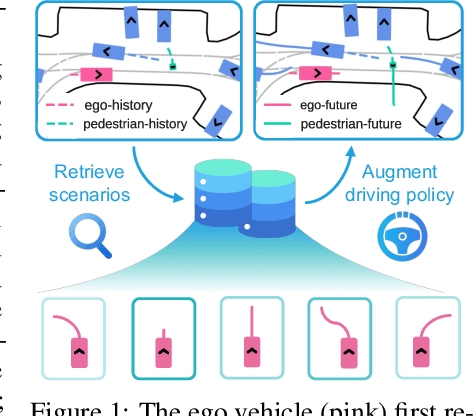
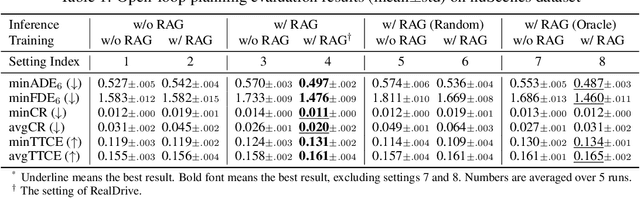
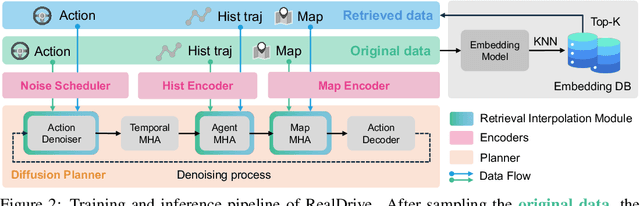
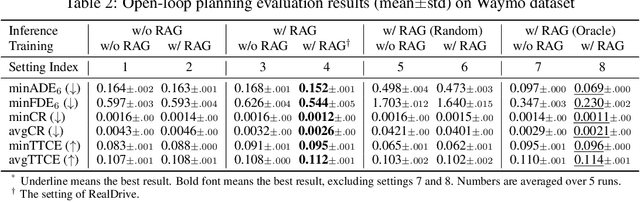
Learning-based planners generate natural human-like driving behaviors by learning to reason about nuanced interactions from data, overcoming the rigid behaviors that arise from rule-based planners. Nonetheless, data-driven approaches often struggle with rare, safety-critical scenarios and offer limited controllability over the generated trajectories. To address these challenges, we propose RealDrive, a Retrieval-Augmented Generation (RAG) framework that initializes a diffusion-based planning policy by retrieving the most relevant expert demonstrations from the training dataset. By interpolating between current observations and retrieved examples through a denoising process, our approach enables fine-grained control and safe behavior across diverse scenarios, leveraging the strong prior provided by the retrieved scenario. Another key insight we produce is that a task-relevant retrieval model trained with planning-based objectives results in superior planning performance in our framework compared to a task-agnostic retriever. Experimental results demonstrate improved generalization to long-tail events and enhanced trajectory diversity compared to standard learning-based planners -- we observe a 40% reduction in collision rate on the Waymo Open Motion dataset with RAG.
Scan, Materialize, Simulate: A Generalizable Framework for Physically Grounded Robot Planning
May 20, 2025Autonomous robots must reason about the physical consequences of their actions to operate effectively in unstructured, real-world environments. We present Scan, Materialize, Simulate (SMS), a unified framework that combines 3D Gaussian Splatting for accurate scene reconstruction, visual foundation models for semantic segmentation, vision-language models for material property inference, and physics simulation for reliable prediction of action outcomes. By integrating these components, SMS enables generalizable physical reasoning and object-centric planning without the need to re-learn foundational physical dynamics. We empirically validate SMS in a billiards-inspired manipulation task and a challenging quadrotor landing scenario, demonstrating robust performance on both simulated domain transfer and real-world experiments. Our results highlight the potential of bridging differentiable rendering for scene reconstruction, foundation models for semantic understanding, and physics-based simulation to achieve physically grounded robot planning across diverse settings.
Real-Time Out-of-Distribution Failure Prevention via Multi-Modal Reasoning
May 15, 2025Foundation models can provide robust high-level reasoning on appropriate safety interventions in hazardous scenarios beyond a robot's training data, i.e. out-of-distribution (OOD) failures. However, due to the high inference latency of Large Vision and Language Models, current methods rely on manually defined intervention policies to enact fallbacks, thereby lacking the ability to plan generalizable, semantically safe motions. To overcome these challenges we present FORTRESS, a framework that generates and reasons about semantically safe fallback strategies in real time to prevent OOD failures. At a low frequency in nominal operations, FORTRESS uses multi-modal reasoners to identify goals and anticipate failure modes. When a runtime monitor triggers a fallback response, FORTRESS rapidly synthesizes plans to fallback goals while inferring and avoiding semantically unsafe regions in real time. By bridging open-world, multi-modal reasoning with dynamics-aware planning, we eliminate the need for hard-coded fallbacks and human safety interventions. FORTRESS outperforms on-the-fly prompting of slow reasoning models in safety classification accuracy on synthetic benchmarks and real-world ANYmal robot data, and further improves system safety and planning success in simulation and on quadrotor hardware for urban navigation.
Deployable and Generalizable Motion Prediction: Taxonomy, Open Challenges and Future Directions
May 14, 2025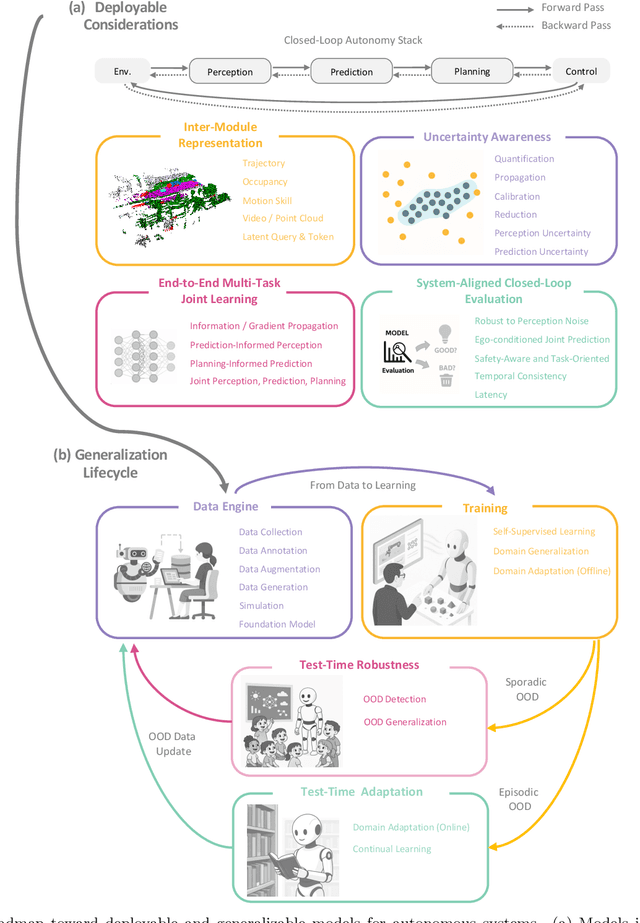
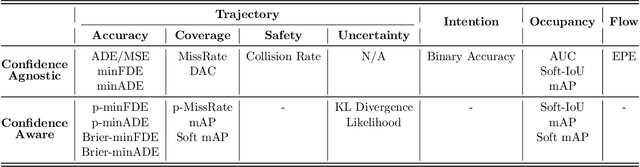
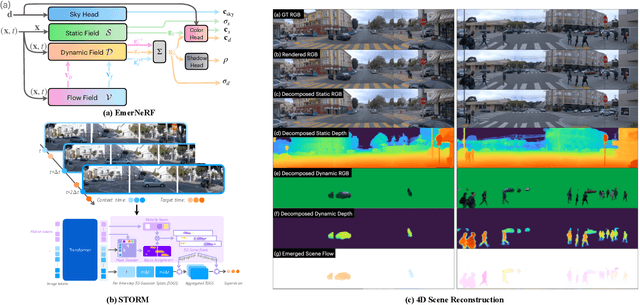
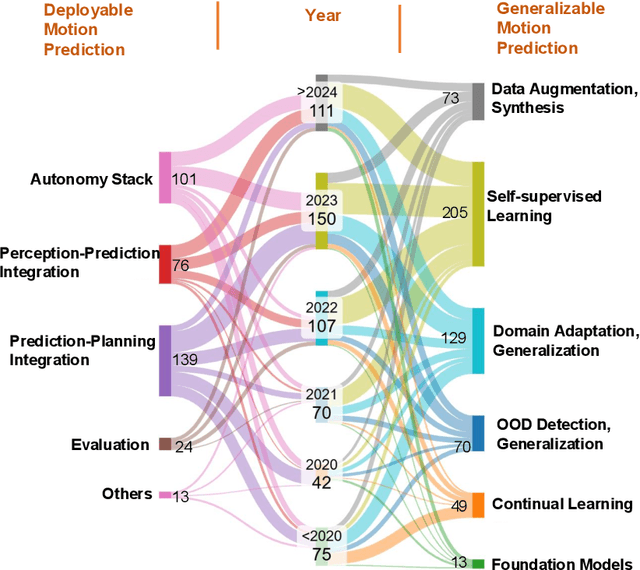
Motion prediction, the anticipation of future agent states or scene evolution, is rooted in human cognition, bridging perception and decision-making. It enables intelligent systems, such as robots and self-driving cars, to act safely in dynamic, human-involved environments, and informs broader time-series reasoning challenges. With advances in methods, representations, and datasets, the field has seen rapid progress, reflected in quickly evolving benchmark results. Yet, when state-of-the-art methods are deployed in the real world, they often struggle to generalize to open-world conditions and fall short of deployment standards. This reveals a gap between research benchmarks, which are often idealized or ill-posed, and real-world complexity. To address this gap, this survey revisits the generalization and deployability of motion prediction models, with an emphasis on the applications of robotics, autonomous driving, and human motion. We first offer a comprehensive taxonomy of motion prediction methods, covering representations, modeling strategies, application domains, and evaluation protocols. We then study two key challenges: (1) how to push motion prediction models to be deployable to realistic deployment standards, where motion prediction does not act in a vacuum, but functions as one module of closed-loop autonomy stacks - it takes input from the localization and perception, and informs downstream planning and control. 2) how to generalize motion prediction models from limited seen scenarios/datasets to the open-world settings. Throughout the paper, we highlight critical open challenges to guide future work, aiming to recalibrate the community's efforts, fostering progress that is not only measurable but also meaningful for real-world applications.
Generative AI for Autonomous Driving: Frontiers and Opportunities
May 13, 2025Generative Artificial Intelligence (GenAI) constitutes a transformative technological wave that reconfigures industries through its unparalleled capabilities for content creation, reasoning, planning, and multimodal understanding. This revolutionary force offers the most promising path yet toward solving one of engineering's grandest challenges: achieving reliable, fully autonomous driving, particularly the pursuit of Level 5 autonomy. This survey delivers a comprehensive and critical synthesis of the emerging role of GenAI across the autonomous driving stack. We begin by distilling the principles and trade-offs of modern generative modeling, encompassing VAEs, GANs, Diffusion Models, and Large Language Models (LLMs). We then map their frontier applications in image, LiDAR, trajectory, occupancy, video generation as well as LLM-guided reasoning and decision making. We categorize practical applications, such as synthetic data workflows, end-to-end driving strategies, high-fidelity digital twin systems, smart transportation networks, and cross-domain transfer to embodied AI. We identify key obstacles and possibilities such as comprehensive generalization across rare cases, evaluation and safety checks, budget-limited implementation, regulatory compliance, ethical concerns, and environmental effects, while proposing research plans across theoretical assurances, trust metrics, transport integration, and socio-technical influence. By unifying these threads, the survey provides a forward-looking reference for researchers, engineers, and policymakers navigating the convergence of generative AI and advanced autonomous mobility. An actively maintained repository of cited works is available at https://github.com/taco-group/GenAI4AD.