 Add to Chrome
 Add to Firefox
 Add to Edge
Fine-grained Controllable Video Generation via Object Appearance and Context
Dec 05, 2023
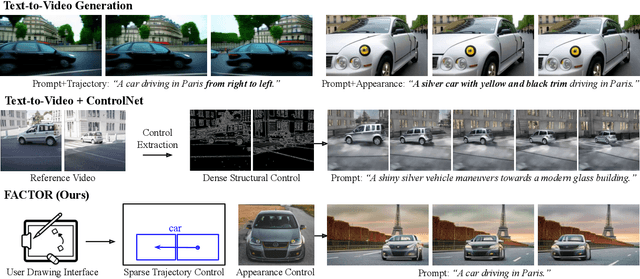
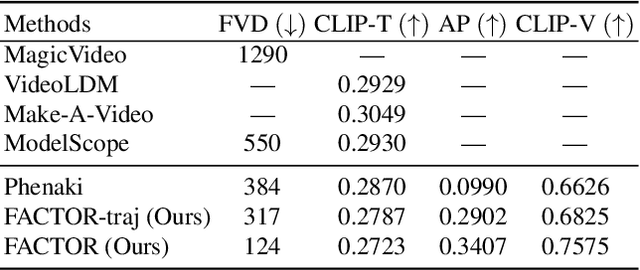
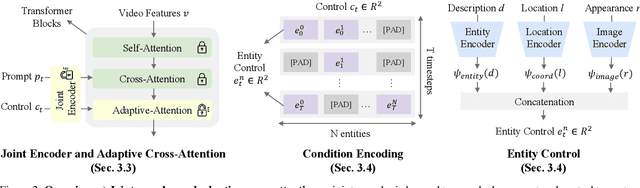
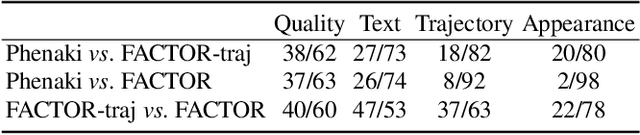
Text-to-video generation has shown promising results. However, by taking only natural languages as input, users often face difficulties in providing detailed information to precisely control the model's output. In this work, we propose fine-grained controllable video generation (FACTOR) to achieve detailed control. Specifically, FACTOR aims to control objects' appearances and context, including their location and category, in conjunction with the text prompt. To achieve detailed control, we propose a unified framework to jointly inject control signals into the existing text-to-video model. Our model consists of a joint encoder and adaptive cross-attention layers. By optimizing the encoder and the inserted layer, we adapt the model to generate videos that are aligned with both text prompts and fine-grained control. Compared to existing methods relying on dense control signals such as edge maps, we provide a more intuitive and user-friendly interface to allow object-level fine-grained control. Our method achieves controllability of object appearances without finetuning, which reduces the per-subject optimization efforts for the users. Extensive experiments on standard benchmark datasets and user-provided inputs validate that our model obtains a 70% improvement in controllability metrics over competitive baselines.

Text-Driven Image Editing via Learnable Regions
Nov 28, 2023Language has emerged as a natural interface for image editing. In this paper, we introduce a method for region-based image editing driven by textual prompts, without the need for user-provided masks or sketches. Specifically, our approach leverages an existing pretrained text-to-image model and introduces a bounding box generator to find the edit regions that are aligned with the textual prompts. We show that this simple approach enables flexible editing that is compatible with current image generation models, and is able to handle complex prompts featuring multiple objects, complex sentences or long paragraphs. We conduct an extensive user study to compare our method against state-of-the-art methods. Experiments demonstrate the competitive performance of our method in manipulating images with high fidelity and realism that align with the language descriptions provided. Our project webpage: https://yuanze-lin.me/LearnableRegions_page.
Language Model Beats Diffusion -- Tokenizer is Key to Visual Generation
Oct 09, 2023While Large Language Models (LLMs) are the dominant models for generative tasks in language, they do not perform as well as diffusion models on image and video generation. To effectively use LLMs for visual generation, one crucial component is the visual tokenizer that maps pixel-space inputs to discrete tokens appropriate for LLM learning. In this paper, we introduce MAGVIT-v2, a video tokenizer designed to generate concise and expressive tokens for both videos and images using a common token vocabulary. Equipped with this new tokenizer, we show that LLMs outperform diffusion models on standard image and video generation benchmarks including ImageNet and Kinetics. In addition, we demonstrate that our tokenizer surpasses the previously top-performing video tokenizer on two more tasks: (1) video compression comparable to the next-generation video codec (VCC) according to human evaluations, and (2) learning effective representations for action recognition tasks.
VideoGLUE: Video General Understanding Evaluation of Foundation Models
Jul 06, 2023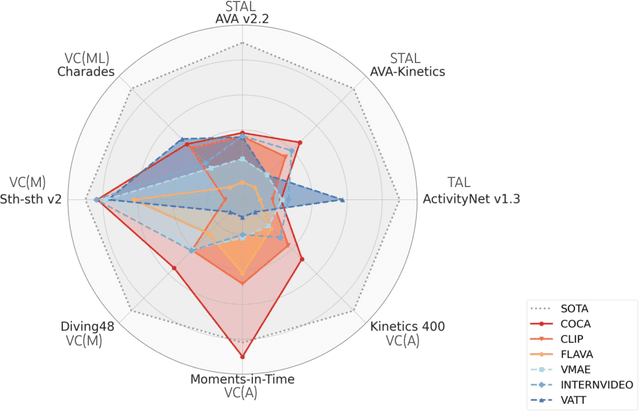


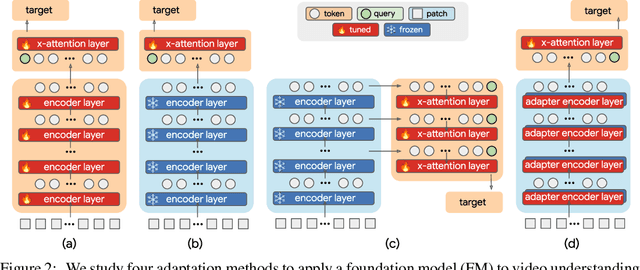
We evaluate existing foundation models video understanding capabilities using a carefully designed experiment protocol consisting of three hallmark tasks (action recognition, temporal localization, and spatiotemporal localization), eight datasets well received by the community, and four adaptation methods tailoring a foundation model (FM) for a downstream task. Moreover, we propose a scalar VideoGLUE score (VGS) to measure an FMs efficacy and efficiency when adapting to general video understanding tasks. Our main findings are as follows. First, task-specialized models significantly outperform the six FMs studied in this work, in sharp contrast to what FMs have achieved in natural language and image understanding. Second,video-native FMs, whose pretraining data contains the video modality, are generally better than image-native FMs in classifying motion-rich videos, localizing actions in time, and understanding a video of more than one action. Third, the video-native FMs can perform well on video tasks under light adaptations to downstream tasks(e.g., freezing the FM backbones), while image-native FMs win in full end-to-end finetuning. The first two observations reveal the need and tremendous opportunities to conduct research on video-focused FMs, and the last confirms that both tasks and adaptation methods matter when it comes to the evaluation of FMs.
SPAE: Semantic Pyramid AutoEncoder for Multimodal Generation with Frozen LLMs
Jul 03, 2023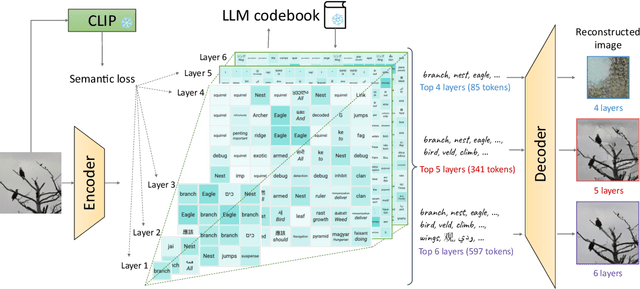

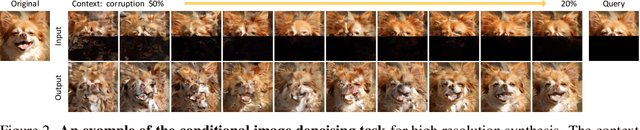
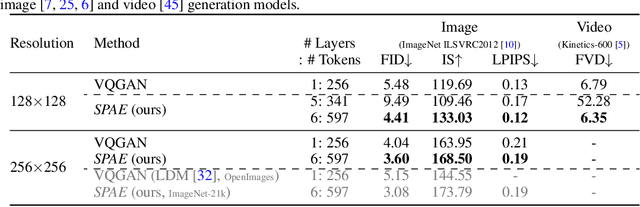
In this work, we introduce Semantic Pyramid AutoEncoder (SPAE) for enabling frozen LLMs to perform both understanding and generation tasks involving non-linguistic modalities such as images or videos. SPAE converts between raw pixels and interpretable lexical tokens (or words) extracted from the LLM's vocabulary. The resulting tokens capture both the semantic meaning and the fine-grained details needed for visual reconstruction, effectively translating the visual content into a language comprehensible to the LLM, and empowering it to perform a wide array of multimodal tasks. Our approach is validated through in-context learning experiments with frozen PaLM 2 and GPT 3.5 on a diverse set of image understanding and generation tasks. Our method marks the first successful attempt to enable a frozen LLM to generate image content while surpassing state-of-the-art performance in image understanding tasks, under the same setting, by over 25%.
StyleDrop: Text-to-Image Generation in Any Style
Jun 01, 2023


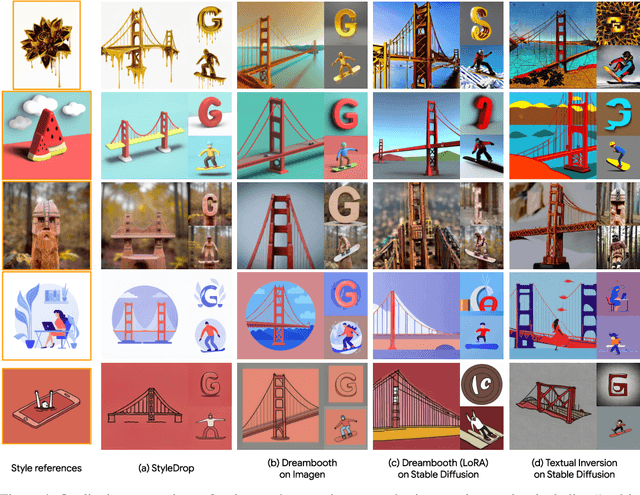
Pre-trained large text-to-image models synthesize impressive images with an appropriate use of text prompts. However, ambiguities inherent in natural language and out-of-distribution effects make it hard to synthesize image styles, that leverage a specific design pattern, texture or material. In this paper, we introduce StyleDrop, a method that enables the synthesis of images that faithfully follow a specific style using a text-to-image model. The proposed method is extremely versatile and captures nuances and details of a user-provided style, such as color schemes, shading, design patterns, and local and global effects. It efficiently learns a new style by fine-tuning very few trainable parameters (less than $1\%$ of total model parameters) and improving the quality via iterative training with either human or automated feedback. Better yet, StyleDrop is able to deliver impressive results even when the user supplies only a single image that specifies the desired style. An extensive study shows that, for the task of style tuning text-to-image models, StyleDrop implemented on Muse convincingly outperforms other methods, including DreamBooth and textual inversion on Imagen or Stable Diffusion. More results are available at our project website: https://styledrop.github.io
Learning Disentangled Prompts for Compositional Image Synthesis
Jun 01, 2023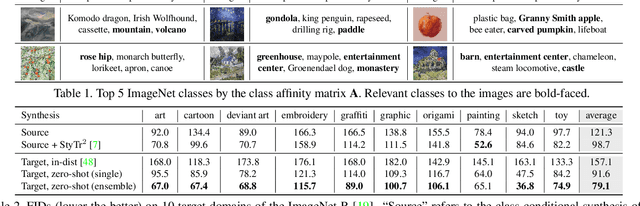



We study domain-adaptive image synthesis, the problem of teaching pretrained image generative models a new style or concept from as few as one image to synthesize novel images, to better understand the compositional image synthesis. We present a framework that leverages a pretrained class-conditional generation model and visual prompt tuning. Specifically, we propose a novel source class distilled visual prompt that learns disentangled prompts of semantic (e.g., class) and domain (e.g., style) from a few images. Learned domain prompt is then used to synthesize images of any classes in the style of target domain. We conduct studies on various target domains with the number of images ranging from one to a few to many, and show qualitative results which show the compositional generalization of our method. Moreover, we show that our method can help improve zero-shot domain adaptation classification accuracy.
Auditing Gender Presentation Differences in Text-to-Image Models
Feb 08, 2023Text-to-image models, which can generate high-quality images based on textual input, have recently enabled various content-creation tools. Despite significantly affecting a wide range of downstream applications, the distributions of these generated images are still not fully understood, especially when it comes to the potential stereotypical attributes of different genders. In this work, we propose a paradigm (Gender Presentation Differences) that utilizes fine-grained self-presentation attributes to study how gender is presented differently in text-to-image models. By probing gender indicators in the input text (e.g., "a woman" or "a man"), we quantify the frequency differences of presentation-centric attributes (e.g., "a shirt" and "a dress") through human annotation and introduce a novel metric: GEP. Furthermore, we propose an automatic method to estimate such differences. The automatic GEP metric based on our approach yields a higher correlation with human annotations than that based on existing CLIP scores, consistently across three state-of-the-art text-to-image models. Finally, we demonstrate the generalization ability of our metrics in the context of gender stereotypes related to occupations.
Muse: Text-To-Image Generation via Masked Generative Transformers
Jan 02, 2023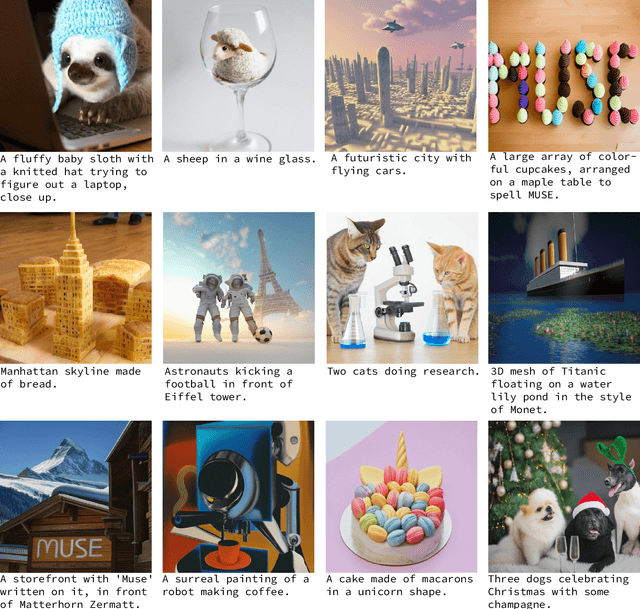
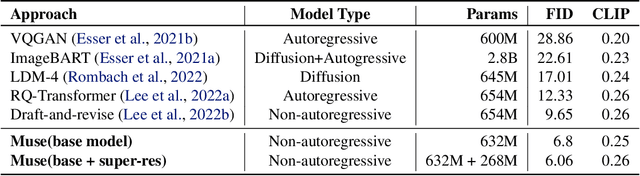
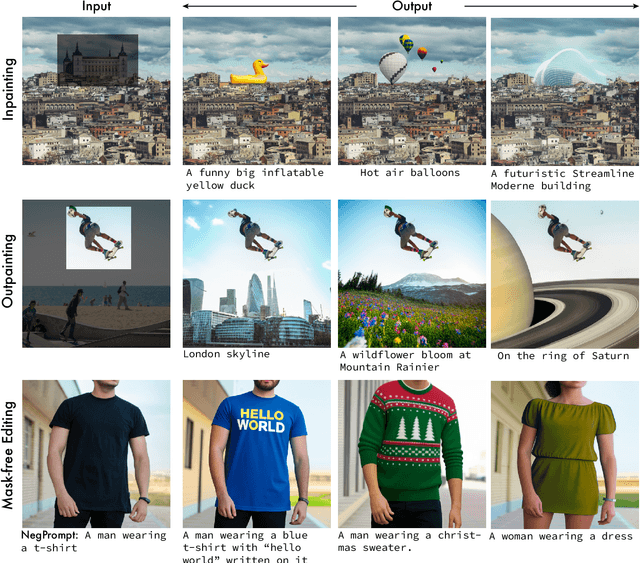
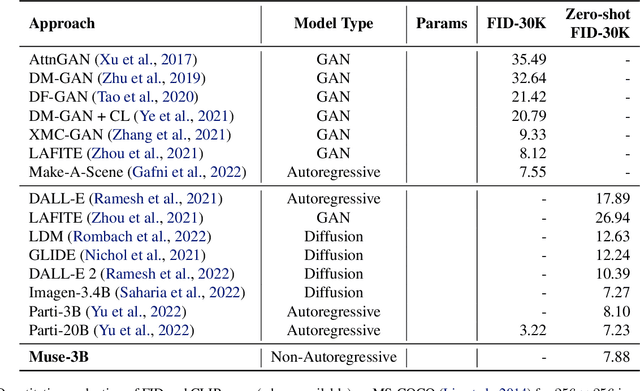
We present Muse, a text-to-image Transformer model that achieves state-of-the-art image generation performance while being significantly more efficient than diffusion or autoregressive models. Muse is trained on a masked modeling task in discrete token space: given the text embedding extracted from a pre-trained large language model (LLM), Muse is trained to predict randomly masked image tokens. Compared to pixel-space diffusion models, such as Imagen and DALL-E 2, Muse is significantly more efficient due to the use of discrete tokens and requiring fewer sampling iterations; compared to autoregressive models, such as Parti, Muse is more efficient due to the use of parallel decoding. The use of a pre-trained LLM enables fine-grained language understanding, translating to high-fidelity image generation and the understanding of visual concepts such as objects, their spatial relationships, pose, cardinality etc. Our 900M parameter model achieves a new SOTA on CC3M, with an FID score of 6.06. The Muse 3B parameter model achieves an FID of 7.88 on zero-shot COCO evaluation, along with a CLIP score of 0.32. Muse also directly enables a number of image editing applications without the need to fine-tune or invert the model: inpainting, outpainting, and mask-free editing. More results are available at https://muse-model.github.io
Multi-View MOOC Quality Evaluation via Information-Aware Graph Representation Learning
Jan 01, 2023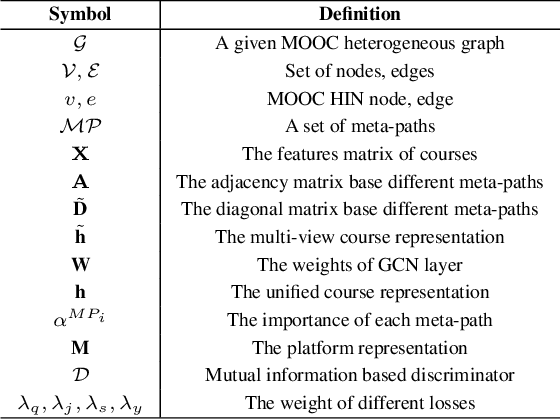
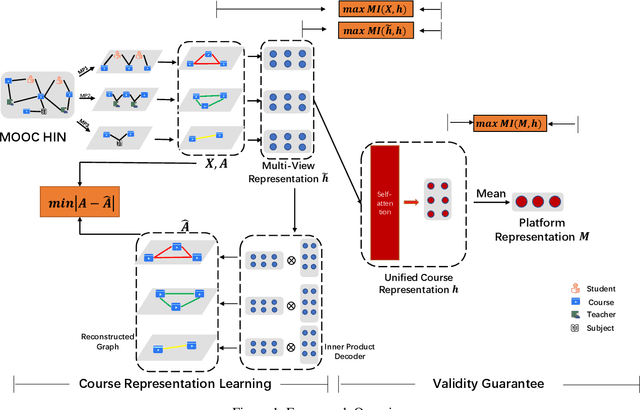
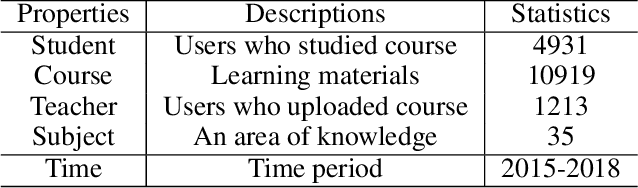
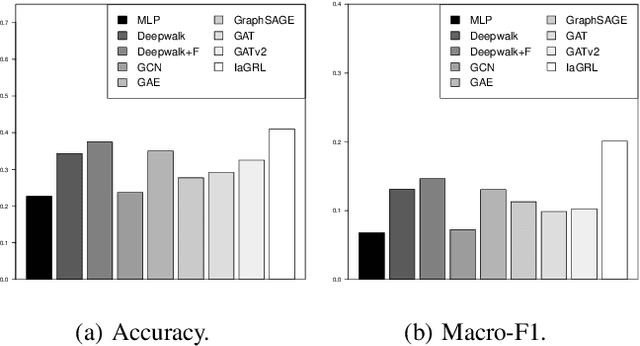
In this paper, we study the problem of MOOC quality evaluation which is essential for improving the course materials, promoting students' learning efficiency, and benefiting user services. While achieving promising performances, current works still suffer from the complicated interactions and relationships of entities in MOOC platforms. To tackle the challenges, we formulate the problem as a course representation learning task-based and develop an Information-aware Graph Representation Learning(IaGRL) for multi-view MOOC quality evaluation. Specifically, We first build a MOOC Heterogeneous Network (HIN) to represent the interactions and relationships among entities in MOOC platforms. And then we decompose the MOOC HIN into multiple single-relation graphs based on meta-paths to depict the multi-view semantics of courses. The course representation learning can be further converted to a multi-view graph representation task. Different from traditional graph representation learning, the learned course representations are expected to match the following three types of validity: (1) the agreement on expressiveness between the raw course portfolio and the learned course representations; (2) the consistency between the representations in each view and the unified representations; (3) the alignment between the course and MOOC platform representations. Therefore, we propose to exploit mutual information for preserving the validity of course representations. We conduct extensive experiments over real-world MOOC datasets to demonstrate the effectiveness of our proposed method.