 Add to Chrome
 Add to Firefox
 Add to Edge
RayPE: Ray-Space Positional Encoding for 3D-Aware Video Generation
Jun 25, 2026
Modern video diffusion transformers position their tokens through RoPE on the (u,v,t) axes -- a description of the camera's sampling grid that says nothing about the 3D structure of the scene. We observe that the geometric relation between two camera rays is captured by the Plucker reciprocal product, which is bilinear in the two rays -- the same algebraic form as the dot product in Transformer attention. Building on this analogy, we propose RayPE, a positional-encoding extension that injects per-token 6D Plucker coordinates additively into the queries and keys of self-attention, with a query/key flip arrangement under which the symmetric identity configuration coincides exactly with the reciprocal product. The injection is additive, the resulting attention score decomposes into a content term, a geometry term, and two content and geometry cross-terms -- all of which our experiments find individually necessary. To make the encoding stable across video data with heterogeneous camera-translation scales (SfM, deep SLAM, metric), we further decouple ray direction from moment magnitude, gate the encoding by a learned function of the log-magnitude, and apply RMSNorm to align it with the QKNorm-normalized content branch. The full module adds less than 0.1% parameters to a pretrained video DiT, is zero-initialized to start from the pretrained weights, and improves camera controllability, cross-frame 3D consistency, and overall video quality on a four-dataset training mixture.

From Passive Reuse to Active Reasoning: Grounding Large Language Models for Neuro-Symbolic Experience Replay
May 10, 2026While experience replay is essential for data efficiency in reinforcement learning (RL), standard methods treat the replay buffer as a passive memory system, prioritizing samples based on numerical prediction errors rather than their semantic significance. This approach stands in contrast to human learning, which accelerates mastery by actively abstracting fragmented experiences into behavioral rules. To bridge this gap, we propose Neuro-Symbolic Experience Replay (NSER), a framework that transforms experience replay from a passive sample reuse mechanism into an active engine for knowledge construction. Specifically, NSER addresses the incompatibility between linguistic reasoning and numerical optimization through a novel neuro-symbolic grounding pipeline. It leverages Large Language Models (LLMs) in a zero-shot manner to induce candidate behavioral rules from accumulated trajectories, grounds these insights into differentiable first-order logic representations, and utilizes the resulting symbolic structures to dynamically reweight the replay distribution. By allowing abstract knowledge to directly shape policy optimization, NSER achieves consistent superior sample efficiency and convergence speed across reactive, rule-based, and procedural benchmarks.
Sculpt4D: Generating 4D Shapes via Sparse-Attention Diffusion Transformers
Apr 23, 2026Recent breakthroughs in 3D generative modeling have yielded remarkable progress in static shape synthesis, yet high-fidelity dynamic 4D generation remains elusive, hindered by temporal artifacts and prohibitive computational demand. We present Sculpt4D, a native 4D generative framework that seamlessly integrates efficient temporal modeling into a pretrained 3D Diffusion Transformer (Hunyuan3D 2.1), thereby mitigating the scarcity of 4D training data. At its core lies a Block Sparse Attention mechanism that preserves object identity by anchoring to the initial frame while capturing rich motion dynamics via a time-decaying sparse mask. This design faithfully models complex spatiotemporal dependencies with high fidelity, while sidestepping the quadratic overhead of full attention and reducing network total computation by 56%. Consequently, Sculpt4D establishes a new state-of-the-art in temporally coherent 4D synthesis and charts a path toward efficient and scalable 4D generation.
VerseCrafter: Dynamic Realistic Video World Model with 4D Geometric Control
Jan 08, 2026Video world models aim to simulate dynamic, real-world environments, yet existing methods struggle to provide unified and precise control over camera and multi-object motion, as videos inherently operate dynamics in the projected 2D image plane. To bridge this gap, we introduce VerseCrafter, a 4D-aware video world model that enables explicit and coherent control over both camera and object dynamics within a unified 4D geometric world state. Our approach is centered on a novel 4D Geometric Control representation, which encodes the world state through a static background point cloud and per-object 3D Gaussian trajectories. This representation captures not only an object's path but also its probabilistic 3D occupancy over time, offering a flexible, category-agnostic alternative to rigid bounding boxes or parametric models. These 4D controls are rendered into conditioning signals for a pretrained video diffusion model, enabling the generation of high-fidelity, view-consistent videos that precisely adhere to the specified dynamics. Unfortunately, another major challenge lies in the scarcity of large-scale training data with explicit 4D annotations. We address this by developing an automatic data engine that extracts the required 4D controls from in-the-wild videos, allowing us to train our model on a massive and diverse dataset.
Watch Closely: Mitigating Object Hallucinations in Large Vision-Language Models with Disentangled Decoding
Dec 22, 2025Large Vision-Language Models (LVLMs) bridge the gap between visual and linguistic modalities, demonstrating strong potential across a variety of domains. However, despite significant progress, LVLMs still suffer from severe hallucination issues in object recognition tasks. These models often fail to accurately identify certain objects, leading to text generation that appears fluent but does not correspond to the visual content, which can have serious consequences in real-world applications. Recently, several methods have been proposed to alleviate LVLM hallucinations, but most focus solely on reducing hallucinations in the language modality. To mitigate hallucinations in both the language and visual modalities, we introduce Hallucination Disentangled Decoding (HDD) method that requires no training. HDD enhances the original image by segmenting it and selecting images that augment the original, while also utilizing a blank image to eliminate language prior hallucinations in both the original and segmented images. This design not only reduces the model's dependence on language priors but also enhances its visual performance. (Code: https://github.com/rickeyhhh/Hallucination-Disentangled-Decoding)
Data-driven solar forecasting enables near-optimal economic decisions
Sep 08, 2025Solar energy adoption is critical to achieving net-zero emissions. However, it remains difficult for many industrial and commercial actors to decide on whether they should adopt distributed solar-battery systems, which is largely due to the unavailability of fast, low-cost, and high-resolution irradiance forecasts. Here, we present SunCastNet, a lightweight data-driven forecasting system that provides 0.05$^\circ$, 10-minute resolution predictions of surface solar radiation downwards (SSRD) up to 7 days ahead. SunCastNet, coupled with reinforcement learning (RL) for battery scheduling, reduces operational regret by 76--93\% compared to robust decision making (RDM). In 25-year investment backtests, it enables up to five of ten high-emitting industrial sectors per region to cross the commercial viability threshold of 12\% Internal Rate of Return (IRR). These results show that high-resolution, long-horizon solar forecasts can directly translate into measurable economic gains, supporting near-optimal energy operations and accelerating renewable deployment.
Splat4D: Diffusion-Enhanced 4D Gaussian Splatting for Temporally and Spatially Consistent Content Creation
Aug 11, 2025Generating high-quality 4D content from monocular videos for applications such as digital humans and AR/VR poses challenges in ensuring temporal and spatial consistency, preserving intricate details, and incorporating user guidance effectively. To overcome these challenges, we introduce Splat4D, a novel framework enabling high-fidelity 4D content generation from a monocular video. Splat4D achieves superior performance while maintaining faithful spatial-temporal coherence by leveraging multi-view rendering, inconsistency identification, a video diffusion model, and an asymmetric U-Net for refinement. Through extensive evaluations on public benchmarks, Splat4D consistently demonstrates state-of-the-art performance across various metrics, underscoring the efficacy of our approach. Additionally, the versatility of Splat4D is validated in various applications such as text/image conditioned 4D generation, 4D human generation, and text-guided content editing, producing coherent outcomes following user instructions.
Scalable Precise Computation of Shannon Entropy
Feb 03, 2025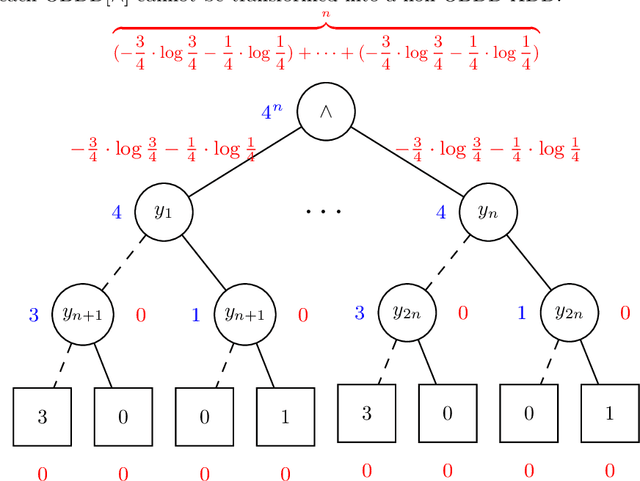
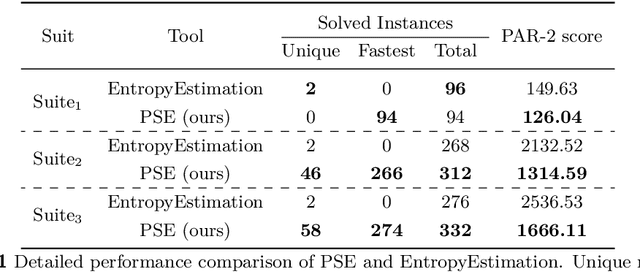
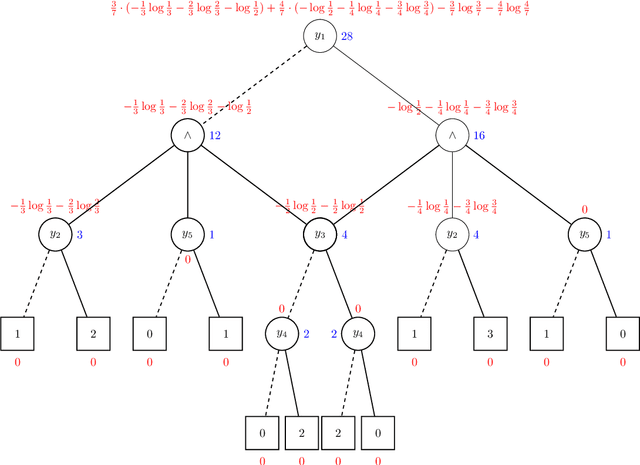
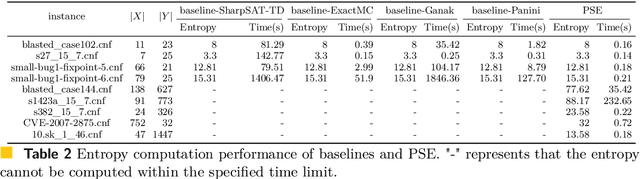
Quantitative information flow analyses (QIF) are a class of techniques for measuring the amount of confidential information leaked by a program to its public outputs. Shannon entropy is an important method to quantify the amount of leakage in QIF. This paper focuses on the programs modeled in Boolean constraints and optimizes the two stages of the Shannon entropy computation to implement a scalable precise tool PSE. In the first stage, we design a knowledge compilation language called \ADDAND that combines Algebraic Decision Diagrams and conjunctive decomposition. \ADDAND avoids enumerating possible outputs of a program and supports tractable entropy computation. In the second stage, we optimize the model counting queries that are used to compute the probabilities of outputs. We compare PSE with the state-of-the-art probably approximately correct tool EntropyEstimation, which was shown to significantly outperform the existing precise tools. The experimental results demonstrate that PSE solved 55 more benchmarks compared to EntropyEstimation in a total of 441. For 98% of the benchmarks that both PSE and EntropyEstimation solved, PSE is at least $10\times$ as efficient as EntropyEstimation.
LatentArtiFusion: An Effective and Efficient Histological Artifacts Restoration Framework
Jul 29, 2024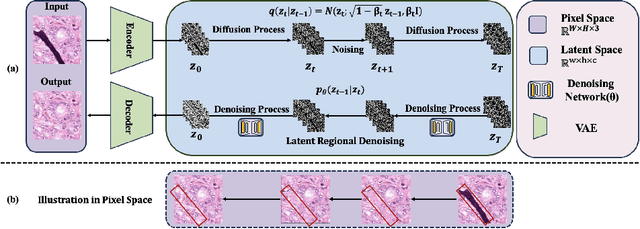
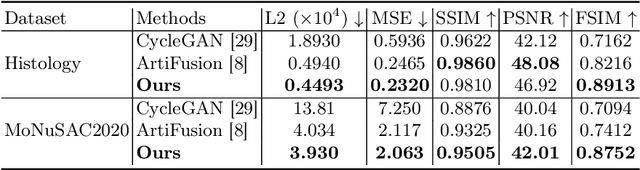
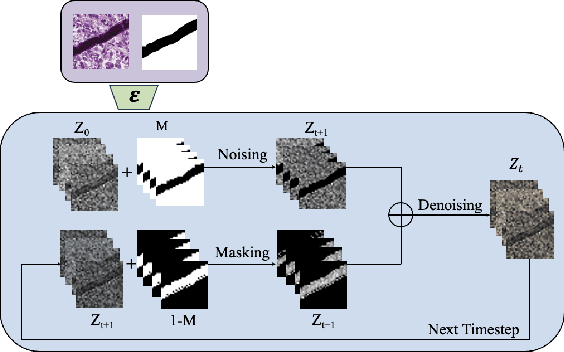

Histological artifacts pose challenges for both pathologists and Computer-Aided Diagnosis (CAD) systems, leading to errors in analysis. Current approaches for histological artifact restoration, based on Generative Adversarial Networks (GANs) and pixel-level Diffusion Models, suffer from performance limitations and computational inefficiencies. In this paper, we propose a novel framework, LatentArtiFusion, which leverages the latent diffusion model (LDM) to reconstruct histological artifacts with high performance and computational efficiency. Unlike traditional pixel-level diffusion frameworks, LatentArtiFusion executes the restoration process in a lower-dimensional latent space, significantly improving computational efficiency. Moreover, we introduce a novel regional artifact reconstruction algorithm in latent space to prevent mistransfer in non-artifact regions, distinguishing our approach from GAN-based methods. Through extensive experiments on real-world histology datasets, LatentArtiFusion demonstrates remarkable speed, outperforming state-of-the-art pixel-level diffusion frameworks by more than 30X. It also consistently surpasses GAN-based methods by at least 5% across multiple evaluation metrics. Furthermore, we evaluate the effectiveness of our proposed framework in downstream tissue classification tasks, showcasing its practical utility. Code is available at https://github.com/bugs-creator/LatentArtiFusion.
PBCounter: Weighted Model Counting on Pseudo-Boolean Formulas
Dec 26, 2023In Weighted Model Counting (WMC), we assign weights to literals and compute the sum of the weights of the models of a given propositional formula where the weight of an assignment is the product of the weights of its literals. The current WMC solvers work on Conjunctive Normal Form (CNF) formulas. However, CNF is not a natural representation for human-being in many applications. Motivated by the stronger expressive power of pseudo-Boolean (PB) formulas than CNF, we propose to perform WMC on PB formulas. Based on a recent dynamic programming algorithm framework called ADDMC for WMC, we implement a weighted PB counting tool PBCounter. We compare PBCounter with the state-of-the-art weighted model counters SharpSAT-TD, ExactMC, D4, and ADDMC, where the latter tools work on CNF with encoding methods that convert PB constraints into a CNF formula. The experiments on three domains of benchmarks show that PBCounter is superior to the model counters on CNF formulas.