 Add to Chrome
 Add to Firefox
 Add to Edge
What Can I Edit? Open-Ended Strategy Discovery and the Emotion Editability Landscape
Jul 27, 2026
Emotional image editing requires more than applying affective filters or modifying predefined visual factors: an effective edit must identify what a particular image can afford for a target emotion. Existing affective image manipulation methods, including recent agentic variants, largely operate within bounded strategy spaces based on predefined factor taxonomies, knowledge libraries, or conventional editing templates, and therefore often miss image-specific, context-grounded strategies. We introduce EmoScope, a multi-agent framework that reframes the task from "how should I edit?" to "what can I edit?" EmoScope first discovers an image-specific editable space through emotion-conditioned affordance reasoning, then uses a semantic hierarchy of anchors, variables, and context to balance content consistency and emotional expressiveness before executing and verifying the edit. Because its plans are expressed as image-specific affordances rather than retrieved templates, EmoScope also exposes the editing strategy as an interactive surface for user refinement at the plan level. In a large-scale human evaluation covering all eight Mikels emotion categories, with 4,693 valid responses across 1,824 pairwise questions, participants preferred EmoScope over two competitive baselines by 88.1% on average. Attribution analysis further shows that EmoScope selects target-emotion-adaptive strategies rather than applying a uniform template. The same affordance-level plan also supports lightweight user refinement in an interactive pilot. Finally, we show that classifier-based metrics exhibit emotion-conditional blind spots toward non-stereotypical, context-grounded edits, and present a relative content-emotion preference-affinity landscape showing that EmoScope's advantage varies systematically across image-emotion combinations.

Cosmos 3: Omnimodal World Models for Physical AI
Jun 01, 2026We introduce Cosmos 3, a family of omnimodal world models designed to jointly process and generate language, image, video, audio, and action sequences within a unified mixture-of-transformers architecture. By supporting highly flexible input-output configurations, Cosmos 3 seamlessly unifies critical modalities for Physical AI -- effectively subsuming vision-language models, video generators, world simulators, and world-action models into a single framework. Our evaluation demonstrates that Cosmos 3 establishes a new state-of-the-art across a diverse suite of understanding and generation tasks, demonstrating omnimodal world models as scalable, general-purpose backbones for embodied agents. Our post-trained Cosmos 3 models were ranked as the best open-source Text-to-Image and Image-to-Video models by Artificial Analysis, and the best policy model by RoboArena at the time the technical report was written. To accelerate open research and deployment in Physical AI, we make our code, model checkpoints, curated synthetic datasets, and evaluation benchmark available under the Linux Foundation's OpenMDW-1.1 https://openmdw.ai/license/1-1/ License at https://github.com/nvidia/cosmos}{github.com/nvidia/cosmos and https://huggingface.co/collections/nvidia/cosmos3 . The project website is available at https://research.nvidia.com/labs/cosmos-lab/cosmos3 .
SAGE: Scalable Agentic 3D Scene Generation for Embodied AI
Feb 10, 2026Real-world data collection for embodied agents remains costly and unsafe, calling for scalable, realistic, and simulator-ready 3D environments. However, existing scene-generation systems often rely on rule-based or task-specific pipelines, yielding artifacts and physically invalid scenes. We present SAGE, an agentic framework that, given a user-specified embodied task (e.g., "pick up a bowl and place it on the table"), understands the intent and automatically generates simulation-ready environments at scale. The agent couples multiple generators for layout and object composition with critics that evaluate semantic plausibility, visual realism, and physical stability. Through iterative reasoning and adaptive tool selection, it self-refines the scenes until meeting user intent and physical validity. The resulting environments are realistic, diverse, and directly deployable in modern simulators for policy training. Policies trained purely on this data exhibit clear scaling trends and generalize to unseen objects and layouts, demonstrating the promise of simulation-driven scaling for embodied AI. Code, demos, and the SAGE-10k dataset can be found on the project page here: https://nvlabs.github.io/sage.
DuoGen: Towards General Purpose Interleaved Multimodal Generation
Feb 03, 2026Interleaved multimodal generation enables capabilities beyond unimodal generation models, such as step-by-step instructional guides, visual planning, and generating visual drafts for reasoning. However, the quality of existing interleaved generation models under general instructions remains limited by insufficient training data and base model capacity. We present DuoGen, a general-purpose interleaved generation framework that systematically addresses data curation, architecture design, and evaluation. On the data side, we build a large-scale, high-quality instruction-tuning dataset by combining multimodal conversations rewritten from curated raw websites, and diverse synthetic examples covering everyday scenarios. Architecturally, DuoGen leverages the strong visual understanding of a pretrained multimodal LLM and the visual generation capabilities of a diffusion transformer (DiT) pretrained on video generation, avoiding costly unimodal pretraining and enabling flexible base model selection. A two-stage decoupled strategy first instruction-tunes the MLLM, then aligns DiT with it using curated interleaved image-text sequences. Across public and newly proposed benchmarks, DuoGen outperforms prior open-source models in text quality, image fidelity, and image-context alignment, and also achieves state-of-the-art performance on text-to-image and image editing among unified generation models. Data and code will be released at https://research.nvidia.com/labs/dir/duogen/.
Bridging Supervised Learning and Reinforcement Learning in Math Reasoning
May 23, 2025Reinforcement Learning (RL) has played a central role in the recent surge of LLMs' math abilities by enabling self-improvement through binary verifier signals. In contrast, Supervised Learning (SL) is rarely considered for such verification-driven training, largely due to its heavy reliance on reference answers and inability to reflect on mistakes. In this work, we challenge the prevailing notion that self-improvement is exclusive to RL and propose Negative-aware Fine-Tuning (NFT) -- a supervised approach that enables LLMs to reflect on their failures and improve autonomously with no external teachers. In online training, instead of throwing away self-generated negative answers, NFT constructs an implicit negative policy to model them. This implicit policy is parameterized with the same positive LLM we target to optimize on positive data, enabling direct policy optimization on all LLMs' generations. We conduct experiments on 7B and 32B models in math reasoning tasks. Results consistently show that through the additional leverage of negative feedback, NFT significantly improves over SL baselines like Rejection sampling Fine-Tuning, matching or even surpassing leading RL algorithms like GRPO and DAPO. Furthermore, we demonstrate that NFT and GRPO are actually equivalent in strict-on-policy training, even though they originate from entirely different theoretical foundations. Our experiments and theoretical findings bridge the gap between SL and RL methods in binary-feedback learning systems.
Describe Anything: Detailed Localized Image and Video Captioning
Apr 22, 2025Generating detailed and accurate descriptions for specific regions in images and videos remains a fundamental challenge for vision-language models. We introduce the Describe Anything Model (DAM), a model designed for detailed localized captioning (DLC). DAM preserves both local details and global context through two key innovations: a focal prompt, which ensures high-resolution encoding of targeted regions, and a localized vision backbone, which integrates precise localization with its broader context. To tackle the scarcity of high-quality DLC data, we propose a Semi-supervised learning (SSL)-based Data Pipeline (DLC-SDP). DLC-SDP starts with existing segmentation datasets and expands to unlabeled web images using SSL. We introduce DLC-Bench, a benchmark designed to evaluate DLC without relying on reference captions. DAM sets new state-of-the-art on 7 benchmarks spanning keyword-level, phrase-level, and detailed multi-sentence localized image and video captioning.
Cosmos-Reason1: From Physical Common Sense To Embodied Reasoning
Mar 18, 2025Physical AI systems need to perceive, understand, and perform complex actions in the physical world. In this paper, we present the Cosmos-Reason1 models that can understand the physical world and generate appropriate embodied decisions (e.g., next step action) in natural language through long chain-of-thought reasoning processes. We begin by defining key capabilities for Physical AI reasoning, with a focus on physical common sense and embodied reasoning. To represent physical common sense, we use a hierarchical ontology that captures fundamental knowledge about space, time, and physics. For embodied reasoning, we rely on a two-dimensional ontology that generalizes across different physical embodiments. Building on these capabilities, we develop two multimodal large language models, Cosmos-Reason1-8B and Cosmos-Reason1-56B. We curate data and train our models in four stages: vision pre-training, general supervised fine-tuning (SFT), Physical AI SFT, and Physical AI reinforcement learning (RL) as the post-training. To evaluate our models, we build comprehensive benchmarks for physical common sense and embodied reasoning according to our ontologies. Evaluation results show that Physical AI SFT and reinforcement learning bring significant improvements. To facilitate the development of Physical AI, we will make our code and pre-trained models available under the NVIDIA Open Model License at https://github.com/nvidia-cosmos/cosmos-reason1.
Cosmos World Foundation Model Platform for Physical AI
Jan 07, 2025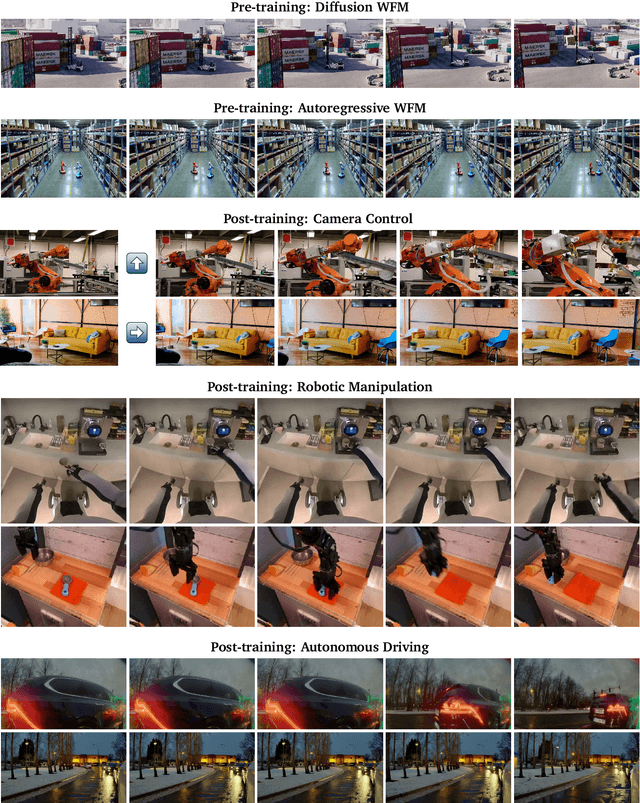
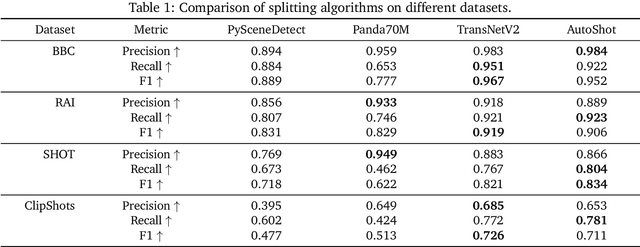
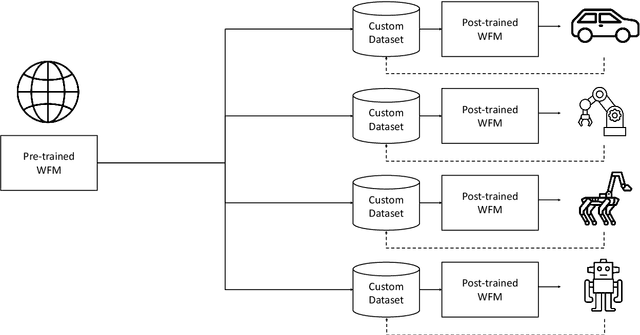

Physical AI needs to be trained digitally first. It needs a digital twin of itself, the policy model, and a digital twin of the world, the world model. In this paper, we present the Cosmos World Foundation Model Platform to help developers build customized world models for their Physical AI setups. We position a world foundation model as a general-purpose world model that can be fine-tuned into customized world models for downstream applications. Our platform covers a video curation pipeline, pre-trained world foundation models, examples of post-training of pre-trained world foundation models, and video tokenizers. To help Physical AI builders solve the most critical problems of our society, we make our platform open-source and our models open-weight with permissive licenses available via https://github.com/NVIDIA/Cosmos.
Edify Image: High-Quality Image Generation with Pixel Space Laplacian Diffusion Models
Nov 11, 2024We introduce Edify Image, a family of diffusion models capable of generating photorealistic image content with pixel-perfect accuracy. Edify Image utilizes cascaded pixel-space diffusion models trained using a novel Laplacian diffusion process, in which image signals at different frequency bands are attenuated at varying rates. Edify Image supports a wide range of applications, including text-to-image synthesis, 4K upsampling, ControlNets, 360 HDR panorama generation, and finetuning for image customization.
Edify 3D: Scalable High-Quality 3D Asset Generation
Nov 11, 2024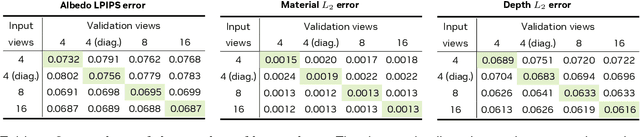
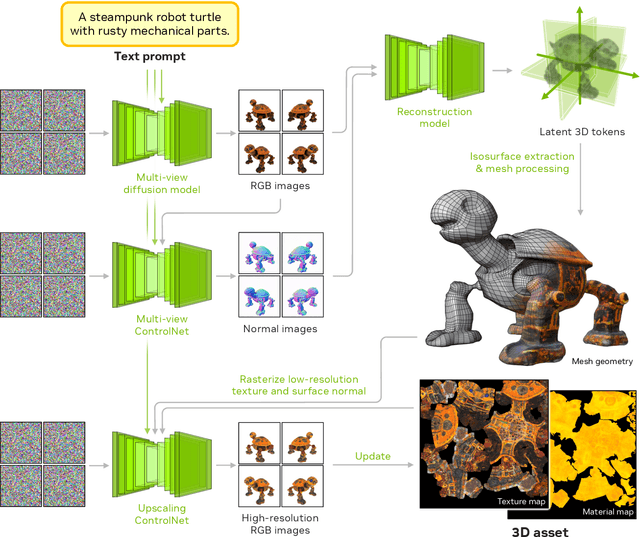
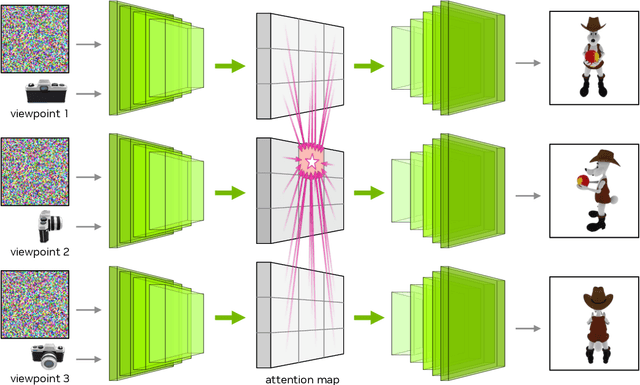
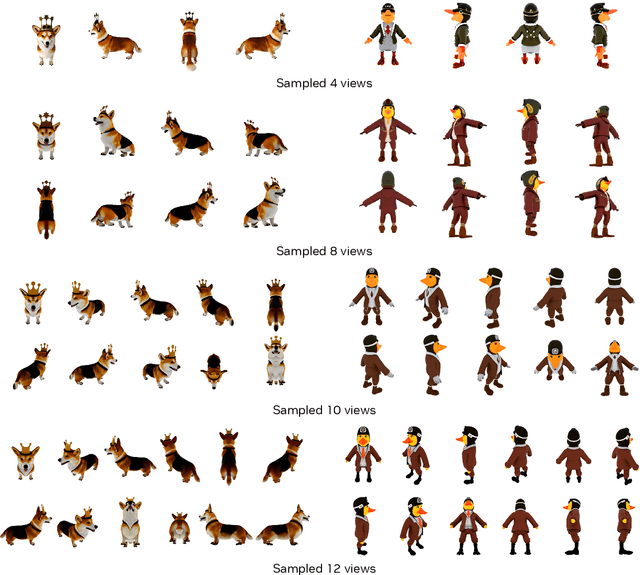
We introduce Edify 3D, an advanced solution designed for high-quality 3D asset generation. Our method first synthesizes RGB and surface normal images of the described object at multiple viewpoints using a diffusion model. The multi-view observations are then used to reconstruct the shape, texture, and PBR materials of the object. Our method can generate high-quality 3D assets with detailed geometry, clean shape topologies, high-resolution textures, and materials within 2 minutes of runtime.