 Add to Chrome
 Add to Firefox
 Add to Edge
ShareLock: A Stealthy Multi-Tool Threshold Poisoning Attack Against MCP
Jun 25, 2026
With the rapid evolution of LLM-driven agents, Model Context Protocol (MCP), an open protocol bridging LLMs with external tools, has quickly become foundational to modern agent ecosystems. However, the expanding adoption of MCP has also introduced novel security concerns such as Tool Poisoning Attack (TPA), which exploit LLM-server interactions to inject malicious prompts. Existing poisoning schemes typically adopt a monolithic plaintext embedding paradigm, which fails to withstand manual inspection or automated detectors. Current research still lacks a systematic analysis on multi-tool poisoning, where multiple tools can be exploited cooperatively to disperse detection risk. In this paper, we introduce ShareLock, a multi-tool threshold poisoning framework that utilizes Shamir's threshold scheme to ensure exceptional stealth and fault tolerance. ShareLock distributes the malicious instruction as benign-looking secret shares across multiple tool descriptions, achieving both information-theoretic secrecy and attack robustness against moderate auditing. After a covert reconstruction trigger is planted during server update, the aggregated shares reconstruct the hidden instruction, resulting in critical breaches of system assets or private data. To evaluate the realistic threat of ShareLock, we constructed a comprehensive benchmark encompassing four multi-tool scenarios and conducted extensive experiments across mainstream LLMs on two distinct MCP clients. Our results demonstrate that ShareLock significantly outperforms existing single-tool poisoning strategies in tool description-based detection while maintaining an average attack success rate exceeding 90%.

Intern-S1-Pro: Scientific Multimodal Foundation Model at Trillion Scale
Mar 26, 2026We introduce Intern-S1-Pro, the first one-trillion-parameter scientific multimodal foundation model. Scaling to this unprecedented size, the model delivers a comprehensive enhancement across both general and scientific domains. Beyond stronger reasoning and image-text understanding capabilities, its intelligence is augmented with advanced agent capabilities. Simultaneously, its scientific expertise has been vastly expanded to master over 100 specialized tasks across critical science fields, including chemistry, materials, life sciences, and earth sciences. Achieving this massive scale is made possible by the robust infrastructure support of XTuner and LMDeploy, which facilitates highly efficient Reinforcement Learning (RL) training at the 1-trillion parameter level while ensuring strict precision consistency between training and inference. By seamlessly integrating these advancements, Intern-S1-Pro further fortifies the fusion of general and specialized intelligence, working as a Specializable Generalist, demonstrating its position in the top tier of open-source models for general capabilities, while outperforming proprietary models in the depth of specialized scientific tasks.
STEP: Scientific Time-Series Encoder Pretraining via Cross-Domain Distillation
Mar 19, 2026Scientific time series are central to scientific AI but are typically sparse, highly heterogeneous, and limited in scale, making unified representation learning particularly challenging. Meanwhile, foundation models pretrained on relevant time series domains such as audio, general time series, and brain signals contain rich knowledge, but their applicability to scientific signals remains underexplored. In this paper, we investigate the transferability and complementarity of foundation models from relevant time series domains, and study how to effectively leverage them to build a unified encoder for scientific time series. We first systematically evaluate relevant foundation models, showing the effectiveness of knowledge transfer to scientific tasks and their complementary strengths. Based on this observation, we propose STEP, a Scientific Time Series Encoder Pretraining framework via cross domain distillation. STEP introduces adaptive patching to handle extreme-length sequences and a statistics compensation scheme to accommodate diverse numerical scales. It further leverages cross-domain distillation to integrate knowledge from multiple foundation models into a unified encoder. By combining complementary representations across different domains, STEP learns general-purpose and transferable features tailored for scientific signals. Experiments on seven scientific time series tasks demonstrate that STEP provides both an effective structure and an effective pretraining paradigm, taking a STEP toward scientific time series representation learning.
LifeBench: A Benchmark for Long-Horizon Multi-Source Memory
Mar 04, 2026Long-term memory is fundamental for personalized agents capable of accumulating knowledge, reasoning over user experiences, and adapting across time. However, existing memory benchmarks primarily target declarative memory, specifically semantic and episodic types, where all information is explicitly presented in dialogues. In contrast, real-world actions are also governed by non-declarative memory, including habitual and procedural types, and need to be inferred from diverse digital traces. To bridge this gap, we introduce Lifebench, which features densely connected, long-horizon event simulation. It pushes AI agents beyond simple recall, requiring the integration of declarative and non-declarative memory reasoning across diverse and temporally extended contexts. Building such a benchmark presents two key challenges: ensuring data quality and scalability. We maintain data quality by employing real-world priors, including anonymized social surveys, map APIs, and holiday-integrated calendars, thus enforcing fidelity, diversity and behavioral rationality within the dataset. Towards scalability, we draw inspiration from cognitive science and structure events according to their partonomic hierarchy; enabling efficient parallel generation while maintaining global coherence. Performance results show that top-tier, state-of-the-art memory systems reach just 55.2\% accuracy, highlighting the inherent difficulty of long-horizon retrieval and multi-source integration within our proposed benchmark. The dataset and data synthesis code are available at https://github.com/1754955896/LifeBench.
Continuous Telemonitoring of Heart Failure using Personalised Speech Dynamics
Feb 25, 2026Remote monitoring of heart failure (HF) via speech signals provides a non-invasive and cost-effective solution for long-term patient management. However, substantial inter-individual heterogeneity in vocal characteristics often limits the accuracy of traditional cross-sectional classification models. To address this, we propose a Longitudinal Intra-Patient Tracking (LIPT) scheme designed to capture the trajectory of relative symptomatic changes within individuals. Central to this framework is a Personalised Sequential Encoder (PSE), which transforms longitudinal speech recordings into context-aware latent representations. By incorporating historical data at each timestamp, the PSE facilitates a holistic assessment of the clinical trajectory rather than modelling discrete visits independently. Experimental results from a cohort of 225 patients demonstrate that the LIPT paradigm significantly outperforms the classic cross-sectional approaches, achieving a recognition accuracy of 99.7% for clinical status transitions. The model's high sensitivity was further corroborated by additional follow-up data, confirming its efficacy in predicting HF deterioration and its potential to secure patient safety in remote, home-based settings. Furthermore, this work addresses the gap in existing literature by providing a comprehensive analysis of different speech task designs and acoustic features. Taken together, the superior performance of the LIPT framework and PSE architecture validates their readiness for integration into long-term telemonitoring systems, offering a scalable solution for remote heart failure management.
Beyond Benchmark: LLMs Evaluation with an Anthropomorphic and Value-oriented Roadmap
Aug 26, 2025For Large Language Models (LLMs), a disconnect persists between benchmark performance and real-world utility. Current evaluation frameworks remain fragmented, prioritizing technical metrics while neglecting holistic assessment for deployment. This survey introduces an anthropomorphic evaluation paradigm through the lens of human intelligence, proposing a novel three-dimensional taxonomy: Intelligence Quotient (IQ)-General Intelligence for foundational capacity, Emotional Quotient (EQ)-Alignment Ability for value-based interactions, and Professional Quotient (PQ)-Professional Expertise for specialized proficiency. For practical value, we pioneer a Value-oriented Evaluation (VQ) framework assessing economic viability, social impact, ethical alignment, and environmental sustainability. Our modular architecture integrates six components with an implementation roadmap. Through analysis of 200+ benchmarks, we identify key challenges including dynamic assessment needs and interpretability gaps. It provides actionable guidance for developing LLMs that are technically proficient, contextually relevant, and ethically sound. We maintain a curated repository of open-source evaluation resources at: https://github.com/onejune2018/Awesome-LLM-Eval.
Siamese Foundation Models for Crystal Structure Prediction
Mar 13, 2025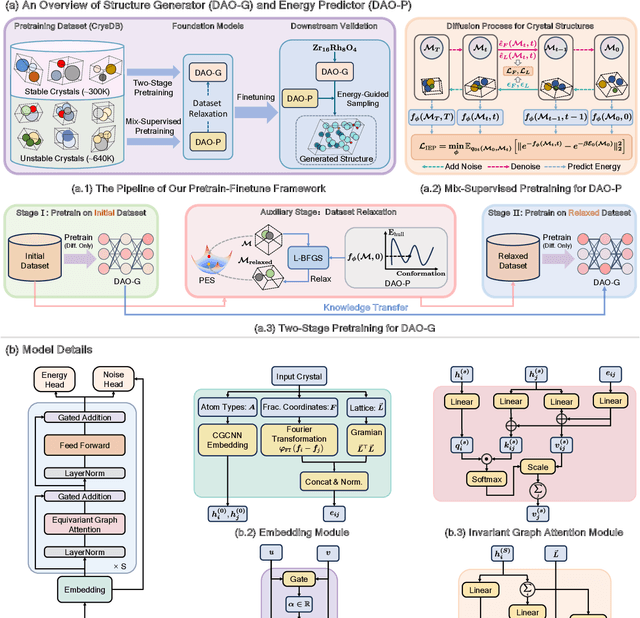
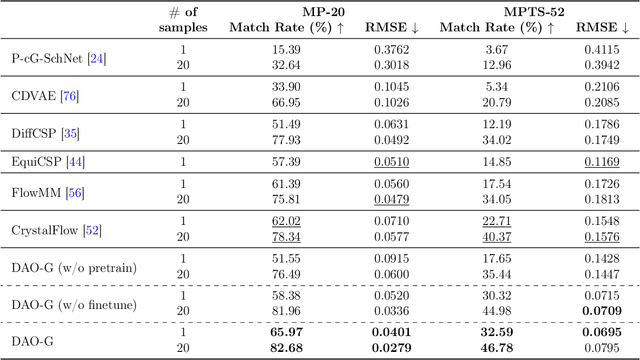
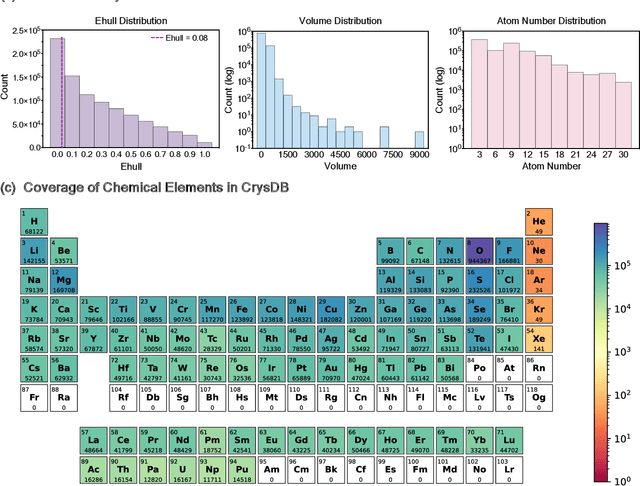

Crystal Structure Prediction (CSP), which aims to generate stable crystal structures from compositions, represents a critical pathway for discovering novel materials. While structure prediction tasks in other domains, such as proteins, have seen remarkable progress, CSP remains a relatively underexplored area due to the more complex geometries inherent in crystal structures. In this paper, we propose Siamese foundation models specifically designed to address CSP. Our pretrain-finetune framework, named DAO, comprises two complementary foundation models: DAO-G for structure generation and DAO-P for energy prediction. Experiments on CSP benchmarks (MP-20 and MPTS-52) demonstrate that our DAO-G significantly surpasses state-of-the-art (SOTA) methods across all metrics. Extensive ablation studies further confirm that DAO-G excels in generating diverse polymorphic structures, and the dataset relaxation and energy guidance provided by DAO-P are essential for enhancing DAO-G's performance. When applied to three real-world superconductors ($\text{CsV}_3\text{Sb}_5$, $ \text{Zr}_{16}\text{Rh}_8\text{O}_4$ and $\text{Zr}_{16}\text{Pd}_8\text{O}_4$) that are known to be challenging to analyze, our foundation models achieve accurate critical temperature predictions and structure generations. For instance, on $\text{CsV}_3\text{Sb}_5$, DAO-G generates a structure close to the experimental one with an RMSE of 0.0085; DAO-P predicts the $T_c$ value with high accuracy (2.26 K vs. the ground-truth value of 2.30 K). In contrast, conventional DFT calculators like Quantum Espresso only successfully derive the structure of the first superconductor within an acceptable time, while the RMSE is nearly 8 times larger, and the computation speed is more than 1000 times slower. These compelling results collectively highlight the potential of our approach for advancing materials science research and development.
Emilia: A Large-Scale, Extensive, Multilingual, and Diverse Dataset for Speech Generation
Jan 27, 2025Recent advancements in speech generation have been driven by the large-scale training datasets. However, current models fall short of capturing the spontaneity and variability inherent in real-world human speech, due to their reliance on audiobook datasets limited to formal read-aloud speech styles. To bridge this gap, we introduce Emilia-Pipe, an open-source preprocessing pipeline to extract high-quality training data from valuable yet underexplored in-the-wild data that capture spontaneous human speech in real-world contexts. By leveraging Emilia-Pipe, we construct Emilia, the first multilingual speech generation dataset derived from in-the-wild speech data. This dataset comprises over 101k hours of speech across six languages: English, Chinese, German, French, Japanese, and Korean. Besides, we expand Emilia to Emilia-Large, a dataset exceeding 216k hours, making it the largest open-source speech generation dataset available. Extensive experiments demonstrate that Emilia significantly outperforms traditional audiobook datasets in generating spontaneous and human-like speech, showcasing superior performance in capturing diverse speaker timbre and speaking styles of real-world human speech. Furthermore, this work underscores the importance of scaling dataset size to advance speech generation research and validates the effectiveness of Emilia for both multilingual and crosslingual speech generation.
GDiffRetro: Retrosynthesis Prediction with Dual Graph Enhanced Molecular Representation and Diffusion Generation
Jan 14, 2025

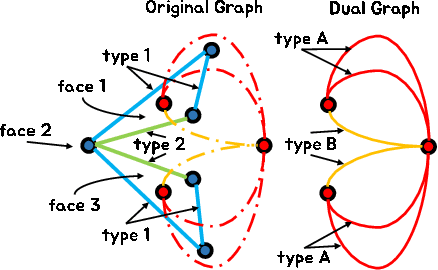

Retrosynthesis prediction focuses on identifying reactants capable of synthesizing a target product. Typically, the retrosynthesis prediction involves two phases: Reaction Center Identification and Reactant Generation. However, we argue that most existing methods suffer from two limitations in the two phases: (i) Existing models do not adequately capture the ``face'' information in molecular graphs for the reaction center identification. (ii) Current approaches for the reactant generation predominantly use sequence generation in a 2D space, which lacks versatility in generating reasonable distributions for completed reactive groups and overlooks molecules' inherent 3D properties. To overcome the above limitations, we propose GDiffRetro. For the reaction center identification, GDiffRetro uniquely integrates the original graph with its corresponding dual graph to represent molecular structures, which helps guide the model to focus more on the faces in the graph. For the reactant generation, GDiffRetro employs a conditional diffusion model in 3D to further transform the obtained synthon into a complete reactant. Our experimental findings reveal that GDiffRetro outperforms state-of-the-art semi-template models across various evaluative metrics.
MaskGCT: Zero-Shot Text-to-Speech with Masked Generative Codec Transformer
Sep 01, 2024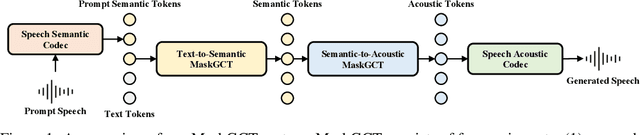
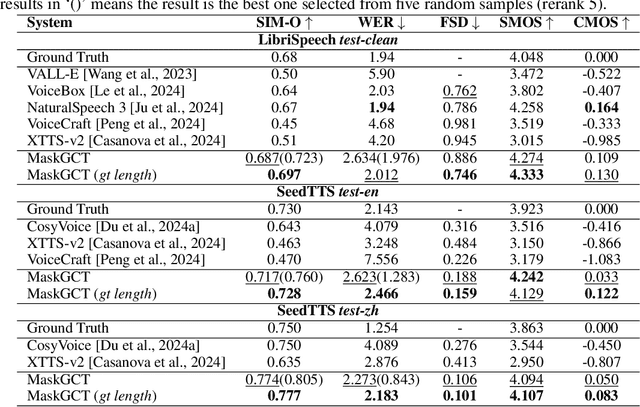
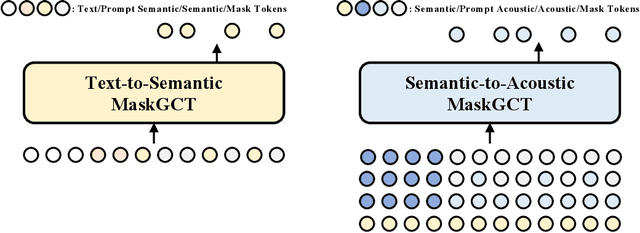
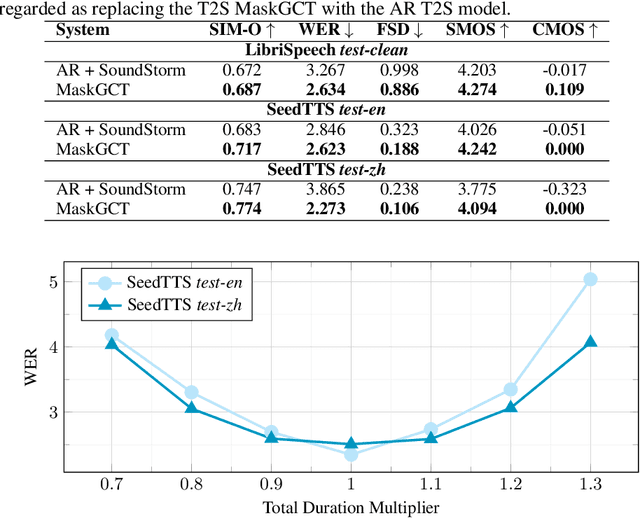
Nowadays, large-scale text-to-speech (TTS) systems are primarily divided into two types: autoregressive and non-autoregressive. The autoregressive systems have certain deficiencies in robustness and cannot control speech duration. In contrast, non-autoregressive systems require explicit prediction of phone-level duration, which may compromise their naturalness. We introduce the Masked Generative Codec Transformer (MaskGCT), a fully non-autoregressive model for TTS that does not require precise alignment information between text and speech. MaskGCT is a two-stage model: in the first stage, the model uses text to predict semantic tokens extracted from a speech self-supervised learning (SSL) model, and in the second stage, the model predicts acoustic tokens conditioned on these semantic tokens. MaskGCT follows the \textit{mask-and-predict} learning paradigm. During training, MaskGCT learns to predict masked semantic or acoustic tokens based on given conditions and prompts. During inference, the model generates tokens of a specified length in a parallel manner. We scale MaskGCT to a large-scale multilingual dataset with 100K hours of in-the-wild speech. Our experiments demonstrate that MaskGCT achieves superior or competitive performance compared to state-of-the-art zero-shot TTS systems in terms of quality, similarity, and intelligibility while offering higher generation efficiency than diffusion-based or autoregressive TTS models. Audio samples are available at https://maskgct.github.io.