 Add to Chrome
 Add to Firefox
 Add to Edge
Native Active Perception as Reasoning for Omni-Modal Understanding
Jun 17, 2026
Passive models for long video understanding typically rely on a "watch-it-all" paradigm, processing frames uniformly regardless of query difficulty, causing computational cost to grow with video duration. Although interactive frameworks have emerged, they often rely on global pre-scanning, and their context cost still scales with video length. We propose OmniAgent, the first native omni-modal agent that formulates video understanding as a POMDP-based iterative Observation-Thought-Action cycle. OmniAgent executes on-demand actions to selectively distill audio-visual cues into a persistent textual memory, effectively decoupling reasoning complexity from raw video duration. To operationalize this, we introduce (1) Agentic Supervised Fine-Tuning to bootstrap native active perception via best-of-N trajectory synthesis with dual-stage quality control, and (2) Agentic Reinforcement Learning with TAURA (Turn-aware Adaptive Uncertainty Rescaled Advantage), which leverages turn-level entropy to steer credit assignment toward pivotal discovery turns. Crucially, OmniAgent exhibits positive test-time scaling, where performance improves as the number of reasoning turns increases, validating the efficacy of active perception. Empirical results across ten benchmarks (e.g., VideoMME, LVBench) demonstrate that OmniAgent achieves state-of-the-art performance among open-source models. Notably, on LVBench, our 7B agent outperforms the 10$\times$ larger Qwen2.5-VL-72B (50.5% vs. 47.3%).

MMAE: A Massive Multitask Audio Editing Benchmark
Jun 05, 2026We introduce MMAE, a Massive Multitask Audio Editing benchmark, serving as the first comprehensive evaluation testbed designed for general-purpose instruction-based audio editing. Spurred by the shift toward intelligent creation, interactive editing has rapidly expanded from visual domains, pioneered by models like Nano-banana 2 for images and Gemini-Omni for video, into audio. However, the current evaluation infrastructure lags severely, remaining highly fragmented and restricted to specific subdomains or basic operations. Unlike existing benchmarks that are limited in scope, MMAE extends to a broad spectrum of real-world scenarios, encompassing 7 distinct audio modalities, including sound, speech, music, and their mixtures. Furthermore, we establish a comprehensive taxonomy spanning 6 levels of task complexity, from basic modifications to multi-hop reasoning and multi-round editing, 2 levels of granularity, and 8 distinct operation types. Meticulously curated through human-agent collaboration, MMAE comprises 2,000 high-fidelity samples paired with a pioneering rubric-based evaluation framework. By decomposing free-form tasks into 17,741 verifiable criteria, this robust rubric-based paradigm enables a precise, multi-dimensional assessment of both instruction following and context consistency. Our extensive evaluation of leading models reveals that current systems remain far from achieving reliable edits. Strikingly, the Exact Match Rate (EMR) consistently falls below 5% and plummets to an absolute 0% in complex, mixed-modality tasks, exposing critical bottlenecks in precise execution and structural robustness. We hope MMAE will serve as a catalyst for future advances in the intelligent creation community, providing a clear diagnostic roadmap and establishing a standardized, long-lasting evaluation paradigm for next-generation audio editing systems.
LifeBench: A Benchmark for Long-Horizon Multi-Source Memory
Mar 04, 2026Long-term memory is fundamental for personalized agents capable of accumulating knowledge, reasoning over user experiences, and adapting across time. However, existing memory benchmarks primarily target declarative memory, specifically semantic and episodic types, where all information is explicitly presented in dialogues. In contrast, real-world actions are also governed by non-declarative memory, including habitual and procedural types, and need to be inferred from diverse digital traces. To bridge this gap, we introduce Lifebench, which features densely connected, long-horizon event simulation. It pushes AI agents beyond simple recall, requiring the integration of declarative and non-declarative memory reasoning across diverse and temporally extended contexts. Building such a benchmark presents two key challenges: ensuring data quality and scalability. We maintain data quality by employing real-world priors, including anonymized social surveys, map APIs, and holiday-integrated calendars, thus enforcing fidelity, diversity and behavioral rationality within the dataset. Towards scalability, we draw inspiration from cognitive science and structure events according to their partonomic hierarchy; enabling efficient parallel generation while maintaining global coherence. Performance results show that top-tier, state-of-the-art memory systems reach just 55.2\% accuracy, highlighting the inherent difficulty of long-horizon retrieval and multi-source integration within our proposed benchmark. The dataset and data synthesis code are available at https://github.com/1754955896/LifeBench.
The Interspeech 2026 Audio Reasoning Challenge: Evaluating Reasoning Process Quality for Audio Reasoning Models and Agents
Feb 15, 2026Recent Large Audio Language Models (LALMs) excel in understanding but often lack transparent reasoning. To address this "black-box" limitation, we organized the Audio Reasoning Challenge at Interspeech 2026, the first shared task dedicated to evaluating Chain-of-Thought (CoT) quality in the audio domain. The challenge introduced MMAR-Rubrics, a novel instance-level protocol assessing the factuality and logic of reasoning chains. Featured Single Model and Agent tracks, the competition attracting 156 teams from 18 countries and regions. Results show agent systems currently lead in reasoning quality, utilizing iterative tool orchestration and cross-modal analysis. Besides, single models are rapidly advancing via reinforcement learning and sophisticated data pipeline. We details the challenge design, methodology, and a comprehensive analysis of state-of-the-art systems, providing new insights for explainable audio intelligence.
SLAM-LLM: A Modular, Open-Source Multimodal Large Language Model Framework and Best Practice for Speech, Language, Audio and Music Processing
Jan 14, 2026The recent surge in open-source Multimodal Large Language Models (MLLM) frameworks, such as LLaVA, provides a convenient kickoff for artificial intelligence developers and researchers. However, most of the MLLM frameworks take vision as the main input modality, and provide limited in-depth support for the modality of speech, audio, and music. This situation hinders the development of audio-language models, and forces researchers to spend a lot of effort on code writing and hyperparameter tuning. We present SLAM-LLM, an open-source deep learning framework designed to train customized MLLMs, focused on speech, language, audio, and music processing. SLAM-LLM provides a modular configuration of different encoders, projectors, LLMs, and parameter-efficient fine-tuning plugins. SLAM-LLM also includes detailed training and inference recipes for mainstream tasks, along with high-performance checkpoints like LLM-based Automatic Speech Recognition (ASR), Automated Audio Captioning (AAC), and Music Captioning (MC). Some of these recipes have already reached or are nearing state-of-the-art performance, and some relevant techniques have also been accepted by academic papers. We hope SLAM-LLM will accelerate iteration, development, data engineering, and model training for researchers. We are committed to continually pushing forward audio-based MLLMs through this open-source framework, and call on the community to contribute to the LLM-based speech, audio and music processing.
Omni-Captioner: Data Pipeline, Models, and Benchmark for Omni Detailed Perception
Oct 14, 2025Fine-grained perception of multimodal information is critical for advancing human-AI interaction. With recent progress in audio-visual technologies, Omni Language Models (OLMs), capable of processing audio and video signals in parallel, have emerged as a promising paradigm for achieving richer understanding and reasoning. However, their capacity to capture and describe fine-grained details remains limited explored. In this work, we present a systematic and comprehensive investigation of omni detailed perception from the perspectives of the data pipeline, models, and benchmark. We first identify an inherent "co-growth" between detail and hallucination in current OLMs. To address this, we propose Omni-Detective, an agentic data generation pipeline integrating tool-calling, to autonomously produce highly detailed yet minimally hallucinatory multimodal data. Based on the data generated with Omni-Detective, we train two captioning models: Audio-Captioner for audio-only detailed perception, and Omni-Captioner for audio-visual detailed perception. Under the cascade evaluation protocol, Audio-Captioner achieves the best performance on MMAU and MMAR among all open-source models, surpassing Gemini 2.5 Flash and delivering performance comparable to Gemini 2.5 Pro. On existing detailed captioning benchmarks, Omni-Captioner sets a new state-of-the-art on VDC and achieves the best trade-off between detail and hallucination on the video-SALMONN 2 testset. Given the absence of a dedicated benchmark for omni detailed perception, we design Omni-Cloze, a novel cloze-style evaluation for detailed audio, visual, and audio-visual captioning that ensures stable, efficient, and reliable assessment. Experimental results and analysis demonstrate the effectiveness of Omni-Detective in generating high-quality detailed captions, as well as the superiority of Omni-Cloze in evaluating such detailed captions.
MMAR: A Challenging Benchmark for Deep Reasoning in Speech, Audio, Music, and Their Mix
May 19, 2025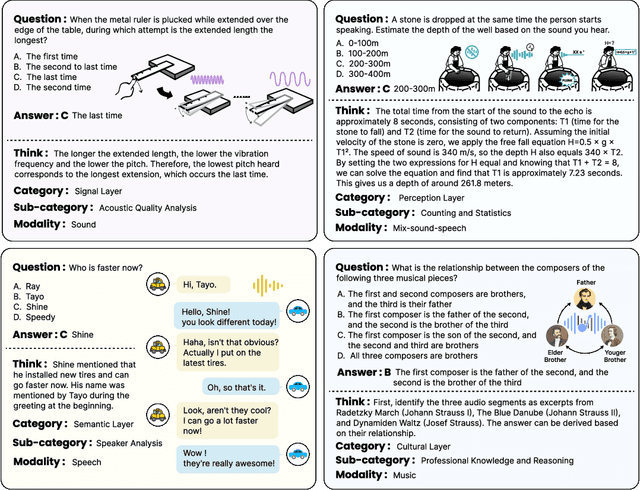
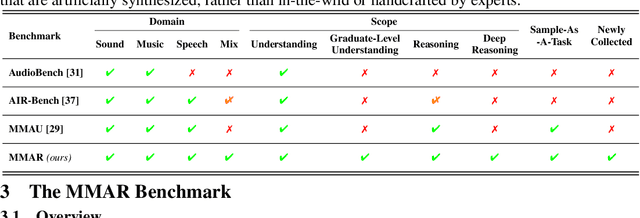
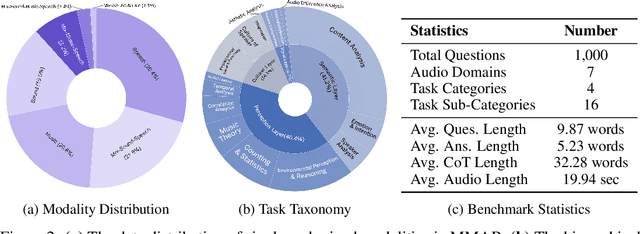
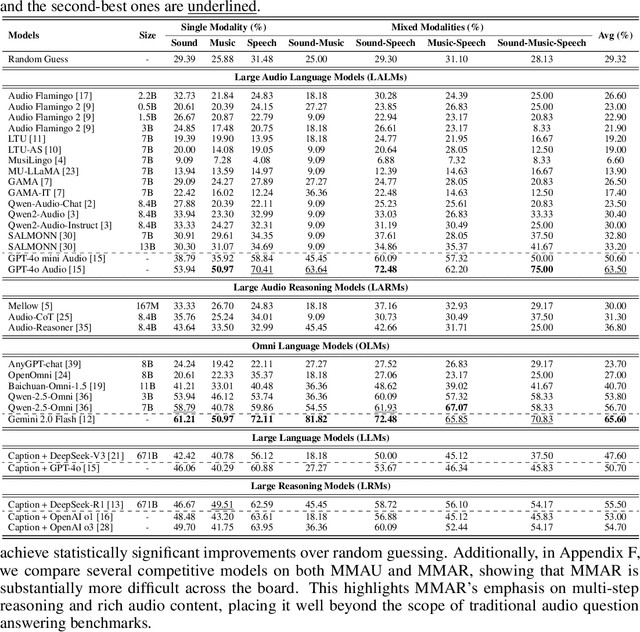
We introduce MMAR, a new benchmark designed to evaluate the deep reasoning capabilities of Audio-Language Models (ALMs) across massive multi-disciplinary tasks. MMAR comprises 1,000 meticulously curated audio-question-answer triplets, collected from real-world internet videos and refined through iterative error corrections and quality checks to ensure high quality. Unlike existing benchmarks that are limited to specific domains of sound, music, or speech, MMAR extends them to a broad spectrum of real-world audio scenarios, including mixed-modality combinations of sound, music, and speech. Each question in MMAR is hierarchically categorized across four reasoning layers: Signal, Perception, Semantic, and Cultural, with additional sub-categories within each layer to reflect task diversity and complexity. To further foster research in this area, we annotate every question with a Chain-of-Thought (CoT) rationale to promote future advancements in audio reasoning. Each item in the benchmark demands multi-step deep reasoning beyond surface-level understanding. Moreover, a part of the questions requires graduate-level perceptual and domain-specific knowledge, elevating the benchmark's difficulty and depth. We evaluate MMAR using a broad set of models, including Large Audio-Language Models (LALMs), Large Audio Reasoning Models (LARMs), Omni Language Models (OLMs), Large Language Models (LLMs), and Large Reasoning Models (LRMs), with audio caption inputs. The performance of these models on MMAR highlights the benchmark's challenging nature, and our analysis further reveals critical limitations of understanding and reasoning capabilities among current models. We hope MMAR will serve as a catalyst for future advances in this important but little-explored area.
Interleaved Speech-Text Language Models are Simple Streaming Text to Speech Synthesizers
Dec 23, 2024This paper introduces Interleaved Speech-Text Language Model (IST-LM) for streaming zero-shot Text-to-Speech (TTS). Unlike many previous approaches, IST-LM is directly trained on interleaved sequences of text and speech tokens with a fixed ratio, eliminating the need for additional efforts in duration prediction and grapheme-to-phoneme alignment. The ratio of text chunk size to speech chunk size is crucial for the performance of IST-LM. To explore this, we conducted a comprehensive series of statistical analyses on the training data and performed correlation analysis with the final performance, uncovering several key factors: 1) the distance between speech tokens and their corresponding text tokens, 2) the number of future text tokens accessible to each speech token, and 3) the frequency of speech tokens precedes their corresponding text tokens. Experimental results demonstrate how to achieve an optimal streaming TTS system without complicated engineering optimization, which has a limited gap with the non-streaming system. IST-LM is conceptually simple and empirically powerful, paving the way for streaming TTS with minimal overhead while largely maintaining performance, showcasing broad prospects coupled with real-time text stream from LLMs.
SLAM-Omni: Timbre-Controllable Voice Interaction System with Single-Stage Training
Dec 20, 2024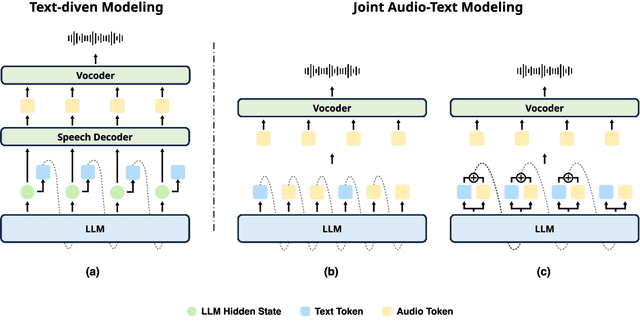
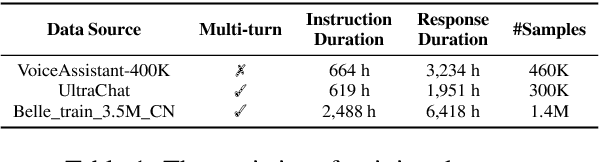
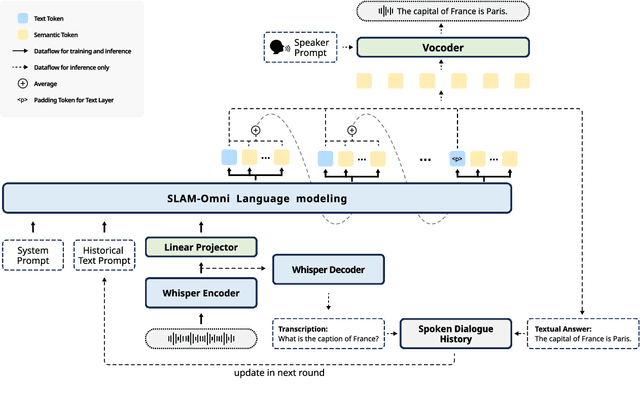
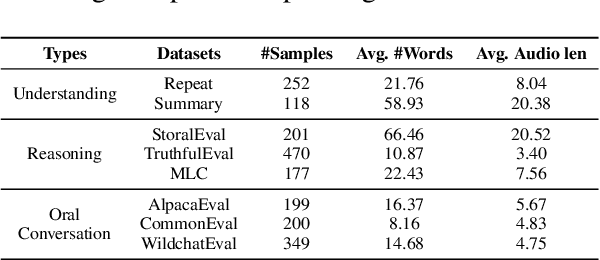
Recent advancements highlight the potential of end-to-end real-time spoken dialogue systems, showcasing their low latency and high quality. In this paper, we introduce SLAM-Omni, a timbre-controllable, end-to-end voice interaction system with single-stage training. SLAM-Omni achieves zero-shot timbre control by modeling spoken language with semantic tokens and decoupling speaker information to a vocoder. By predicting grouped speech semantic tokens at each step, our method significantly reduces the sequence length of audio tokens, accelerating both training and inference. Additionally, we propose historical text prompting to compress dialogue history, facilitating efficient multi-round interactions. Comprehensive evaluations reveal that SLAM-Omni outperforms prior models of similar scale, requiring only 15 hours of training on 4 GPUs with limited data. Notably, it is the first spoken dialogue system to achieve competitive performance with a single-stage training approach, eliminating the need for pre-training on TTS or ASR tasks. Further experiments validate its multilingual and multi-turn dialogue capabilities on larger datasets.
CRUXEval-X: A Benchmark for Multilingual Code Reasoning, Understanding and Execution
Aug 23, 2024
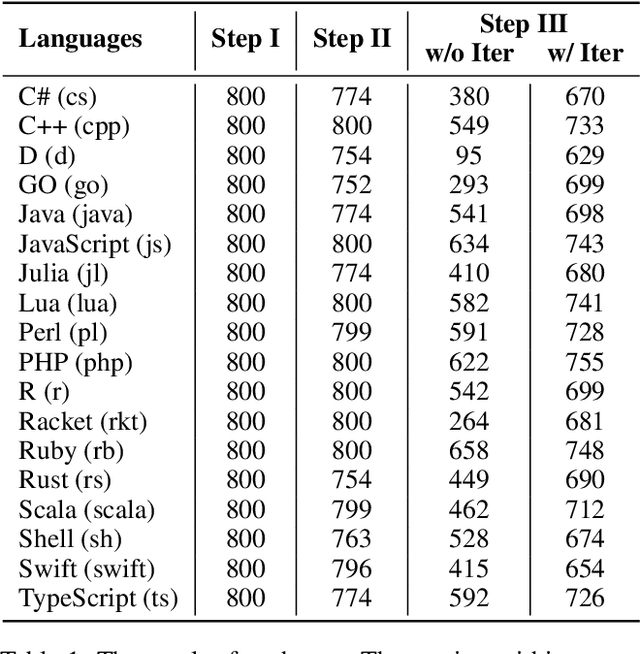


Code benchmarks such as HumanEval are widely adopted to evaluate Large Language Models' (LLMs) coding capabilities. However, there is an unignorable programming language bias in existing code benchmarks -- over 95% code generation benchmarks are dominated by Python, leaving the LLMs' capabilities in other programming languages such as Java and C/C++ unknown. Moreover, coding task bias is also crucial. Most benchmarks focus on code generation capability, while benchmarks for code reasoning (given input, reasoning output; and given output, reasoning input), an essential coding capability, are insufficient. Yet, constructing multi-lingual benchmarks can be expensive and labor-intensive, and codes in contest websites such as Leetcode suffer from data contamination during training. To fill this gap, we propose CRUXEVAL-X, a multi-lingual code reasoning benchmark that contains 19 programming languages. It comprises at least 600 subjects for each language, along with 19K content-consistent tests in total. In particular, the construction pipeline of CRUXEVAL-X works in a fully automated and test-guided manner, which iteratively generates and repairs based on execution feedback. Also, to cross language barriers (e.g., dynamic/static type systems in Python/C++), we formulated various transition rules between language pairs to facilitate translation. Our intensive evaluation of 24 representative LLMs reveals the correlation between language pairs. For example, TypeScript and JavaScript show a significant positive correlation, while Racket has less correlation with other languages. More interestingly, even a model trained solely on Python can achieve at most 34.4% Pass@1 in other languages, revealing the cross-language generalization of LLMs.