 Add to Chrome
 Add to Firefox
 Add to Edge
MAGA: Multi-Platform Self-Fusion of GUI Agents via Structured Action Distillation
Jul 31, 2026
Graphical user interface (GUI) agents based on large language models are increasingly deployed across mobile, web, and desktop environments. However, existing agents are typically domain-specific, limiting the deployment and user experience. This motivates the consolidation of specialized models into a single cross-environment policy. Weight merging directly merges domain-specific experts but can corrupt executable actions under expert disagreement, while on-policy distillation (OPD) avoids conflicting teacher supervision yet still treats all response tokens equally during distillation, ignoring that action tokens are the only interface between the environment and the agent. To address this, We introduce MAGA that re-allocates training signal according to the structured action. Based on the correctness of the generated action, it suppresses unnecessary or invalid distillation signals and focuses learning on erroneous actions. Besides, a training-only hint optimizes the supervision signal provided by domain-specific teachers without changing the student input. Across two model scales, MAGA achieves the highest mean success rate, outperforming the strongest baseline by 2.0% at 8B and achieves almost the same average performance with teachers.

DeltaServe: Host-Agnostic Co-Serving of Inference and Fine-Tuning for LLMs
Jul 30, 2026LLM serving systems are provisioned for peak load to meet strict latency targets, leaving substantial GPU compute idle whenever traffic falls below peak. We present DeltaServe, a host-agnostic co-serving design that converts this idle inference capacity into LoRA fine-tuning throughput while preserving inference service-level objectives (SLOs). DeltaServe integrates with existing inference engines through a compact hook interface that requires only multi-LoRA batching support. It exploits the shared execution structure of inference prefill and LoRA fine-tuning forward passes, and uses an SLO-aware scheduler to admit and execute fine-tuning only when sufficient inference headroom is available. The scheduler is driven by a CUDA-graph-aware latency model calibrated offline and refined online. We integrate DeltaServe with vLLM, SGLang, and S-LoRA. On a production trace from Company X, DeltaServe on vLLM delivers 2.9x higher fine-tuning throughput than LLMStation at 100% inference SLO compliance, versus 85% for LLMStation. It also achieves 39% higher fine-tuning throughput than a baseline running vLLM+torchtune, using no additional hardware and maintaining full SLO compliance.
Structure from Reasoning, Numbers from Search: On-Premise Open LLMs as Structural Priors for Coupled MIMO Controller Tuning
Jun 09, 2026Tuning controllers for strongly coupled multi-input multi-output (MIMO) industrial processes is hard: decentralized classical auto-tuning ignores loop interaction, and local numerical optimization from natural initializations stalls in the resulting non-convex cost landscape. We ask whether on-premise open-source large language models (LLMs), which keep data on-site and need no plant model, can help. On a single-loop CSTR, classical relay-feedback tuning (IAE 0.106, near the 0.102 optimum) beats an LLM tuner (0.162): for simple loops the LLM adds nothing. The picture inverts on a strongly coupled quadruple-tank with conflicting set-points, scored by a penalized cost J = IAE + lambda*TV(u) that rewards tracking without chattering actuators. There, naive relay tuning (J ~ 28.6) and naive LLM tuning (29.7) are no better than open loop (22.7), and a local optimizer from balanced starts fails in 10/10 runs. A scaffolded open LLM instead reasons about the coupling, proposes the counter-intuitive asymmetric structure, and reaches J ~ 16.9 +/- 0.2 from any start; refining it with a classical optimizer attains the smooth global optimum (J ~ 12.0, 10/10 vs. 0/10), which even applies a non-obvious negative integral correction decentralized tuning cannot. A global optimizer (differential evolution) also reaches this optimum, so the LLM is not the only route; its advantage is sample efficiency and interpretability: a usable controller in 18 evaluations (where the global optimizer is worse than open loop) plus a stated rationale. This edge grows with dimension, reaching ~6x fewer evaluations on a 3x3 plant. The behaviour generalizes across four open models, and on a benign plant the LLM offers no advantage, sharpening the boundary. We contribute a reproducible benchmark delimiting when open LLMs help in control tuning: not as optimizers, but as a sample-efficient, interpretable structural prior.
BiDexGrasp: Coordinated Bimanual Dexterous Grasps across Object Geometries and Sizes
Apr 08, 2026Bimanual dexterous grasping is a fundamental and promising area in robotics, yet its progress is constrained by the lack of comprehensive datasets and powerful generation models. In this work, we propose BiDexGrasp, consists of a large-scale bimanual dexterous grasp dataset and a novel generation model. For dataset, we propose a novel bimanual grasp synthesis pipeline to efficiently annotate physically feasible data for dataset construction. This pipeline addresses the challenges of high-dimensional bimanual grasping through a two-stage synthesis strategy of efficient region-based grasp initialization and decoupled force-closure grasp optimization. Powered by this pipeline, we construct a large-scale bimanual dexterous grasp dataset, comprising 6351 diverse objects with sizes ranging from 30 to 80 cm, along with 9.7 million annotated grasp data. Based on this dataset, we further introduce a bimanual-coordinated and geometry-size-adaptive dexterous grasping generation framework. The framework lies in two key designs: a bimanual coordination module and a geometry-size-adaptive grasp generation strategy to generate coordinated and high-quality grasps on unseen objects. Extensive experiments conducted in both simulation and real world demonstrate the superior performance of our proposed data synthesis pipeline and learned generative framework.
Reflection Generation for Composite Image Using Diffusion Model
Apr 02, 2026Image composition involves inserting a foreground object into the background while synthesizing environment-consistent effects such as shadows and reflections. Although shadow generation has been extensively studied, reflection generation remains largely underexplored. In this work, we focus on reflection generation. We inject the prior information of reflection placement and reflection appearance into foundation diffusion model. We also divide reflections into two types and adopt type-aware model design. To support training, we construct the first large-scale object reflection dataset DEROBA. Experiments demonstrate that our method generates reflections that are physically coherent and visually realistic, establishing a new benchmark for reflection generation.
LifeBench: A Benchmark for Long-Horizon Multi-Source Memory
Mar 04, 2026Long-term memory is fundamental for personalized agents capable of accumulating knowledge, reasoning over user experiences, and adapting across time. However, existing memory benchmarks primarily target declarative memory, specifically semantic and episodic types, where all information is explicitly presented in dialogues. In contrast, real-world actions are also governed by non-declarative memory, including habitual and procedural types, and need to be inferred from diverse digital traces. To bridge this gap, we introduce Lifebench, which features densely connected, long-horizon event simulation. It pushes AI agents beyond simple recall, requiring the integration of declarative and non-declarative memory reasoning across diverse and temporally extended contexts. Building such a benchmark presents two key challenges: ensuring data quality and scalability. We maintain data quality by employing real-world priors, including anonymized social surveys, map APIs, and holiday-integrated calendars, thus enforcing fidelity, diversity and behavioral rationality within the dataset. Towards scalability, we draw inspiration from cognitive science and structure events according to their partonomic hierarchy; enabling efficient parallel generation while maintaining global coherence. Performance results show that top-tier, state-of-the-art memory systems reach just 55.2\% accuracy, highlighting the inherent difficulty of long-horizon retrieval and multi-source integration within our proposed benchmark. The dataset and data synthesis code are available at https://github.com/1754955896/LifeBench.
LLM-based Embeddings: Attention Values Encode Sentence Semantics Better Than Hidden States
Feb 02, 2026Sentence representations are foundational to many Natural Language Processing (NLP) applications. While recent methods leverage Large Language Models (LLMs) to derive sentence representations, most rely on final-layer hidden states, which are optimized for next-token prediction and thus often fail to capture global, sentence-level semantics. This paper introduces a novel perspective, demonstrating that attention value vectors capture sentence semantics more effectively than hidden states. We propose Value Aggregation (VA), a simple method that pools token values across multiple layers and token indices. In a training-free setting, VA outperforms other LLM-based embeddings, even matches or surpasses the ensemble-based MetaEOL. Furthermore, we demonstrate that when paired with suitable prompts, the layer attention outputs can be interpreted as aligned weighted value vectors. Specifically, the attention scores of the last token function as the weights, while the output projection matrix ($W_O$) aligns these weighted value vectors with the common space of the LLM residual stream. This refined method, termed Aligned Weighted VA (AlignedWVA), achieves state-of-the-art performance among training-free LLM-based embeddings, outperforming the high-cost MetaEOL by a substantial margin. Finally, we highlight the potential of obtaining strong LLM embedding models through fine-tuning Value Aggregation.
CareCom: Generative Image Composition with Calibrated Reference Features
Nov 14, 2025Image composition aims to seamlessly insert foreground object into background. Despite the huge progress in generative image composition, the existing methods are still struggling with simultaneous detail preservation and foreground pose/view adjustment. To address this issue, we extend the existing generative composition model to multi-reference version, which allows using arbitrary number of foreground reference images. Furthermore, we propose to calibrate the global and local features of foreground reference images to make them compatible with the background information. The calibrated reference features can supplement the original reference features with useful global and local information of proper pose/view. Extensive experiments on MVImgNet and MureCom demonstrate that the generative model can greatly benefit from the calibrated reference features.
Human-like Cognitive Generalization for Large Models via Brain-in-the-loop Supervision
May 14, 2025Recent advancements in deep neural networks (DNNs), particularly large-scale language models, have demonstrated remarkable capabilities in image and natural language understanding. Although scaling up model parameters with increasing volume of training data has progressively improved DNN capabilities, achieving complex cognitive abilities - such as understanding abstract concepts, reasoning, and adapting to novel scenarios, which are intrinsic to human cognition - remains a major challenge. In this study, we show that brain-in-the-loop supervised learning, utilizing a small set of brain signals, can effectively transfer human conceptual structures to DNNs, significantly enhancing their comprehension of abstract and even unseen concepts. Experimental results further indicate that the enhanced cognitive capabilities lead to substantial performance gains in challenging tasks, including few-shot/zero-shot learning and out-of-distribution recognition, while also yielding highly interpretable concept representations. These findings highlight that human-in-the-loop supervision can effectively augment the complex cognitive abilities of large models, offering a promising pathway toward developing more human-like cognitive abilities in artificial systems.
MureObjectStitch: Multi-reference Image Composition
Nov 12, 2024
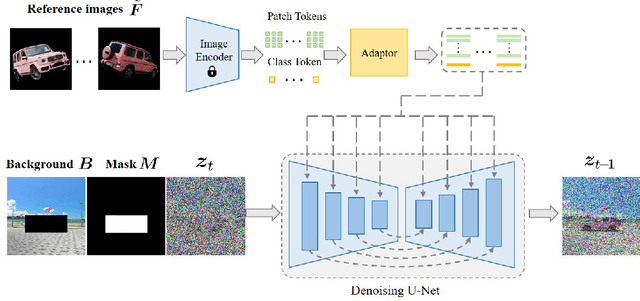


Generative image composition aims to regenerate the given foreground object in the background image to produce a realistic composite image. In this work, we propose an effective finetuning strategy for generative image composition model, in which we finetune a pretrained model using one or more images containing the same foreground object. Moreover, we propose a multi-reference strategy, which allows the model to take in multiple reference images of the foreground object. The experiments on MureCOM dataset verify the effectiveness of our method.