 Add to Chrome
 Add to Firefox
 Add to Edge
Where Do Deep-Research Agents Go Wrong? Span-Level Error Localization in Agent Trajectories
Jun 01, 2026
Deep-research agents solve tasks through long trajectories of search, tool use, evidence inspection, and answer synthesis. Evaluation based on final answers shows whether an agent succeeds, but not which parts of the trajectory make the answer unreliable. We study span-level error localization for deep-research agents. We collect 2,790 real trajectories from two agent frameworks, three backbone models, and three benchmarks, convert raw logs into semantic spans, and annotate harmful error spans through LLM-assisted expert review. From these annotations, we build TELBench, a 1,000-instance benchmark for identifying error spans among normal exploration, failed searches, tentative hypotheses, and harmless noise. We further propose DRIFT, a claim-centric auditing framework that tracks agent claims, checks their support in trajectory evidence, and marks spans where unsupported or conflicting claims affect the answer path. Experiments across model families and auditing frameworks show that DRIFT improves span-level error localization and first-error accuracy by up to 30 percentage points. Our work provides a process-level view of reliability in deep-research agents.

ScrapMem: A Bio-inspired Framework for On-device Personalized Agent Memory via Optical Forgetting
May 05, 2026Long-term personalized memory for LLM agents is challenging on resource-limited edge devices due to high storage costs and multimodal complexity. To address this, we propose ScrapMem, a framework that integrates multimodal data into "Scrapbook Page." ScrapMem introduces Optical Forgetting, an optical compression mechanism that progressively reduces the resolution of older memories, lowering storage cost while suppressing low-value details. To maintain semantic consistency, we construct an Episodic Memory Graph (EM-Graph) that organizes key events into a causal-temporal structure. Extensive experiments on the multimodal ATM-Bench showcase that ScrapMem provides three main benefits: (1) strong performance, achieving a new state-of-the-art with a 51.0% Joint@10 score; (2) high storage efficiency, reducing memory usage by up to 93% via optical forgetting; and (3) improved recall, increasing Recall@10 to 70.3% through structured aggregation. ScrapMem offers an effective and storage-efficient solution for on-device long-term memory in multimodal LLM agents.
DR$^{3}$-Eval: Towards Realistic and Reproducible Deep Research Evaluation
Apr 16, 2026Deep Research Agents (DRAs) aim to solve complex, long-horizon research tasks involving planning, retrieval, multimodal understanding, and report generation, yet their evaluation remains challenging due to dynamic web environments and ambiguous task definitions. We propose DR$^{3}$-Eval, a realistic and reproducible benchmark for evaluating deep research agents on multimodal, multi-file report generation. DR$^{3}$-Eval is constructed from authentic user-provided materials and paired with a per-task static research sandbox corpus that simulates open-web complexity while remaining fully verifiable, containing supportive documents, distractors, and noise. Moreover, we introduce a multi-dimensional evaluation framework measuring Information Recall, Factual Accuracy, Citation Coverage, Instruction Following, and Depth Quality, and validate its alignment with human judgments. Experiments with our developed multi-agent system DR$^{3}$-Agent based on multiple state-of-the-art language models demonstrate that DR$^{3}$-Eval is highly challenging and reveals critical failure modes in retrieval robustness and hallucination control. Our code and data are publicly available.
LoTA-QAF: Lossless Ternary Adaptation for Quantization-Aware Fine-Tuning
May 24, 2025Quantization and fine-tuning are crucial for deploying large language models (LLMs) on resource-constrained edge devices. However, fine-tuning quantized models presents significant challenges, primarily stemming from: First, the mismatch in data types between the low-precision quantized weights (e.g., 4-bit) and the high-precision adaptation weights (e.g., 16-bit). This mismatch limits the computational efficiency advantage offered by quantized weights during inference. Second, potential accuracy degradation when merging these high-precision adaptation weights into the low-precision quantized weights, as the adaptation weights often necessitate approximation or truncation. Third, as far as we know, no existing methods support the lossless merging of adaptation while adjusting all quantized weights. To address these challenges, we introduce lossless ternary adaptation for quantization-aware fine-tuning (LoTA-QAF). This is a novel fine-tuning method specifically designed for quantized LLMs, enabling the lossless merging of ternary adaptation weights into quantized weights and the adjustment of all quantized weights. LoTA-QAF operates through a combination of: i) A custom-designed ternary adaptation (TA) that aligns ternary weights with the quantization grid and uses these ternary weights to adjust quantized weights. ii) A TA-based mechanism that enables the lossless merging of adaptation weights. iii) Ternary signed gradient descent (t-SignSGD) for updating the TA weights. We apply LoTA-QAF to Llama-3.1/3.3 and Qwen-2.5 model families and validate its effectiveness on several downstream tasks. On the MMLU benchmark, our method effectively recovers performance for quantized models, surpassing 16-bit LoRA by up to 5.14\%. For task-specific fine-tuning, 16-bit LoRA achieves superior results, but LoTA-QAF still outperforms other methods.
Siamese Foundation Models for Crystal Structure Prediction
Mar 13, 2025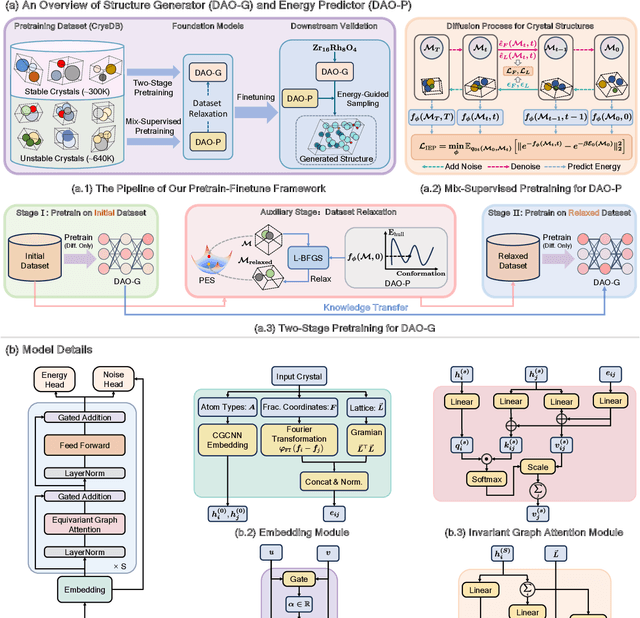
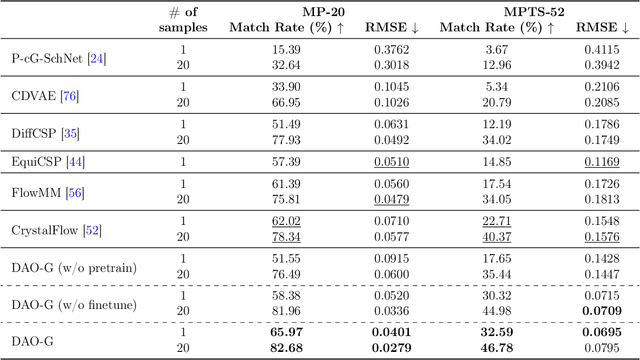
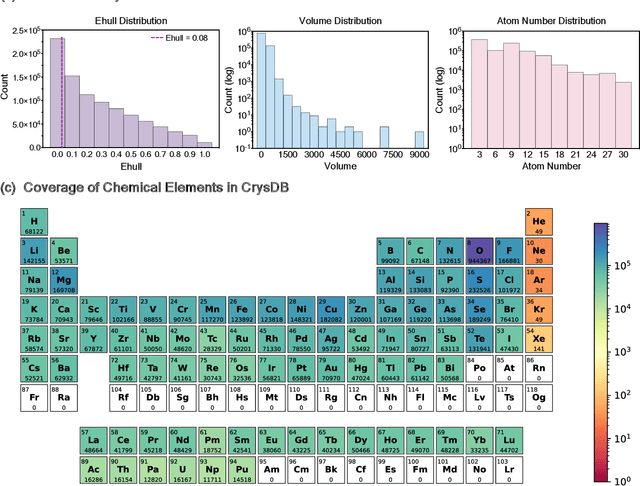

Crystal Structure Prediction (CSP), which aims to generate stable crystal structures from compositions, represents a critical pathway for discovering novel materials. While structure prediction tasks in other domains, such as proteins, have seen remarkable progress, CSP remains a relatively underexplored area due to the more complex geometries inherent in crystal structures. In this paper, we propose Siamese foundation models specifically designed to address CSP. Our pretrain-finetune framework, named DAO, comprises two complementary foundation models: DAO-G for structure generation and DAO-P for energy prediction. Experiments on CSP benchmarks (MP-20 and MPTS-52) demonstrate that our DAO-G significantly surpasses state-of-the-art (SOTA) methods across all metrics. Extensive ablation studies further confirm that DAO-G excels in generating diverse polymorphic structures, and the dataset relaxation and energy guidance provided by DAO-P are essential for enhancing DAO-G's performance. When applied to three real-world superconductors ($\text{CsV}_3\text{Sb}_5$, $ \text{Zr}_{16}\text{Rh}_8\text{O}_4$ and $\text{Zr}_{16}\text{Pd}_8\text{O}_4$) that are known to be challenging to analyze, our foundation models achieve accurate critical temperature predictions and structure generations. For instance, on $\text{CsV}_3\text{Sb}_5$, DAO-G generates a structure close to the experimental one with an RMSE of 0.0085; DAO-P predicts the $T_c$ value with high accuracy (2.26 K vs. the ground-truth value of 2.30 K). In contrast, conventional DFT calculators like Quantum Espresso only successfully derive the structure of the first superconductor within an acceptable time, while the RMSE is nearly 8 times larger, and the computation speed is more than 1000 times slower. These compelling results collectively highlight the potential of our approach for advancing materials science research and development.
G-Refer: Graph Retrieval-Augmented Large Language Model for Explainable Recommendation
Feb 18, 2025Explainable recommendation has demonstrated significant advantages in informing users about the logic behind recommendations, thereby increasing system transparency, effectiveness, and trustworthiness. To provide personalized and interpretable explanations, existing works often combine the generation capabilities of large language models (LLMs) with collaborative filtering (CF) information. CF information extracted from the user-item interaction graph captures the user behaviors and preferences, which is crucial for providing informative explanations. However, due to the complexity of graph structure, effectively extracting the CF information from graphs still remains a challenge. Moreover, existing methods often struggle with the integration of extracted CF information with LLMs due to its implicit representation and the modality gap between graph structures and natural language explanations. To address these challenges, we propose G-Refer, a framework using graph retrieval-augmented large language models (LLMs) for explainable recommendation. Specifically, we first employ a hybrid graph retrieval mechanism to retrieve explicit CF signals from both structural and semantic perspectives. The retrieved CF information is explicitly formulated as human-understandable text by the proposed graph translation and accounts for the explanations generated by LLMs. To bridge the modality gap, we introduce knowledge pruning and retrieval-augmented fine-tuning to enhance the ability of LLMs to process and utilize the retrieved CF information to generate explanations. Extensive experiments show that G-Refer achieves superior performance compared with existing methods in both explainability and stability. Codes and data are available at https://github.com/Yuhan1i/G-Refer.
GDiffRetro: Retrosynthesis Prediction with Dual Graph Enhanced Molecular Representation and Diffusion Generation
Jan 14, 2025

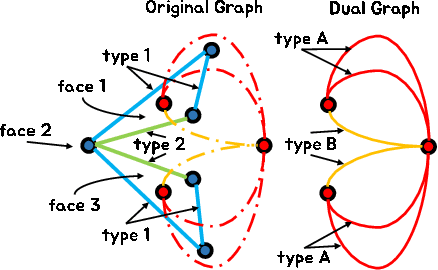

Retrosynthesis prediction focuses on identifying reactants capable of synthesizing a target product. Typically, the retrosynthesis prediction involves two phases: Reaction Center Identification and Reactant Generation. However, we argue that most existing methods suffer from two limitations in the two phases: (i) Existing models do not adequately capture the ``face'' information in molecular graphs for the reaction center identification. (ii) Current approaches for the reactant generation predominantly use sequence generation in a 2D space, which lacks versatility in generating reasonable distributions for completed reactive groups and overlooks molecules' inherent 3D properties. To overcome the above limitations, we propose GDiffRetro. For the reaction center identification, GDiffRetro uniquely integrates the original graph with its corresponding dual graph to represent molecular structures, which helps guide the model to focus more on the faces in the graph. For the reactant generation, GDiffRetro employs a conditional diffusion model in 3D to further transform the obtained synthon into a complete reactant. Our experimental findings reveal that GDiffRetro outperforms state-of-the-art semi-template models across various evaluative metrics.
Are High-Degree Representations Really Unnecessary in Equivariant Graph Neural Networks?
Oct 15, 2024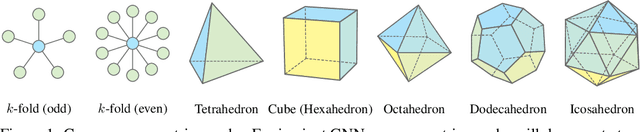
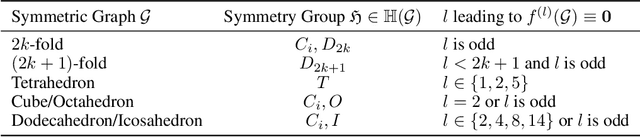
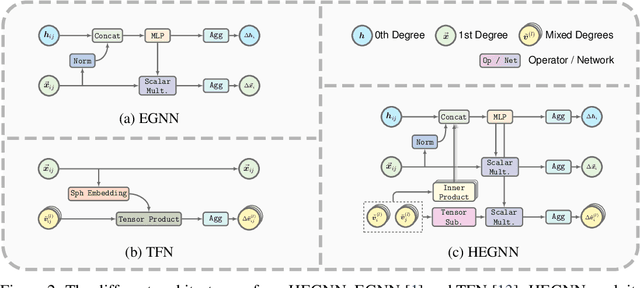
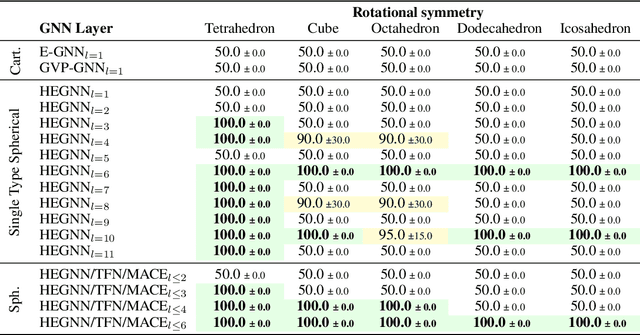
Equivariant Graph Neural Networks (GNNs) that incorporate E(3) symmetry have achieved significant success in various scientific applications. As one of the most successful models, EGNN leverages a simple scalarization technique to perform equivariant message passing over only Cartesian vectors (i.e., 1st-degree steerable vectors), enjoying greater efficiency and efficacy compared to equivariant GNNs using higher-degree steerable vectors. This success suggests that higher-degree representations might be unnecessary. In this paper, we disprove this hypothesis by exploring the expressivity of equivariant GNNs on symmetric structures, including $k$-fold rotations and regular polyhedra. We theoretically demonstrate that equivariant GNNs will always degenerate to a zero function if the degree of the output representations is fixed to 1 or other specific values. Based on this theoretical insight, we propose HEGNN, a high-degree version of EGNN to increase the expressivity by incorporating high-degree steerable vectors while maintaining EGNN's efficiency through the scalarization trick. Our extensive experiments demonstrate that HEGNN not only aligns with our theoretical analyses on toy datasets consisting of symmetric structures, but also shows substantial improvements on more complicated datasets such as $N$-body and MD17. Our theoretical findings and empirical results potentially open up new possibilities for the research of equivariant GNNs.
Molecular Graph Representation Learning Integrating Large Language Models with Domain-specific Small Models
Aug 19, 2024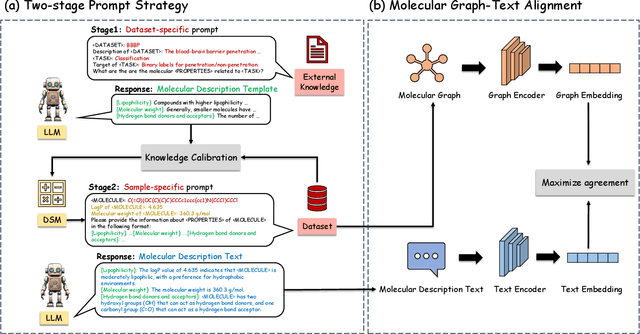
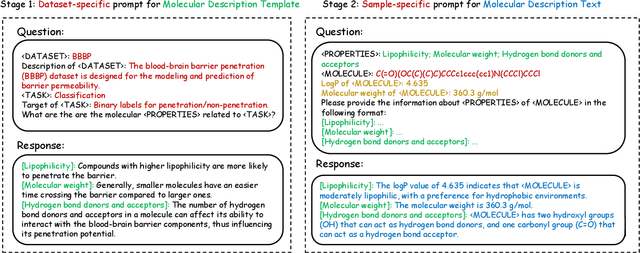

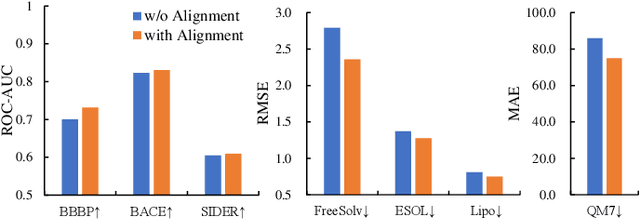
Molecular property prediction is a crucial foundation for drug discovery. In recent years, pre-trained deep learning models have been widely applied to this task. Some approaches that incorporate prior biological domain knowledge into the pre-training framework have achieved impressive results. However, these methods heavily rely on biochemical experts, and retrieving and summarizing vast amounts of domain knowledge literature is both time-consuming and expensive. Large Language Models (LLMs) have demonstrated remarkable performance in understanding and efficiently providing general knowledge. Nevertheless, they occasionally exhibit hallucinations and lack precision in generating domain-specific knowledge. Conversely, Domain-specific Small Models (DSMs) possess rich domain knowledge and can accurately calculate molecular domain-related metrics. However, due to their limited model size and singular functionality, they lack the breadth of knowledge necessary for comprehensive representation learning. To leverage the advantages of both approaches in molecular property prediction, we propose a novel Molecular Graph representation learning framework that integrates Large language models and Domain-specific small models (MolGraph-LarDo). Technically, we design a two-stage prompt strategy where DSMs are introduced to calibrate the knowledge provided by LLMs, enhancing the accuracy of domain-specific information and thus enabling LLMs to generate more precise textual descriptions for molecular samples. Subsequently, we employ a multi-modal alignment method to coordinate various modalities, including molecular graphs and their corresponding descriptive texts, to guide the pre-training of molecular representations. Extensive experiments demonstrate the effectiveness of the proposed method.
Characterizing the Influence of Topology on Graph Learning Tasks
Apr 11, 2024
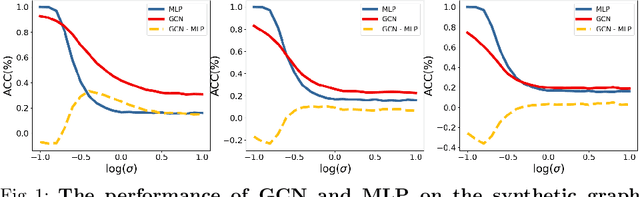
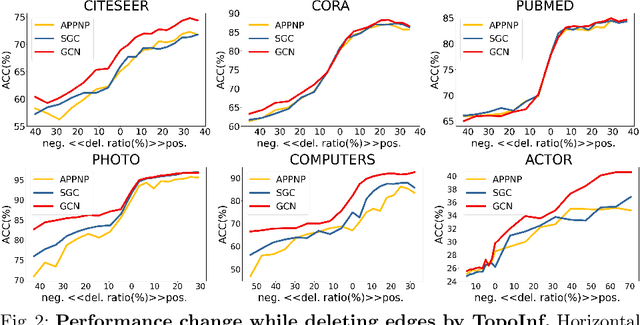
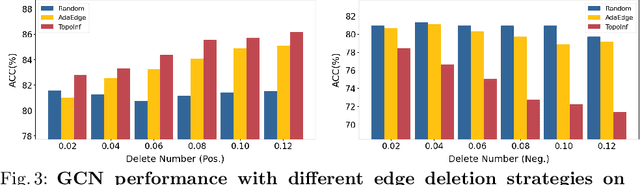
Graph neural networks (GNN) have achieved remarkable success in a wide range of tasks by encoding features combined with topology to create effective representations. However, the fundamental problem of understanding and analyzing how graph topology influences the performance of learning models on downstream tasks has not yet been well understood. In this paper, we propose a metric, TopoInf, which characterizes the influence of graph topology by measuring the level of compatibility between the topological information of graph data and downstream task objectives. We provide analysis based on the decoupled GNNs on the contextual stochastic block model to demonstrate the effectiveness of the metric. Through extensive experiments, we demonstrate that TopoInf is an effective metric for measuring topological influence on corresponding tasks and can be further leveraged to enhance graph learning.