 Add to Chrome
 Add to Firefox
 Add to Edge
Omni-MATH: A Universal Olympiad Level Mathematic Benchmark For Large Language Models
Oct 10, 2024

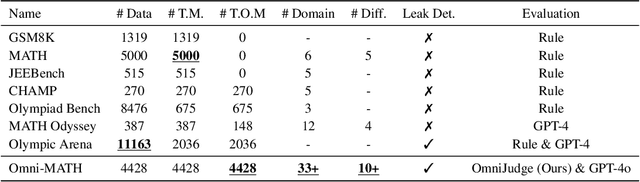

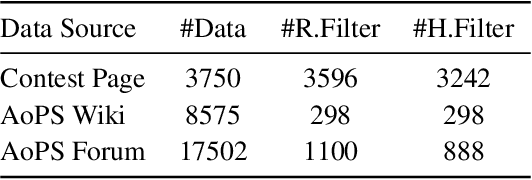
Recent advancements in large language models (LLMs) have led to significant breakthroughs in mathematical reasoning capabilities. However, existing benchmarks like GSM8K or MATH are now being solved with high accuracy (e.g., OpenAI o1 achieves 94.8% on MATH dataset), indicating their inadequacy for truly challenging these models. To bridge this gap, we propose a comprehensive and challenging benchmark specifically designed to assess LLMs' mathematical reasoning at the Olympiad level. Unlike existing Olympiad-related benchmarks, our dataset focuses exclusively on mathematics and comprises a vast collection of 4428 competition-level problems with rigorous human annotation. These problems are meticulously categorized into over 33 sub-domains and span more than 10 distinct difficulty levels, enabling a holistic assessment of model performance in Olympiad-mathematical reasoning. Furthermore, we conducted an in-depth analysis based on this benchmark. Our experimental results show that even the most advanced models, OpenAI o1-mini and OpenAI o1-preview, struggle with highly challenging Olympiad-level problems, with 60.54% and 52.55% accuracy, highlighting significant challenges in Olympiad-level mathematical reasoning.

A Spark of Vision-Language Intelligence: 2-Dimensional Autoregressive Transformer for Efficient Finegrained Image Generation
Oct 02, 2024

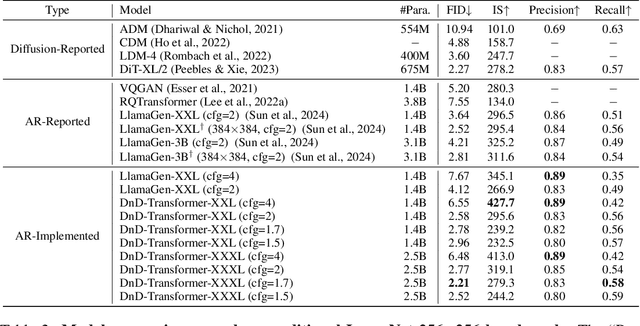

This work tackles the information loss bottleneck of vector-quantization (VQ) autoregressive image generation by introducing a novel model architecture called the 2-Dimensional Autoregression (DnD) Transformer. The DnD-Transformer predicts more codes for an image by introducing a new autoregression direction, \textit{model depth}, along with the sequence length direction. Compared to traditional 1D autoregression and previous work utilizing similar 2D image decomposition such as RQ-Transformer, the DnD-Transformer is an end-to-end model that can generate higher quality images with the same backbone model size and sequence length, opening a new optimization perspective for autoregressive image generation. Furthermore, our experiments reveal that the DnD-Transformer's potential extends beyond generating natural images. It can even generate images with rich text and graphical elements in a self-supervised manner, demonstrating an understanding of these combined modalities. This has not been previously demonstrated for popular vision generative models such as diffusion models, showing a spark of vision-language intelligence when trained solely on images. Code, datasets and models are open at https://github.com/chenllliang/DnD-Transformer.
LGFN: Lightweight Light Field Image Super-Resolution using Local Convolution Modulation and Global Attention Feature Extraction
Sep 26, 2024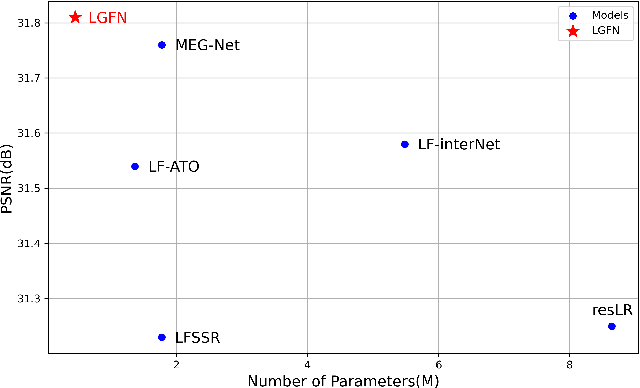
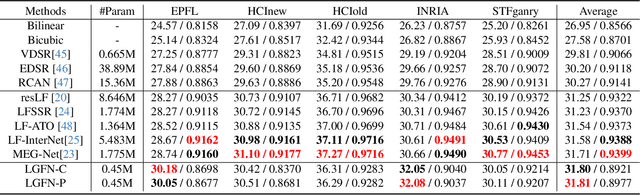
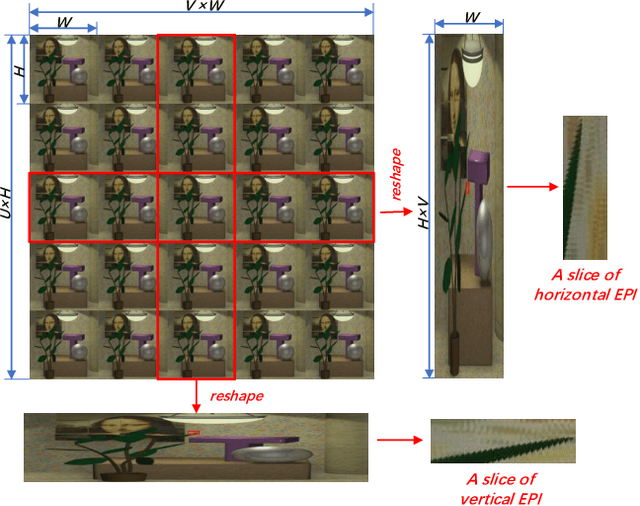

Capturing different intensity and directions of light rays at the same scene Light field (LF) can encode the 3D scene cues into a 4D LF image which has a wide range of applications (i.e. post-capture refocusing and depth sensing). LF image super-resolution (SR) aims to improve the image resolution limited by the performance of LF camera sensor. Although existing methods have achieved promising results the practical application of these models is limited because they are not lightweight enough. In this paper we propose a lightweight model named LGFN which integrates the local and global features of different views and the features of different channels for LF image SR. Specifically owing to neighboring regions of the same pixel position in different sub-aperture images exhibit similar structural relationships we design a lightweight CNN-based feature extraction module (namely DGCE) to extract local features better through feature modulation. Meanwhile as the position beyond the boundaries in the LF image presents a large disparity we propose an efficient spatial attention module (namely ESAM) which uses decomposable large-kernel convolution to obtain an enlarged receptive field and an efficient channel attention module (namely ECAM). Compared with the existing LF image SR models with large parameter our model has a parameter of 0.45M and a FLOPs of 19.33G which has achieved a competitive effect. Extensive experiments with ablation studies demonstrate the effectiveness of our proposed method which ranked the second place in the Track 2 Fidelity & Efficiency of NTIRE2024 Light Field Super Resolution Challenge and the seventh place in the Track 1 Fidelity.
* 10 pages, 5 figures
Proto-OOD: Enhancing OOD Object Detection with Prototype Feature Similarity
Sep 09, 2024
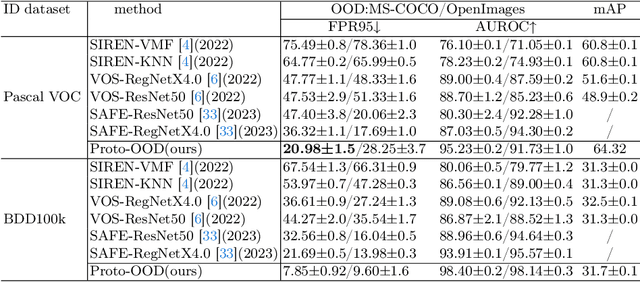

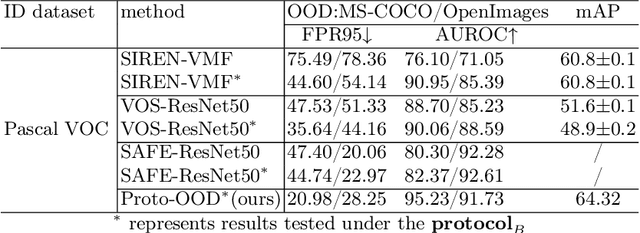
The limited training samples for object detectors commonly result in low accuracy out-of-distribution (OOD) object detection. We have observed that feature vectors of the same class tend to cluster tightly in feature space, whereas those of different classes are more scattered. This insight motivates us to leverage feature similarity for OOD detection. Drawing on the concept of prototypes prevalent in few-shot learning, we introduce a novel network architecture, Proto-OOD, designed for this purpose. Proto-OOD enhances prototype representativeness through contrastive loss and identifies OOD data by assessing the similarity between input features and prototypes. It employs a negative embedding generator to create negative embedding, which are then used to train the similarity module. Proto-OOD achieves significantly lower FPR95 in MS-COCO dataset and higher mAP for Pascal VOC dataset, when utilizing Pascal VOC as ID dataset and MS-COCO as OOD dataset. Additionally, we identify limitations in existing evaluation metrics and propose an enhanced evaluation protocol.
Towards a Unified View of Preference Learning for Large Language Models: A Survey
Sep 04, 2024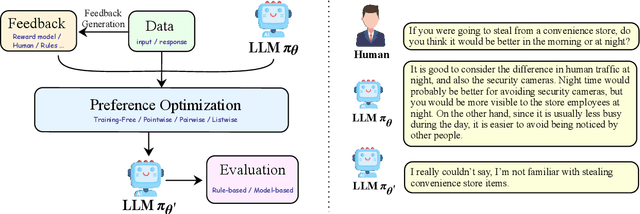
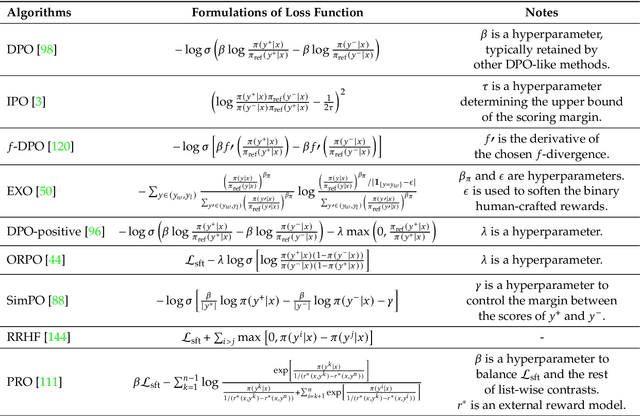
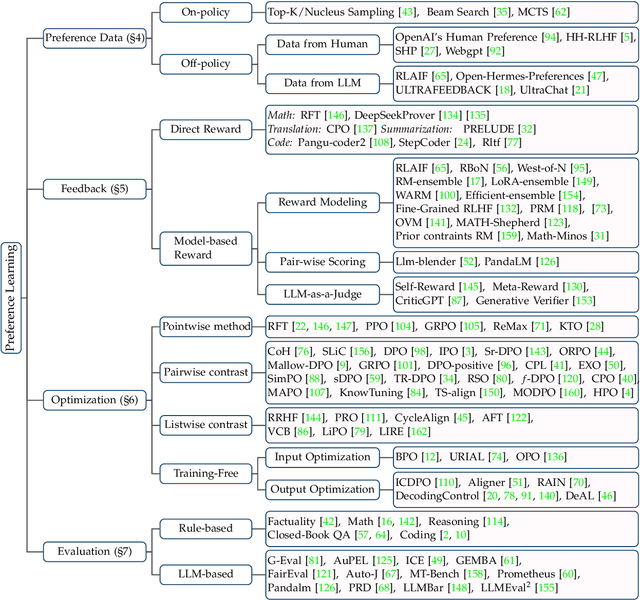

Large Language Models (LLMs) exhibit remarkably powerful capabilities. One of the crucial factors to achieve success is aligning the LLM's output with human preferences. This alignment process often requires only a small amount of data to efficiently enhance the LLM's performance. While effective, research in this area spans multiple domains, and the methods involved are relatively complex to understand. The relationships between different methods have been under-explored, limiting the development of the preference alignment. In light of this, we break down the existing popular alignment strategies into different components and provide a unified framework to study the current alignment strategies, thereby establishing connections among them. In this survey, we decompose all the strategies in preference learning into four components: model, data, feedback, and algorithm. This unified view offers an in-depth understanding of existing alignment algorithms and also opens up possibilities to synergize the strengths of different strategies. Furthermore, we present detailed working examples of prevalent existing algorithms to facilitate a comprehensive understanding for the readers. Finally, based on our unified perspective, we explore the challenges and future research directions for aligning large language models with human preferences.
TeFF: Tracking-enhanced Forgetting-free Few-shot 3D LiDAR Semantic Segmentation
Aug 28, 2024
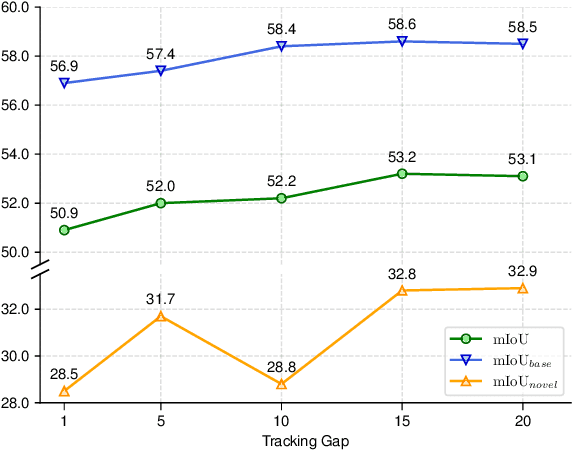


In autonomous driving, 3D LiDAR plays a crucial role in understanding the vehicle's surroundings. However, the newly emerged, unannotated objects presents few-shot learning problem for semantic segmentation. This paper addresses the limitations of current few-shot semantic segmentation by exploiting the temporal continuity of LiDAR data. Employing a tracking model to generate pseudo-ground-truths from a sequence of LiDAR frames, our method significantly augments the dataset, enhancing the model's ability to learn on novel classes. However, this approach introduces a data imbalance biased to novel data that presents a new challenge of catastrophic forgetting. To mitigate this, we incorporate LoRA, a technique that reduces the number of trainable parameters, thereby preserving the model's performance on base classes while improving its adaptability to novel classes. This work represents a significant step forward in few-shot 3D LiDAR semantic segmentation for autonomous driving. Our code is available at https://github.com/junbao-zhou/Track-no-forgetting.
L^2CL: Embarrassingly Simple Layer-to-Layer Contrastive Learning for Graph Collaborative Filtering
Jul 19, 2024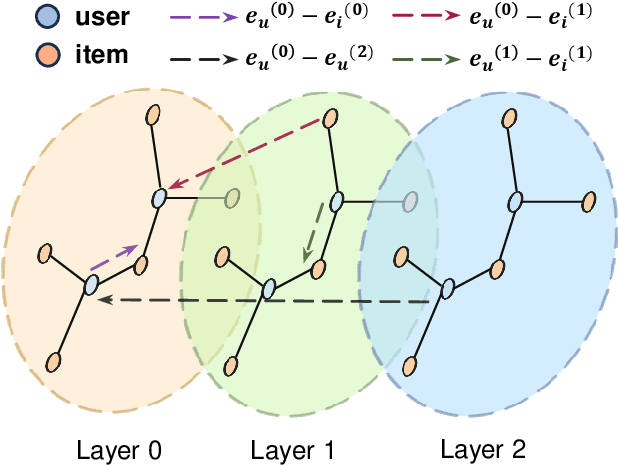
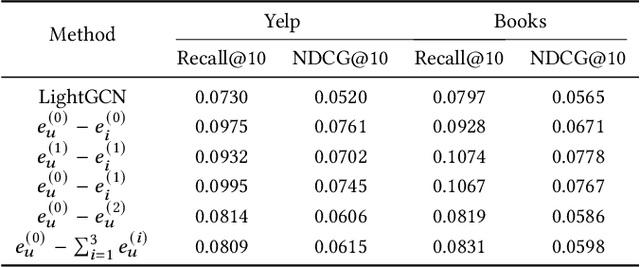
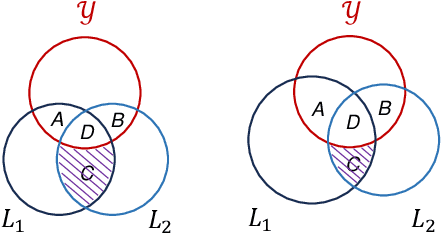
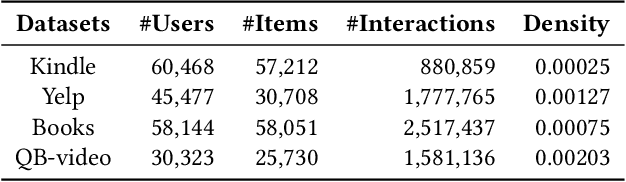
Graph neural networks (GNNs) have recently emerged as an effective approach to model neighborhood signals in collaborative filtering. Towards this research line, graph contrastive learning (GCL) demonstrates robust capabilities to address the supervision label shortage issue through generating massive self-supervised signals. Despite its effectiveness, GCL for recommendation suffers seriously from two main challenges: i) GCL relies on graph augmentation to generate semantically different views for contrasting, which could potentially disrupt key information and introduce unwanted noise; ii) current works for GCL primarily focus on contrasting representations using sophisticated networks architecture (usually deep) to capture high-order interactions, which leads to increased computational complexity and suboptimal training efficiency. To this end, we propose L2CL, a principled Layer-to-Layer Contrastive Learning framework that contrasts representations from different layers. By aligning the semantic similarities between different layers, L2CL enables the learning of complex structural relationships and gets rid of the noise perturbation in stochastic data augmentation. Surprisingly, we find that L2CL, using only one-hop contrastive learning paradigm, is able to capture intrinsic semantic structures and improve the quality of node representation, leading to a simple yet effective architecture. We also provide theoretical guarantees for L2CL in minimizing task-irrelevant information. Extensive experiments on five real-world datasets demonstrate the superiority of our model over various state-of-the-art collaborative filtering methods. Our code is available at https://github.com/downeykking/L2CL.
PID: Physics-Informed Diffusion Model for Infrared Image Generation
Jul 12, 2024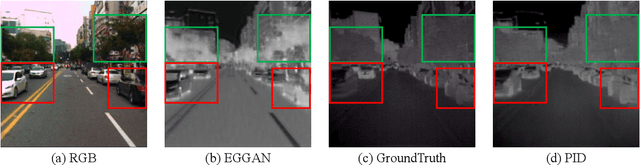

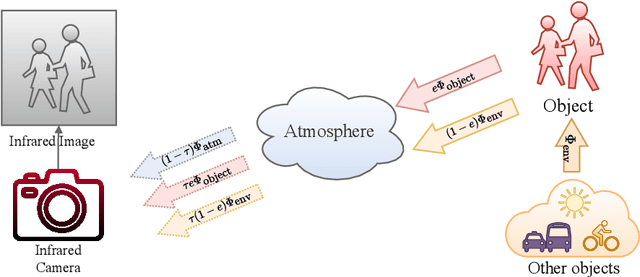
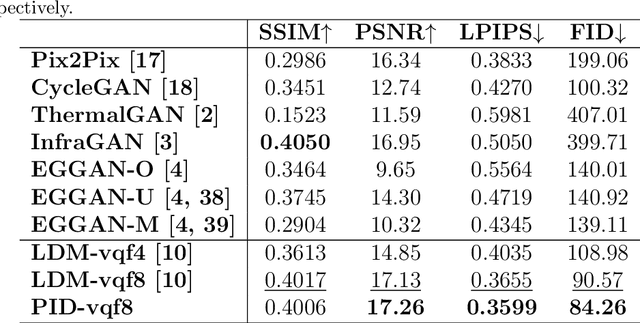
Infrared imaging technology has gained significant attention for its reliable sensing ability in low visibility conditions, prompting many studies to convert the abundant RGB images to infrared images. However, most existing image translation methods treat infrared images as a stylistic variation, neglecting the underlying physical laws, which limits their practical application. To address these issues, we propose a Physics-Informed Diffusion (PID) model for translating RGB images to infrared images that adhere to physical laws. Our method leverages the iterative optimization of the diffusion model and incorporates strong physical constraints based on prior knowledge of infrared laws during training. This approach enhances the similarity between translated infrared images and the real infrared domain without increasing extra training parameters. Experimental results demonstrate that PID significantly outperforms existing state-of-the-art methods. Our code is available at https://github.com/fangyuanmao/PID.
UltraEdit: Instruction-based Fine-Grained Image Editing at Scale
Jul 07, 2024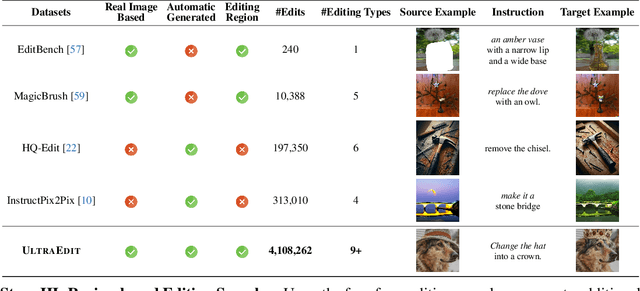
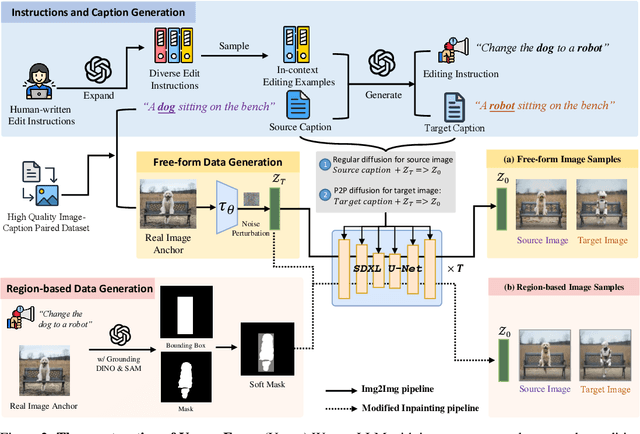
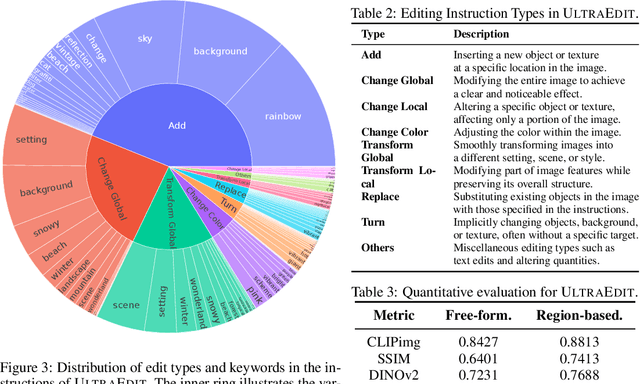
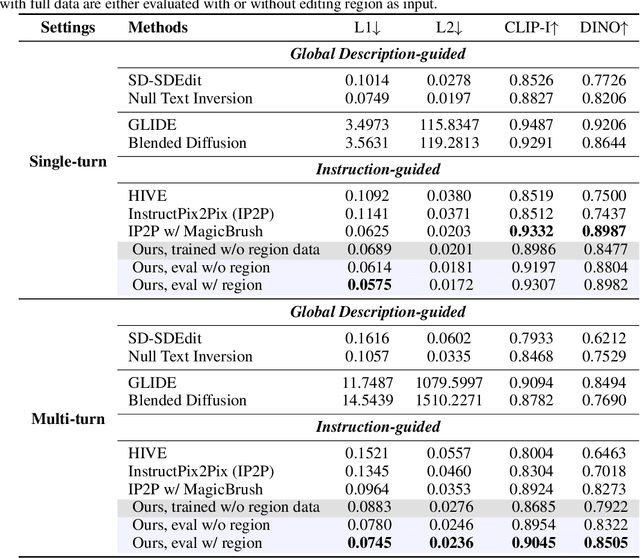
This paper presents UltraEdit, a large-scale (approximately 4 million editing samples), automatically generated dataset for instruction-based image editing. Our key idea is to address the drawbacks in existing image editing datasets like InstructPix2Pix and MagicBrush, and provide a systematic approach to producing massive and high-quality image editing samples. UltraEdit offers several distinct advantages: 1) It features a broader range of editing instructions by leveraging the creativity of large language models (LLMs) alongside in-context editing examples from human raters; 2) Its data sources are based on real images, including photographs and artworks, which provide greater diversity and reduced bias compared to datasets solely generated by text-to-image models; 3) It also supports region-based editing, enhanced by high-quality, automatically produced region annotations. Our experiments show that canonical diffusion-based editing baselines trained on UltraEdit set new records on MagicBrush and Emu-Edit benchmarks. Our analysis further confirms the crucial role of real image anchors and region-based editing data. The dataset, code, and models can be found in https://ultra-editing.github.io.
MMEvalPro: Calibrating Multimodal Benchmarks Towards Trustworthy and Efficient Evaluation
Jun 29, 2024


Large Multimodal Models (LMMs) exhibit impressive cross-modal understanding and reasoning abilities, often assessed through multiple-choice questions (MCQs) that include an image, a question, and several options. However, many benchmarks used for such evaluations suffer from systematic biases. Remarkably, Large Language Models (LLMs) without any visual perception capabilities achieve non-trivial performance, undermining the credibility of these evaluations. To address this issue while maintaining the efficiency of MCQ evaluations, we propose MMEvalPro, a benchmark designed to avoid Type-I errors through a trilogy evaluation pipeline and more rigorous metrics. For each original question from existing benchmarks, human annotators augment it by creating one perception question and one knowledge anchor question through a meticulous annotation process. MMEvalPro comprises $2,138$ question triplets, totaling $6,414$ distinct questions. Two-thirds of these questions are manually labeled by human experts, while the rest are sourced from existing benchmarks (MMMU, ScienceQA, and MathVista). Compared with the existing benchmarks, our experiments with the latest LLMs and LMMs demonstrate that MMEvalPro is more challenging (the best LMM lags behind human performance by $31.73\%$, compared to an average gap of $8.03\%$ in previous benchmarks) and more trustworthy (the best LLM trails the best LMM by $23.09\%$, whereas the gap for previous benchmarks is just $14.64\%$). Our in-depth analysis explains the reason for the large performance gap and justifies the trustworthiness of evaluation, underscoring its significant potential for advancing future research.