 Add to Chrome
 Add to Firefox
 Add to Edge
Echoes within the Reasoning: Stealthy and Effective Watermarking via Chain of Thought
May 27, 2026
Large Language Models with Chain-of-Thought reasoning capabilities represent valuable intellectual property, yet existing black-box watermarking methods often trade robustness for reasoning fidelity by perturbing final answers or relying on fragile trigger patterns. We propose BiCoT, a watermarking framework that embeds ownership signals into the internal geometry of reasoning traces by aligning high-saliency structural anchors with a private signature subspace while regularizing ordinary control tokens to preserve semantic capacity. This design couples the watermark with reasoning-relevant representations, making removal difficult without disrupting the features that support coherent reasoning. To enable verification under model theft and representation drift, we introduce Robust Subspace Registration (RSR), a Top- logprob-based black-box verifier that uses sentinel tokens to calibrate systematic shifts in the output distribution. Experiments show that BiCoT preserves reasoning fidelity across diverse complex reasoning tasks while achieving robust detection under fine-tuning, quantization, model-level perturbations, and adaptive output-level attacks across in-domain and out-of-distribution settings.

Calibrated Speculative Decoding: Frequency-Guided Candidate Selection for Efficient Inference
Apr 15, 2026Speculative decoding accelerates autoregressive generation by letting draft tokens bypass full verification, but conventional frameworks suffer from frequent false rejections, particularly when draft models produce semantically correct but lexically divergent outputs. In this paper, we present Calibrated Speculative Decoding (CSD), a training-free framework that recovers valid tokens discarded by standard verification. Guided by the principle of "Frequency-Guided Candidate Selection and Probability-Guarded Acceptance," CSD incorporates two lightweight modules: Online Correction Memory, which aggregates historical rejections to propose recurring divergence patterns as rescue candidates, and Semantic Consistency Gating, which verifies candidate admissibility using probability ratios instead of exact token matching. Our evaluation across diverse large language models demonstrates that CSD outperforms existing methods, achieving a peak throughput speedup of 2.33x. CSD preserves model accuracy across all tasks while further boosting performance on complex reasoning datasets. These results establish CSD as a highly effective, lightweight solution for practical LLM deployments.
FedMomentum: Preserving LoRA Training Momentum in Federated Fine-Tuning
Mar 09, 2026Federated fine-tuning of large language models (LLMs) with low-rank adaptation (LoRA) offers a communication-efficient and privacy-preserving solution for task-specific adaptation. Naive aggregation of LoRA modules introduces noise due to mathematical incorrectness when averaging the downsampling and upsampling matrices independently. However, existing noise-free aggregation strategies inevitably compromise the structural expressiveness of LoRA, limiting its ability to retain client-specific adaptations by either improperly reconstructing the low-rank structure or excluding partially trainable components. We identify this problem as loss of training momentum, where LoRA updates fail to accumulate effectively across rounds, resulting in slower convergence and suboptimal performance. To address this, we propose FedMomentum, a novel framework that enables structured and momentum-preserving LoRA aggregation via singular value decomposition (SVD). Specifically, after aggregating low-rank updates in a mathematically correct manner, FedMomentum applies SVD to extract the dominant components that capture the main update directions. These components are used to reconstruct the LoRA modules with the same rank, while residual components can be retained and later merged into the backbone to preserve semantic information and ensure robustness. Extensive experiments across multiple tasks demonstrate that FedMomentum consistently outperforms prior state-of-the-art methods in convergence speed and final accuracy.
SettleFL: Trustless and Scalable Reward Settlement Protocol for Federated Learning on Permissionless Blockchains (Extended version)
Feb 26, 2026In open Federated Learning (FL) environments where no central authority exists, ensuring collaboration fairness relies on decentralized reward settlement, yet the prohibitive cost of permissionless blockchains directly clashes with the high-frequency, iterative nature of model training. Existing solutions either compromise decentralization or suffer from scalability bottlenecks due to linear on-chain costs. To address this, we present SettleFL, a trustless and scalable reward settlement protocol designed to minimize total economic friction by offering a family of two interoperable protocols. Leveraging a shared domain-specific circuit architecture, SettleFL offers two interoperable strategies: (1) a Commit-and-Challenge variant that minimizes on-chain costs via optimistic execution and dispute-driven arbitration, and (2) a Commit-with-Proof variant that guarantees instant finality through per-round validity proofs. This design allows the protocol to flexibly adapt to varying latency and cost constraints while enforcing rational robustness without trusted coordination. We conduct extensive experiments combining real FL workloads and controlled simulations. Results show that SettleFL remains practical when scaling to 800 participants, achieving substantially lower gas cost.
pFedNavi: Structure-Aware Personalized Federated Vision-Language Navigation for Embodied AI
Feb 16, 2026Vision-Language Navigation VLN requires large-scale trajectory instruction data from private indoor environments, raising significant privacy concerns. Federated Learning FL mitigates this by keeping data on-device, but vanilla FL struggles under VLNs' extreme cross-client heterogeneity in environments and instruction styles, making a single global model suboptimal. This paper proposes pFedNavi, a structure-aware and dynamically adaptive personalized federated learning framework tailored for VLN. Our key idea is to personalize where it matters: pFedNavi adaptively identifies client-specific layers via layer-wise mixing coefficients, and performs fine-grained parameter fusion on the selected components (e.g., the encoder-decoder projection and environment-sensitive decoder layers) to balance global knowledge sharing with local specialization. We evaluate pFedNavi on two standard VLN benchmarks, R2R and RxR, using both ResNet and CLIP visual representations. Across all metrics, pFedNavi consistently outperforms the FedAvg-based VLN baseline, achieving up to 7.5% improvement in navigation success rate and up to 7.8% gain in trajectory fidelity, while converging 1.38x faster under non-IID conditions.
HyperOffload: Graph-Driven Hierarchical Memory Management for Large Language Models on SuperNode Architectures
Feb 03, 2026The rapid evolution of Large Language Models (LLMs) towards long-context reasoning and sparse architectures has pushed memory requirements far beyond the capacity of individual device HBM. While emerging supernode architectures offer terabyte-scale shared memory pools via high-bandwidth interconnects, existing software stacks fail to exploit this hardware effectively. Current runtime-based offloading and swapping techniques operate with a local view, leading to reactive scheduling and exposed communication latency that stall the computation pipeline. In this paper, we propose the SuperNode Memory Management Framework (\textbf{HyperOffload}). It employs a compiler-assisted approach that leverages graph-driven memory management to treat remote memory access as explicit operations in the computation graph, specifically designed for hierarchical SuperNode architectures. Unlike reactive runtime systems, SuperNode represents data movement using cache operators within the compiler's Intermediate Representation (IR). This design enables a global, compile-time analysis of tensor lifetimes and execution dependencies. Leveraging this visibility, we develop a global execution-order refinement algorithm that statically schedules data transfers to hide remote memory latency behind compute-intensive regions. We implement SuperNode within the production deep learning framework MindSpore, adding a remote memory backend and specialized compiler passes. Evaluation on representative LLM workloads shows that SuperNode reduces peak device memory usage by up to 26\% for inference while maintaining end-to-end performance. Our work demonstrates that integrating memory-augmented hardware into the compiler's optimization framework is essential for scaling next-generation AI workloads.
SpecQuant: Spectral Decomposition and Adaptive Truncation for Ultra-Low-Bit LLMs Quantization
Nov 11, 2025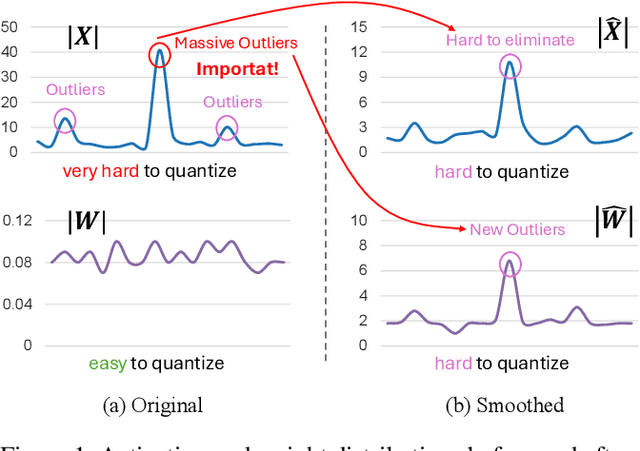
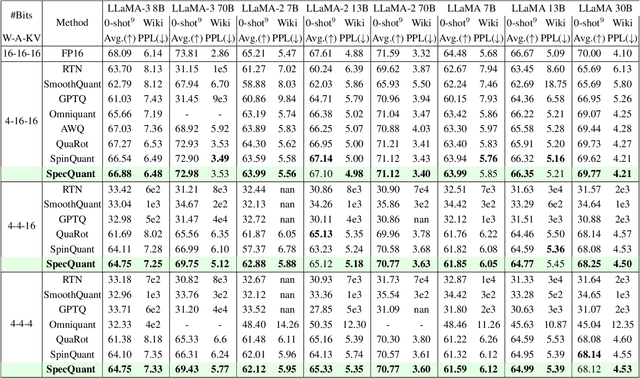
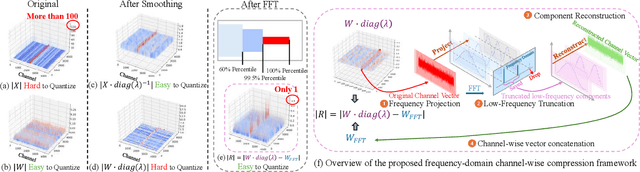
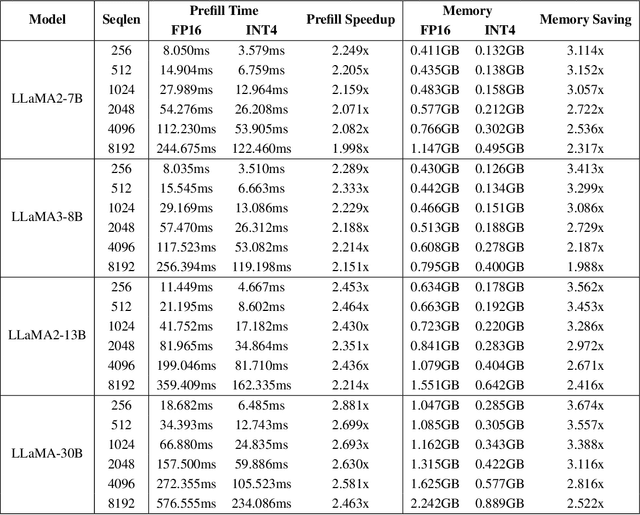
The emergence of accurate open large language models (LLMs) has sparked a push for advanced quantization techniques to enable efficient deployment on end-user devices. In this paper, we revisit the challenge of extreme LLM compression -- targeting ultra-low-bit quantization for both activations and weights -- from a Fourier frequency domain perspective. We propose SpecQuant, a two-stage framework that tackles activation outliers and cross-channel variance. In the first stage, activation outliers are smoothed and transferred into the weight matrix to simplify downstream quantization. In the second stage, we apply channel-wise low-frequency Fourier truncation to suppress high-frequency components while preserving essential signal energy, improving quantization robustness. Our method builds on the principle that most of the weight energy is concentrated in low-frequency components, which can be retained with minimal impact on model accuracy. To enable runtime adaptability, we introduce a lightweight truncation module during inference that adjusts truncation thresholds based on channel characteristics. On LLaMA-3 8B, SpecQuant achieves 4-bit quantization for both weights and activations, narrowing the zero-shot accuracy gap to only 1.5% compared to full precision, while delivering 2 times faster inference and 3times lower memory usage.
QUARK: Quantization-Enabled Circuit Sharing for Transformer Acceleration by Exploiting Common Patterns in Nonlinear Operations
Nov 10, 2025Transformer-based models have revolutionized computer vision (CV) and natural language processing (NLP) by achieving state-of-the-art performance across a range of benchmarks. However, nonlinear operations in models significantly contribute to inference latency, presenting unique challenges for efficient hardware acceleration. To this end, we propose QUARK, a quantization-enabled FPGA acceleration framework that leverages common patterns in nonlinear operations to enable efficient circuit sharing, thereby reducing hardware resource requirements. QUARK targets all nonlinear operations within Transformer-based models, achieving high-performance approximation through a novel circuit-sharing design tailored to accelerate these operations. Our evaluation demonstrates that QUARK significantly reduces the computational overhead of nonlinear operators in mainstream Transformer architectures, achieving up to a 1.96 times end-to-end speedup over GPU implementations. Moreover, QUARK lowers the hardware overhead of nonlinear modules by more than 50% compared to prior approaches, all while maintaining high model accuracy -- and even substantially boosting accuracy under ultra-low-bit quantization.
POLAR: Policy-based Layerwise Reinforcement Learning Method for Stealthy Backdoor Attacks in Federated Learning
Oct 21, 2025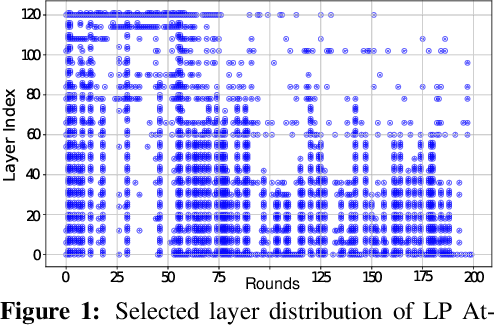
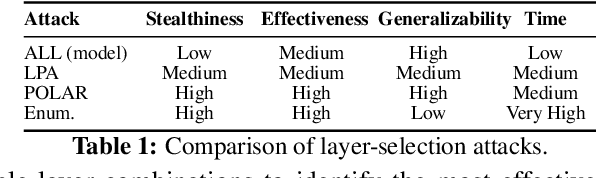
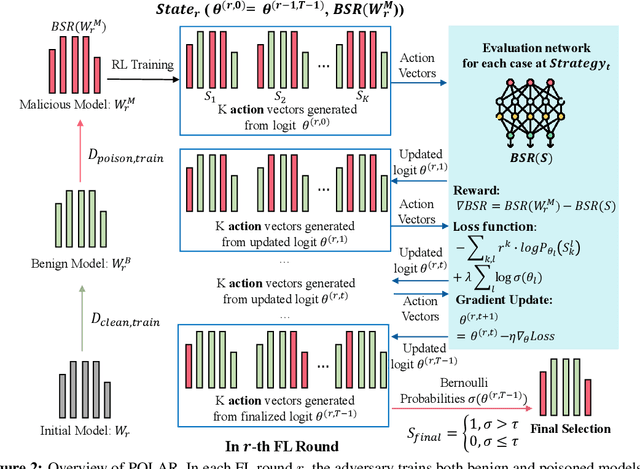
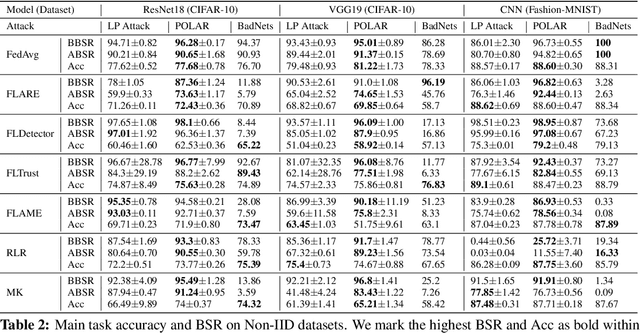
Federated Learning (FL) enables decentralized model training across multiple clients without exposing local data, but its distributed feature makes it vulnerable to backdoor attacks. Despite early FL backdoor attacks modifying entire models, recent studies have explored the concept of backdoor-critical (BC) layers, which poison the chosen influential layers to maintain stealthiness while achieving high effectiveness. However, existing BC layers approaches rely on rule-based selection without consideration of the interrelations between layers, making them ineffective and prone to detection by advanced defenses. In this paper, we propose POLAR (POlicy-based LAyerwise Reinforcement learning), the first pipeline to creatively adopt RL to solve the BC layer selection problem in layer-wise backdoor attack. Different from other commonly used RL paradigm, POLAR is lightweight with Bernoulli sampling. POLAR dynamically learns an attack strategy, optimizing layer selection using policy gradient updates based on backdoor success rate (BSR) improvements. To ensure stealthiness, we introduce a regularization constraint that limits the number of modified layers by penalizing large attack footprints. Extensive experiments demonstrate that POLAR outperforms the latest attack methods by up to 40% against six state-of-the-art (SOTA) defenses.
Dissecting the Impact of Mobile DVFS Governors on LLM Inference Performance and Energy Efficiency
Jul 02, 2025Large Language Models (LLMs) are increasingly being integrated into various applications and services running on billions of mobile devices. However, deploying LLMs on resource-limited mobile devices faces a significant challenge due to their high demand for computation, memory, and ultimately energy. While current LLM frameworks for mobile use three power-hungry components-CPU, GPU, and Memory-even when running primarily-GPU LLM models, optimized DVFS governors for CPU, GPU, and memory featured in modern mobile devices operate independently and are oblivious of each other. Motivated by the above observation, in this work, we first measure the energy-efficiency of a SOTA LLM framework consisting of various LLM models on mobile phones which showed the triplet mobile governors result in up to 40.4% longer prefilling and decoding latency compared to optimal combinations of CPU, GPU, and memory frequencies with the same energy consumption for sampled prefill and decode lengths. Second, we conduct an in-depth measurement study to uncover how the intricate interplay (or lack of) among the mobile governors cause the above inefficiency in LLM inference. Finally, based on these insights, we design FUSE - a unified energy-aware governor for optimizing the energy efficiency of LLM inference on mobile devices. Our evaluation using a ShareGPT dataset shows FUSE reduces the time-to-first-token and time-per-output-token latencies by 7.0%-16.9% and 25.4%-36.8% on average with the same energy-per-token for various mobile LLM models.