 Add to Chrome
 Add to Firefox
 Add to Edge
Deltoris: Enabling Real-time VLA Inference in Embodied AI via Bit-level Sparsity and Speculative Inference
Aug 05, 2026
Vision-language-action (VLA) models have emerged as a key component in embodied AI. Among existing approaches, diffusion-based VLA models achieve superior motion quality and generalization. However, diffusion-based VLA models are compute-intensive and must run at high control frequency, e.g., 50-200 Hz. Thus, it imposes strict latency and energy constraints on edge devices. In this work, we present Deltoris, an algorithm-hardware co-design framework for efficient diffusion-based VLA inference. First, we exploit the temporal similarity of consecutive inputs and propose a \textit{temporal-aware bit-sparsity} algorithm that computes only the differences between consecutive inputs, eliminating redundant bit-level operations. To further address the extra off-chip traffic introduced by our algorithm, we propose a \textit{speculative inference} technique, which amortizes data loading across multiple control steps. Lastly, to support these techniques, we co-design a dedicated accelerator with customized 1D systolic bit-serial PE arrays that eliminate PE workload imbalance. Our evaluation shows that Deltoris achieves up to 34.2$\times$ speedup over mobile GPUs and 6.1$\times$ over prior accelerators, while maintaining comparable accuracy.

DeGS: A Scalable 3DGS Architecture via Decoupled Workload Parsing and Reorganization
Aug 03, 20263D Gaussian Splatting (3DGS) has emerged as a leading technique for real-time novel view synthesis, yet existing 3DGS accelerators suffer from poor architectural scalability: increasing the number of PEs leads to marginal performance improvement during rendering. We identify that the root cause is the tightly coupled ``checking-while-blending'' dataflow, which exacerbates PE underutilization caused by spatial redundancy from irregular Gaussian coverage and temporal redundancy from asynchronous pixel-wise termination under parallel execution. To address this issue, we propose DeGS, a scalable architecture for efficient 3DGS inference. To systematically eliminate the redundancies inherent in rendering, DeGS exploits a decoupled dataflow, restructuring the coupled $α$-checking, transmittance checking, and $α$-blending of the standard rendering process into consecutive workload parsing, reorganization, and blending stages. This allows the fragmented, length-variable, and temporal-dependent workloads to be reorganized into compact, conflict-free, and dense workloads prior to blending, thereby significantly improving PE utilization during parallel blending. Implemented in 28 nm technology, DeGS achieves 2.36$\times$--7.25$\times$ throughput, 1.82$\times$--6.02$\times$ end-to-end speedup, and 1.59$\times$--4.42$\times$ energy efficiency over state-of-the-art 3DGS accelerators (GSCore, GBU, GCC) across diverse scenes and resolutions (720p to 8K). Moreover, scaling from 16 to 1024 PEs, DeGS maintains over 80\% PE utilization at high resolutions, significantly outperforming existing accelerators.
Bole: Efficient Tree Speculation for Hybrid-Attention Language Models
Aug 03, 2026Hybrid-attention large language models combine full attention with recurrent linear attention to reduce long-context inference costs, yet their autoregressive decoding remains memory-bound. Tree speculative decoding offers an attractive acceleration path, but existing tree-speculation systems are designed around the key--value caches of full-attention models. On hybrid models, they traverse recurrent layers branch by branch and materialize a full state for every proposal node, causing verification latency and transient memory to scale poorly with tree and batch sizes. We present Bole, a kernel--runtime co-design that enables efficient tree speculation for hybrid-attention LLMs. Bole transforms the linear-attention recurrence into a tree-structured closed form and realizes it with a resource-efficient GPU kernel, verifying all proposal nodes in parallel and accelerating linear-attention tree verification by 3.4--7.7$\times$. It losslessly encodes speculative state updates as token-level factors and reconstructs only the state selected after sampling, reducing transient state memory by 82--99$\times$ and freeing GPU capacity for KV caches. Its integration into SGLang, a widely deployed production LLM serving engine, couples efficient state management with a batch-wide verification budget calibrated to the complete hybrid forward. Across four models, two GPU platforms, and diverse datasets, Bole delivers up to $4.72\times$ the offline decode throughput of autoregressive decoding and up to $2.03\times$ that of the strongest tree-speculative baseline. Under online agent workloads, it reduces TTFT and TPOT by up to $67.6%$ and $49.9%$, respectively, over the strongest tree-speculative baseline.
TaPR: Test-Aware Policy Refinement for Feedback-Conditioned Code Generation
Aug 01, 2026Multi-turn code agents rely on execution feedback to repair incorrect programs, yet standard reinforcement learning paradigms optimize and evaluate policy performance primarily using single-shot outcome rewards. This misalignment conflates initial code generation with feedback-driven refinement, discards granular execution signals across intermediate turns, and fails to evaluate whether the policy actually acquires self-repair capabilities. We propose Test-aware Policy Refinement (TaPR), a framework that transforms execution feedback into a dense per-turn test-pass-ratio reward under a consistent multi-turn interaction protocol. Across six models on 219 code-generation problems from LiveCodeBench, TaPR improves the pooled three-turn success rate (Pass@3) by 2.44 percentage points. In the predefined 7B/8B high-headroom slice, pooled accuracy increases from 30.25% to 33.56% (+3.31 pp), with 42 improvements and 13 regressions in paired trials. On a matched Qwen3-8B ablation, the dense reward supplies nonzero feedback in all of the first ten steps and reaches a higher Hard-subset peak than outcome-only GRPO within the tested budget, although GRPO nearly matches pooled Pass@3 by step 300. Our primary contribution is a reward-decomposition framework and a turn-aware evaluation protocol that decouple first-shot generation quality from multi-turn repair competence.
CURE: Local Uncertainty Repair for Block-Parallel Speculative Decoding
Aug 01, 2026Speculative decoding mitigates the latency of sequential generation in autoregressive Large Language Models (LLMs) by interleaving draft generation with target verification. However, existing parallel drafting backends often suffer from rapid accuracy degradation over long horizons, leading to high rejection rates during verification and suboptimal wall-clock speedups. We observe that drafting errors are not uniformly distributed but typically stem from localized high-uncertainty tokens that destabilize downstream generation trajectories. Motivated by this token error pattern, we propose CURE, a budget-aware dynamic repair tree designed to repair errors at uncertainty focal points without incurring prohibitive tree-verification overheads. Specifically, our method uses predictive confidence margins to dynamically locate candidate error tokens within a block-parallel draft, expands bounded repair paths only at these fragile nodes, and employs a novel repair resynchronization mechanism to realign draft states post-verification. Evaluations on code-generation benchmarks (HumanEval, MBPP, and LiveCodeBench-lite) and mathematical reasoning benchmark (GSM8K) demonstrate that CURE increases the average accepted length by 4.2-7.5% over parallel baselines without repair, translating to an end-to-end speedup of $2.66-3.49\times$ over target-only decoding. Furthermore, we provide a plug-and-play repair module compatible with standard parallel drafting frameworks. We also characterize the trade-off between draft compute and verification efficiency.
From Craft to Kernel: A Governance-First Execution Architecture and Semantic ISA for Agentic Computers
Apr 20, 2026The transition of agentic AI from brittle prototypes to production systems is stalled by a pervasive crisis of craft. We suggest that the prevailing orchestration paradigm-delegating the system control loop to large language models and merely patching with heuristic guardrails-is the root cause of this fragility. Instead, we propose Arbiter-K, a Governance-First execution architecture that reconceptualizes the underlying model as a Probabilistic Processing Unit encapsulated by a deterministic, neuro-symbolic kernel. Arbiter-K implements a Semantic Instruction Set Architecture (ISA) to reify probabilistic messages into discrete instructions. This allows the kernel to maintain a Security Context Registry and construct an Instruction Dependency Graph at runtime, enabling active taint propagation based on the data-flow pedigree of each reasoning node. By leveraging this mechanism, Arbiter-K precisely interdicts unsafe trajectories at deterministic sinks (e.g., high-risk tool calls or unauthorized network egress) and enables autonomous execution correction and architectural rollback when security policies are triggered. Evaluations on OpenClaw and NanoBot demonstrate that Arbiter-K enforces security as a microarchitectural property, achieving 76% to 95% unsafe interception for a 92.79% absolute gain over native policies. The code is publicly available at https://github.com/cure-lab/ArbiterOS.
Calibrated Speculative Decoding: Frequency-Guided Candidate Selection for Efficient Inference
Apr 15, 2026Speculative decoding accelerates autoregressive generation by letting draft tokens bypass full verification, but conventional frameworks suffer from frequent false rejections, particularly when draft models produce semantically correct but lexically divergent outputs. In this paper, we present Calibrated Speculative Decoding (CSD), a training-free framework that recovers valid tokens discarded by standard verification. Guided by the principle of "Frequency-Guided Candidate Selection and Probability-Guarded Acceptance," CSD incorporates two lightweight modules: Online Correction Memory, which aggregates historical rejections to propose recurring divergence patterns as rescue candidates, and Semantic Consistency Gating, which verifies candidate admissibility using probability ratios instead of exact token matching. Our evaluation across diverse large language models demonstrates that CSD outperforms existing methods, achieving a peak throughput speedup of 2.33x. CSD preserves model accuracy across all tasks while further boosting performance on complex reasoning datasets. These results establish CSD as a highly effective, lightweight solution for practical LLM deployments.
HyperOffload: Graph-Driven Hierarchical Memory Management for Large Language Models on SuperNode Architectures
Feb 03, 2026The rapid evolution of Large Language Models (LLMs) towards long-context reasoning and sparse architectures has pushed memory requirements far beyond the capacity of individual device HBM. While emerging supernode architectures offer terabyte-scale shared memory pools via high-bandwidth interconnects, existing software stacks fail to exploit this hardware effectively. Current runtime-based offloading and swapping techniques operate with a local view, leading to reactive scheduling and exposed communication latency that stall the computation pipeline. In this paper, we propose the SuperNode Memory Management Framework (\textbf{HyperOffload}). It employs a compiler-assisted approach that leverages graph-driven memory management to treat remote memory access as explicit operations in the computation graph, specifically designed for hierarchical SuperNode architectures. Unlike reactive runtime systems, SuperNode represents data movement using cache operators within the compiler's Intermediate Representation (IR). This design enables a global, compile-time analysis of tensor lifetimes and execution dependencies. Leveraging this visibility, we develop a global execution-order refinement algorithm that statically schedules data transfers to hide remote memory latency behind compute-intensive regions. We implement SuperNode within the production deep learning framework MindSpore, adding a remote memory backend and specialized compiler passes. Evaluation on representative LLM workloads shows that SuperNode reduces peak device memory usage by up to 26\% for inference while maintaining end-to-end performance. Our work demonstrates that integrating memory-augmented hardware into the compiler's optimization framework is essential for scaling next-generation AI workloads.
SpecQuant: Spectral Decomposition and Adaptive Truncation for Ultra-Low-Bit LLMs Quantization
Nov 11, 2025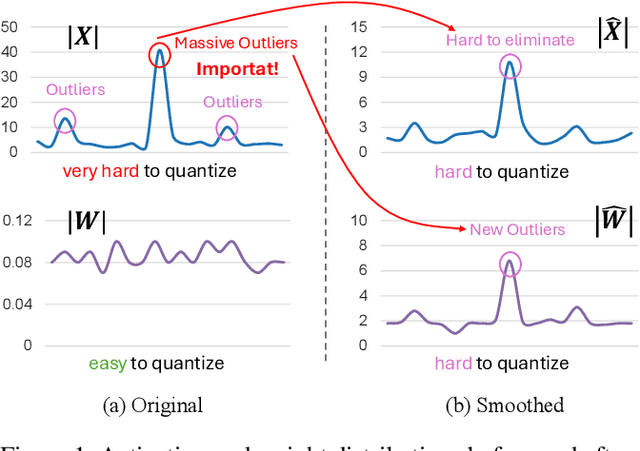
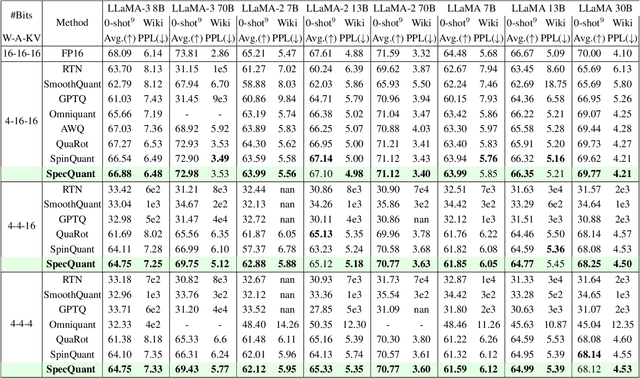
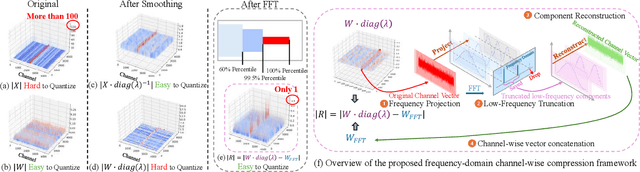
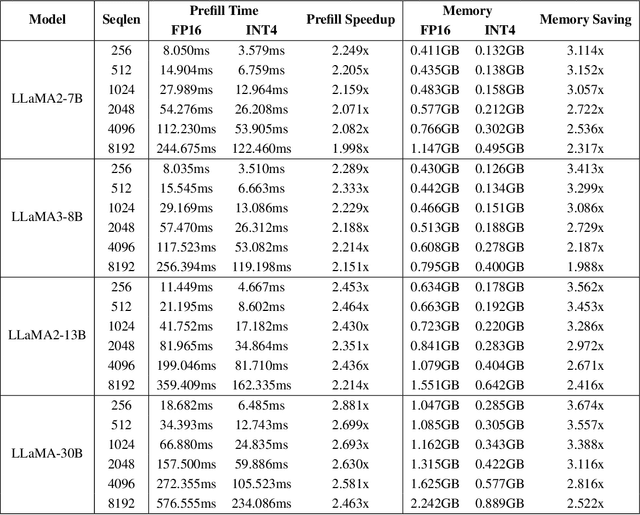
The emergence of accurate open large language models (LLMs) has sparked a push for advanced quantization techniques to enable efficient deployment on end-user devices. In this paper, we revisit the challenge of extreme LLM compression -- targeting ultra-low-bit quantization for both activations and weights -- from a Fourier frequency domain perspective. We propose SpecQuant, a two-stage framework that tackles activation outliers and cross-channel variance. In the first stage, activation outliers are smoothed and transferred into the weight matrix to simplify downstream quantization. In the second stage, we apply channel-wise low-frequency Fourier truncation to suppress high-frequency components while preserving essential signal energy, improving quantization robustness. Our method builds on the principle that most of the weight energy is concentrated in low-frequency components, which can be retained with minimal impact on model accuracy. To enable runtime adaptability, we introduce a lightweight truncation module during inference that adjusts truncation thresholds based on channel characteristics. On LLaMA-3 8B, SpecQuant achieves 4-bit quantization for both weights and activations, narrowing the zero-shot accuracy gap to only 1.5% compared to full precision, while delivering 2 times faster inference and 3times lower memory usage.
QUARK: Quantization-Enabled Circuit Sharing for Transformer Acceleration by Exploiting Common Patterns in Nonlinear Operations
Nov 10, 2025Transformer-based models have revolutionized computer vision (CV) and natural language processing (NLP) by achieving state-of-the-art performance across a range of benchmarks. However, nonlinear operations in models significantly contribute to inference latency, presenting unique challenges for efficient hardware acceleration. To this end, we propose QUARK, a quantization-enabled FPGA acceleration framework that leverages common patterns in nonlinear operations to enable efficient circuit sharing, thereby reducing hardware resource requirements. QUARK targets all nonlinear operations within Transformer-based models, achieving high-performance approximation through a novel circuit-sharing design tailored to accelerate these operations. Our evaluation demonstrates that QUARK significantly reduces the computational overhead of nonlinear operators in mainstream Transformer architectures, achieving up to a 1.96 times end-to-end speedup over GPU implementations. Moreover, QUARK lowers the hardware overhead of nonlinear modules by more than 50% compared to prior approaches, all while maintaining high model accuracy -- and even substantially boosting accuracy under ultra-low-bit quantization.