 Add to Chrome
 Add to Firefox
 Add to Edge
From LLM Inference to Agentic Workloads: Characterization and Implications for Serving Systems
Aug 15, 2026
Agentic applications are shifting AI serving from isolated model inference to long-running workloads in which LLMs coordinate tools, environments, and persistent state. However, the system behavior of these workloads---where latency, cost, and bottlenecks arise---remains poorly characterized, leaving serving systems to rely on assumptions built for conventional inference. We present AgentSysBench, a benchmark suite and measurement toolkit with ten representative agentic applications and unified systems-level instrumentation. Across controlled deployments and production traces, we identify six properties that distinguish agentic workloads from conventional LLM serving: (1) execution is heavyweight and stateful, with non-LLM components dominating latency in 5 of 10 applications and sandbox working-set memory peaking at 28 GB per session; (2) applications compose components with heterogeneous resource affinity---GPU-bound inference, memory-bound retrieval, CPU-bound sandboxes---whose task latencies diverge by up to 32x; (3) bottlenecks shift across requests, models, and deployments; (4) production sessions hold state idle for minutes to hours between active steps; (5) a control-plane tax---auxiliary LLM calls and context overhead from tool schemas and observations---crowds out productive compute and context; and (6) production traces from three applications reveal heavy cross-request redundancy in search queries and web fetches, exposing a large caching opportunity. Four design explorations demonstrate that these findings are actionable: task-aware serving reduces latency by 29--40%, communication-aware placement by up to 4.5x, state offloading reduces memory usage by 4.6x, and tool-result caching removes 35.2% of redundant search calls and saves 19.3% of aggregate search latency.

Rollplex: Cross-Phase GPU Spatial Sharing for Vision Language Model Post-Training
Aug 14, 2026Vision-language models (VLMs) enable embodied agents to reason and act from visual observations and language instructions. Reinforcement learning (RL) post-training enhances these capabilities using task feedback, but current on-policy RL runtimes execute rollout, reference scoring, and actor training in strict serial phases. While effective for text-only RL, this phase-granular execution is wasteful for VLMs, where processing dense video inputs and prompt prefixes occupies a large fraction of each phase. Because prefix processing is independent of the generated response, it can be run alongside rollout decoding, which leaves GPU compute capacity underutilized, without breaking synchronous on-policy semantics. We present Rollplex, a runtime that decomposes the reference and training phase and moves the prefix computation into the rollout decode window. Realizing this schedule requires more than concurrent kernel launches: naive colocation of Qwen2.5-VL-32\,B requires roughly 165\,GiB per GPU, while rollout and training prefer different tensor-parallel (TP) degrees and weight layouts. Rollplex addresses these constraints with two mechanisms. Phase-aware memory management controls HBM residency according to producer--consumer lifetimes. Parallelism-aware weight sharing uses the same physical storage for layout-compatible tensors across distinct TP degrees and reconstructs only incompatible tensors, avoiding a complete second actor copy. On 32 H800 GPUs, Rollplex achieves $1.23\times$--$1.30\times$ speedup over serial colocation and $1.57\times$--$2.24\times$ over disaggregation under the same GPU budget, while preserving the synchronous RL update.
SwiftDiffusion: Efficient Diffusion Model Serving with Add-on Modules
Jul 02, 2024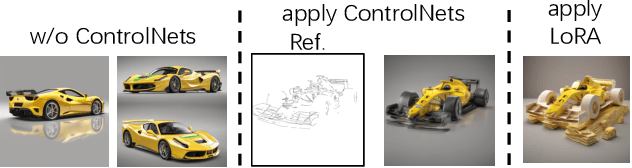
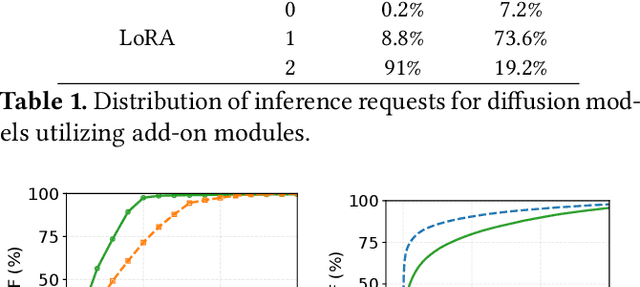
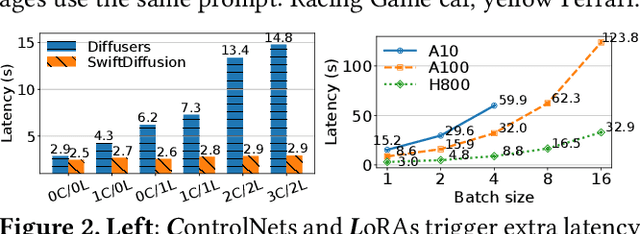

This paper documents our characterization study and practices for serving text-to-image requests with stable diffusion models in production. We first comprehensively analyze inference request traces for commercial text-to-image applications. It commences with our observation that add-on modules, i.e., ControlNets and LoRAs, that augment the base stable diffusion models, are ubiquitous in generating images for commercial applications. Despite their efficacy, these add-on modules incur high loading overhead, prolong the serving latency, and swallow up expensive GPU resources. Driven by our characterization study, we present SwiftDiffusion, a system that efficiently generates high-quality images using stable diffusion models and add-on modules. To achieve this, SwiftDiffusion reconstructs the existing text-to-image serving workflow by identifying the opportunities for parallel computation and distributing ControlNet computations across multiple GPUs. Further, SwiftDiffusion thoroughly analyzes the dynamics of image generation and develops techniques to eliminate the overhead associated with LoRA loading and patching while preserving the image quality. Last, SwiftDiffusion proposes specialized optimizations in the backbone architecture of the stable diffusion models, which are also compatible with the efficient serving of add-on modules. Compared to state-of-the-art text-to-image serving systems, SwiftDiffusion reduces serving latency by up to 5x and improves serving throughput by up to 2x without compromising image quality.