 Add to Chrome
 Add to Firefox
 Add to Edge
Auto MC-Reward: Automated Dense Reward Design with Large Language Models for Minecraft
Dec 14, 2023

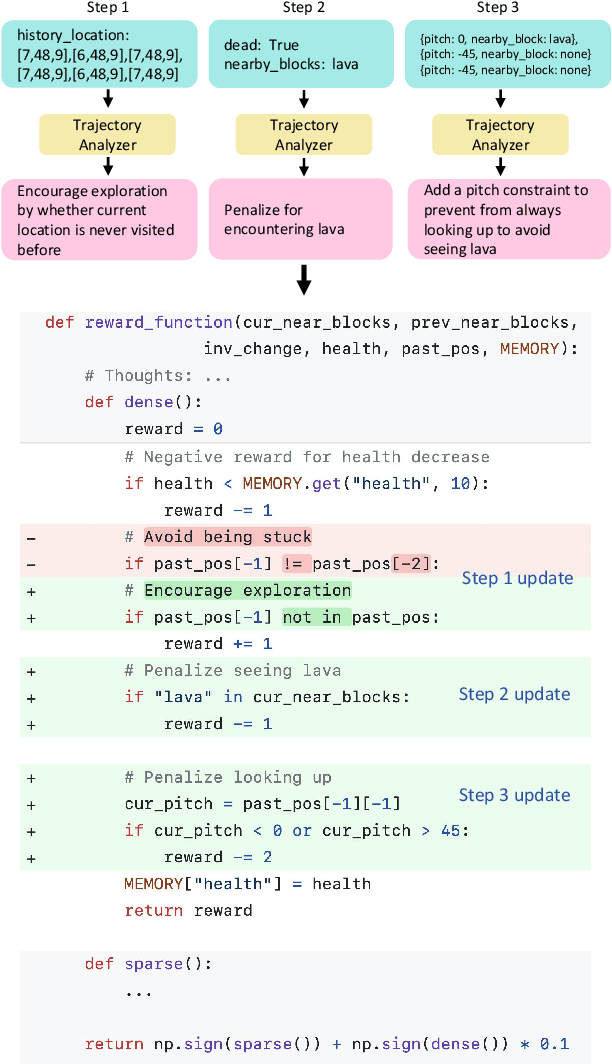


Traditional reinforcement-learning-based agents rely on sparse rewards that often only use binary values to indicate task completion or failure. The challenge in exploration efficiency makes it difficult to effectively learn complex tasks in Minecraft. To address this, this paper introduces an advanced learning system, named Auto MC-Reward, that leverages Large Language Models (LLMs) to automatically design dense reward functions, thereby enhancing the learning efficiency. Auto MC-Reward consists of three important components: Reward Designer, Reward Critic, and Trajectory Analyzer. Given the environment information and task descriptions, the Reward Designer first design the reward function by coding an executable Python function with predefined observation inputs. Then, our Reward Critic will be responsible for verifying the code, checking whether the code is self-consistent and free of syntax and semantic errors. Further, the Trajectory Analyzer summarizes possible failure causes and provides refinement suggestions according to collected trajectories. In the next round, Reward Designer will take further refine and iterate the dense reward function based on feedback. Experiments demonstrate a significant improvement in the success rate and learning efficiency of our agents in complex tasks in Minecraft, such as obtaining diamond with the efficient ability to avoid lava, and efficiently explore trees and animals that are sparse on the plains biome.

InstructSeq: Unifying Vision Tasks with Instruction-conditioned Multi-modal Sequence Generation
Nov 30, 2023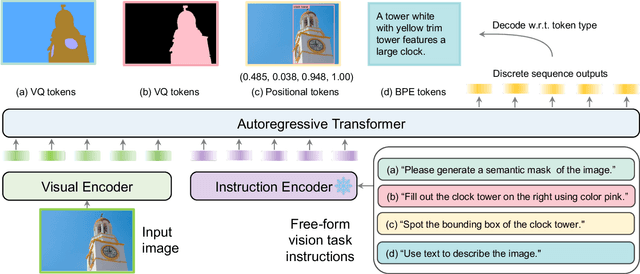
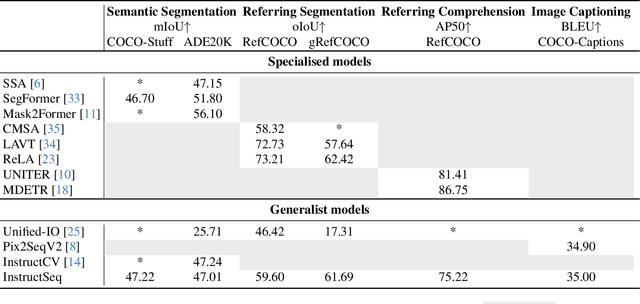
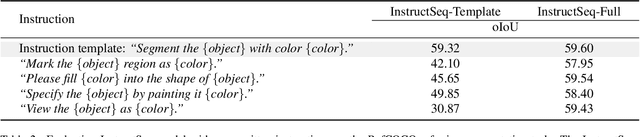
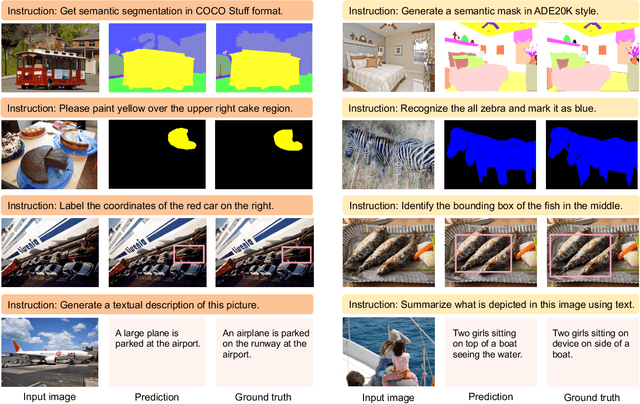
Empowering models to dynamically accomplish tasks specified through natural language instructions represents a promising path toward more capable and general artificial intelligence. In this work, we introduce InstructSeq, an instruction-conditioned multi-modal modeling framework that unifies diverse vision tasks through flexible natural language control and handling of both visual and textual data. InstructSeq employs a multimodal transformer architecture encompassing visual, language, and sequential modeling. We utilize a visual encoder to extract image features and a text encoder to encode instructions. An autoregressive transformer fuses the representations and generates sequential task outputs. By training with LLM-generated natural language instructions, InstructSeq acquires a strong comprehension of free-form instructions for specifying visual tasks. This provides an intuitive interface for directing capabilities using flexible natural instructions. Without any task-specific tuning, InstructSeq achieves compelling performance on semantic segmentation, referring expression segmentation/comprehension, and image captioning. The flexible control and multi-task unification empower the model with more human-like versatility and generalizability for computer vision. The code will be released soon at https://github.com/rongyaofang/InstructSeq.
Point2RBox: Combine Knowledge from Synthetic Visual Patterns for End-to-end Oriented Object Detection with Single Point Supervision
Nov 23, 2023With the rapidly increasing demand for oriented object detection (OOD), recent research involving weakly-supervised detectors for learning rotated box (RBox) from the horizontal box (HBox) has attracted more and more attention. In this paper, we explore a more challenging yet label-efficient setting, namely single point-supervised OOD, and present our approach called Point2RBox. Specifically, we propose to leverage two principles: 1) Synthetic pattern knowledge combination: By sampling around each labelled point on the image, we transfer the object feature to synthetic visual patterns with the known bounding box to provide the knowledge for box regression. 2) Transform self-supervision: With a transformed input image (e.g. scaled/rotated), the output RBoxes are trained to follow the same transformation so that the network can perceive the relative size/rotation between objects. The detector is further enhanced by a few devised techniques to cope with peripheral issues, e.g. the anchor/layer assignment as the size of the object is not available in our point supervision setting. To our best knowledge, Point2RBox is the first end-to-end solution for point-supervised OOD. In particular, our method uses a lightweight paradigm, yet it achieves a competitive performance among point-supervised alternatives, 41.05%/27.62%/80.01% on DOTA/DIOR/HRSC datasets.
ControlLLM: Augment Language Models with Tools by Searching on Graphs
Oct 30, 2023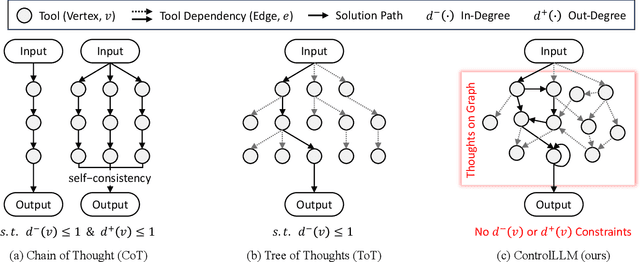
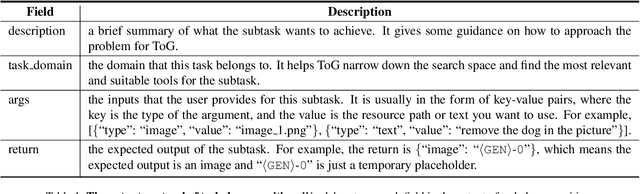
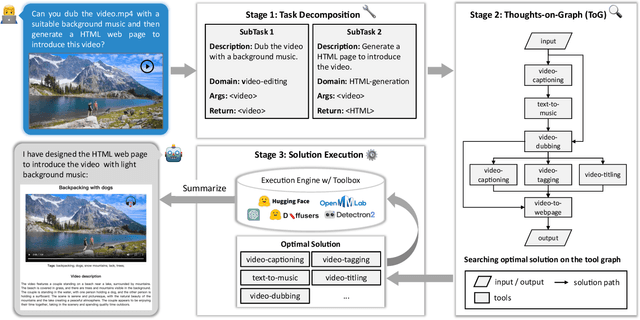
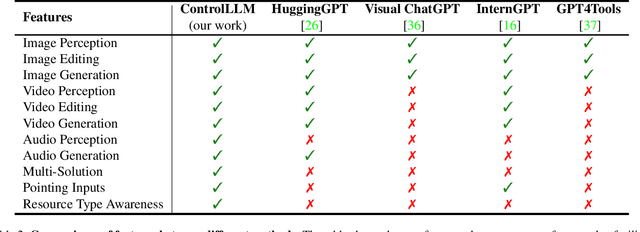
We present ControlLLM, a novel framework that enables large language models (LLMs) to utilize multi-modal tools for solving complex real-world tasks. Despite the remarkable performance of LLMs, they still struggle with tool invocation due to ambiguous user prompts, inaccurate tool selection and parameterization, and inefficient tool scheduling. To overcome these challenges, our framework comprises three key components: (1) a \textit{task decomposer} that breaks down a complex task into clear subtasks with well-defined inputs and outputs; (2) a \textit{Thoughts-on-Graph (ToG) paradigm} that searches the optimal solution path on a pre-built tool graph, which specifies the parameter and dependency relations among different tools; and (3) an \textit{execution engine with a rich toolbox} that interprets the solution path and runs the tools efficiently on different computational devices. We evaluate our framework on diverse tasks involving image, audio, and video processing, demonstrating its superior accuracy, efficiency, and versatility compared to existing methods. The code is at https://github.com/OpenGVLab/ControlLLM .
Mini-DALLE3: Interactive Text to Image by Prompting Large Language Models
Oct 12, 2023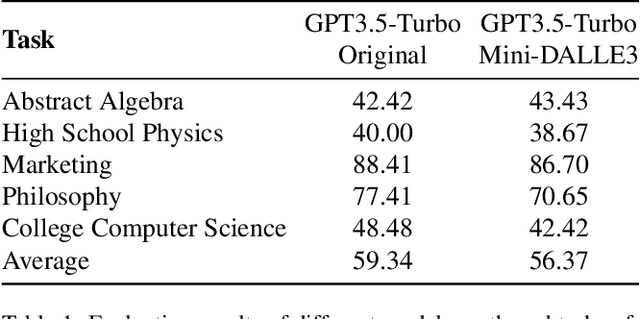
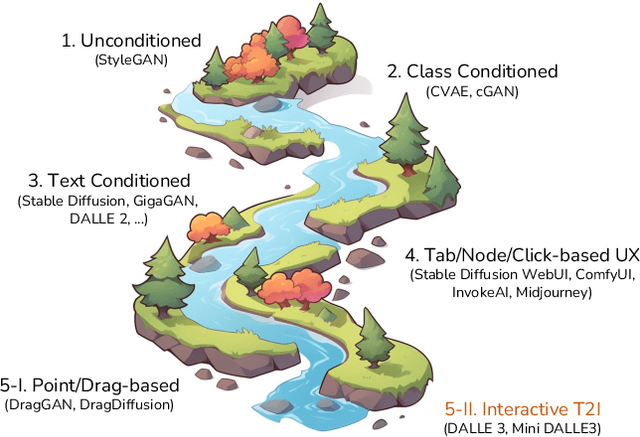
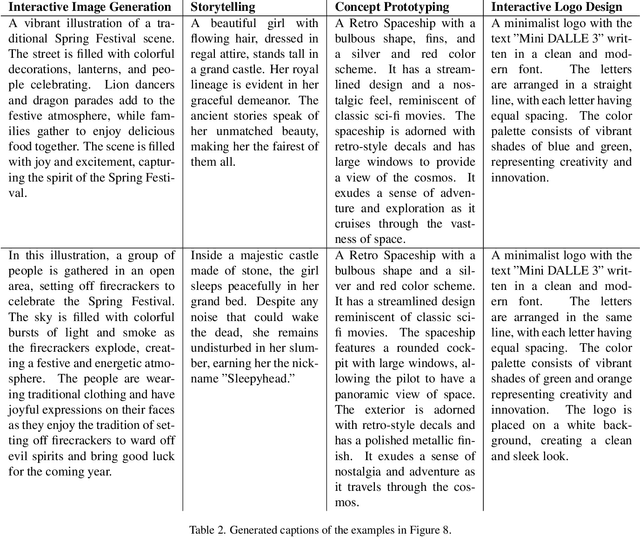
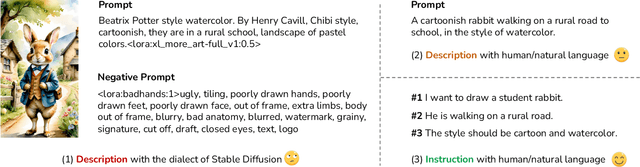
The revolution of artificial intelligence content generation has been rapidly accelerated with the booming text-to-image (T2I) diffusion models. Within just two years of development, it was unprecedentedly of high-quality, diversity, and creativity that the state-of-the-art models could generate. However, a prevalent limitation persists in the effective communication with these popular T2I models, such as Stable Diffusion, using natural language descriptions. This typically makes an engaging image hard to obtain without expertise in prompt engineering with complex word compositions, magic tags, and annotations. Inspired by the recently released DALLE3 - a T2I model directly built-in ChatGPT that talks human language, we revisit the existing T2I systems endeavoring to align human intent and introduce a new task - interactive text to image (iT2I), where people can interact with LLM for interleaved high-quality image generation/edit/refinement and question answering with stronger images and text correspondences using natural language. In addressing the iT2I problem, we present a simple approach that augments LLMs for iT2I with prompting techniques and off-the-shelf T2I models. We evaluate our approach for iT2I in a variety of common-used scenarios under different LLMs, e.g., ChatGPT, LLAMA, Baichuan, and InternLM. We demonstrate that our approach could be a convenient and low-cost way to introduce the iT2I ability for any existing LLMs and any text-to-image models without any training while bringing little degradation on LLMs' inherent capabilities in, e.g., question answering and code generation. We hope this work could draw broader attention and provide inspiration for boosting user experience in human-machine interactions alongside the image quality of the next-generation T2I systems.
The All-Seeing Project: Towards Panoptic Visual Recognition and Understanding of the Open World
Aug 03, 2023We present the All-Seeing (AS) project: a large-scale data and model for recognizing and understanding everything in the open world. Using a scalable data engine that incorporates human feedback and efficient models in the loop, we create a new dataset (AS-1B) with over 1 billion regions annotated with semantic tags, question-answering pairs, and detailed captions. It covers a wide range of 3.5 million common and rare concepts in the real world, and has 132.2 billion tokens that describe the concepts and their attributes. Leveraging this new dataset, we develop the All-Seeing model (ASM), a unified framework for panoptic visual recognition and understanding. The model is trained with open-ended language prompts and locations, which allows it to generalize to various vision and language tasks with remarkable zero-shot performance, including region-text retrieval, region recognition, captioning, and question-answering. We hope that this project can serve as a foundation for vision-language artificial general intelligence research. Models and the dataset shall be released at https://github.com/OpenGVLab/All-Seeing, and demo can be seen at https://huggingface.co/spaces/OpenGVLab/all-seeing.
JourneyDB: A Benchmark for Generative Image Understanding
Jul 03, 2023While recent advancements in vision-language models have revolutionized multi-modal understanding, it remains unclear whether they possess the capabilities of comprehending the generated images. Compared to real data, synthetic images exhibit a higher degree of diversity in both content and style, for which there are significant difficulties for the models to fully apprehend. To this end, we present a large-scale dataset, JourneyDB, for multi-modal visual understanding in generative images. Our curated dataset covers 4 million diverse and high-quality generated images paired with the text prompts used to produce them. We further design 4 benchmarks to quantify the performance of generated image understanding in terms of both content and style interpretation. These benchmarks include prompt inversion, style retrieval, image captioning and visual question answering. Lastly, we assess the performance of current state-of-the-art multi-modal models when applied to JourneyDB, and provide an in-depth analysis of their strengths and limitations in generated content understanding. We hope the proposed dataset and benchmarks will facilitate the research in the field of generative content understanding. The dataset will be available on https://journeydb.github.io.
Denoising Diffusion Semantic Segmentation with Mask Prior Modeling
Jun 22, 2023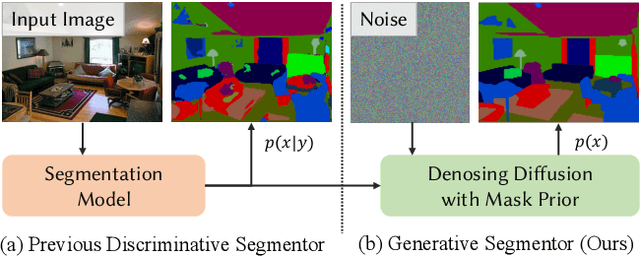
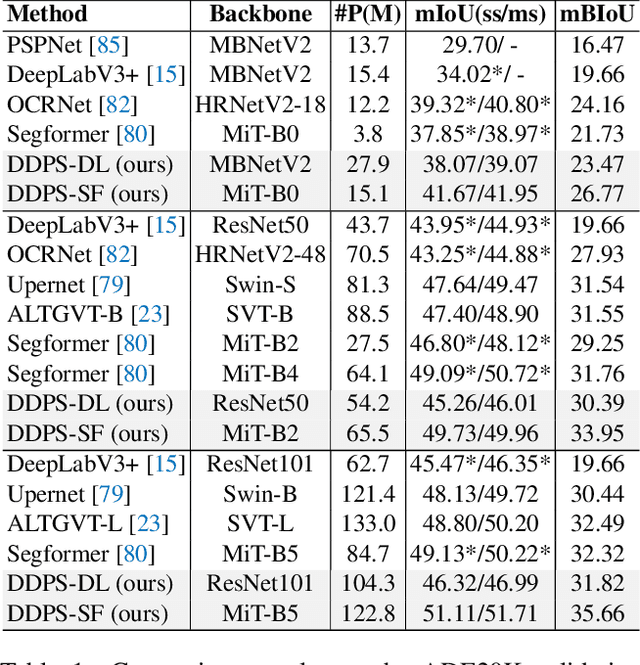
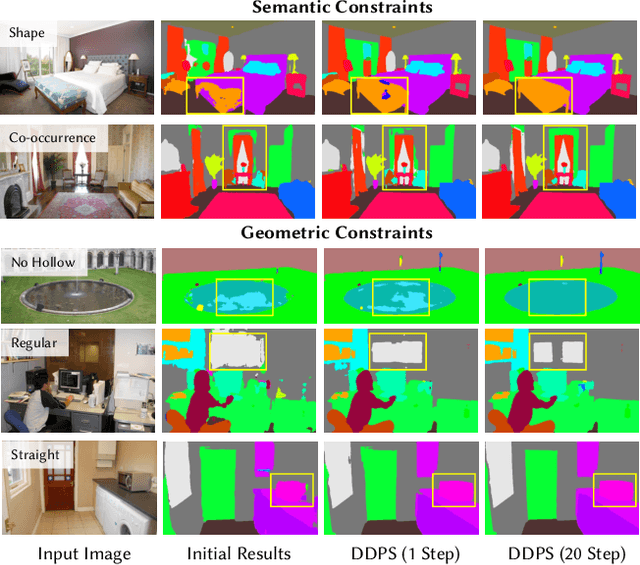
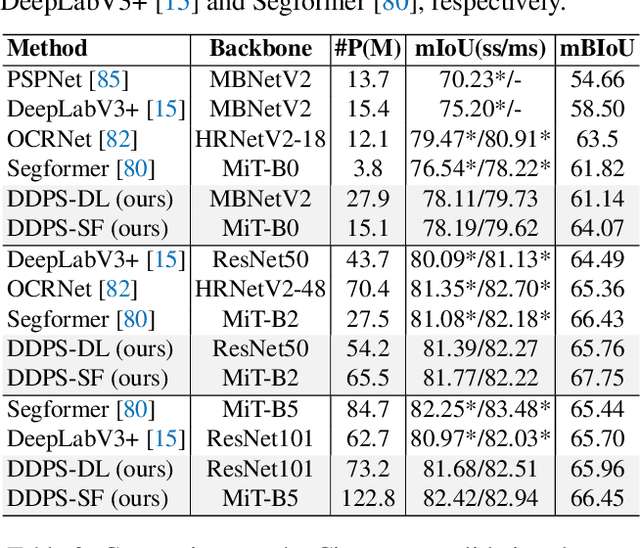
The evolution of semantic segmentation has long been dominated by learning more discriminative image representations for classifying each pixel. Despite the prominent advancements, the priors of segmentation masks themselves, e.g., geometric and semantic constraints, are still under-explored. In this paper, we propose to ameliorate the semantic segmentation quality of existing discriminative approaches with a mask prior modeled by a recently-developed denoising diffusion generative model. Beginning with a unified architecture that adapts diffusion models for mask prior modeling, we focus this work on a specific instantiation with discrete diffusion and identify a variety of key design choices for its successful application. Our exploratory analysis revealed several important findings, including: (1) a simple integration of diffusion models into semantic segmentation is not sufficient, and a poorly-designed diffusion process might lead to degradation in segmentation performance; (2) during the training, the object to which noise is added is more important than the type of noise; (3) during the inference, the strict diffusion denoising scheme may not be essential and can be relaxed to a simpler scheme that even works better. We evaluate the proposed prior modeling with several off-the-shelf segmentors, and our experimental results on ADE20K and Cityscapes demonstrate that our approach could achieve competitively quantitative performance and more appealing visual quality.
FlowFormer: A Transformer Architecture and Its Masked Cost Volume Autoencoding for Optical Flow
Jun 08, 2023This paper introduces a novel transformer-based network architecture, FlowFormer, along with the Masked Cost Volume AutoEncoding (MCVA) for pretraining it to tackle the problem of optical flow estimation. FlowFormer tokenizes the 4D cost-volume built from the source-target image pair and iteratively refines flow estimation with a cost-volume encoder-decoder architecture. The cost-volume encoder derives a cost memory with alternate-group transformer~(AGT) layers in a latent space and the decoder recurrently decodes flow from the cost memory with dynamic positional cost queries. On the Sintel benchmark, FlowFormer architecture achieves 1.16 and 2.09 average end-point-error~(AEPE) on the clean and final pass, a 16.5\% and 15.5\% error reduction from the GMA~(1.388 and 2.47). MCVA enhances FlowFormer by pretraining the cost-volume encoder with a masked autoencoding scheme, which further unleashes the capability of FlowFormer with unlabeled data. This is especially critical in optical flow estimation because ground truth flows are more expensive to acquire than labels in other vision tasks. MCVA improves FlowFormer all-sided and FlowFormer+MCVA ranks 1st among all published methods on both Sintel and KITTI-2015 benchmarks and achieves the best generalization performance. Specifically, FlowFormer+MCVA achieves 1.07 and 1.94 AEPE on the Sintel benchmark, leading to 7.76\% and 7.18\% error reductions from FlowFormer.
ADDP: Learning General Representations for Image Recognition and Generation with Alternating Denoising Diffusion Process
Jun 08, 2023Image recognition and generation have long been developed independently of each other. With the recent trend towards general-purpose representation learning, the development of general representations for both recognition and generation tasks is also promoted. However, preliminary attempts mainly focus on generation performance, but are still inferior on recognition tasks. These methods are modeled in the vector-quantized (VQ) space, whereas leading recognition methods use pixels as inputs. Our key insights are twofold: (1) pixels as inputs are crucial for recognition tasks; (2) VQ tokens as reconstruction targets are beneficial for generation tasks. These observations motivate us to propose an Alternating Denoising Diffusion Process (ADDP) that integrates these two spaces within a single representation learning framework. In each denoising step, our method first decodes pixels from previous VQ tokens, then generates new VQ tokens from the decoded pixels. The diffusion process gradually masks out a portion of VQ tokens to construct the training samples. The learned representations can be used to generate diverse high-fidelity images and also demonstrate excellent transfer performance on recognition tasks. Extensive experiments show that our method achieves competitive performance on unconditional generation, ImageNet classification, COCO detection, and ADE20k segmentation. Importantly, our method represents the first successful development of general representations applicable to both generation and dense recognition tasks. Code shall be released.