 Add to Chrome
 Add to Firefox
 Add to Edge
Semantic to Structure: Learning Structural Representations for Infringement Detection
Feb 11, 2025
Structural information in images is crucial for aesthetic assessment, and it is widely recognized in the artistic field that imitating the structure of other works significantly infringes on creators' rights. The advancement of diffusion models has led to AI-generated content imitating artists' structural creations, yet effective detection methods are still lacking. In this paper, we define this phenomenon as "structural infringement" and propose a corresponding detection method. Additionally, we develop quantitative metrics and create manually annotated datasets for evaluation: the SIA dataset of synthesized data, and the SIR dataset of real data. Due to the current lack of datasets for structural infringement detection, we propose a new data synthesis strategy based on diffusion models and LLM, successfully training a structural infringement detection model. Experimental results show that our method can successfully detect structural infringements and achieve notable improvements on annotated test sets.

LLM-KT: Aligning Large Language Models with Knowledge Tracing using a Plug-and-Play Instruction
Feb 05, 2025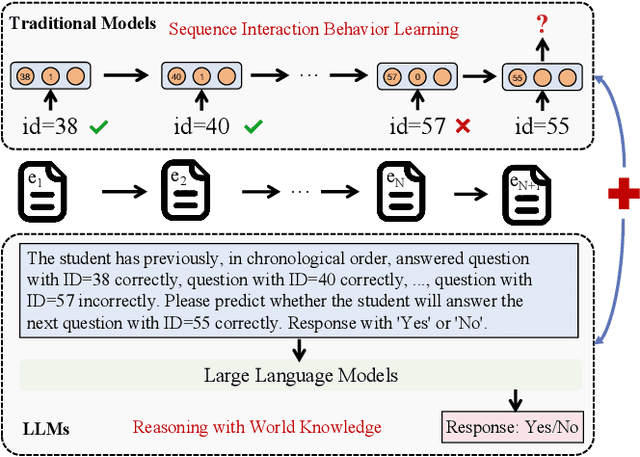

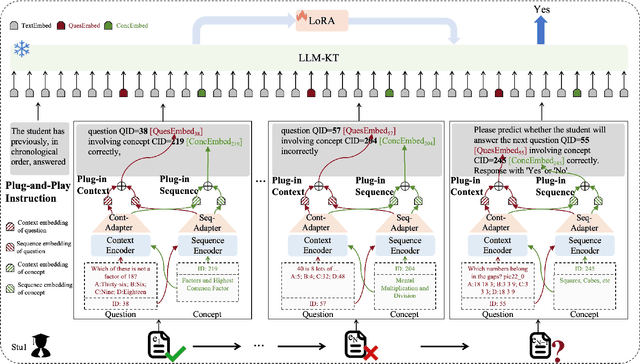
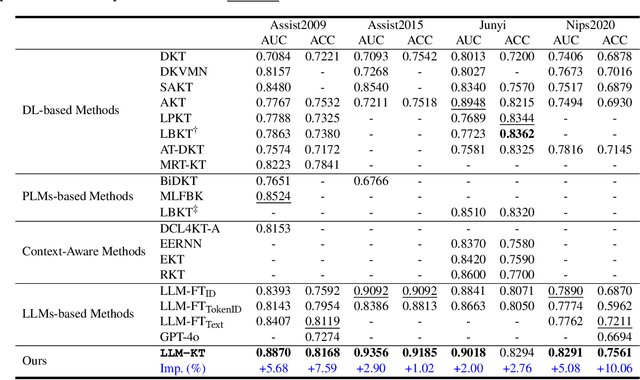
The knowledge tracing (KT) problem is an extremely important topic in personalized education, which aims to predict whether students can correctly answer the next question based on their past question-answer records. Prior work on this task mainly focused on learning the sequence of behaviors based on the IDs or textual information. However, these studies usually fail to capture students' sufficient behavioral patterns without reasoning with rich world knowledge about questions. In this paper, we propose a large language models (LLMs)-based framework for KT, named \texttt{\textbf{LLM-KT}}, to integrate the strengths of LLMs and traditional sequence interaction models. For task-level alignment, we design Plug-and-Play instruction to align LLMs with KT, leveraging LLMs' rich knowledge and powerful reasoning capacity. For modality-level alignment, we design the plug-in context and sequence to integrate multiple modalities learned by traditional methods. To capture the long context of history records, we present a plug-in context to flexibly insert the compressed context embedding into LLMs using question-specific and concept-specific tokens. Furthermore, we introduce a plug-in sequence to enhance LLMs with sequence interaction behavior representation learned by traditional sequence models using a sequence adapter. Extensive experiments show that \texttt{\textbf{LLM-KT}} obtains state-of-the-art performance on four typical datasets by comparing it with approximately 20 strong baselines.
LongDPO: Unlock Better Long-form Generation Abilities for LLMs via Critique-augmented Stepwise Information
Feb 04, 2025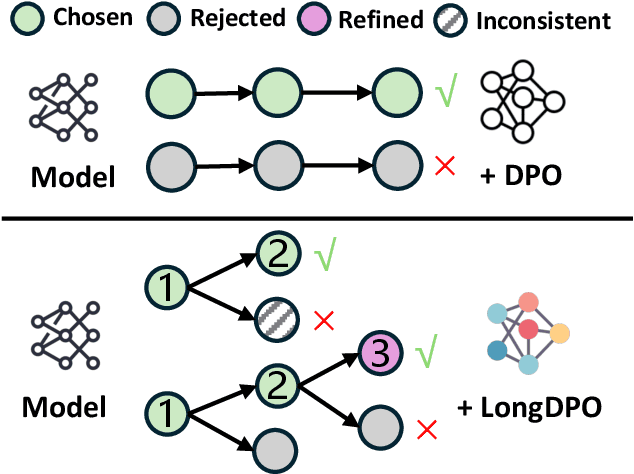
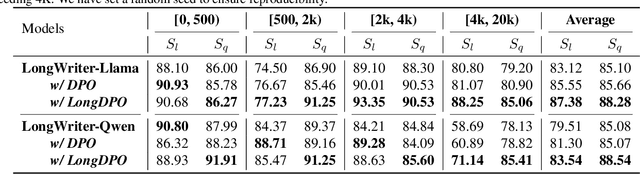
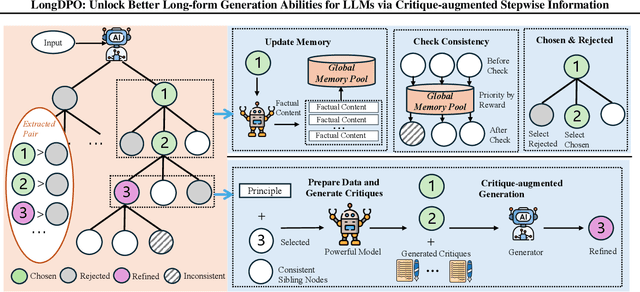

Long-form generation is crucial for academic writing papers and repo-level code generation. Despite this, current models, including GPT-4o, still exhibit unsatisfactory performance. Existing methods that utilize preference learning with outcome supervision often fail to provide detailed feedback for extended contexts. This shortcoming can lead to content that does not fully satisfy query requirements, resulting in issues like length deviations, and diminished quality. In this paper, we propose enhancing long-form generation by incorporating process supervision. We employ Monte Carlo Tree Search to gather stepwise preference pairs, utilizing a global memory pool to maintain consistency. To address the issue of suboptimal candidate selection, we integrate external critiques to refine and improve the quality of the preference pairs. Finally, we apply step-level DPO using the collected stepwise preference pairs. Experimental results show that our method improves length and quality on long-form generation benchmarks, with almost lossless performance on general benchmarks across various model backbones.
DeepRAG: Thinking to Retrieval Step by Step for Large Language Models
Feb 03, 2025


Large Language Models (LLMs) have shown remarkable potential in reasoning while they still suffer from severe factual hallucinations due to timeliness, accuracy, and coverage of parametric knowledge. Meanwhile, integrating reasoning with retrieval-augmented generation (RAG) remains challenging due to ineffective task decomposition and redundant retrieval, which can introduce noise and degrade response quality. In this paper, we propose DeepRAG, a framework that models retrieval-augmented reasoning as a Markov Decision Process (MDP), enabling strategic and adaptive retrieval. By iteratively decomposing queries, DeepRAG dynamically determines whether to retrieve external knowledge or rely on parametric reasoning at each step. Experiments show that DeepRAG improves retrieval efficiency while improving answer accuracy by 21.99%, demonstrating its effectiveness in optimizing retrieval-augmented reasoning.
Learning with Open-world Noisy Data via Class-independent Margin in Dual Representation Space
Jan 19, 2025

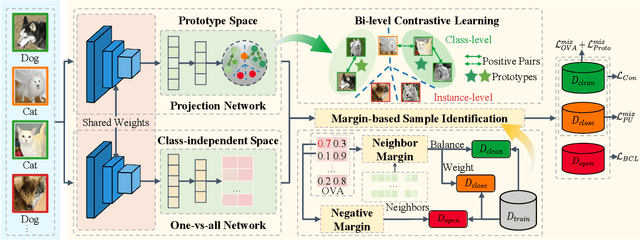

Learning with Noisy Labels (LNL) aims to improve the model generalization when facing data with noisy labels, and existing methods generally assume that noisy labels come from known classes, called closed-set noise. However, in real-world scenarios, noisy labels from similar unknown classes, i.e., open-set noise, may occur during the training and inference stage. Such open-world noisy labels may significantly impact the performance of LNL methods. In this study, we propose a novel dual-space joint learning method to robustly handle the open-world noise. To mitigate model overfitting on closed-set and open-set noises, a dual representation space is constructed by two networks. One is a projection network that learns shared representations in the prototype space, while the other is a One-Vs-All (OVA) network that makes predictions using unique semantic representations in the class-independent space. Then, bi-level contrastive learning and consistency regularization are introduced in two spaces to enhance the detection capability for data with unknown classes. To benefit from the memorization effects across different types of samples, class-independent margin criteria are designed for sample identification, which selects clean samples, weights closed-set noise, and filters open-set noise effectively. Extensive experiments demonstrate that our method outperforms the state-of-the-art methods and achieves an average accuracy improvement of 4.55\% and an AUROC improvement of 6.17\% on CIFAR80N.
Personalized Language Model Learning on Text Data Without User Identifiers
Jan 10, 2025

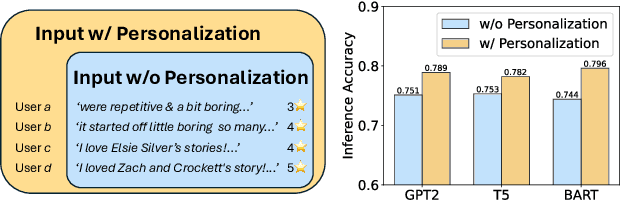

In many practical natural language applications, user data are highly sensitive, requiring anonymous uploads of text data from mobile devices to the cloud without user identifiers. However, the absence of user identifiers restricts the ability of cloud-based language models to provide personalized services, which are essential for catering to diverse user needs. The trivial method of replacing an explicit user identifier with a static user embedding as model input still compromises data anonymization. In this work, we propose to let each mobile device maintain a user-specific distribution to dynamically generate user embeddings, thereby breaking the one-to-one mapping between an embedding and a specific user. We further theoretically demonstrate that to prevent the cloud from tracking users via uploaded embeddings, the local distributions of different users should either be derived from a linearly dependent space to avoid identifiability or be close to each other to prevent accurate attribution. Evaluation on both public and industrial datasets using different language models reveals a remarkable improvement in accuracy from incorporating anonymous user embeddings, while preserving real-time inference requirement.
Fuzzy Granule Density-Based Outlier Detection with Multi-Scale Granular Balls
Jan 06, 2025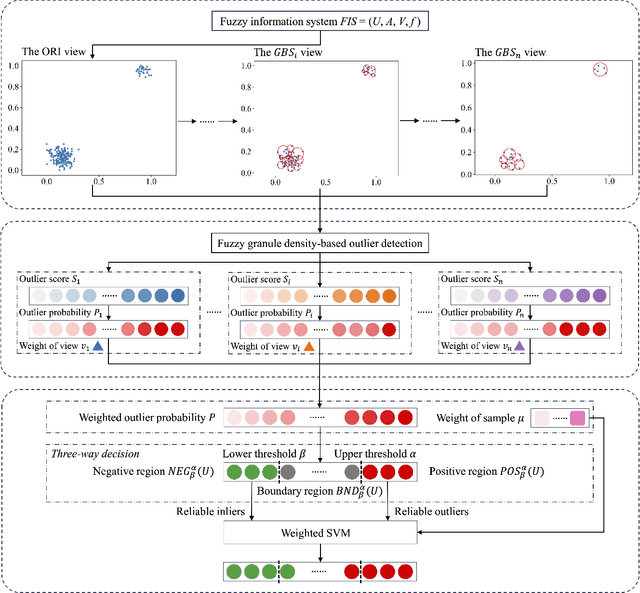
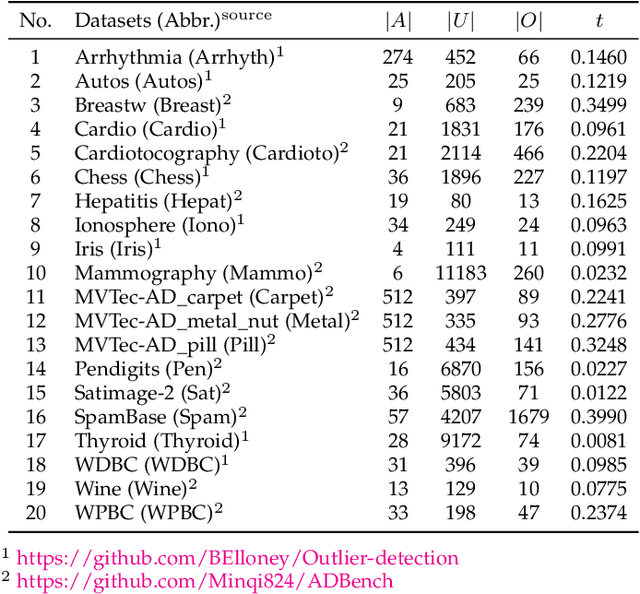
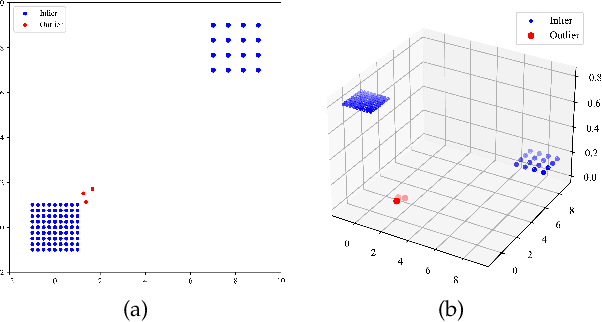
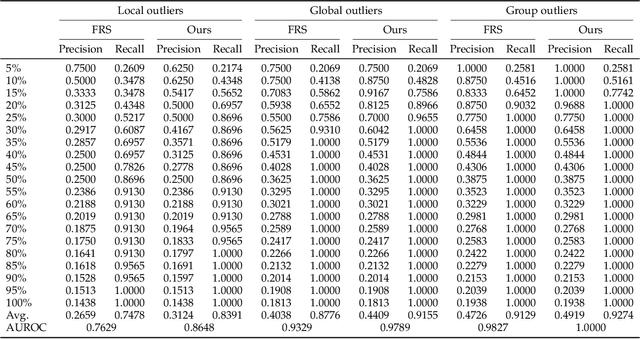
Outlier detection refers to the identification of anomalous samples that deviate significantly from the distribution of normal data and has been extensively studied and used in a variety of practical tasks. However, most unsupervised outlier detection methods are carefully designed to detect specified outliers, while real-world data may be entangled with different types of outliers. In this study, we propose a fuzzy rough sets-based multi-scale outlier detection method to identify various types of outliers. Specifically, a novel fuzzy rough sets-based method that integrates relative fuzzy granule density is first introduced to improve the capability of detecting local outliers. Then, a multi-scale view generation method based on granular-ball computing is proposed to collaboratively identify group outliers at different levels of granularity. Moreover, reliable outliers and inliers determined by the three-way decision are used to train a weighted support vector machine to further improve the performance of outlier detection. The proposed method innovatively transforms unsupervised outlier detection into a semi-supervised classification problem and for the first time explores the fuzzy rough sets-based outlier detection from the perspective of multi-scale granular balls, allowing for high adaptability to different types of outliers. Extensive experiments carried out on both artificial and UCI datasets demonstrate that the proposed outlier detection method significantly outperforms the state-of-the-art methods, improving the results by at least 8.48% in terms of the Area Under the ROC Curve (AUROC) index. { The source codes are released at \url{https://github.com/Xiaofeng-Tan/MGBOD}. }
The Essence of Contextual Understanding in Theory of Mind: A Study on Question Answering with Story Characters
Jan 03, 2025

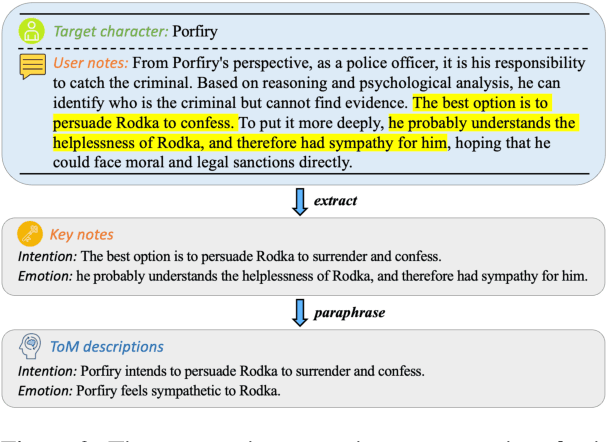
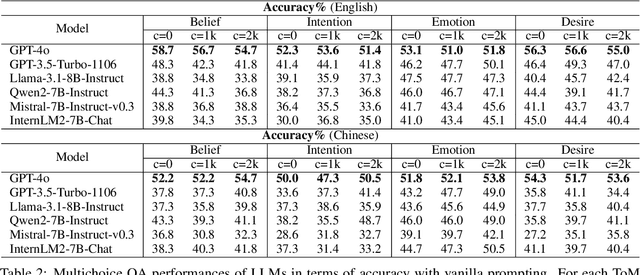
Theory-of-Mind (ToM) is a fundamental psychological capability that allows humans to understand and interpret the mental states of others. Humans infer others' thoughts by integrating causal cues and indirect clues from broad contextual information, often derived from past interactions. In other words, human ToM heavily relies on the understanding about the backgrounds and life stories of others. Unfortunately, this aspect is largely overlooked in existing benchmarks for evaluating machines' ToM capabilities, due to their usage of short narratives without global backgrounds. In this paper, we verify the importance of understanding long personal backgrounds in ToM and assess the performance of LLMs in such realistic evaluation scenarios. To achieve this, we introduce a novel benchmark, CharToM-QA, comprising 1,035 ToM questions based on characters from classic novels. Our human study reveals a significant disparity in performance: the same group of educated participants performs dramatically better when they have read the novels compared to when they have not. In parallel, our experiments on state-of-the-art LLMs, including the very recent o1 model, show that LLMs still perform notably worse than humans, despite that they have seen these stories during pre-training. This highlights the limitations of current LLMs in capturing the nuanced contextual information required for ToM reasoning.
Enhancing Uncertainty Modeling with Semantic Graph for Hallucination Detection
Jan 02, 2025
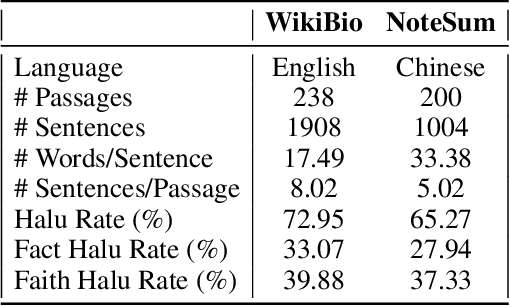

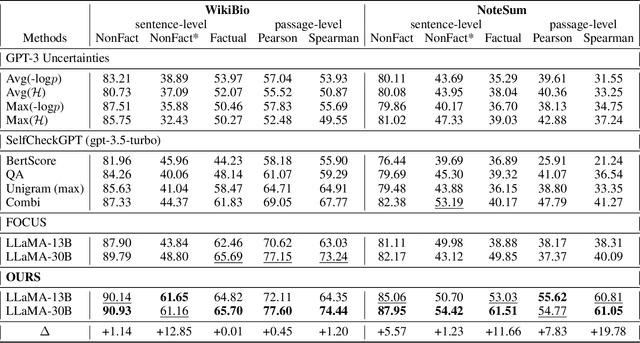
Large Language Models (LLMs) are prone to hallucination with non-factual or unfaithful statements, which undermines the applications in real-world scenarios. Recent researches focus on uncertainty-based hallucination detection, which utilizes the output probability of LLMs for uncertainty calculation and does not rely on external knowledge or frequent sampling from LLMs. Whereas, most approaches merely consider the uncertainty of each independent token, while the intricate semantic relations among tokens and sentences are not well studied, which limits the detection of hallucination that spans over multiple tokens and sentences in the passage. In this paper, we propose a method to enhance uncertainty modeling with semantic graph for hallucination detection. Specifically, we first construct a semantic graph that well captures the relations among entity tokens and sentences. Then, we incorporate the relations between two entities for uncertainty propagation to enhance sentence-level hallucination detection. Given that hallucination occurs due to the conflict between sentences, we further present a graph-based uncertainty calibration method that integrates the contradiction probability of the sentence with its neighbors in the semantic graph for uncertainty calculation. Extensive experiments on two datasets show the great advantages of our proposed approach. In particular, we obtain substantial improvements with 19.78% in passage-level hallucination detection.
WalkVLM:Aid Visually Impaired People Walking by Vision Language Model
Dec 30, 2024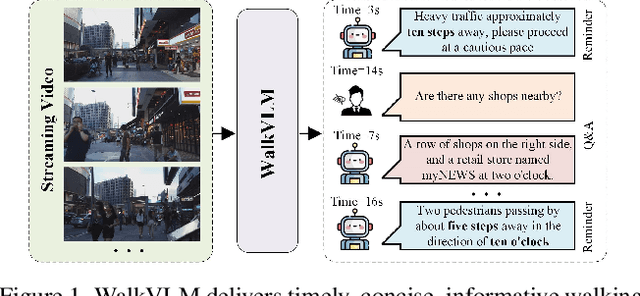

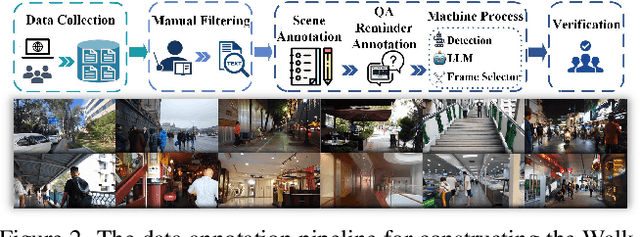
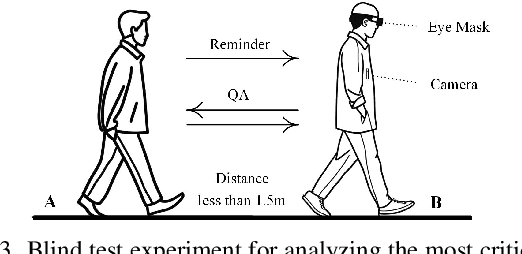
Approximately 200 million individuals around the world suffer from varying degrees of visual impairment, making it crucial to leverage AI technology to offer walking assistance for these people. With the recent progress of vision-language models (VLMs), employing VLMs to improve this field has emerged as a popular research topic. However, most existing methods are studied on self-built question-answering datasets, lacking a unified training and testing benchmark for walk guidance. Moreover, in blind walking task, it is necessary to perform real-time streaming video parsing and generate concise yet informative reminders, which poses a great challenge for VLMs that suffer from redundant responses and low inference efficiency. In this paper, we firstly release a diverse, extensive, and unbiased walking awareness dataset, containing 12k video-manual annotation pairs from Europe and Asia to provide a fair training and testing benchmark for blind walking task. Furthermore, a WalkVLM model is proposed, which employs chain of thought for hierarchical planning to generate concise but informative reminders and utilizes temporal-aware adaptive prediction to reduce the temporal redundancy of reminders. Finally, we have established a solid benchmark for blind walking task and verified the advantages of WalkVLM in stream video processing for this task compared to other VLMs. Our dataset and code will be released at anonymous link https://walkvlm2024.github.io.