 Add to Chrome
 Add to Firefox
 Add to Edge
Internalizing Academic Writing Workflows for Introduction Generation via Struct-Aware Policy Learning
Aug 04, 2026
Generating a rigorous paper introduction with large language models (LLMs) remains challenging, since it requires coordinating background, gap identification, method and contribution within a coherent narrative. Existing solutions externalize this process as multi-stage prompts or agent workflows which are expensive and vulnerable to cross-stage drift. We propose StructPO, a struct-aware policy learning framework that internalizes the entire multi-stage writing workflow into a single-pass policy controlled by explicit stage tokens. StructPO introduces struct-aware credit assignment to decouple local stage quality from global coherence and refinement-guided optimization to internalize revision behavior into the first-pass policy. Experiments show that StructPO improves semantic alignment, structural rationality and inference efficiency over workflow-based baselines, generalizes to out-of-domain settings, and remains competitive with GPT-5.1 in human evaluation when scaled to Qwen3-32B. These results show that internalizing academic writing workflows through fine-grained policy optimization offers a viable alternative to costly external orchestration.

MemPro: Agentic Memory Systems as Evolvable Programs
May 30, 2026Long-horizon autonomous agents require memory systems to retain historical information, track evolving states, and reuse relevant knowledge beyond finite context windows. Existing agentic memory systems typically follow a memory construction-retrieval (MCR) pipeline, but often adapt mainly the memory bank while keeping the surrounding pipeline fixed after deployment. This fixed-pipeline design struggles to handle heterogeneous task-specific failure modes and can become misaligned with memory banks that evolve in scale and structure over time. To address these limitations, we propose MemPro, a system-level evolution framework that treats the entire MCR pipeline as an evolvable program rather than adapting only the memory bank or prompt text. MemPro maintains a version tree of runnable memory-system implementations, where an Evolving Agent iteratively selects promising versions, diagnoses recurring failures, and creates improved child versions through failure-mode-guided edit-debug refinement. Experiments on LongMemEval, LoCoMo, HotpotQA, and NarrativeQA show that MemPro consistently outperforms strong static and prompt-level evolving baselines within a few iterations, continues to improve with evolution, and achieves a favorable performance-cost trade-off. Code is available at https://github.com/wanghai673/MemPro.
Enhancing Uncertainty Modeling with Semantic Graph for Hallucination Detection
Jan 02, 2025
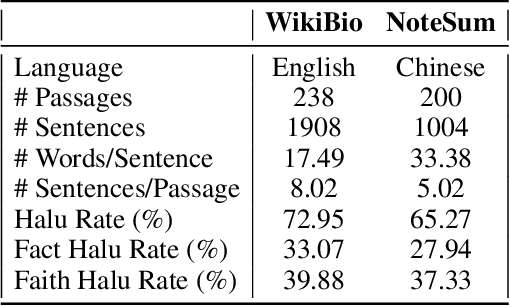

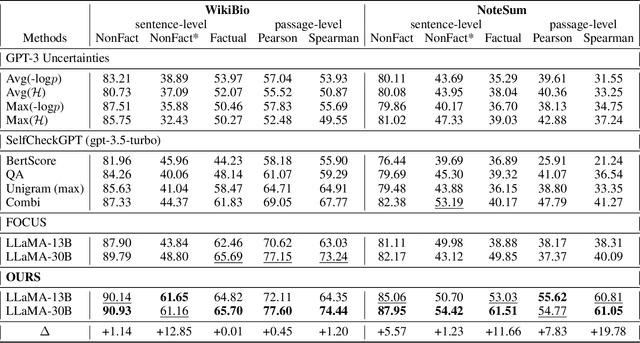
Large Language Models (LLMs) are prone to hallucination with non-factual or unfaithful statements, which undermines the applications in real-world scenarios. Recent researches focus on uncertainty-based hallucination detection, which utilizes the output probability of LLMs for uncertainty calculation and does not rely on external knowledge or frequent sampling from LLMs. Whereas, most approaches merely consider the uncertainty of each independent token, while the intricate semantic relations among tokens and sentences are not well studied, which limits the detection of hallucination that spans over multiple tokens and sentences in the passage. In this paper, we propose a method to enhance uncertainty modeling with semantic graph for hallucination detection. Specifically, we first construct a semantic graph that well captures the relations among entity tokens and sentences. Then, we incorporate the relations between two entities for uncertainty propagation to enhance sentence-level hallucination detection. Given that hallucination occurs due to the conflict between sentences, we further present a graph-based uncertainty calibration method that integrates the contradiction probability of the sentence with its neighbors in the semantic graph for uncertainty calculation. Extensive experiments on two datasets show the great advantages of our proposed approach. In particular, we obtain substantial improvements with 19.78% in passage-level hallucination detection.