 Add to Chrome
 Add to Firefox
 Add to Edge
Cascade Forgery Mining Network for Fingerprint Presentation Attack Detection
Jul 27, 2026
Fingerprint Presentation Attack Detection (PAD) is a critical component of fingerprint identification systems, serving as a protective measure against unauthorized access. In this paper, we observe that different regions of a fingerprint image can exhibit varying Artifact Extraction Difficulty (AED), with high-AED regions requiring more sophisticated extraction mechanisms to capture more subtle discriminative evidence. To address this issue, we propose to quantify AED using local Gabor feature certainty and partition fingerprint images into multiple regions based on their respective AED values. We then propose an AED guided Cascade Forgery Mining Network (CFM-Net) that employs an adaptive-depth feature extraction architecture to detect more precise and comprehensive artifact evidence across regions with heterogeneous AED values. Furthermore, we introduce an Orientation Guided Adversarial Training (OGAT) module to filter out identity information from PAD features while preserving the integrity of original artifact evidence. Experimental evaluations on LivDet datasets demonstrate the superior performance of our approach compared to state-of-the-art methods and achieve significant improvement in the classification ability of high AED fingerprints.

Exploring Specular Reflection Inconsistency for Generalizable Face Forgery Detection
Feb 06, 2026Detecting deepfakes has become increasingly challenging as forgery faces synthesized by AI-generated methods, particularly diffusion models, achieve unprecedented quality and resolution. Existing forgery detection approaches relying on spatial and frequency features demonstrate limited efficacy against high-quality, entirely synthesized forgeries. In this paper, we propose a novel detection method grounded in the observation that facial attributes governed by complex physical laws and multiple parameters are inherently difficult to replicate. Specifically, we focus on illumination, particularly the specular reflection component in the Phong illumination model, which poses the greatest replication challenge due to its parametric complexity and nonlinear formulation. We introduce a fast and accurate face texture estimation method based on Retinex theory to enable precise specular reflection separation. Furthermore, drawing from the mathematical formulation of specular reflection, we posit that forgery evidence manifests not only in the specular reflection itself but also in its relationship with corresponding face texture and direct light. To address this issue, we design the Specular-Reflection-Inconsistency-Network (SRI-Net), incorporating a two-stage cross-attention mechanism to capture these correlations and integrate specular reflection related features with image features for robust forgery detection. Experimental results demonstrate that our method achieves superior performance on both traditional deepfake datasets and generative deepfake datasets, particularly those containing diffusion-generated forgery faces.
Control-CLIP: Decoupling Category and Style Guidance in CLIP for Specific-Domain Generation
Feb 17, 2025Text-to-image diffusion models have shown remarkable capabilities of generating high-quality images closely aligned with textual inputs. However, the effectiveness of text guidance heavily relies on the CLIP text encoder, which is trained to pay more attention to general content but struggles to capture semantics in specific domains like styles. As a result, generation models tend to fail on prompts like "a photo of a cat in Pokemon style" in terms of simply producing images depicting "a photo of a cat". To fill this gap, we propose Control-CLIP, a novel decoupled CLIP fine-tuning framework that enables the CLIP model to learn the meaning of category and style in a complement manner. With specially designed fine-tuning tasks on minimal data and a modified cross-attention mechanism, Control-CLIP can precisely guide the diffusion model to a specific domain. Moreover, the parameters of the diffusion model remain unchanged at all, preserving the original generation performance and diversity. Experiments across multiple domains confirm the effectiveness of our approach, particularly highlighting its robust plug-and-play capability in generating content with various specific styles.
Semantic to Structure: Learning Structural Representations for Infringement Detection
Feb 11, 2025Structural information in images is crucial for aesthetic assessment, and it is widely recognized in the artistic field that imitating the structure of other works significantly infringes on creators' rights. The advancement of diffusion models has led to AI-generated content imitating artists' structural creations, yet effective detection methods are still lacking. In this paper, we define this phenomenon as "structural infringement" and propose a corresponding detection method. Additionally, we develop quantitative metrics and create manually annotated datasets for evaluation: the SIA dataset of synthesized data, and the SIR dataset of real data. Due to the current lack of datasets for structural infringement detection, we propose a new data synthesis strategy based on diffusion models and LLM, successfully training a structural infringement detection model. Experimental results show that our method can successfully detect structural infringements and achieve notable improvements on annotated test sets.
Face Forgery Detection by 3D Decomposition
Nov 19, 2020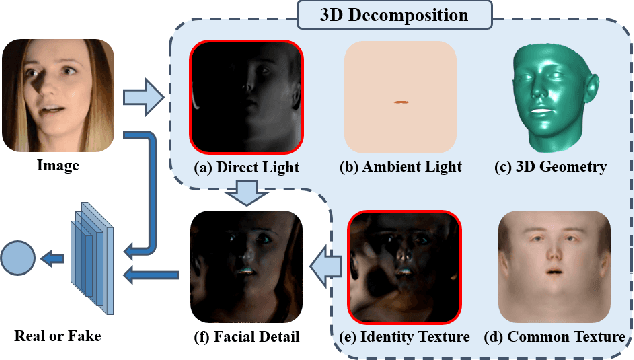
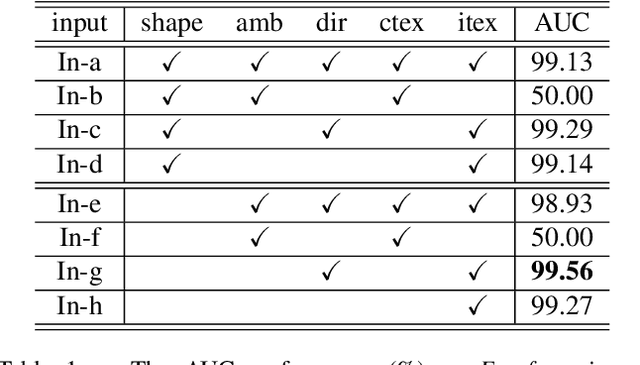
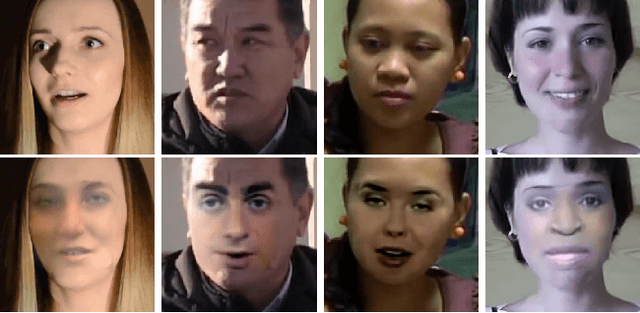
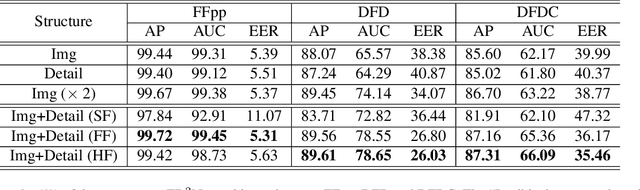
Detecting digital face manipulation has attracted extensive attention due to fake media's potential harms to the public. However, recent advances have been able to reduce the forgery signals to a low magnitude. Decomposition, which reversibly decomposes an image into several constituent elements, is a promising way to highlight the hidden forgery details. In this paper, we consider a face image as the production of the intervention of the underlying 3D geometry and the lighting environment, and decompose it in a computer graphics view. Specifically, by disentangling the face image into 3D shape, common texture, identity texture, ambient light, and direct light, we find the devil lies in the direct light and the identity texture. Based on this observation, we propose to utilize facial detail, which is the combination of direct light and identity texture, as the clue to detect the subtle forgery patterns. Besides, we highlight the manipulated region with a supervised attention mechanism and introduce a two-stream structure to exploit both face image and facial detail together as a multi-modality task. Extensive experiments indicate the effectiveness of the extra features extracted from the facial detail, and our method achieves the state-of-the-art performance.