 Add to Chrome
 Add to Firefox
 Add to Edge
Lumina-Video: Efficient and Flexible Video Generation with Multi-scale Next-DiT
Feb 10, 2025
Recent advancements have established Diffusion Transformers (DiTs) as a dominant framework in generative modeling. Building on this success, Lumina-Next achieves exceptional performance in the generation of photorealistic images with Next-DiT. However, its potential for video generation remains largely untapped, with significant challenges in modeling the spatiotemporal complexity inherent to video data. To address this, we introduce Lumina-Video, a framework that leverages the strengths of Next-DiT while introducing tailored solutions for video synthesis. Lumina-Video incorporates a Multi-scale Next-DiT architecture, which jointly learns multiple patchifications to enhance both efficiency and flexibility. By incorporating the motion score as an explicit condition, Lumina-Video also enables direct control of generated videos' dynamic degree. Combined with a progressive training scheme with increasingly higher resolution and FPS, and a multi-source training scheme with mixed natural and synthetic data, Lumina-Video achieves remarkable aesthetic quality and motion smoothness at high training and inference efficiency. We additionally propose Lumina-V2A, a video-to-audio model based on Next-DiT, to create synchronized sounds for generated videos. Codes are released at https://www.github.com/Alpha-VLLM/Lumina-Video.

Can We Generate Images with CoT? Let's Verify and Reinforce Image Generation Step by Step
Jan 23, 2025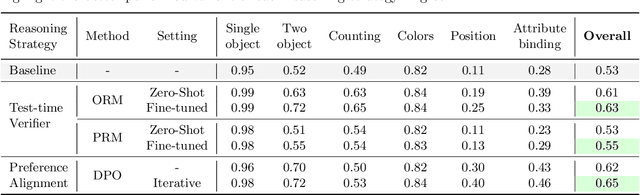


Chain-of-Thought (CoT) reasoning has been extensively explored in large models to tackle complex understanding tasks. However, it still remains an open question whether such strategies can be applied to verifying and reinforcing image generation scenarios. In this paper, we provide the first comprehensive investigation of the potential of CoT reasoning to enhance autoregressive image generation. We focus on three techniques: scaling test-time computation for verification, aligning model preferences with Direct Preference Optimization (DPO), and integrating these techniques for complementary effects. Our results demonstrate that these approaches can be effectively adapted and combined to significantly improve image generation performance. Furthermore, given the pivotal role of reward models in our findings, we propose the Potential Assessment Reward Model (PARM) and PARM++, specialized for autoregressive image generation. PARM adaptively assesses each generation step through a potential assessment approach, merging the strengths of existing reward models, and PARM++ further introduces a reflection mechanism to self-correct the generated unsatisfactory image. Using our investigated reasoning strategies, we enhance a baseline model, Show-o, to achieve superior results, with a significant +24% improvement on the GenEval benchmark, surpassing Stable Diffusion 3 by +15%. We hope our study provides unique insights and paves a new path for integrating CoT reasoning with autoregressive image generation. Code and models are released at https://github.com/ZiyuGuo99/Image-Generation-CoT
IMAGINE-E: Image Generation Intelligence Evaluation of State-of-the-art Text-to-Image Models
Jan 23, 2025


With the rapid development of diffusion models, text-to-image(T2I) models have made significant progress, showcasing impressive abilities in prompt following and image generation. Recently launched models such as FLUX.1 and Ideogram2.0, along with others like Dall-E3 and Stable Diffusion 3, have demonstrated exceptional performance across various complex tasks, raising questions about whether T2I models are moving towards general-purpose applicability. Beyond traditional image generation, these models exhibit capabilities across a range of fields, including controllable generation, image editing, video, audio, 3D, and motion generation, as well as computer vision tasks like semantic segmentation and depth estimation. However, current evaluation frameworks are insufficient to comprehensively assess these models' performance across expanding domains. To thoroughly evaluate these models, we developed the IMAGINE-E and tested six prominent models: FLUX.1, Ideogram2.0, Midjourney, Dall-E3, Stable Diffusion 3, and Jimeng. Our evaluation is divided into five key domains: structured output generation, realism, and physical consistency, specific domain generation, challenging scenario generation, and multi-style creation tasks. This comprehensive assessment highlights each model's strengths and limitations, particularly the outstanding performance of FLUX.1 and Ideogram2.0 in structured and specific domain tasks, underscoring the expanding applications and potential of T2I models as foundational AI tools. This study provides valuable insights into the current state and future trajectory of T2I models as they evolve towards general-purpose usability. Evaluation scripts will be released at https://github.com/jylei16/Imagine-e.
GS-DiT: Advancing Video Generation with Pseudo 4D Gaussian Fields through Efficient Dense 3D Point Tracking
Jan 05, 2025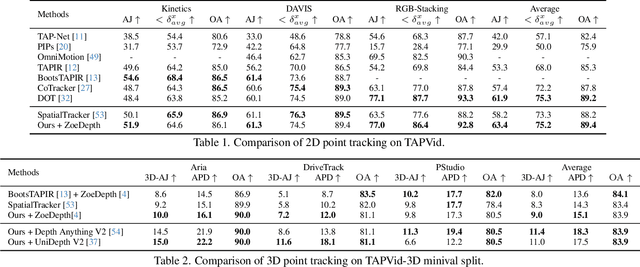
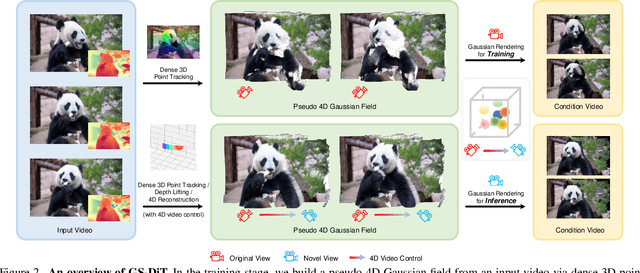
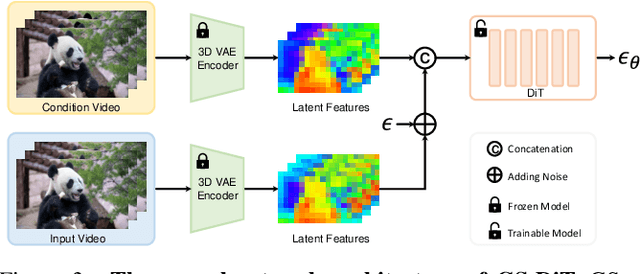
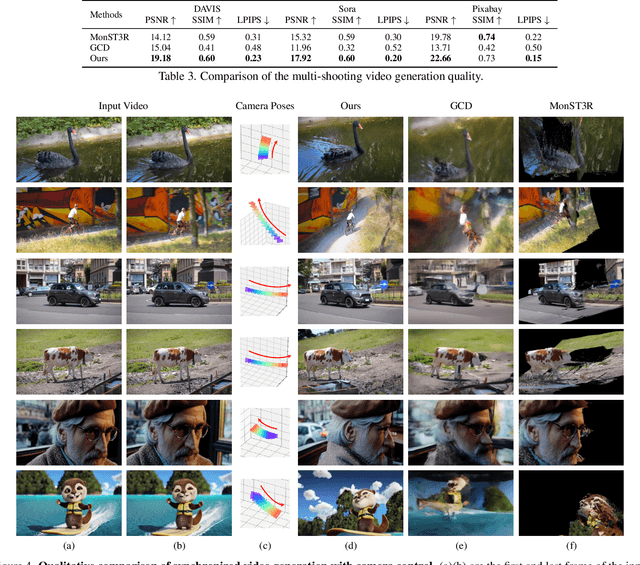
4D video control is essential in video generation as it enables the use of sophisticated lens techniques, such as multi-camera shooting and dolly zoom, which are currently unsupported by existing methods. Training a video Diffusion Transformer (DiT) directly to control 4D content requires expensive multi-view videos. Inspired by Monocular Dynamic novel View Synthesis (MDVS) that optimizes a 4D representation and renders videos according to different 4D elements, such as camera pose and object motion editing, we bring pseudo 4D Gaussian fields to video generation. Specifically, we propose a novel framework that constructs a pseudo 4D Gaussian field with dense 3D point tracking and renders the Gaussian field for all video frames. Then we finetune a pretrained DiT to generate videos following the guidance of the rendered video, dubbed as GS-DiT. To boost the training of the GS-DiT, we also propose an efficient Dense 3D Point Tracking (D3D-PT) method for the pseudo 4D Gaussian field construction. Our D3D-PT outperforms SpatialTracker, the state-of-the-art sparse 3D point tracking method, in accuracy and accelerates the inference speed by two orders of magnitude. During the inference stage, GS-DiT can generate videos with the same dynamic content while adhering to different camera parameters, addressing a significant limitation of current video generation models. GS-DiT demonstrates strong generalization capabilities and extends the 4D controllability of Gaussian splatting to video generation beyond just camera poses. It supports advanced cinematic effects through the manipulation of the Gaussian field and camera intrinsics, making it a powerful tool for creative video production. Demos are available at https://wkbian.github.io/Projects/GS-DiT/.
EnerVerse: Envisioning Embodied Future Space for Robotics Manipulation
Jan 03, 2025


We introduce EnerVerse, a comprehensive framework for embodied future space generation specifically designed for robotic manipulation tasks. EnerVerse seamlessly integrates convolutional and bidirectional attention mechanisms for inner-chunk space modeling, ensuring low-level consistency and continuity. Recognizing the inherent redundancy in video data, we propose a sparse memory context combined with a chunkwise unidirectional generative paradigm to enable the generation of infinitely long sequences. To further augment robotic capabilities, we introduce the Free Anchor View (FAV) space, which provides flexible perspectives to enhance observation and analysis. The FAV space mitigates motion modeling ambiguity, removes physical constraints in confined environments, and significantly improves the robot's generalization and adaptability across various tasks and settings. To address the prohibitive costs and labor intensity of acquiring multi-camera observations, we present a data engine pipeline that integrates a generative model with 4D Gaussian Splatting (4DGS). This pipeline leverages the generative model's robust generalization capabilities and the spatial constraints provided by 4DGS, enabling an iterative enhancement of data quality and diversity, thus creating a data flywheel effect that effectively narrows the sim-to-real gap. Finally, our experiments demonstrate that the embodied future space generation prior substantially enhances policy predictive capabilities, resulting in improved overall performance, particularly in long-range robotic manipulation tasks.
A3: Android Agent Arena for Mobile GUI Agents
Jan 02, 2025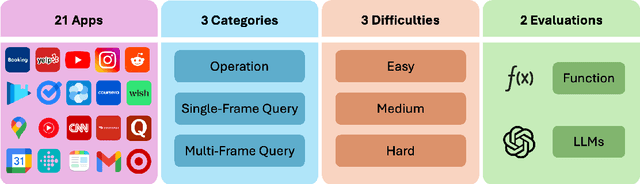
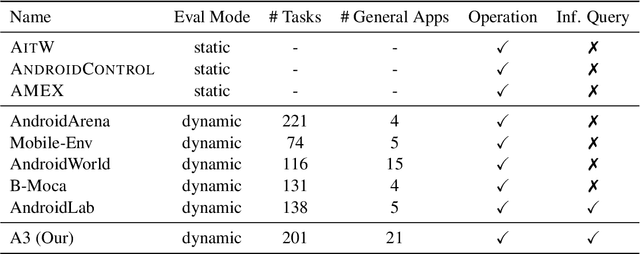
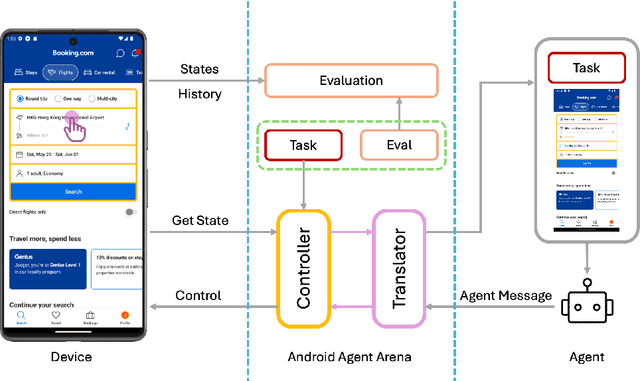
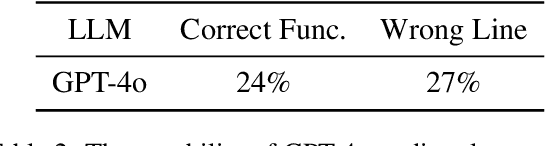
AI agents have become increasingly prevalent in recent years, driven by significant advancements in the field of large language models (LLMs). Mobile GUI agents, a subset of AI agents, are designed to autonomously perform tasks on mobile devices. While numerous studies have introduced agents, datasets, and benchmarks to advance mobile GUI agent research, many existing datasets focus on static frame evaluations and fail to provide a comprehensive platform for assessing performance on real-world, in-the-wild tasks. To address this gap, we present Android Agent Arena (A3), a novel evaluation platform. Unlike existing in-the-wild systems, A3 offers: (1) meaningful and practical tasks, such as real-time online information retrieval and operational instructions; (2) a larger, more flexible action space, enabling compatibility with agents trained on any dataset; and (3) automated business-level LLM-based evaluation process. A3 includes 21 widely used general third-party apps and 201 tasks representative of common user scenarios, providing a robust foundation for evaluating mobile GUI agents in real-world situations and a new autonomous evaluation process for less human labor and coding expertise. The project is available at \url{https://yuxiangchai.github.io/Android-Agent-Arena/}.
GaussianPainter: Painting Point Cloud into 3D Gaussians with Normal Guidance
Dec 23, 2024
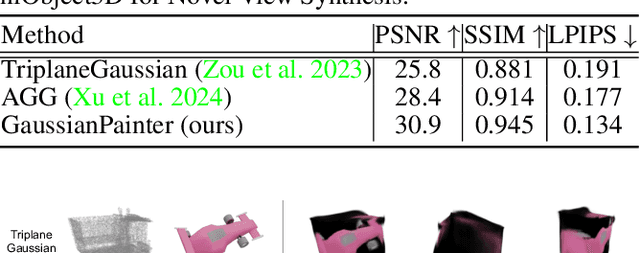
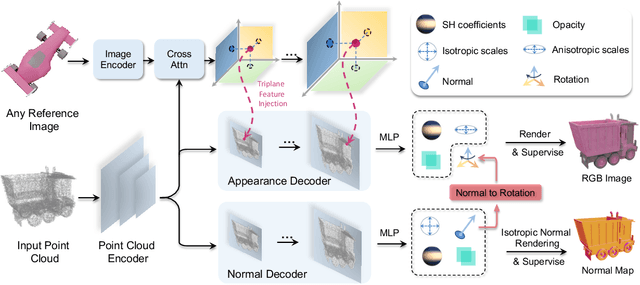
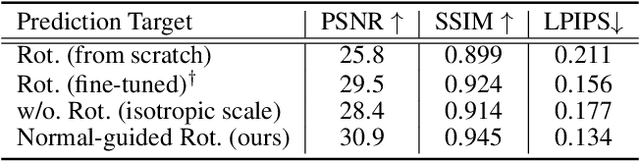
In this paper, we present GaussianPainter, the first method to paint a point cloud into 3D Gaussians given a reference image. GaussianPainter introduces an innovative feed-forward approach to overcome the limitations of time-consuming test-time optimization in 3D Gaussian splatting. Our method addresses a critical challenge in the field: the non-uniqueness problem inherent in the large parameter space of 3D Gaussian splatting. This space, encompassing rotation, anisotropic scales, and spherical harmonic coefficients, introduces the challenge of rendering similar images from substantially different Gaussian fields. As a result, feed-forward networks face instability when attempting to directly predict high-quality Gaussian fields, struggling to converge on consistent parameters for a given output. To address this issue, we propose to estimate a surface normal for each point to determine its Gaussian rotation. This strategy enables the network to effectively predict the remaining Gaussian parameters in the constrained space. We further enhance our approach with an appearance injection module, incorporating reference image appearance into Gaussian fields via a multiscale triplane representation. Our method successfully balances efficiency and fidelity in 3D Gaussian generation, achieving high-quality, diverse, and robust 3D content creation from point clouds in a single forward pass.
VividFace: A Diffusion-Based Hybrid Framework for High-Fidelity Video Face Swapping
Dec 15, 2024


Video face swapping is becoming increasingly popular across various applications, yet existing methods primarily focus on static images and struggle with video face swapping because of temporal consistency and complex scenarios. In this paper, we present the first diffusion-based framework specifically designed for video face swapping. Our approach introduces a novel image-video hybrid training framework that leverages both abundant static image data and temporal video sequences, addressing the inherent limitations of video-only training. The framework incorporates a specially designed diffusion model coupled with a VidFaceVAE that effectively processes both types of data to better maintain temporal coherence of the generated videos. To further disentangle identity and pose features, we construct the Attribute-Identity Disentanglement Triplet (AIDT) Dataset, where each triplet has three face images, with two images sharing the same pose and two sharing the same identity. Enhanced with a comprehensive occlusion augmentation, this dataset also improves robustness against occlusions. Additionally, we integrate 3D reconstruction techniques as input conditioning to our network for handling large pose variations. Extensive experiments demonstrate that our framework achieves superior performance in identity preservation, temporal consistency, and visual quality compared to existing methods, while requiring fewer inference steps. Our approach effectively mitigates key challenges in video face swapping, including temporal flickering, identity preservation, and robustness to occlusions and pose variations.
EasyRef: Omni-Generalized Group Image Reference for Diffusion Models via Multimodal LLM
Dec 12, 2024
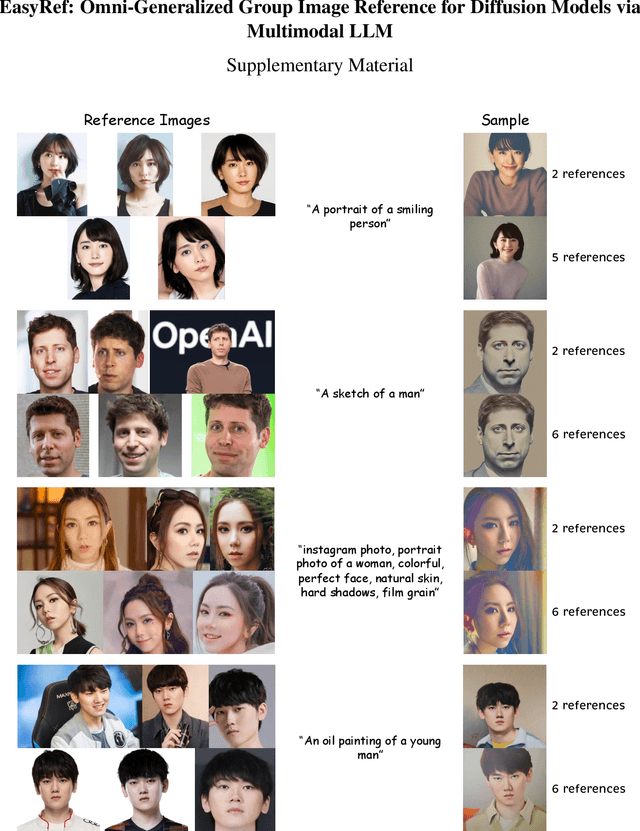


Significant achievements in personalization of diffusion models have been witnessed. Conventional tuning-free methods mostly encode multiple reference images by averaging their image embeddings as the injection condition, but such an image-independent operation cannot perform interaction among images to capture consistent visual elements within multiple references. Although the tuning-based Low-Rank Adaptation (LoRA) can effectively extract consistent elements within multiple images through the training process, it necessitates specific finetuning for each distinct image group. This paper introduces EasyRef, a novel plug-and-play adaptation method that enables diffusion models to be conditioned on multiple reference images and the text prompt. To effectively exploit consistent visual elements within multiple images, we leverage the multi-image comprehension and instruction-following capabilities of the multimodal large language model (MLLM), prompting it to capture consistent visual elements based on the instruction. Besides, injecting the MLLM's representations into the diffusion process through adapters can easily generalize to unseen domains, mining the consistent visual elements within unseen data. To mitigate computational costs and enhance fine-grained detail preservation, we introduce an efficient reference aggregation strategy and a progressive training scheme. Finally, we introduce MRBench, a new multi-reference image generation benchmark. Experimental results demonstrate EasyRef surpasses both tuning-free methods like IP-Adapter and tuning-based methods like LoRA, achieving superior aesthetic quality and robust zero-shot generalization across diverse domains.
SynerGen-VL: Towards Synergistic Image Understanding and Generation with Vision Experts and Token Folding
Dec 12, 2024


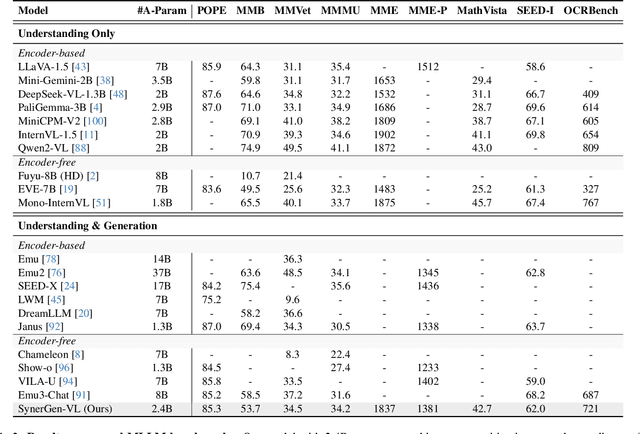
The remarkable success of Large Language Models (LLMs) has extended to the multimodal domain, achieving outstanding performance in image understanding and generation. Recent efforts to develop unified Multimodal Large Language Models (MLLMs) that integrate these capabilities have shown promising results. However, existing approaches often involve complex designs in model architecture or training pipeline, increasing the difficulty of model training and scaling. In this paper, we propose SynerGen-VL, a simple yet powerful encoder-free MLLM capable of both image understanding and generation. To address challenges identified in existing encoder-free unified MLLMs, we introduce the token folding mechanism and the vision-expert-based progressive alignment pretraining strategy, which effectively support high-resolution image understanding while reducing training complexity. After being trained on large-scale mixed image-text data with a unified next-token prediction objective, SynerGen-VL achieves or surpasses the performance of existing encoder-free unified MLLMs with comparable or smaller parameter sizes, and narrows the gap with task-specific state-of-the-art models, highlighting a promising path toward future unified MLLMs. Our code and models shall be released.