 Add to Chrome
 Add to Firefox
 Add to Edge
Kimi K3: Open Frontier Intelligence
Jul 27, 2026
We introduce Kimi K3, a 2.8T parameter Mixture-of-Experts model with 104 billion activated parameters, native vision capabilities, and a 1-million-token context window. Kimi K3 is built on Kimi Delta Attention and Attention Residuals, which improve information flow across sequence length and model depth. Together with Stable LatentMoE, which effectively activates 16 of 896 routed experts per token, and refined training and data recipes, these advances yield an approximately 2.5x improvement in overall scaling efficiency over Kimi K2. Post-training highlights reinforcement learning across general, agentic, and coding domains and multiple reasoning-effort levels, enabling compositional generalization and robust long-horizon execution. At 2.8T scale, Kimi K3 is supported by infrastructure advances in multiple areas: algorithm-system co-design for KDA, perfectly balanced expert-parallel training with efficient memory management, million-token agentic RL with persistent rollout and sandbox states, and deployment innovations. Extensive evaluations show that Kimi K3 achieves frontier-level performance across long-horizon coding, agentic, knowledge, reasoning, and vision tasks. While its overall performance still trails the most powerful proprietary models, namely Claude Fable 5 and GPT-5.6 Sol, Kimi K3 consistently outperforms other open and proprietary models evaluated in our suite. We release the full Kimi K3 model weights to facilitate future research and accelerate the broader deployment and adoption of frontier intelligence.

PerceptionBench: Evaluating Atomic Visual Perception in Multimodal Large Language Models
Jul 27, 2026We introduce PerceptionBench, a benchmark specifically designed to evaluate the atomic visual perception capabilities of Multimodal Large Language Models (MLLMs). Existing benchmarks often fail to isolate perception: holistic evaluations conflate perceptual errors with failures in reasoning or domain knowledge, while application-driven benchmarks only cover narrow, fragmented domains shaped by heuristic designs. To address these limitations, PerceptionBench adopts a bottom-up approach: by diagnosing the earliest failure points in the responses of frontier MLLMs across 42 existing benchmarks, we construct an error taxonomy whose perception branch defines ten atomic perceptual capabilities. Guided by this taxonomy, we construct 3,000 verified questions with short, unambiguous answers, each isolating a single capability, with difficulty stemming from perception rather than reasoning or knowledge. Benchmark results across sixteen frontier MLLMs reveal that atomic perception remains largely unsolved---no model reaches 60\% accuracy, perception-related hallucination is the weakest capability on average, and similar overall scores conceal sharply divergent capability profiles. PerceptionBench thus provides a capability-level standard for measuring and diagnosing the visual perception boundaries of MLLMs.
Attention Residuals
Mar 16, 2026Residual connections with PreNorm are standard in modern LLMs, yet they accumulate all layer outputs with fixed unit weights. This uniform aggregation causes uncontrolled hidden-state growth with depth, progressively diluting each layer's contribution. We propose Attention Residuals (AttnRes), which replaces this fixed accumulation with softmax attention over preceding layer outputs, allowing each layer to selectively aggregate earlier representations with learned, input-dependent weights. To address the memory and communication overhead of attending over all preceding layer outputs for large-scale model training, we introduce Block AttnRes, which partitions layers into blocks and attends over block-level representations, reducing the memory footprint while preserving most of the gains of full AttnRes. Combined with cache-based pipeline communication and a two-phase computation strategy, Block AttnRes becomes a practical drop-in replacement for standard residual connections with minimal overhead. Scaling law experiments confirm that the improvement is consistent across model sizes, and ablations validate the benefit of content-dependent depth-wise selection. We further integrate AttnRes into the Kimi Linear architecture (48B total / 3B activated parameters) and pre-train on 1.4T tokens, where AttnRes mitigates PreNorm dilution, yielding more uniform output magnitudes and gradient distribution across depth, and improves downstream performance across all evaluated tasks.
Kimi K2.5: Visual Agentic Intelligence
Feb 02, 2026We introduce Kimi K2.5, an open-source multimodal agentic model designed to advance general agentic intelligence. K2.5 emphasizes the joint optimization of text and vision so that two modalities enhance each other. This includes a series of techniques such as joint text-vision pre-training, zero-vision SFT, and joint text-vision reinforcement learning. Building on this multimodal foundation, K2.5 introduces Agent Swarm, a self-directed parallel agent orchestration framework that dynamically decomposes complex tasks into heterogeneous sub-problems and executes them concurrently. Extensive evaluations show that Kimi K2.5 achieves state-of-the-art results across various domains including coding, vision, reasoning, and agentic tasks. Agent Swarm also reduces latency by up to $4.5\times$ over single-agent baselines. We release the post-trained Kimi K2.5 model checkpoint to facilitate future research and real-world applications of agentic intelligence.
WorldVQA: Measuring Atomic World Knowledge in Multimodal Large Language Models
Jan 28, 2026We introduce WorldVQA, a benchmark designed to evaluate the atomic visual world knowledge of Multimodal Large Language Models (MLLMs). Unlike current evaluations, which often conflate visual knowledge retrieval with reasoning, WorldVQA decouples these capabilities to strictly measure "what the model memorizes." The benchmark assesses the atomic capability of grounding and naming visual entities across a stratified taxonomy, spanning from common head-class objects to long-tail rarities. We expect WorldVQA to serve as a rigorous test for visual factuality, thereby establishing a standard for assessing the encyclopedic breadth and hallucination rates of current and next-generation frontier models.
Enhancing the Outcome Reward-based RL Training of MLLMs with Self-Consistency Sampling
Nov 13, 2025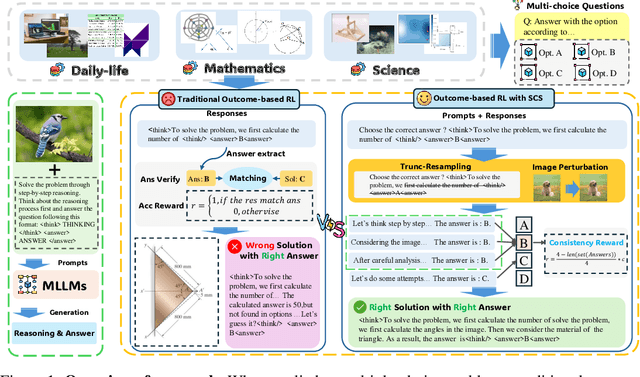
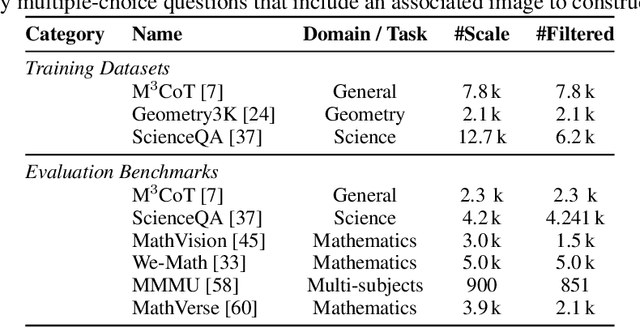
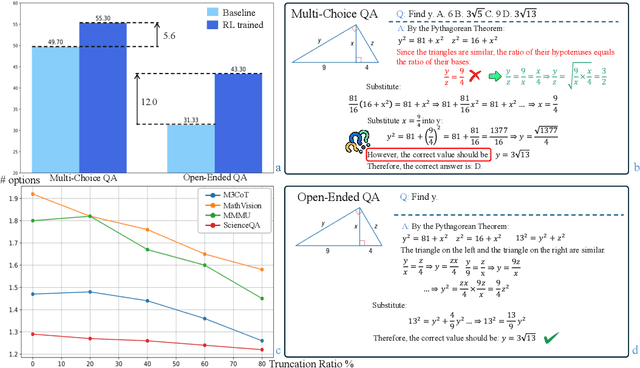
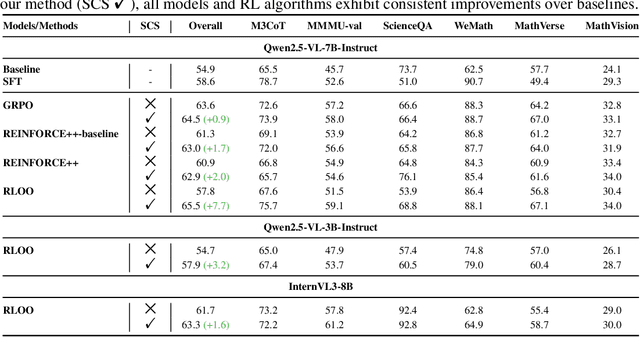
Outcome-reward reinforcement learning (RL) is a common and increasingly significant way to refine the step-by-step reasoning of multimodal large language models (MLLMs). In the multiple-choice setting - a dominant format for multimodal reasoning benchmarks - the paradigm faces a significant yet often overlooked obstacle: unfaithful trajectories that guess the correct option after a faulty chain of thought receive the same reward as genuine reasoning, which is a flaw that cannot be ignored. We propose Self-Consistency Sampling (SCS) to correct this issue. For each question, SCS (i) introduces small visual perturbations and (ii) performs repeated truncation and resampling of an initial trajectory; agreement among the resulting trajectories yields a differentiable consistency score that down-weights unreliable traces during policy updates. Based on Qwen2.5-VL-7B-Instruct, plugging SCS into RLOO, GRPO, and REINFORCE++ series improves accuracy by up to 7.7 percentage points on six multimodal benchmarks with negligible extra computation. SCS also yields notable gains on both Qwen2.5-VL-3B-Instruct and InternVL3-8B, offering a simple, general remedy for outcome-reward RL in MLLMs.
ZeroGUI: Automating Online GUI Learning at Zero Human Cost
May 29, 2025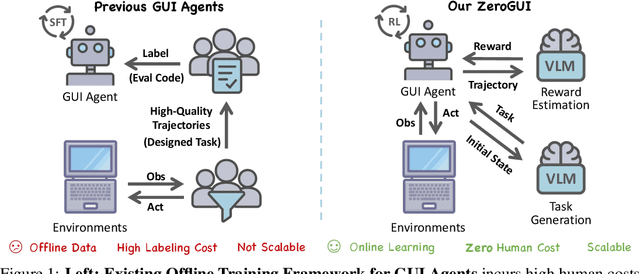
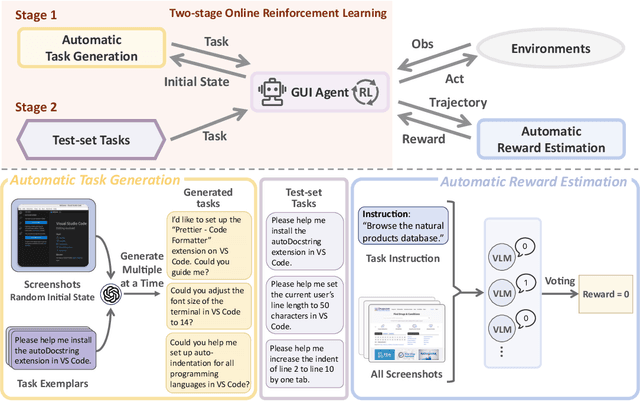
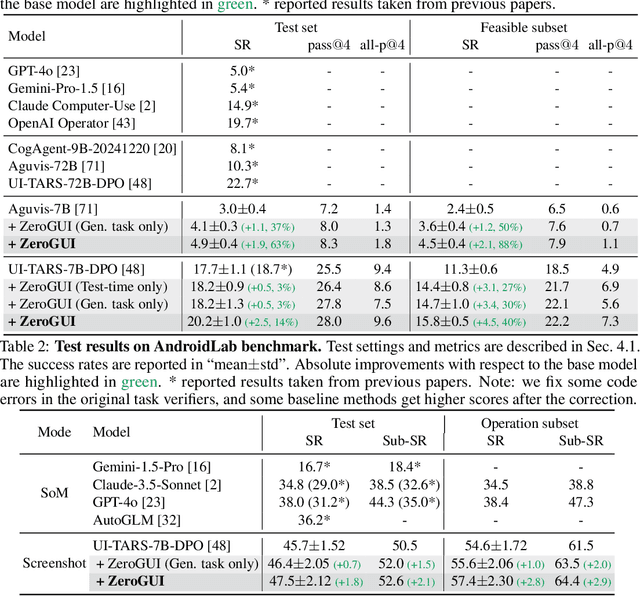
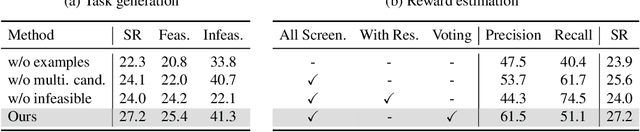
The rapid advancement of large Vision-Language Models (VLMs) has propelled the development of pure-vision-based GUI Agents, capable of perceiving and operating Graphical User Interfaces (GUI) to autonomously fulfill user instructions. However, existing approaches usually adopt an offline learning framework, which faces two core limitations: (1) heavy reliance on high-quality manual annotations for element grounding and action supervision, and (2) limited adaptability to dynamic and interactive environments. To address these limitations, we propose ZeroGUI, a scalable, online learning framework for automating GUI Agent training at Zero human cost. Specifically, ZeroGUI integrates (i) VLM-based automatic task generation to produce diverse training goals from the current environment state, (ii) VLM-based automatic reward estimation to assess task success without hand-crafted evaluation functions, and (iii) two-stage online reinforcement learning to continuously interact with and learn from GUI environments. Experiments on two advanced GUI Agents (UI-TARS and Aguvis) demonstrate that ZeroGUI significantly boosts performance across OSWorld and AndroidLab environments. The code is available at https://github.com/OpenGVLab/ZeroGUI.
VisuLogic: A Benchmark for Evaluating Visual Reasoning in Multi-modal Large Language Models
Apr 21, 2025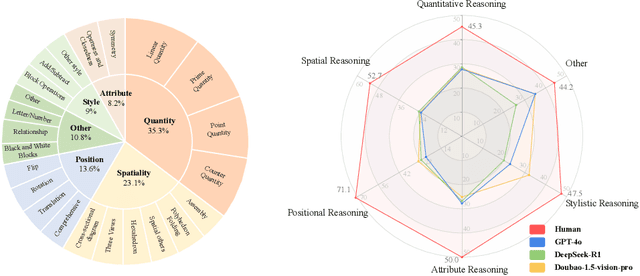
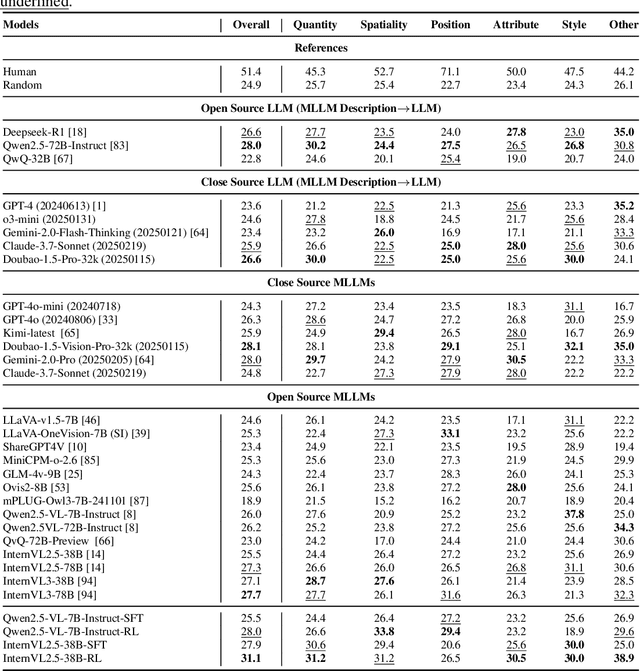
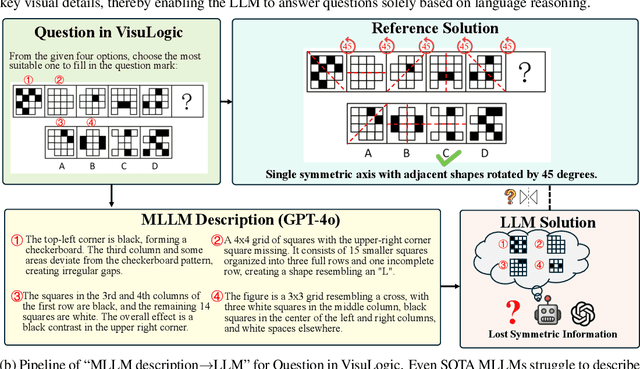
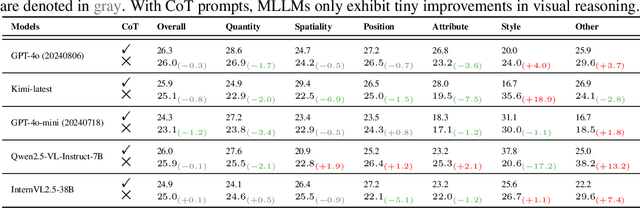
Visual reasoning is a core component of human intelligence and a critical capability for advanced multimodal models. Yet current reasoning evaluations of multimodal large language models (MLLMs) often rely on text descriptions and allow language-based reasoning shortcuts, failing to measure genuine vision-centric reasoning. To address this, we introduce VisuLogic: a benchmark of 1,000 human-verified problems across six categories (e.g., quantitative shifts, spatial relations, attribute comparisons). These various types of questions can be evaluated to assess the visual reasoning capabilities of MLLMs from multiple perspectives. We evaluate leading MLLMs on this benchmark and analyze their results to identify common failure modes. Most models score below 30% accuracy-only slightly above the 25% random baseline and far below the 51.4% achieved by humans-revealing significant gaps in visual reasoning. Furthermore, we provide a supplementary training dataset and a reinforcement-learning baseline to support further progress.
InternVL3: Exploring Advanced Training and Test-Time Recipes for Open-Source Multimodal Models
Apr 15, 2025We introduce InternVL3, a significant advancement in the InternVL series featuring a native multimodal pre-training paradigm. Rather than adapting a text-only large language model (LLM) into a multimodal large language model (MLLM) that supports visual inputs, InternVL3 jointly acquires multimodal and linguistic capabilities from both diverse multimodal data and pure-text corpora during a single pre-training stage. This unified training paradigm effectively addresses the complexities and alignment challenges commonly encountered in conventional post-hoc training pipelines for MLLMs. To further improve performance and scalability, InternVL3 incorporates variable visual position encoding (V2PE) to support extended multimodal contexts, employs advanced post-training techniques such as supervised fine-tuning (SFT) and mixed preference optimization (MPO), and adopts test-time scaling strategies alongside an optimized training infrastructure. Extensive empirical evaluations demonstrate that InternVL3 delivers superior performance across a wide range of multi-modal tasks. In particular, InternVL3-78B achieves a score of 72.2 on the MMMU benchmark, setting a new state-of-the-art among open-source MLLMs. Its capabilities remain highly competitive with leading proprietary models, including ChatGPT-4o, Claude 3.5 Sonnet, and Gemini 2.5 Pro, while also maintaining strong pure-language proficiency. In pursuit of open-science principles, we will publicly release both the training data and model weights to foster further research and development in next-generation MLLMs.
VisualPRM: An Effective Process Reward Model for Multimodal Reasoning
Mar 13, 2025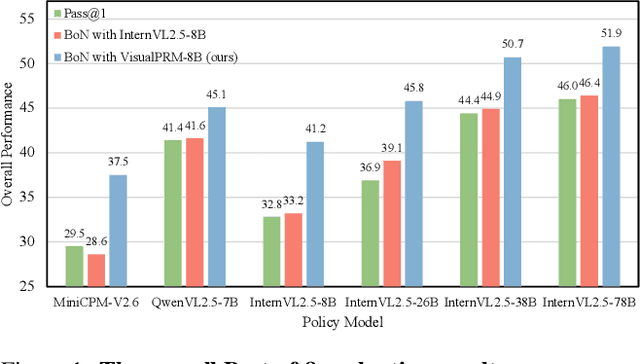
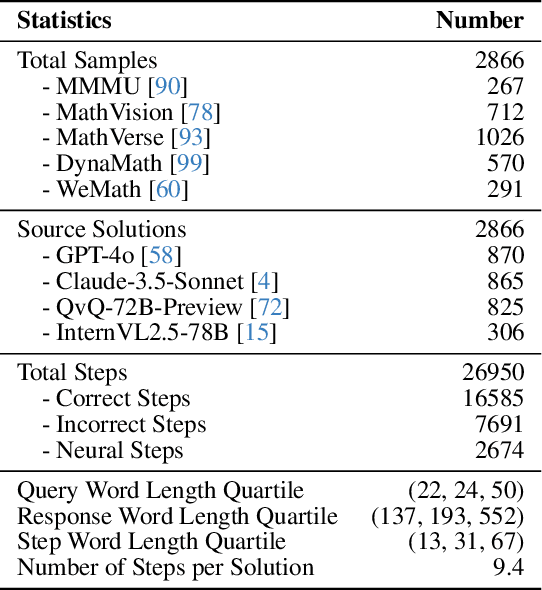
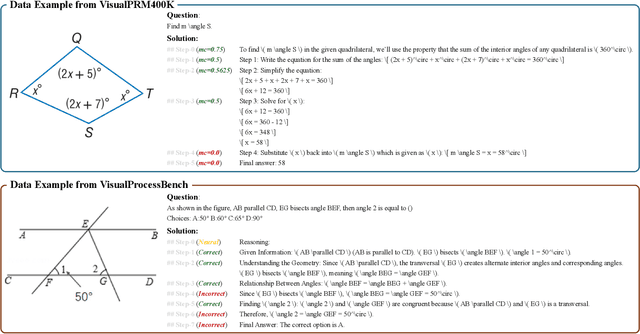
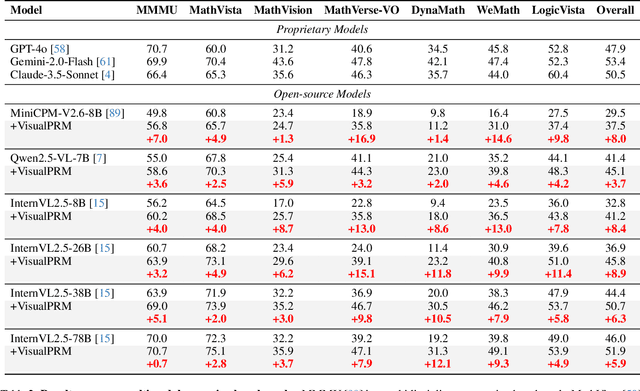
We introduce VisualPRM, an advanced multimodal Process Reward Model (PRM) with 8B parameters, which improves the reasoning abilities of existing Multimodal Large Language Models (MLLMs) across different model scales and families with Best-of-N (BoN) evaluation strategies. Specifically, our model improves the reasoning performance of three types of MLLMs and four different model scales. Even when applied to the highly capable InternVL2.5-78B, it achieves a 5.9-point improvement across seven multimodal reasoning benchmarks. Experimental results show that our model exhibits superior performance compared to Outcome Reward Models and Self-Consistency during BoN evaluation. To facilitate the training of multimodal PRMs, we construct a multimodal process supervision dataset VisualPRM400K using an automated data pipeline. For the evaluation of multimodal PRMs, we propose VisualProcessBench, a benchmark with human-annotated step-wise correctness labels, to measure the abilities of PRMs to detect erroneous steps in multimodal reasoning tasks. We hope that our work can inspire more future research and contribute to the development of MLLMs. Our model, data, and benchmark are released in https://internvl.github.io/blog/2025-03-13-VisualPRM/.