 Add to Chrome
 Add to Firefox
 Add to Edge
MoCapAnything: Unified 3D Motion Capture for Arbitrary Skeletons from Monocular Videos
Dec 11, 2025
Motion capture now underpins content creation far beyond digital humans, yet most existing pipelines remain species- or template-specific. We formalize this gap as Category-Agnostic Motion Capture (CAMoCap): given a monocular video and an arbitrary rigged 3D asset as a prompt, the goal is to reconstruct a rotation-based animation such as BVH that directly drives the specific asset. We present MoCapAnything, a reference-guided, factorized framework that first predicts 3D joint trajectories and then recovers asset-specific rotations via constraint-aware inverse kinematics. The system contains three learnable modules and a lightweight IK stage: (1) a Reference Prompt Encoder that extracts per-joint queries from the asset's skeleton, mesh, and rendered images; (2) a Video Feature Extractor that computes dense visual descriptors and reconstructs a coarse 4D deforming mesh to bridge the gap between video and joint space; and (3) a Unified Motion Decoder that fuses these cues to produce temporally coherent trajectories. We also curate Truebones Zoo with 1038 motion clips, each providing a standardized skeleton-mesh-render triad. Experiments on both in-domain benchmarks and in-the-wild videos show that MoCapAnything delivers high-quality skeletal animations and exhibits meaningful cross-species retargeting across heterogeneous rigs, enabling scalable, prompt-driven 3D motion capture for arbitrary assets. Project page: https://animotionlab.github.io/MoCapAnything/

SWiT-4D: Sliding-Window Transformer for Lossless and Parameter-Free Temporal 4D Generation
Dec 11, 2025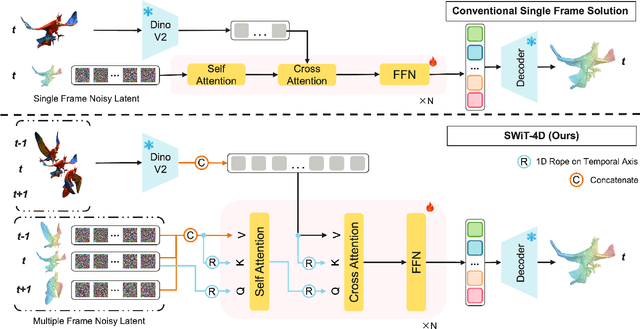
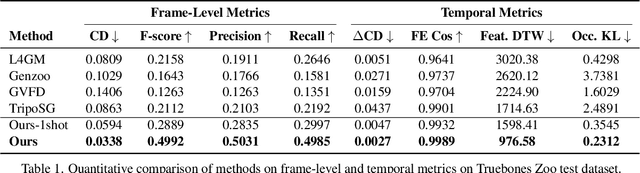
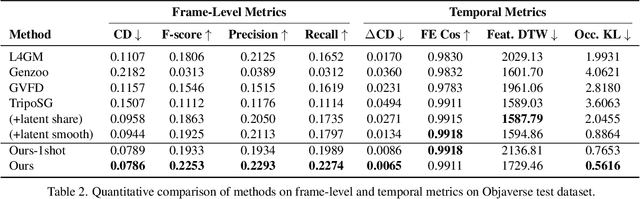
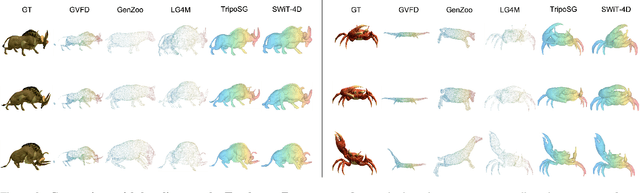
Despite significant progress in 4D content generation, the conversion of monocular videos into high-quality animated 3D assets with explicit 4D meshes remains considerably challenging. The scarcity of large-scale, naturally captured 4D mesh datasets further limits the ability to train generalizable video-to-4D models from scratch in a purely data-driven manner. Meanwhile, advances in image-to-3D generation, supported by extensive datasets, offer powerful prior models that can be leveraged. To better utilize these priors while minimizing reliance on 4D supervision, we introduce SWiT-4D, a Sliding-Window Transformer for lossless, parameter-free temporal 4D mesh generation. SWiT-4D integrates seamlessly with any Diffusion Transformer (DiT)-based image-to-3D generator, adding spatial-temporal modeling across video frames while preserving the original single-image forward process, enabling 4D mesh reconstruction from videos of arbitrary length. To recover global translation, we further introduce an optimization-based trajectory module tailored for static-camera monocular videos. SWiT-4D demonstrates strong data efficiency: with only a single short (<10s) video for fine-tuning, it achieves high-fidelity geometry and stable temporal consistency, indicating practical deployability under extremely limited 4D supervision. Comprehensive experiments on both in-domain zoo-test sets and challenging out-of-domain benchmarks (C4D, Objaverse, and in-the-wild videos) show that SWiT-4D consistently outperforms existing baselines in temporal smoothness. Project page: https://animotionlab.github.io/SWIT4D/
Parameter-Efficient and Memory-Efficient Tuning for Vision Transformer: A Disentangled Approach
Jul 09, 2024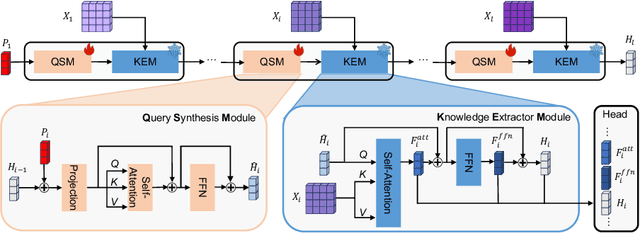
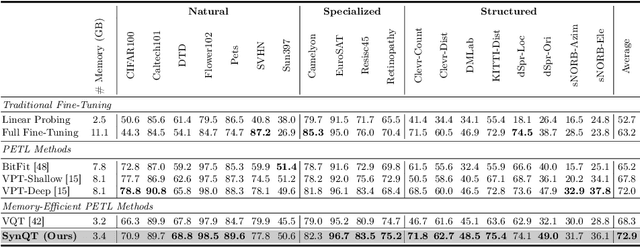
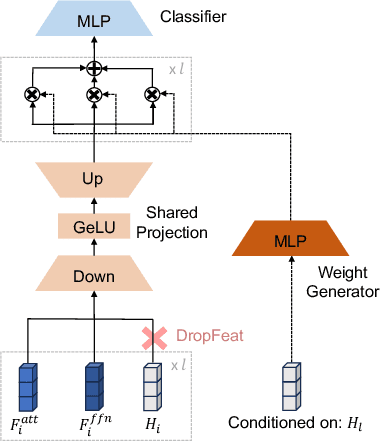
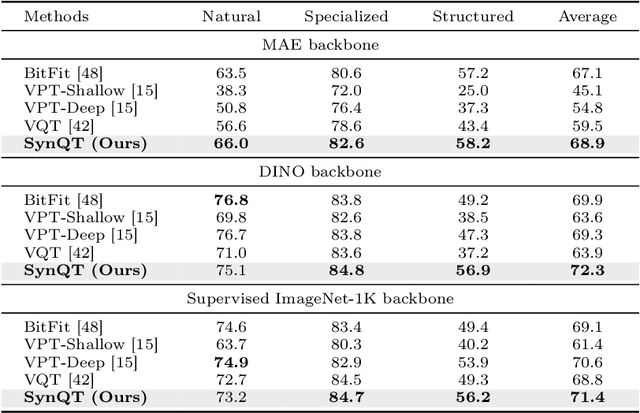
Recent works on parameter-efficient transfer learning (PETL) show the potential to adapt a pre-trained Vision Transformer to downstream recognition tasks with only a few learnable parameters. However, since they usually insert new structures into the pre-trained model, entire intermediate features of that model are changed and thus need to be stored to be involved in back-propagation, resulting in memory-heavy training. We solve this problem from a novel disentangled perspective, i.e., dividing PETL into two aspects: task-specific learning and pre-trained knowledge utilization. Specifically, we synthesize the task-specific query with a learnable and lightweight module, which is independent of the pre-trained model. The synthesized query equipped with task-specific knowledge serves to extract the useful features for downstream tasks from the intermediate representations of the pre-trained model in a query-only manner. Built upon these features, a customized classification head is proposed to make the prediction for the input sample. lightweight architecture and avoids the use of heavy intermediate features for running gradient descent, it demonstrates limited memory usage in training. Extensive experiments manifest that our method achieves state-of-the-art performance under memory constraints, showcasing its applicability in real-world situations.
FCA-RAC: First Cycle Annotated Repetitive Action Counting
Jun 18, 2024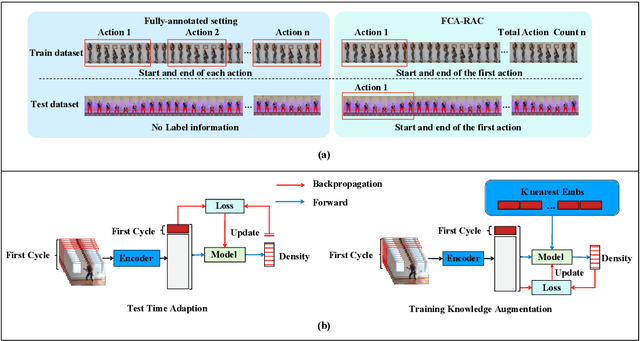


Repetitive action counting quantifies the frequency of specific actions performed by individuals. However, existing action-counting datasets have limited action diversity, potentially hampering model performance on unseen actions. To address this issue, we propose a framework called First Cycle Annotated Repetitive Action Counting (FCA-RAC). This framework contains 4 parts: 1) a labeling technique that annotates each training video with the start and end of the first action cycle, along with the total action count. This technique enables the model to capture the correlation between the initial action cycle and subsequent actions; 2) an adaptive sampling strategy that maximizes action information retention by adjusting to the speed of the first annotated action cycle in videos; 3) a Multi-Temporal Granularity Convolution (MTGC) module, that leverages the muli-scale first action as a kernel to convolve across the entire video. This enables the model to capture action variations at different time scales within the video; 4) a strategy called Training Knowledge Augmentation (TKA) that exploits the annotated first action cycle information from the entire dataset. This allows the network to harness shared characteristics across actions effectively, thereby enhancing model performance and generalizability to unseen actions. Experimental results demonstrate that our approach achieves superior outcomes on RepCount-A and related datasets, highlighting the efficacy of our framework in improving model performance on seen and unseen actions. Our paper makes significant contributions to the field of action counting by addressing the limitations of existing datasets and proposing novel techniques for improving model generalizability.
DreamDrone
Dec 17, 2023

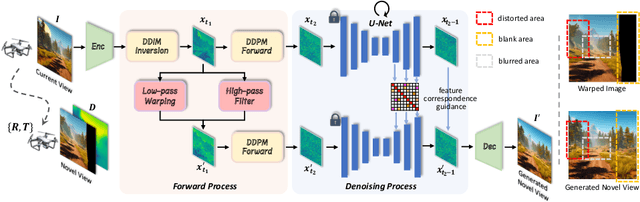
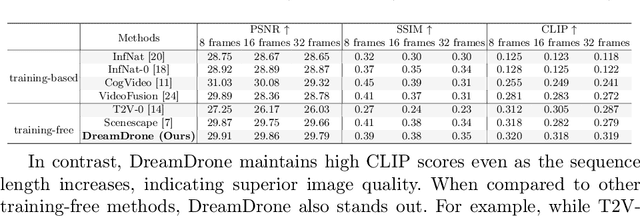
We introduce DreamDrone, an innovative method for generating unbounded flythrough scenes from textual prompts. Central to our method is a novel feature-correspondence-guidance diffusion process, which utilizes the strong correspondence of intermediate features in the diffusion model. Leveraging this guidance strategy, we further propose an advanced technique for editing the intermediate latent code, enabling the generation of subsequent novel views with geometric consistency. Extensive experiments reveal that DreamDrone significantly surpasses existing methods, delivering highly authentic scene generation with exceptional visual quality. This approach marks a significant step in zero-shot perpetual view generation from textual prompts, enabling the creation of diverse scenes, including natural landscapes like oases and caves, as well as complex urban settings such as Lego-style street views. Our code is publicly available.
TSP-Transformer: Task-Specific Prompts Boosted Transformer for Holistic Scene Understanding
Nov 06, 2023Holistic scene understanding includes semantic segmentation, surface normal estimation, object boundary detection, depth estimation, etc. The key aspect of this problem is to learn representation effectively, as each subtask builds upon not only correlated but also distinct attributes. Inspired by visual-prompt tuning, we propose a Task-Specific Prompts Transformer, dubbed TSP-Transformer, for holistic scene understanding. It features a vanilla transformer in the early stage and tasks-specific prompts transformer encoder in the lateral stage, where tasks-specific prompts are augmented. By doing so, the transformer layer learns the generic information from the shared parts and is endowed with task-specific capacity. First, the tasks-specific prompts serve as induced priors for each task effectively. Moreover, the task-specific prompts can be seen as switches to favor task-specific representation learning for different tasks. Extensive experiments on NYUD-v2 and PASCAL-Context show that our method achieves state-of-the-art performance, validating the effectiveness of our method for holistic scene understanding. We also provide our code in the following link https://github.com/tb2-sy/TSP-Transformer.
GraphAdapter: Tuning Vision-Language Models With Dual Knowledge Graph
Sep 24, 2023


Adapter-style efficient transfer learning (ETL) has shown excellent performance in the tuning of vision-language models (VLMs) under the low-data regime, where only a few additional parameters are introduced to excavate the task-specific knowledge based on the general and powerful representation of VLMs. However, most adapter-style works face two limitations: (i) modeling task-specific knowledge with a single modality only; and (ii) overlooking the exploitation of the inter-class relationships in downstream tasks, thereby leading to sub-optimal solutions. To mitigate that, we propose an effective adapter-style tuning strategy, dubbed GraphAdapter, which performs the textual adapter by explicitly modeling the dual-modality structure knowledge (i.e., the correlation of different semantics/classes in textual and visual modalities) with a dual knowledge graph. In particular, the dual knowledge graph is established with two sub-graphs, i.e., a textual knowledge sub-graph, and a visual knowledge sub-graph, where the nodes and edges represent the semantics/classes and their correlations in two modalities, respectively. This enables the textual feature of each prompt to leverage the task-specific structure knowledge from both textual and visual modalities, yielding a more effective classifier for downstream tasks. Extensive experimental results on 11 benchmark datasets reveal that our GraphAdapter significantly outperforms previous adapter-based methods. The code will be released at https://github.com/lixinustc/GraphAdapter
Priority-Centric Human Motion Generation in Discrete Latent Space
Aug 30, 2023Text-to-motion generation is a formidable task, aiming to produce human motions that align with the input text while also adhering to human capabilities and physical laws. While there have been advancements in diffusion models, their application in discrete spaces remains underexplored. Current methods often overlook the varying significance of different motions, treating them uniformly. It is essential to recognize that not all motions hold the same relevance to a particular textual description. Some motions, being more salient and informative, should be given precedence during generation. In response, we introduce a Priority-Centric Motion Discrete Diffusion Model (M2DM), which utilizes a Transformer-based VQ-VAE to derive a concise, discrete motion representation, incorporating a global self-attention mechanism and a regularization term to counteract code collapse. We also present a motion discrete diffusion model that employs an innovative noise schedule, determined by the significance of each motion token within the entire motion sequence. This approach retains the most salient motions during the reverse diffusion process, leading to more semantically rich and varied motions. Additionally, we formulate two strategies to gauge the importance of motion tokens, drawing from both textual and visual indicators. Comprehensive experiments on the HumanML3D and KIT-ML datasets confirm that our model surpasses existing techniques in fidelity and diversity, particularly for intricate textual descriptions.
Dataset Quantization
Aug 21, 2023State-of-the-art deep neural networks are trained with large amounts (millions or even billions) of data. The expensive computation and memory costs make it difficult to train them on limited hardware resources, especially for recent popular large language models (LLM) and computer vision models (CV). Recent popular dataset distillation methods are thus developed, aiming to reduce the number of training samples via synthesizing small-scale datasets via gradient matching. However, as the gradient calculation is coupled with the specific network architecture, the synthesized dataset is biased and performs poorly when used for training unseen architectures. To address these limitations, we present dataset quantization (DQ), a new framework to compress large-scale datasets into small subsets which can be used for training any neural network architectures. Extensive experiments demonstrate that DQ is able to generate condensed small datasets for training unseen network architectures with state-of-the-art compression ratios for lossless model training. To the best of our knowledge, DQ is the first method that can successfully distill large-scale datasets such as ImageNet-1k with a state-of-the-art compression ratio. Notably, with 60% data from ImageNet and 20% data from Alpaca's instruction tuning data, the models can be trained with negligible or no performance drop for both vision tasks (including classification, semantic segmentation, and object detection) as well as language tasks (including instruction tuning tasks such as BBH and DROP).
Revisiting Event-based Video Frame Interpolation
Jul 24, 2023


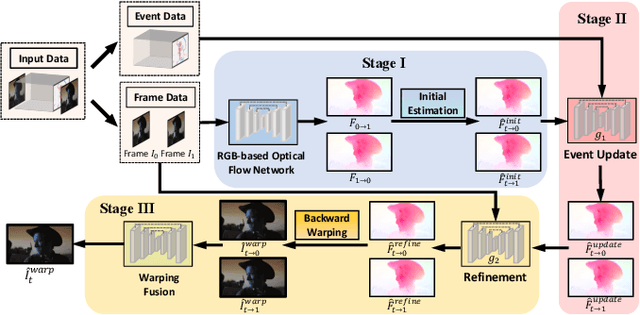
Dynamic vision sensors or event cameras provide rich complementary information for video frame interpolation. Existing state-of-the-art methods follow the paradigm of combining both synthesis-based and warping networks. However, few of those methods fully respect the intrinsic characteristics of events streams. Given that event cameras only encode intensity changes and polarity rather than color intensities, estimating optical flow from events is arguably more difficult than from RGB information. We therefore propose to incorporate RGB information in an event-guided optical flow refinement strategy. Moreover, in light of the quasi-continuous nature of the time signals provided by event cameras, we propose a divide-and-conquer strategy in which event-based intermediate frame synthesis happens incrementally in multiple simplified stages rather than in a single, long stage. Extensive experiments on both synthetic and real-world datasets show that these modifications lead to more reliable and realistic intermediate frame results than previous video frame interpolation methods. Our findings underline that a careful consideration of event characteristics such as high temporal density and elevated noise benefits interpolation accuracy.