 Add to Chrome
 Add to Firefox
 Add to Edge
Enhancing Irregular Time Series Forecasting with Continuous-Time Modeling Framework
Jul 30, 2026
Irregular multivariate time series are widely encountered in applications such as healthcare monitoring, human activity recognition, and environmental sensing. Their core challenges stem from asynchronous observations, non-uniform sampling intervals, and the fact that temporal patterns themselves carry critical dynamic information. Existing approaches either rely on discretization-based preprocessing (e.g., interpolation, imputation, or aggregation), which disrupts the underlying continuous-time semantics, or adopt continuous-time modeling via ODE-based frameworks, which typically require specialized architectures and incur substantial computational overhead due to numerical solvers. To address these limitations, we propose WrapFlow, a continuous-time modeling framework for irregular time series forecasting. On the input side, WrapFlow introduces Continuous-Time Tokenization, which directly encodes raw observation events and explicitly models long unobserved intervals via gap-aware tokens. The resulting continuous-time tokens are then processed by a standard Transformer backbone to capture long-range temporal dependencies. On the output side, we develop a simulation-free training paradigm for Residual Flow Matching, which learns conditional residual vector fields around base predictions while avoiding numerical-solver simulation and backpropagation during training. This design enables high-quality continuous forecasting using only a small number of fixed rollout steps at inference. Extensive experiments on multiple real-world datasets demonstrate that WrapFlow achieves state-of-the-art performance.

GCGNet: Graph-Consistent Generative Network for Time Series Forecasting with Exogenous Variables
Mar 09, 2026Exogenous variables offer valuable supplementary information for predicting future endogenous variables. Forecasting with exogenous variables needs to consider both past-to-future dependencies (i.e., temporal correlations) and the influence of exogenous variables on endogenous variables (i.e., channel correlations). This is pivotal when future exogenous variables are available, because they may directly affect the future endogenous variables. Many methods have been proposed for time series forecasting with exogenous variables, focusing on modeling temporal and channel correlations. However, most of them use a two-step strategy, modeling temporal and channel correlations separately, which limits their ability to capture joint correlations across time and channels. Furthermore, in real-world scenarios, time series are frequently affected by various forms of noises, underscoring the critical importance of robustness in such correlations modeling. To address these limitations, we propose GCGNet, a Graph-Consistent Generative Network for time series forecasting with exogenous variables. Specifically, GCGNet first employs a Variational Generator to produce coarse predictions. A Graph Structure Aligner then further guides it by evaluating the consistency between the generated and true correlations, where the correlations are represented as graphs, and are robust to noises. Finally, a Graph Refiner is proposed to refine the predictions to prevent degeneration and improve accuracy. Extensive experiments on 12 real-world datasets demonstrate that GCGNet outperforms state-of-the-art baselines.
NECromancer: Breathing Life into Skeletons via BVH Animation
Feb 06, 2026Motion tokenization is a key component of generalizable motion models, yet most existing approaches are restricted to species-specific skeletons, limiting their applicability across diverse morphologies. We propose NECromancer (NEC), a universal motion tokenizer that operates directly on arbitrary BVH skeletons. NEC consists of three components: (1) an Ontology-aware Skeletal Graph Encoder (OwO) that encodes structural priors from BVH files, including joint semantics, rest-pose offsets, and skeletal topology, into skeletal embeddings; (2) a Topology-Agnostic Tokenizer (TAT) that compresses motion sequences into a universal, topology-invariant discrete representation; and (3) the Unified BVH Universe (UvU), a large-scale dataset aggregating BVH motions across heterogeneous skeletons. Experiments show that NEC achieves high-fidelity reconstruction under substantial compression and effectively disentangles motion from skeletal structure. The resulting token space supports cross-species motion transfer, composition, denoising, generation with token-based models, and text-motion retrieval, establishing a unified framework for motion analysis and synthesis across diverse morphologies. Demo page: https://animotionlab.github.io/NECromancer/
DiMo: Discrete Diffusion Modeling for Motion Generation and Understanding
Feb 04, 2026Prior masked modeling motion generation methods predominantly study text-to-motion. We present DiMo, a discrete diffusion-style framework, which extends masked modeling to bidirectional text--motion understanding and generation. Unlike GPT-style autoregressive approaches that tokenize motion and decode sequentially, DiMo performs iterative masked token refinement, unifying Text-to-Motion (T2M), Motion-to-Text (M2T), and text-free Motion-to-Motion (M2M) within a single model. This decoding paradigm naturally enables a quality-latency trade-off at inference via the number of refinement steps.We further improve motion token fidelity with residual vector quantization (RVQ) and enhance alignment and controllability with Group Relative Policy Optimization (GRPO). Experiments on HumanML3D and KIT-ML show strong motion quality and competitive bidirectional understanding under a unified framework. In addition, we demonstrate model ability in text-free motion completion, text-guided motion prediction and motion caption correction without architectural change.Additional qualitative results are available on our project page: https://animotionlab.github.io/DiMo/.
TimeART: Towards Agentic Time Series Reasoning via Tool-Augmentation
Jan 20, 2026Time series data widely exist in real-world cyber-physical systems. Though analyzing and interpreting them contributes to significant values, e.g, disaster prediction and financial risk control, current workflows mainly rely on human data scientists, which requires significant labor costs and lacks automation. To tackle this, we introduce TimeART, a framework fusing the analytical capability of strong out-of-the-box tools and the reasoning capability of Large Language Models (LLMs), which serves as a fully agentic data scientist for Time Series Question Answering (TSQA). To teach the LLM-based Time Series Reasoning Models (TSRMs) strategic tool-use, we also collect a 100k expert trajectory corpus called TimeToolBench. To enhance TSRMs' generalization capability, we then devise a four-stage training strategy, which boosts TSRMs through learning from their own early experiences and self-reflections. Experimentally, we train an 8B TSRM on TimeToolBench and equip it with the TimeART framework, and it achieves consistent state-of-the-art performance on multiple TSQA tasks, which pioneers a novel approach towards agentic time series reasoning.
FLAME: Flow Enhanced Legendre Memory Models for General Time Series Forecasting
Dec 16, 2025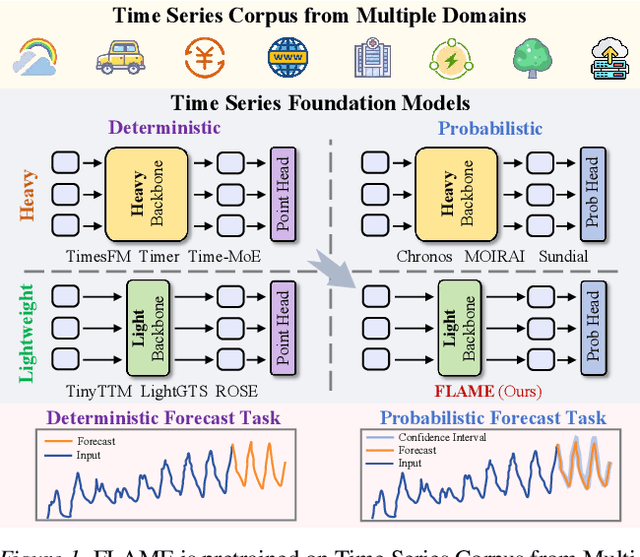
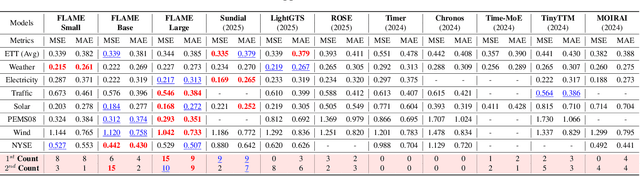
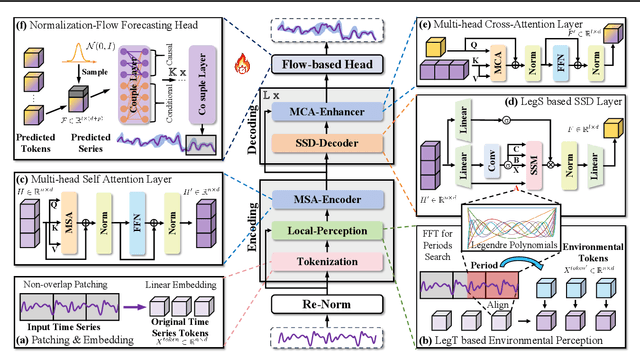

In this work, we introduce FLAME, a family of extremely lightweight and capable Time Series Foundation Models, which support both deterministic and probabilistic forecasting via generative probabilistic modeling, thus ensuring both efficiency and robustness. FLAME utilizes the Legendre Memory for strong generalization capabilities. Through adapting variants of Legendre Memory, i.e., translated Legendre (LegT) and scaled Legendre (LegS), in the Encoding and Decoding phases, FLAME can effectively capture the inherent inductive bias within data and make efficient long-range inferences. To enhance the accuracy of probabilistic forecasting while keeping efficient, FLAME adopts a Normalization Flow based forecasting head, which can model the arbitrarily intricate distributions over the forecasting horizon in a generative manner. Comprehensive experiments on well-recognized benchmarks, including TSFM-Bench and ProbTS, demonstrate the consistent state-of-the-art zero-shot performance of FLAME on both deterministic and probabilistic forecasting tasks.
MoCapAnything: Unified 3D Motion Capture for Arbitrary Skeletons from Monocular Videos
Dec 11, 2025Motion capture now underpins content creation far beyond digital humans, yet most existing pipelines remain species- or template-specific. We formalize this gap as Category-Agnostic Motion Capture (CAMoCap): given a monocular video and an arbitrary rigged 3D asset as a prompt, the goal is to reconstruct a rotation-based animation such as BVH that directly drives the specific asset. We present MoCapAnything, a reference-guided, factorized framework that first predicts 3D joint trajectories and then recovers asset-specific rotations via constraint-aware inverse kinematics. The system contains three learnable modules and a lightweight IK stage: (1) a Reference Prompt Encoder that extracts per-joint queries from the asset's skeleton, mesh, and rendered images; (2) a Video Feature Extractor that computes dense visual descriptors and reconstructs a coarse 4D deforming mesh to bridge the gap between video and joint space; and (3) a Unified Motion Decoder that fuses these cues to produce temporally coherent trajectories. We also curate Truebones Zoo with 1038 motion clips, each providing a standardized skeleton-mesh-render triad. Experiments on both in-domain benchmarks and in-the-wild videos show that MoCapAnything delivers high-quality skeletal animations and exhibits meaningful cross-species retargeting across heterogeneous rigs, enabling scalable, prompt-driven 3D motion capture for arbitrary assets. Project page: https://animotionlab.github.io/MoCapAnything/
SWiT-4D: Sliding-Window Transformer for Lossless and Parameter-Free Temporal 4D Generation
Dec 11, 2025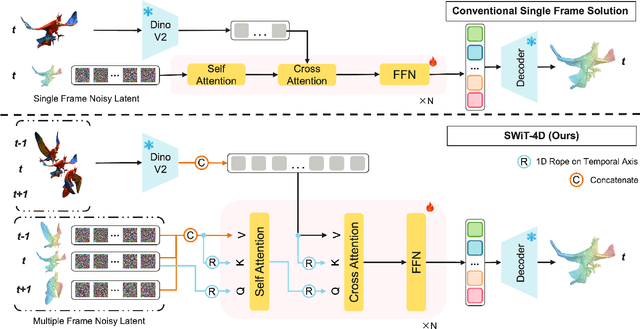
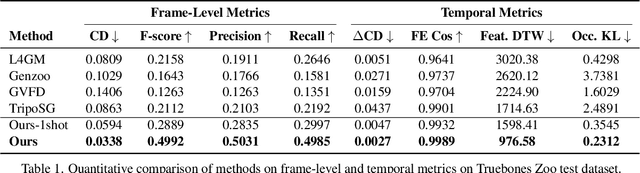
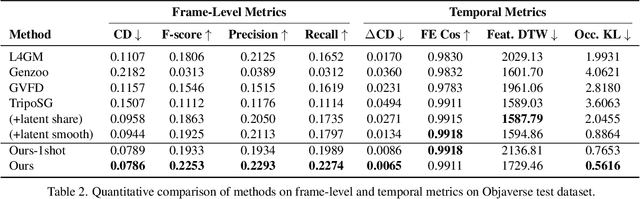
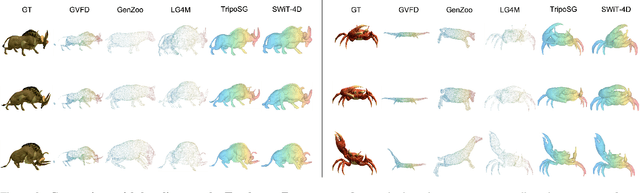
Despite significant progress in 4D content generation, the conversion of monocular videos into high-quality animated 3D assets with explicit 4D meshes remains considerably challenging. The scarcity of large-scale, naturally captured 4D mesh datasets further limits the ability to train generalizable video-to-4D models from scratch in a purely data-driven manner. Meanwhile, advances in image-to-3D generation, supported by extensive datasets, offer powerful prior models that can be leveraged. To better utilize these priors while minimizing reliance on 4D supervision, we introduce SWiT-4D, a Sliding-Window Transformer for lossless, parameter-free temporal 4D mesh generation. SWiT-4D integrates seamlessly with any Diffusion Transformer (DiT)-based image-to-3D generator, adding spatial-temporal modeling across video frames while preserving the original single-image forward process, enabling 4D mesh reconstruction from videos of arbitrary length. To recover global translation, we further introduce an optimization-based trajectory module tailored for static-camera monocular videos. SWiT-4D demonstrates strong data efficiency: with only a single short (<10s) video for fine-tuning, it achieves high-fidelity geometry and stable temporal consistency, indicating practical deployability under extremely limited 4D supervision. Comprehensive experiments on both in-domain zoo-test sets and challenging out-of-domain benchmarks (C4D, Objaverse, and in-the-wild videos) show that SWiT-4D consistently outperforms existing baselines in temporal smoothness. Project page: https://animotionlab.github.io/SWIT4D/
Enhancing Time Series Forecasting through Selective Representation Spaces: A Patch Perspective
Oct 16, 2025Time Series Forecasting has made significant progress with the help of Patching technique, which partitions time series into multiple patches to effectively retain contextual semantic information into a representation space beneficial for modeling long-term dependencies. However, conventional patching partitions a time series into adjacent patches, which causes a fixed representation space, thus resulting in insufficiently expressful representations. In this paper, we pioneer the exploration of constructing a selective representation space to flexibly include the most informative patches for forecasting. Specifically, we propose the Selective Representation Space (SRS) module, which utilizes the learnable Selective Patching and Dynamic Reassembly techniques to adaptively select and shuffle the patches from the contextual time series, aiming at fully exploiting the information of contextual time series to enhance the forecasting performance of patch-based models. To demonstrate the effectiveness of SRS module, we propose a simple yet effective SRSNet consisting of SRS and an MLP head, which achieves state-of-the-art performance on real-world datasets from multiple domains. Furthermore, as a novel plugin-and-play module, SRS can also enhance the performance of existing patch-based models. The resources are available at https://github.com/decisionintelligence/SRSNet.
Unlocking the Power of Mixture-of-Experts for Task-Aware Time Series Analytics
Sep 26, 2025Time Series Analysis is widely used in various real-world applications such as weather forecasting, financial fraud detection, imputation for missing data in IoT systems, and classification for action recognization. Mixture-of-Experts (MoE), as a powerful architecture, though demonstrating effectiveness in NLP, still falls short in adapting to versatile tasks in time series analytics due to its task-agnostic router and the lack of capability in modeling channel correlations. In this study, we propose a novel, general MoE-based time series framework called PatchMoE to support the intricate ``knowledge'' utilization for distinct tasks, thus task-aware. Based on the observation that hierarchical representations often vary across tasks, e.g., forecasting vs. classification, we propose a Recurrent Noisy Gating to utilize the hierarchical information in routing, thus obtaining task-sepcific capability. And the routing strategy is operated on time series tokens in both temporal and channel dimensions, and encouraged by a meticulously designed Temporal \& Channel Load Balancing Loss to model the intricate temporal and channel correlations. Comprehensive experiments on five downstream tasks demonstrate the state-of-the-art performance of PatchMoE.