 Add to Chrome
 Add to Firefox
 Add to Edge
SWiT-4D: Sliding-Window Transformer for Lossless and Parameter-Free Temporal 4D Generation
Dec 11, 2025
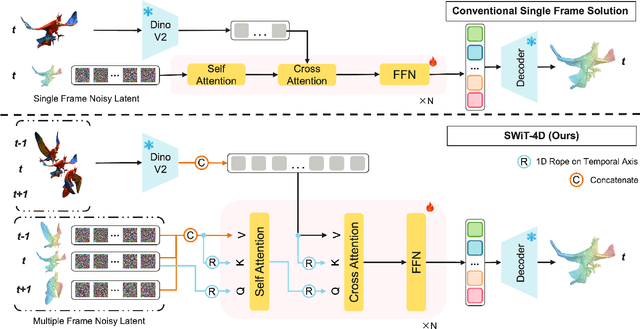
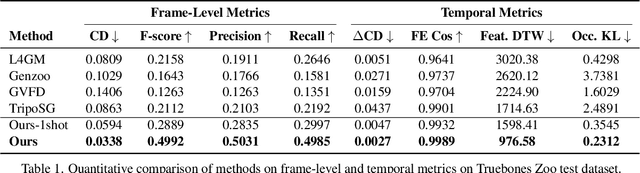
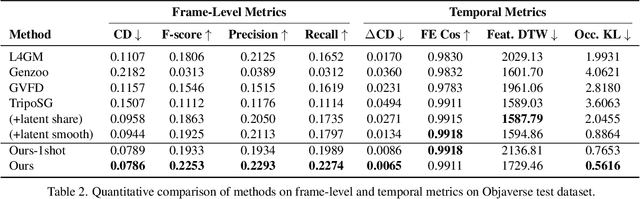
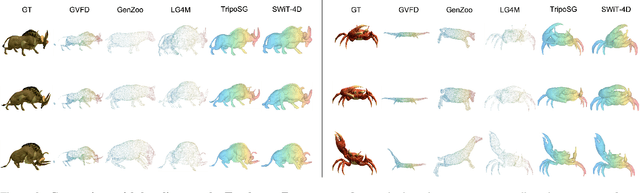
Despite significant progress in 4D content generation, the conversion of monocular videos into high-quality animated 3D assets with explicit 4D meshes remains considerably challenging. The scarcity of large-scale, naturally captured 4D mesh datasets further limits the ability to train generalizable video-to-4D models from scratch in a purely data-driven manner. Meanwhile, advances in image-to-3D generation, supported by extensive datasets, offer powerful prior models that can be leveraged. To better utilize these priors while minimizing reliance on 4D supervision, we introduce SWiT-4D, a Sliding-Window Transformer for lossless, parameter-free temporal 4D mesh generation. SWiT-4D integrates seamlessly with any Diffusion Transformer (DiT)-based image-to-3D generator, adding spatial-temporal modeling across video frames while preserving the original single-image forward process, enabling 4D mesh reconstruction from videos of arbitrary length. To recover global translation, we further introduce an optimization-based trajectory module tailored for static-camera monocular videos. SWiT-4D demonstrates strong data efficiency: with only a single short (<10s) video for fine-tuning, it achieves high-fidelity geometry and stable temporal consistency, indicating practical deployability under extremely limited 4D supervision. Comprehensive experiments on both in-domain zoo-test sets and challenging out-of-domain benchmarks (C4D, Objaverse, and in-the-wild videos) show that SWiT-4D consistently outperforms existing baselines in temporal smoothness. Project page: https://animotionlab.github.io/SWIT4D/

NeRF synthesis with shading guidance
Jun 20, 2023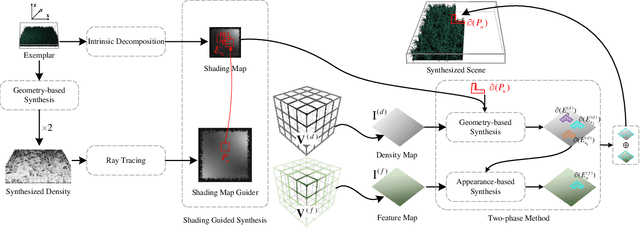
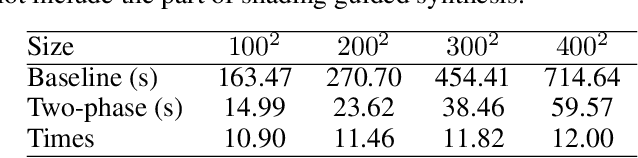
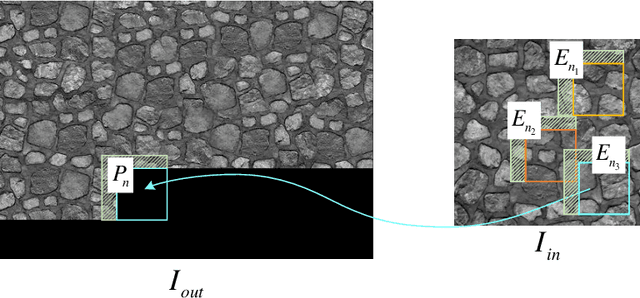
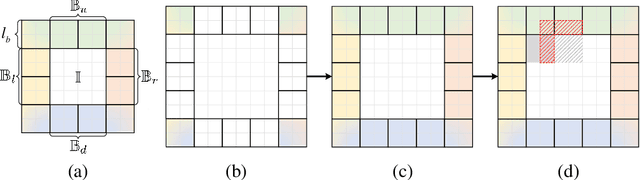
The emerging Neural Radiance Field (NeRF) shows great potential in representing 3D scenes, which can render photo-realistic images from novel view with only sparse views given. However, utilizing NeRF to reconstruct real-world scenes requires images from different viewpoints, which limits its practical application. This problem can be even more pronounced for large scenes. In this paper, we introduce a new task called NeRF synthesis that utilizes the structural content of a NeRF patch exemplar to construct a new radiance field of large size. We propose a two-phase method for synthesizing new scenes that are continuous in geometry and appearance. We also propose a boundary constraint method to synthesize scenes of arbitrary size without artifacts. Specifically, we control the lighting effects of synthesized scenes using shading guidance instead of decoupling the scene. We have demonstrated that our method can generate high-quality results with consistent geometry and appearance, even for scenes with complex lighting. We can also synthesize new scenes on curved surface with arbitrary lighting effects, which enhances the practicality of our proposed NeRF synthesis approach.