 Add to Chrome
 Add to Firefox
 Add to Edge
A Unified Benchmark and Modality-Adaptive Network for Day-and-Night Drone-View Geo-Localization
Jul 28, 2026
Most existing drone-view geo-localization (DVGL) benchmarks contain drone imagery captured under a single illumination condition and lack geographically aligned visible drone images, infrared drone images, and satellite images from the same locations. To evaluate the generalization capability of DVGL methods under challenging illumination conditions, some methods train models on a visible benchmark and test them on an independent infrared benchmark. This protocol essentially constitutes transfer between datasets, which makes it difficult to systematically evaluate DVGL across daytime and nighttime conditions within a unified benchmark. To address this limitation, we construct IRCHN,a real-world DVGL benchmark designed for localization across different illumination conditions. IRCHN contains 26,460 images collected from 8,820 geographic locations across four representative scene categories, including farmland, coastline, forest, and urban areas. Each location provides one visible drone image, one infrared drone image, and one corresponding satellite image, which enables unified evaluation of DVGL methods across different illumination conditions and sensing modalities. We further propose the Modality-Adaptive State-Space Transport Relation Network (MASTR-Net), a DVGL framework tailored to localization under varying illumination conditions. MASTR-Net integrates modality-adaptive feature enhancement, bidirectional selective state-space relation modeling, and soft optimal transport relation alignment to jointly reduce modality gaps and view-induced structural discrepancies. Extensive experiments demonstrate that MASTR-Net outperforms existing state-of-the-art methods on IRCHN for localization under varying illumination conditions and achieves competitive performance on two infrared benchmarks, IR-VL328 and CVGL-RGBT. Code: https://github.com/SongtianhaoXu/MASTR-Net

FCA-RAC: First Cycle Annotated Repetitive Action Counting
Jun 18, 2024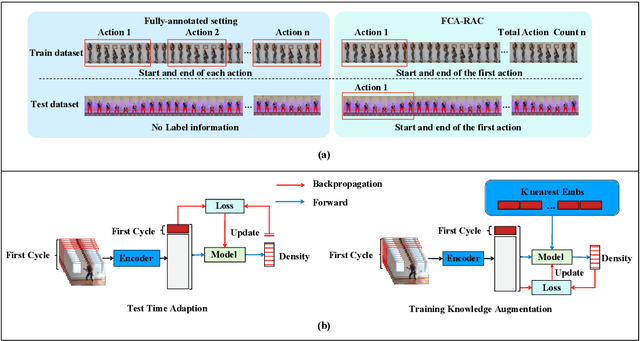


Repetitive action counting quantifies the frequency of specific actions performed by individuals. However, existing action-counting datasets have limited action diversity, potentially hampering model performance on unseen actions. To address this issue, we propose a framework called First Cycle Annotated Repetitive Action Counting (FCA-RAC). This framework contains 4 parts: 1) a labeling technique that annotates each training video with the start and end of the first action cycle, along with the total action count. This technique enables the model to capture the correlation between the initial action cycle and subsequent actions; 2) an adaptive sampling strategy that maximizes action information retention by adjusting to the speed of the first annotated action cycle in videos; 3) a Multi-Temporal Granularity Convolution (MTGC) module, that leverages the muli-scale first action as a kernel to convolve across the entire video. This enables the model to capture action variations at different time scales within the video; 4) a strategy called Training Knowledge Augmentation (TKA) that exploits the annotated first action cycle information from the entire dataset. This allows the network to harness shared characteristics across actions effectively, thereby enhancing model performance and generalizability to unseen actions. Experimental results demonstrate that our approach achieves superior outcomes on RepCount-A and related datasets, highlighting the efficacy of our framework in improving model performance on seen and unseen actions. Our paper makes significant contributions to the field of action counting by addressing the limitations of existing datasets and proposing novel techniques for improving model generalizability.
Boosting Continuous Emotion Recognition with Self-Pretraining using Masked Autoencoders, Temporal Convolutional Networks, and Transformers
Mar 18, 2024Human emotion recognition holds a pivotal role in facilitating seamless human-computer interaction. This paper delineates our methodology in tackling the Valence-Arousal (VA) Estimation Challenge, Expression (Expr) Classification Challenge, and Action Unit (AU) Detection Challenge within the ambit of the 6th Workshop and Competition on Affective Behavior Analysis in-the-wild (ABAW). Our study advocates a novel approach aimed at refining continuous emotion recognition. We achieve this by initially harnessing pre-training with Masked Autoencoders (MAE) on facial datasets, followed by fine-tuning on the aff-wild2 dataset annotated with expression (Expr) labels. The pre-trained model serves as an adept visual feature extractor, thereby enhancing the model's robustness. Furthermore, we bolster the performance of continuous emotion recognition by integrating Temporal Convolutional Network (TCN) modules and Transformer Encoder modules into our framework.
Continuous emotion recognition based on TCN and Transformer
Mar 15, 2023Human emotion recognition plays an important role in human-computer interaction. In this paper, we present our approach to the Valence-Arousal (VA) Estimation Challenge, Expression (Expr) Classification Challenge, and Action Unit (AU) Detection Challenge of the 5th Workshop and Competition on Affective Behavior Analysis in-the-wild (ABAW). Specifically, we propose a novel multi-modal fusion model that leverages Temporal Convolutional Networks (TCN) and Transformer to enhance the performance of continuous emotion recognition. Our model aims to effectively integrate visual and audio information for improved accuracy in recognizing emotions. The model is evaluate with Concordance Correlation Coefficient (CCC)