 Add to Chrome
 Add to Firefox
 Add to Edge
NECromancer: Breathing Life into Skeletons via BVH Animation
Feb 06, 2026
Motion tokenization is a key component of generalizable motion models, yet most existing approaches are restricted to species-specific skeletons, limiting their applicability across diverse morphologies. We propose NECromancer (NEC), a universal motion tokenizer that operates directly on arbitrary BVH skeletons. NEC consists of three components: (1) an Ontology-aware Skeletal Graph Encoder (OwO) that encodes structural priors from BVH files, including joint semantics, rest-pose offsets, and skeletal topology, into skeletal embeddings; (2) a Topology-Agnostic Tokenizer (TAT) that compresses motion sequences into a universal, topology-invariant discrete representation; and (3) the Unified BVH Universe (UvU), a large-scale dataset aggregating BVH motions across heterogeneous skeletons. Experiments show that NEC achieves high-fidelity reconstruction under substantial compression and effectively disentangles motion from skeletal structure. The resulting token space supports cross-species motion transfer, composition, denoising, generation with token-based models, and text-motion retrieval, establishing a unified framework for motion analysis and synthesis across diverse morphologies. Demo page: https://animotionlab.github.io/NECromancer/

DiMo: Discrete Diffusion Modeling for Motion Generation and Understanding
Feb 04, 2026Prior masked modeling motion generation methods predominantly study text-to-motion. We present DiMo, a discrete diffusion-style framework, which extends masked modeling to bidirectional text--motion understanding and generation. Unlike GPT-style autoregressive approaches that tokenize motion and decode sequentially, DiMo performs iterative masked token refinement, unifying Text-to-Motion (T2M), Motion-to-Text (M2T), and text-free Motion-to-Motion (M2M) within a single model. This decoding paradigm naturally enables a quality-latency trade-off at inference via the number of refinement steps.We further improve motion token fidelity with residual vector quantization (RVQ) and enhance alignment and controllability with Group Relative Policy Optimization (GRPO). Experiments on HumanML3D and KIT-ML show strong motion quality and competitive bidirectional understanding under a unified framework. In addition, we demonstrate model ability in text-free motion completion, text-guided motion prediction and motion caption correction without architectural change.Additional qualitative results are available on our project page: https://animotionlab.github.io/DiMo/.
MoCapAnything: Unified 3D Motion Capture for Arbitrary Skeletons from Monocular Videos
Dec 11, 2025Motion capture now underpins content creation far beyond digital humans, yet most existing pipelines remain species- or template-specific. We formalize this gap as Category-Agnostic Motion Capture (CAMoCap): given a monocular video and an arbitrary rigged 3D asset as a prompt, the goal is to reconstruct a rotation-based animation such as BVH that directly drives the specific asset. We present MoCapAnything, a reference-guided, factorized framework that first predicts 3D joint trajectories and then recovers asset-specific rotations via constraint-aware inverse kinematics. The system contains three learnable modules and a lightweight IK stage: (1) a Reference Prompt Encoder that extracts per-joint queries from the asset's skeleton, mesh, and rendered images; (2) a Video Feature Extractor that computes dense visual descriptors and reconstructs a coarse 4D deforming mesh to bridge the gap between video and joint space; and (3) a Unified Motion Decoder that fuses these cues to produce temporally coherent trajectories. We also curate Truebones Zoo with 1038 motion clips, each providing a standardized skeleton-mesh-render triad. Experiments on both in-domain benchmarks and in-the-wild videos show that MoCapAnything delivers high-quality skeletal animations and exhibits meaningful cross-species retargeting across heterogeneous rigs, enabling scalable, prompt-driven 3D motion capture for arbitrary assets. Project page: https://animotionlab.github.io/MoCapAnything/
SWiT-4D: Sliding-Window Transformer for Lossless and Parameter-Free Temporal 4D Generation
Dec 11, 2025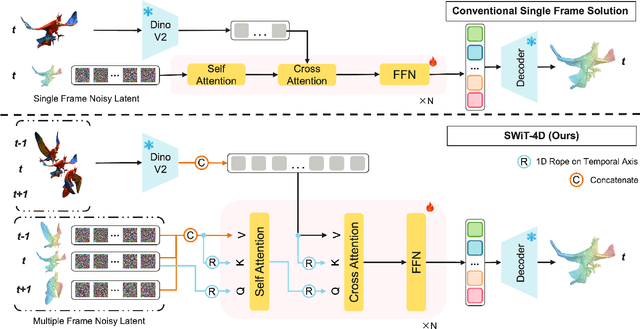
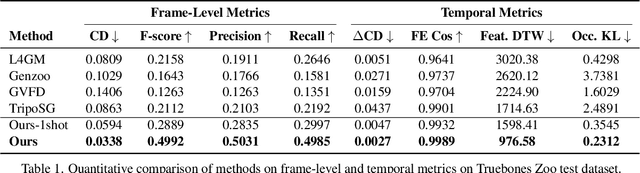
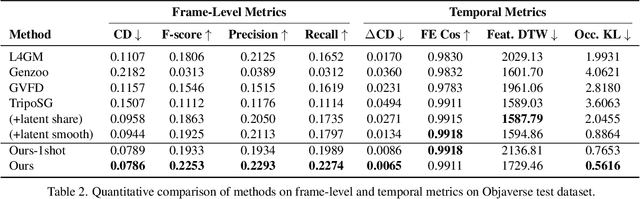
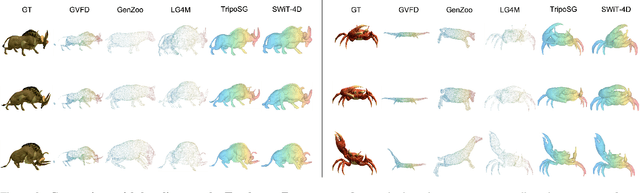
Despite significant progress in 4D content generation, the conversion of monocular videos into high-quality animated 3D assets with explicit 4D meshes remains considerably challenging. The scarcity of large-scale, naturally captured 4D mesh datasets further limits the ability to train generalizable video-to-4D models from scratch in a purely data-driven manner. Meanwhile, advances in image-to-3D generation, supported by extensive datasets, offer powerful prior models that can be leveraged. To better utilize these priors while minimizing reliance on 4D supervision, we introduce SWiT-4D, a Sliding-Window Transformer for lossless, parameter-free temporal 4D mesh generation. SWiT-4D integrates seamlessly with any Diffusion Transformer (DiT)-based image-to-3D generator, adding spatial-temporal modeling across video frames while preserving the original single-image forward process, enabling 4D mesh reconstruction from videos of arbitrary length. To recover global translation, we further introduce an optimization-based trajectory module tailored for static-camera monocular videos. SWiT-4D demonstrates strong data efficiency: with only a single short (<10s) video for fine-tuning, it achieves high-fidelity geometry and stable temporal consistency, indicating practical deployability under extremely limited 4D supervision. Comprehensive experiments on both in-domain zoo-test sets and challenging out-of-domain benchmarks (C4D, Objaverse, and in-the-wild videos) show that SWiT-4D consistently outperforms existing baselines in temporal smoothness. Project page: https://animotionlab.github.io/SWIT4D/
GS-Octree: Octree-based 3D Gaussian Splatting for Robust Object-level 3D Reconstruction Under Strong Lighting
Jun 26, 2024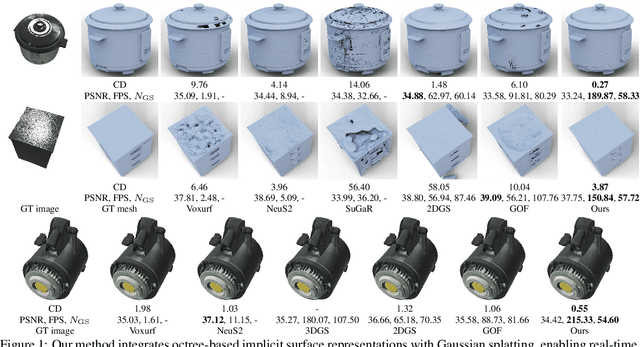
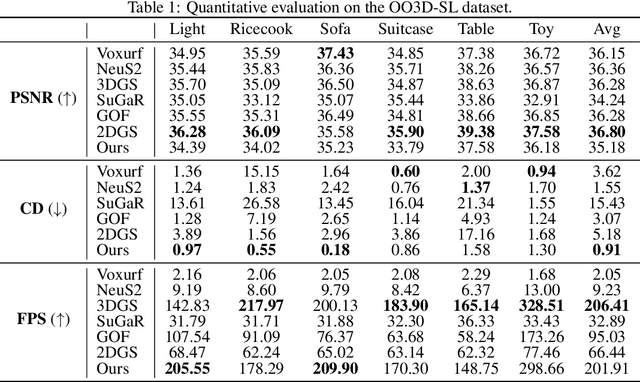
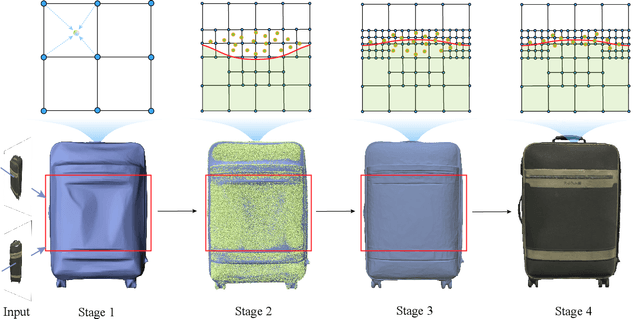
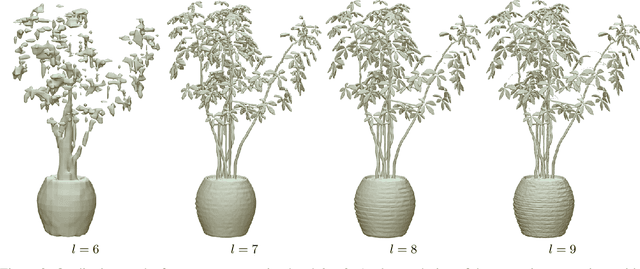
The 3D Gaussian Splatting technique has significantly advanced the construction of radiance fields from multi-view images, enabling real-time rendering. While point-based rasterization effectively reduces computational demands for rendering, it often struggles to accurately reconstruct the geometry of the target object, especially under strong lighting. To address this challenge, we introduce a novel approach that combines octree-based implicit surface representations with Gaussian splatting. Our method consists of four stages. Initially, it reconstructs a signed distance field (SDF) and a radiance field through volume rendering, encoding them in a low-resolution octree. The initial SDF represents the coarse geometry of the target object. Subsequently, it introduces 3D Gaussians as additional degrees of freedom, which are guided by the SDF. In the third stage, the optimized Gaussians further improve the accuracy of the SDF, allowing it to recover finer geometric details compared to the initial SDF obtained in the first stage. Finally, it adopts the refined SDF to further optimize the 3D Gaussians via splatting, eliminating those that contribute little to visual appearance. Experimental results show that our method, which leverages the distribution of 3D Gaussians with SDFs, reconstructs more accurate geometry, particularly in images with specular highlights caused by strong lighting.
Pair then Relation: Pair-Net for Panoptic Scene Graph Generation
Aug 01, 2023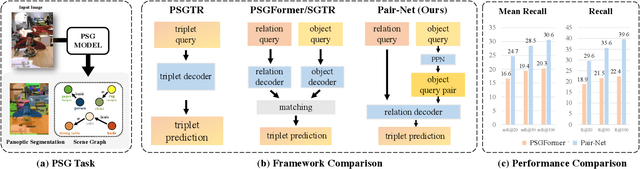

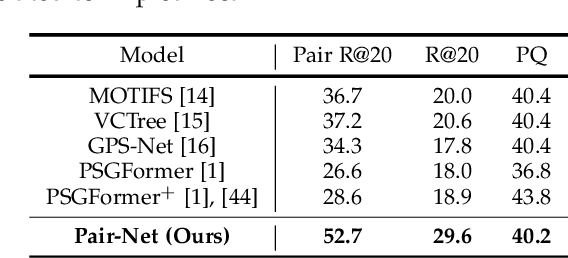
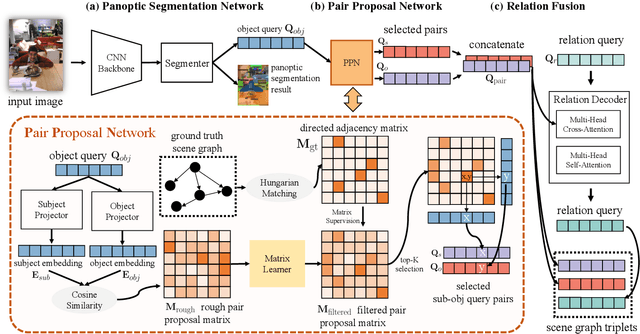
Panoptic Scene Graph (PSG) is a challenging task in Scene Graph Generation (SGG) that aims to create a more comprehensive scene graph representation using panoptic segmentation instead of boxes. Compared to SGG, PSG has several challenging problems: pixel-level segment outputs and full relationship exploration (It also considers thing and stuff relation). Thus, current PSG methods have limited performance, which hinders downstream tasks or applications. The goal of this work aims to design a novel and strong baseline for PSG. To achieve that, we first conduct an in-depth analysis to identify the bottleneck of the current PSG models, finding that inter-object pair-wise recall is a crucial factor that was ignored by previous PSG methods. Based on this and the recent query-based frameworks, we present a novel framework: Pair then Relation (Pair-Net), which uses a Pair Proposal Network (PPN) to learn and filter sparse pair-wise relationships between subjects and objects. Moreover, we also observed the sparse nature of object pairs for both Motivated by this, we design a lightweight Matrix Learner within the PPN, which directly learn pair-wised relationships for pair proposal generation. Through extensive ablation and analysis, our approach significantly improves upon leveraging the segmenter solid baseline. Notably, our method achieves new state-of-the-art results on the PSG benchmark, with over 10\% absolute gains compared to PSGFormer. The code of this paper is publicly available at https://github.com/king159/Pair-Net.