 Add to Chrome
 Add to Firefox
 Add to Edge
MMScan: A Multi-Modal 3D Scene Dataset with Hierarchical Grounded Language Annotations
Jun 13, 2024
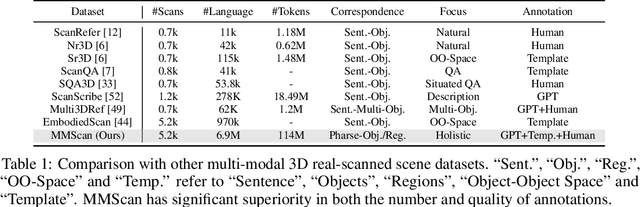

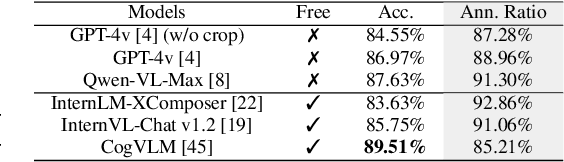
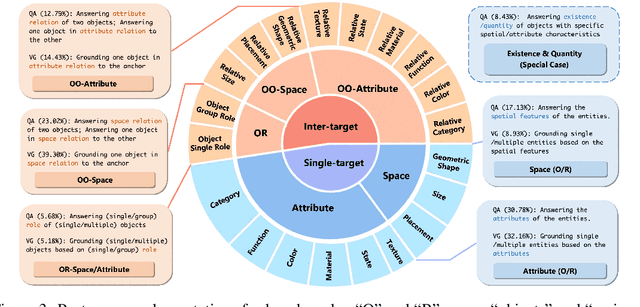
With the emergence of LLMs and their integration with other data modalities, multi-modal 3D perception attracts more attention due to its connectivity to the physical world and makes rapid progress. However, limited by existing datasets, previous works mainly focus on understanding object properties or inter-object spatial relationships in a 3D scene. To tackle this problem, this paper builds the first largest ever multi-modal 3D scene dataset and benchmark with hierarchical grounded language annotations, MMScan. It is constructed based on a top-down logic, from region to object level, from a single target to inter-target relationships, covering holistic aspects of spatial and attribute understanding. The overall pipeline incorporates powerful VLMs via carefully designed prompts to initialize the annotations efficiently and further involve humans' correction in the loop to ensure the annotations are natural, correct, and comprehensive. Built upon existing 3D scanning data, the resulting multi-modal 3D dataset encompasses 1.4M meta-annotated captions on 109k objects and 7.7k regions as well as over 3.04M diverse samples for 3D visual grounding and question-answering benchmarks. We evaluate representative baselines on our benchmarks, analyze their capabilities in different aspects, and showcase the key problems to be addressed in the future. Furthermore, we use this high-quality dataset to train state-of-the-art 3D visual grounding and LLMs and obtain remarkable performance improvement both on existing benchmarks and in-the-wild evaluation. Codes, datasets, and benchmarks will be available at https://github.com/OpenRobotLab/EmbodiedScan.

OmniCorpus: An Unified Multimodal Corpus of 10 Billion-Level Images Interleaved with Text
Jun 12, 2024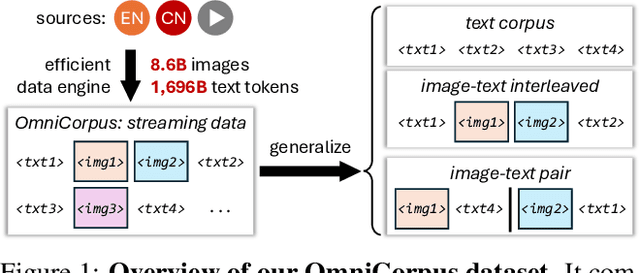


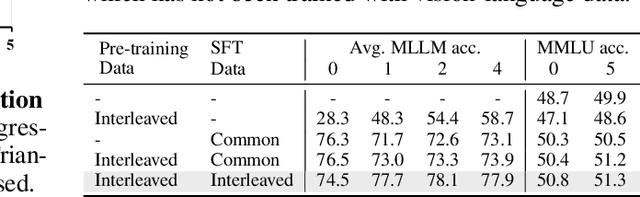
Image-text interleaved data, consisting of multiple images and texts arranged in a natural document format, aligns with the presentation paradigm of internet data and closely resembles human reading habits. Recent studies have shown that such data aids multimodal in-context learning and maintains the capabilities of large language models during multimodal fine-tuning. However, the limited scale and diversity of current image-text interleaved data restrict the development of multimodal large language models. In this paper, we introduce OmniCorpus, a 10 billion-scale image-text interleaved dataset. Using an efficient data engine, we filter and extract large-scale high-quality documents, which contain 8.6 billion images and 1,696 billion text tokens. Compared to counterparts (e.g., MMC4, OBELICS), our dataset 1) has 15 times larger scales while maintaining good data quality; 2) features more diverse sources, including both English and non-English websites as well as video-centric websites; 3) is more flexible, easily degradable from an image-text interleaved format to pure text corpus and image-text pairs. Through comprehensive analysis and experiments, we validate the quality, usability, and effectiveness of the proposed dataset. We hope this could provide a solid data foundation for future multimodal model research. Code and data are released at https://github.com/OpenGVLab/OmniCorpus.
Lean Workbook: A large-scale Lean problem set formalized from natural language math problems
Jun 07, 2024Large language models have demonstrated impressive capabilities across various natural language processing tasks, especially in solving mathematical problems. However, large language models are not good at math theorem proving using formal languages like Lean. A significant challenge in this area is the scarcity of training data available in these formal languages. To address this issue, we propose a novel pipeline that iteratively generates and filters synthetic data to translate natural language mathematical problems into Lean 4 statements, and vice versa. Our results indicate that the synthetic data pipeline can provide useful training data and improve the performance of LLMs in translating and understanding complex mathematical problems and proofs. Our final dataset contains about 57K formal-informal question pairs along with searched proof from the math contest forum and 21 new IMO questions. We open-source our code at https://github.com/InternLM/InternLM-Math and our data at https://huggingface.co/datasets/InternLM/Lean-Workbook.
Uncertainty Aware Learning for Language Model Alignment
Jun 07, 2024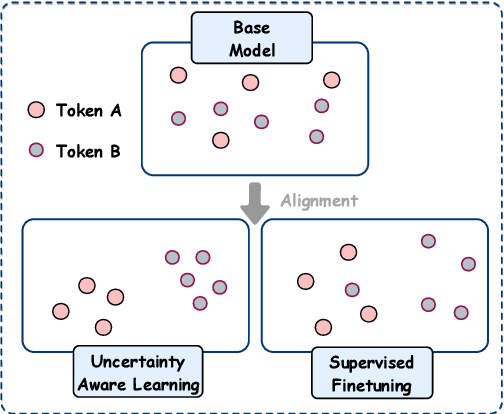


As instruction-tuned large language models (LLMs) evolve, aligning pretrained foundation models presents increasing challenges. Existing alignment strategies, which typically leverage diverse and high-quality data sources, often overlook the intrinsic uncertainty of tasks, learning all data samples equally. This may lead to suboptimal data efficiency and model performance. In response, we propose uncertainty-aware learning (UAL) to improve the model alignment of different task scenarios, by introducing the sample uncertainty (elicited from more capable LLMs). We implement UAL in a simple fashion -- adaptively setting the label smoothing value of training according to the uncertainty of individual samples. Analysis shows that our UAL indeed facilitates better token clustering in the feature space, validating our hypothesis. Extensive experiments on widely used benchmarks demonstrate that our UAL significantly and consistently outperforms standard supervised fine-tuning. Notably, LLMs aligned in a mixed scenario have achieved an average improvement of 10.62\% on high-entropy tasks (i.e., AlpacaEval leaderboard), and 1.81\% on complex low-entropy tasks (i.e., MetaMath and GSM8K).
ShareGPT4Video: Improving Video Understanding and Generation with Better Captions
Jun 06, 2024


We present the ShareGPT4Video series, aiming to facilitate the video understanding of large video-language models (LVLMs) and the video generation of text-to-video models (T2VMs) via dense and precise captions. The series comprises: 1) ShareGPT4Video, 40K GPT4V annotated dense captions of videos with various lengths and sources, developed through carefully designed data filtering and annotating strategy. 2) ShareCaptioner-Video, an efficient and capable captioning model for arbitrary videos, with 4.8M high-quality aesthetic videos annotated by it. 3) ShareGPT4Video-8B, a simple yet superb LVLM that reached SOTA performance on three advancing video benchmarks. To achieve this, taking aside the non-scalable costly human annotators, we find using GPT4V to caption video with a naive multi-frame or frame-concatenation input strategy leads to less detailed and sometimes temporal-confused results. We argue the challenge of designing a high-quality video captioning strategy lies in three aspects: 1) Inter-frame precise temporal change understanding. 2) Intra-frame detailed content description. 3) Frame-number scalability for arbitrary-length videos. To this end, we meticulously designed a differential video captioning strategy, which is stable, scalable, and efficient for generating captions for videos with arbitrary resolution, aspect ratios, and length. Based on it, we construct ShareGPT4Video, which contains 40K high-quality videos spanning a wide range of categories, and the resulting captions encompass rich world knowledge, object attributes, camera movements, and crucially, detailed and precise temporal descriptions of events. Based on ShareGPT4Video, we further develop ShareCaptioner-Video, a superior captioner capable of efficiently generating high-quality captions for arbitrary videos...
Bootstrap3D: Improving 3D Content Creation with Synthetic Data
May 31, 2024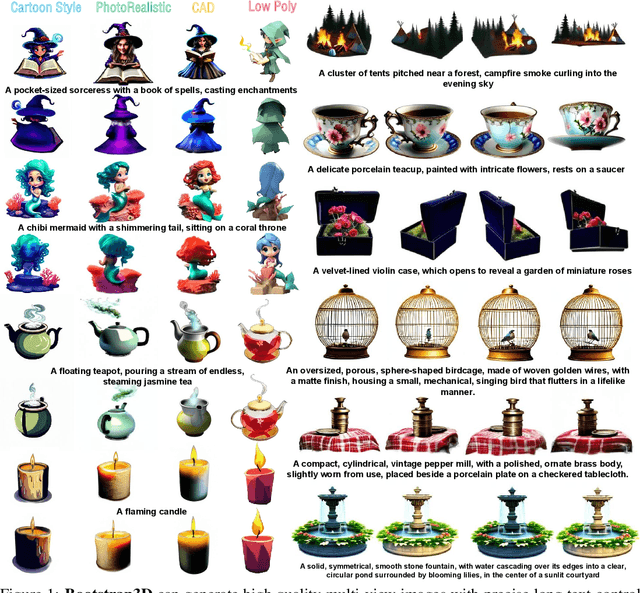
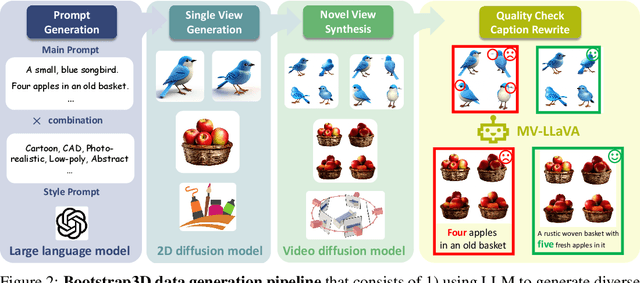
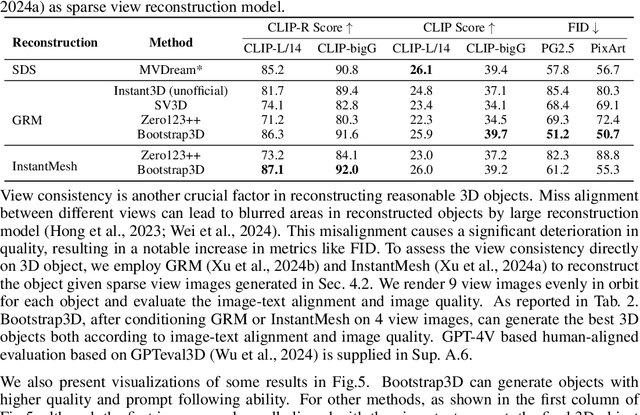
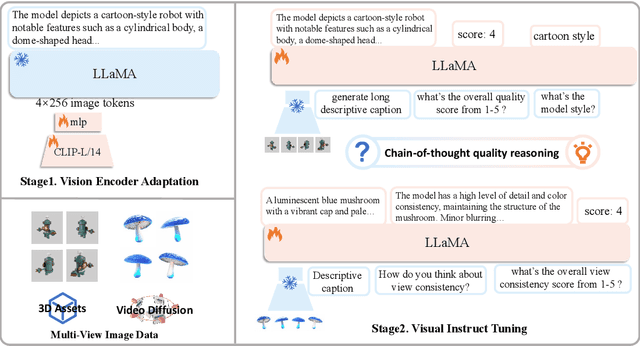
Recent years have witnessed remarkable progress in multi-view diffusion models for 3D content creation. However, there remains a significant gap in image quality and prompt-following ability compared to 2D diffusion models. A critical bottleneck is the scarcity of high-quality 3D assets with detailed captions. To address this challenge, we propose Bootstrap3D, a novel framework that automatically generates an arbitrary quantity of multi-view images to assist in training multi-view diffusion models. Specifically, we introduce a data generation pipeline that employs (1) 2D and video diffusion models to generate multi-view images based on constructed text prompts, and (2) our fine-tuned 3D-aware MV-LLaVA for filtering high-quality data and rewriting inaccurate captions. Leveraging this pipeline, we have generated 1 million high-quality synthetic multi-view images with dense descriptive captions to address the shortage of high-quality 3D data. Furthermore, we present a Training Timestep Reschedule (TTR) strategy that leverages the denoising process to learn multi-view consistency while maintaining the original 2D diffusion prior. Extensive experiments demonstrate that Bootstrap3D can generate high-quality multi-view images with superior aesthetic quality, image-text alignment, and maintained view consistency.
ANAH: Analytical Annotation of Hallucinations in Large Language Models
May 30, 2024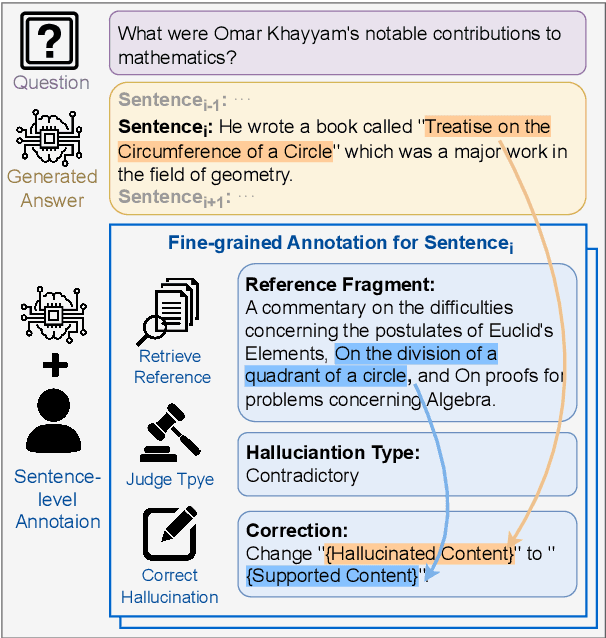
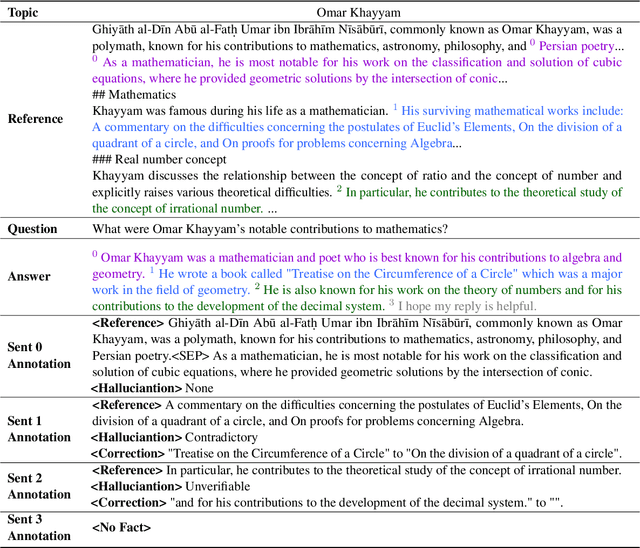
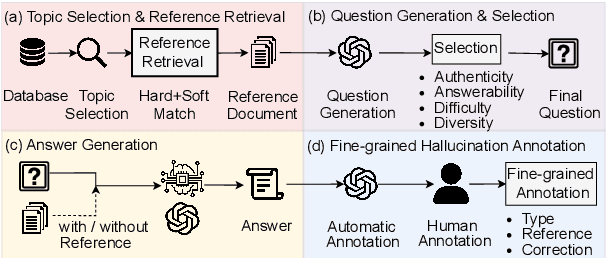
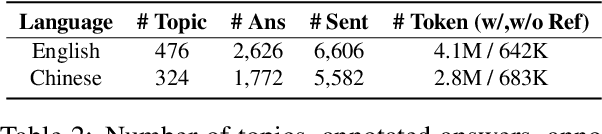
Reducing the `$\textit{hallucination}$' problem of Large Language Models (LLMs) is crucial for their wide applications. A comprehensive and fine-grained measurement of the hallucination is the first key step for the governance of this issue but is under-explored in the community. Thus, we present $\textbf{ANAH}$, a bilingual dataset that offers $\textbf{AN}$alytical $\textbf{A}$nnotation of $\textbf{H}$allucinations in LLMs within Generative Question Answering. Each answer sentence in our dataset undergoes rigorous annotation, involving the retrieval of a reference fragment, the judgment of the hallucination type, and the correction of hallucinated content. ANAH consists of ~12k sentence-level annotations for ~4.3k LLM responses covering over 700 topics, constructed by a human-in-the-loop pipeline. Thanks to the fine granularity of the hallucination annotations, we can quantitatively confirm that the hallucinations of LLMs progressively accumulate in the answer and use ANAH to train and evaluate hallucination annotators. We conduct extensive experiments on studying generative and discriminative annotators and show that, although current open-source LLMs have difficulties in fine-grained hallucination annotation, the generative annotator trained with ANAH can surpass all open-source LLMs and GPT-3.5, obtain performance competitive with GPT-4, and exhibits better generalization ability on unseen questions.
AlchemistCoder: Harmonizing and Eliciting Code Capability by Hindsight Tuning on Multi-source Data
May 29, 2024Open-source Large Language Models (LLMs) and their specialized variants, particularly Code LLMs, have recently delivered impressive performance. However, previous Code LLMs are typically fine-tuned on single-source data with limited quality and diversity, which may insufficiently elicit the potential of pre-trained Code LLMs. In this paper, we present AlchemistCoder, a series of Code LLMs with enhanced code generation and generalization capabilities fine-tuned on multi-source data. To achieve this, we pioneer to unveil inherent conflicts among the various styles and qualities in multi-source code corpora and introduce data-specific prompts with hindsight relabeling, termed AlchemistPrompts, to harmonize different data sources and instruction-response pairs. Additionally, we propose incorporating the data construction process into the fine-tuning data as code comprehension tasks, including instruction evolution, data filtering, and code review. Extensive experiments demonstrate that AlchemistCoder holds a clear lead among all models of the same size (6.7B/7B) and rivals or even surpasses larger models (15B/33B/70B), showcasing the efficacy of our method in refining instruction-following capabilities and advancing the boundaries of code intelligence.
DSDL: Data Set Description Language for Bridging Modalities and Tasks in AI Data
May 28, 2024In the era of artificial intelligence, the diversity of data modalities and annotation formats often renders data unusable directly, requiring understanding and format conversion before it can be used by researchers or developers with different needs. To tackle this problem, this article introduces a framework called Dataset Description Language (DSDL) that aims to simplify dataset processing by providing a unified standard for AI datasets. DSDL adheres to the three basic practical principles of generic, portable, and extensible, using a unified standard to express data of different modalities and structures, facilitating the dissemination of AI data, and easily extending to new modalities and tasks. The standardized specifications of DSDL reduce the workload for users in data dissemination, processing, and usage. To further improve user convenience, we provide predefined DSDL templates for various tasks, convert mainstream datasets to comply with DSDL specifications, and provide comprehensive documentation and DSDL tools. These efforts aim to simplify the use of AI data, thereby improving the efficiency of AI development.
Streaming Long Video Understanding with Large Language Models
May 25, 2024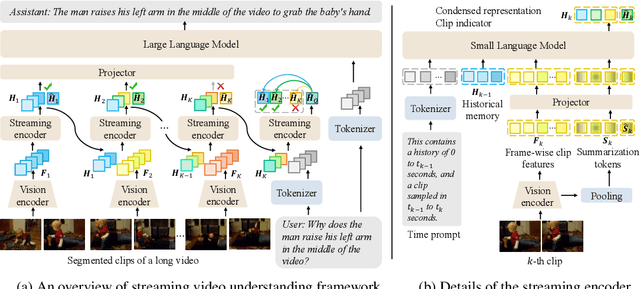
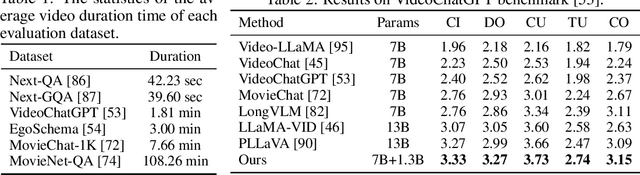
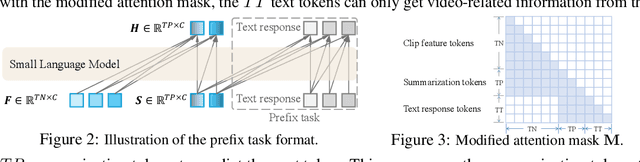
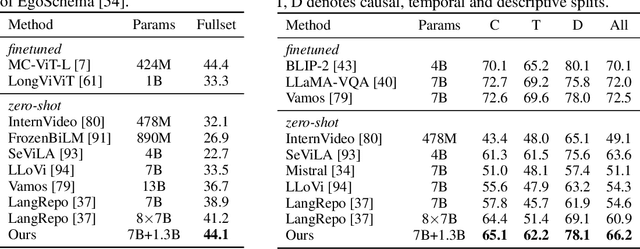
This paper presents VideoStreaming, an advanced vision-language large model (VLLM) for video understanding, that capably understands arbitrary-length video with a constant number of video tokens streamingly encoded and adaptively selected. The challenge of video understanding in the vision language area mainly lies in the significant computational burden caused by the great number of tokens extracted from long videos. Previous works rely on sparse sampling or frame compression to reduce tokens. However, such approaches either disregard temporal information in a long time span or sacrifice spatial details, resulting in flawed compression. To address these limitations, our VideoStreaming has two core designs: Memory-Propagated Streaming Encoding and Adaptive Memory Selection. The Memory-Propagated Streaming Encoding architecture segments long videos into short clips and sequentially encodes each clip with a propagated memory. In each iteration, we utilize the encoded results of the preceding clip as historical memory, which is integrated with the current clip to distill a condensed representation that encapsulates the video content up to the current timestamp. After the encoding process, the Adaptive Memory Selection strategy selects a constant number of question-related memories from all the historical memories and feeds them into the LLM to generate informative responses. The question-related selection reduces redundancy within the memories, enabling efficient and precise video understanding. Meanwhile, the disentangled video extraction and reasoning design allows the LLM to answer different questions about a video by directly selecting corresponding memories, without the need to encode the whole video for each question. Our model achieves superior performance and higher efficiency on long video benchmarks, showcasing precise temporal comprehension for detailed question answering.