 Add to Chrome
 Add to Firefox
 Add to Edge
G$^2$TAM: Geometry Grounded Track Anything Model
Jul 04, 2026
Human spatial understanding arises from jointly perceiving geometry and semantics, enabling consistent object identification and localization across viewpoints and time. Current video segmentation models depend on explicit object appearance memory banks for instance tracking, yet they remain vulnerable to large viewpoint changes and long-term occlusions. Leveraging the spatial consistency afforded by modern feed-forward 3D reconstruction models, we propose the Geometry Grounded Tracking Anything Model (G$^2$TAM), a unified framework for promptable instance tracking in 3D using only unordered RGB images or videos. G$^2$TAM employs spatially aligned geometric representations as implicit memory, ensuring stable instance identity and localization across frames and views. At its core is a cross-modal spatial encoder that integrates visual and textual prompts into a shared geometric space, enabling end-to-end spatial reconstruction and instance-consistent mask prediction. To support training and evaluation, we construct InsTrack, a large-scale dataset with a dedicated validation split for benchmarking. Extensive experiments show that G$^2$TAM delivers strong cross-view consistency, promptable instance spatial tracking, video object segmentation and spatial reconstruction, establishing a foundation for interactive, geometry-grounded spatial reasoning.

Thinking with Imagination: Agentic Visual Spatial Reasoning with World Simulators
Jun 04, 2026While Vision-Language Models (VLMs) have shown strong visual reasoning capabilities, their spatial reasoning abilities remain largely constrained to the observed images and text-oriented chain-of-thought. They often struggle to infer unobserved layouts, maintain cross-view consistency, and reason from alternative viewpoints when only limited egocentric observations are available. In this work, we study this problem as thinking with imagination, where a VLM actively acquires imagined visual evidence by interacting with a world simulator during reasoning. We propose Astra, an agentic spatial reasoning framework that empowers VLMs with action-conditioned visual imagination. Specifically, Astra couples Astra-VL, an RL-trained VLM policy, with Astra-WM, a Bagel-based world simulator that generates novel-view observations from context images and natural-language camera motions. To provide reliable imagined evidence, Astra-WM is trained with view consistency tuning to improve pose and content consistency across views. In the RL stage, we propose a world-simulator-in-the-loop two-phase RL curriculum to stabilize tool-use exploration and advance the model's ability to invoke the simulator only when imagined observations improve over direct answering. Experiments demonstrate that both the world simulator and the agentic policy are necessary: Astra-WM improves simulator-augmented Gemini-3-Flash on MMSI-Bench from 45.1 to 49.5, while Astra-VL improves the Qwen3-VL backbone from 29.8 to 38.8 on MMSI-Bench and from 36.8 to 42.7 on MindCube. These results show that imagined observations can provide useful spatial evidence, but effective world-model-augmented reasoning requires learning when, where, and how to imagine.
MMSI-Video-Bench: A Holistic Benchmark for Video-Based Spatial Intelligence
Dec 11, 2025Spatial understanding over continuous visual input is crucial for MLLMs to evolve into general-purpose assistants in physical environments. Yet there is still no comprehensive benchmark that holistically assesses the progress toward this goal. In this work, we introduce MMSI-Video-Bench, a fully human-annotated benchmark for video-based spatial intelligence in MLLMs. It operationalizes a four-level framework, Perception, Planning, Prediction, and Cross-Video Reasoning, through 1,106 questions grounded in 1,278 clips from 25 datasets and in-house videos. Each item is carefully designed and reviewed by 3DV experts with explanatory rationales to ensure precise, unambiguous grounding. Leveraging its diverse data sources and holistic task coverage, MMSI-Video-Bench also supports three domain-oriented sub-benchmarks (Indoor Scene Perception Bench, Robot Bench and Grounding Bench) for targeted capability assessment. We evaluate 25 strong open-source and proprietary MLLMs, revealing a striking human--AI gap: many models perform near chance, and the best reasoning model lags humans by nearly 60%. We further find that spatially fine-tuned models still fail to generalize effectively on our benchmark. Fine-grained error analysis exposes systematic failures in geometric reasoning, motion grounding, long-horizon prediction, and cross-video correspondence. We also show that typical frame-sampling strategies transfer poorly to our reasoning-intensive benchmark, and that neither 3D spatial cues nor chain-of-thought prompting yields meaningful gains. We expect our benchmark to establish a solid testbed for advancing video-based spatial intelligence.
Ground Slow, Move Fast: A Dual-System Foundation Model for Generalizable Vision-and-Language Navigation
Dec 09, 2025While recent large vision-language models (VLMs) have improved generalization in vision-language navigation (VLN), existing methods typically rely on end-to-end pipelines that map vision-language inputs directly to short-horizon discrete actions. Such designs often produce fragmented motions, incur high latency, and struggle with real-world challenges like dynamic obstacle avoidance. We propose DualVLN, the first dual-system VLN foundation model that synergistically integrates high-level reasoning with low-level action execution. System 2, a VLM-based global planner, "grounds slowly" by predicting mid-term waypoint goals via image-grounded reasoning. System 1, a lightweight, multi-modal conditioning Diffusion Transformer policy, "moves fast" by leveraging both explicit pixel goals and latent features from System 2 to generate smooth and accurate trajectories. The dual-system design enables robust real-time control and adaptive local decision-making in complex, dynamic environments. By decoupling training, the VLM retains its generalization, while System 1 achieves interpretable and effective local navigation. DualVLN outperforms prior methods across all VLN benchmarks and real-world experiments demonstrate robust long-horizon planning and real-time adaptability in dynamic environments.
OST-Bench: Evaluating the Capabilities of MLLMs in Online Spatio-temporal Scene Understanding
Jul 10, 2025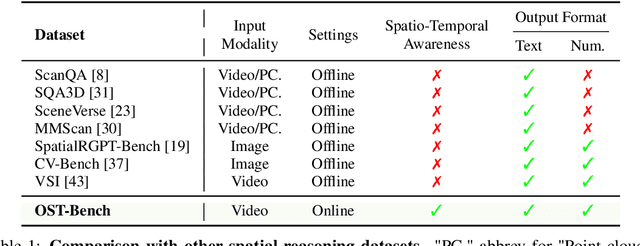
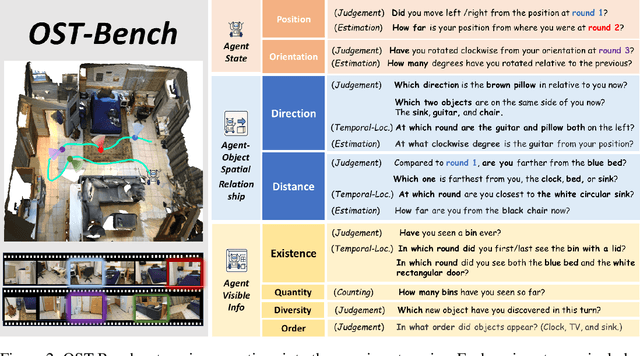
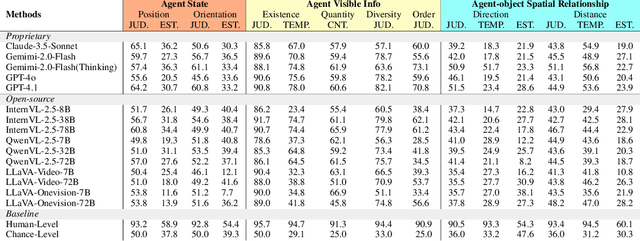
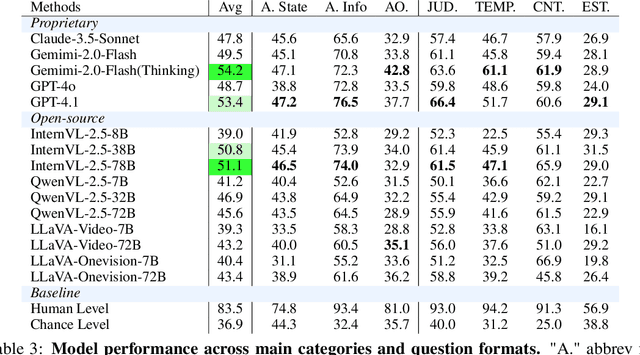
Recent advances in multimodal large language models (MLLMs) have shown remarkable capabilities in integrating vision and language for complex reasoning. While most existing benchmarks evaluate models under offline settings with a fixed set of pre-recorded inputs, we introduce OST-Bench, a benchmark designed to evaluate Online Spatio-Temporal understanding from the perspective of an agent actively exploring a scene. The Online aspect emphasizes the need to process and reason over incrementally acquired observations, while the Spatio-Temporal component requires integrating current visual inputs with historical memory to support dynamic spatial reasoning. OST-Bench better reflects the challenges of real-world embodied perception. Built on an efficient data collection pipeline, OST-Bench consists of 1.4k scenes and 10k question-answer pairs collected from ScanNet, Matterport3D, and ARKitScenes. We evaluate several leading MLLMs on OST-Bench and observe that they fall short on tasks requiring complex spatio-temporal reasoning. Under the online setting, their accuracy declines as the exploration horizon extends and the memory grows. Through further experimental analysis, we identify common error patterns across models and find that both complex clue-based spatial reasoning demands and long-term memory retrieval requirements significantly drop model performance along two separate axes, highlighting the core challenges that must be addressed to improve online embodied reasoning. To foster further research and development in the field, our codes, dataset, and benchmark are available. Our project page is: https://rbler1234.github.io/OSTBench.github.io/
MMSI-Bench: A Benchmark for Multi-Image Spatial Intelligence
May 29, 2025Spatial intelligence is essential for multimodal large language models (MLLMs) operating in the complex physical world. Existing benchmarks, however, probe only single-image relations and thus fail to assess the multi-image spatial reasoning that real-world deployments demand. We introduce MMSI-Bench, a VQA benchmark dedicated to multi-image spatial intelligence. Six 3D-vision researchers spent more than 300 hours meticulously crafting 1,000 challenging, unambiguous multiple-choice questions from over 120,000 images, each paired with carefully designed distractors and a step-by-step reasoning process. We conduct extensive experiments and thoroughly evaluate 34 open-source and proprietary MLLMs, observing a wide gap: the strongest open-source model attains roughly 30% accuracy and OpenAI's o3 reasoning model reaches 40%, while humans score 97%. These results underscore the challenging nature of MMSI-Bench and the substantial headroom for future research. Leveraging the annotated reasoning processes, we also provide an automated error analysis pipeline that diagnoses four dominant failure modes, including (1) grounding errors, (2) overlap-matching and scene-reconstruction errors, (3) situation-transformation reasoning errors, and (4) spatial-logic errors, offering valuable insights for advancing multi-image spatial intelligence. Project page: https://runsenxu.com/projects/MMSI_Bench .
LLaVA-3D: A Simple yet Effective Pathway to Empowering LMMs with 3D-awareness
Sep 26, 2024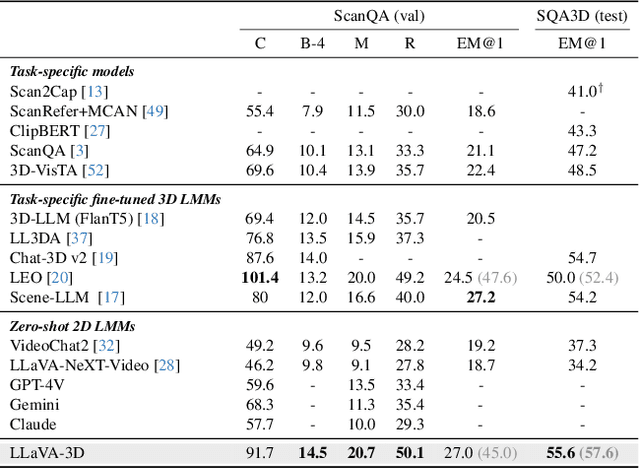



Recent advancements in Large Multimodal Models (LMMs) have greatly enhanced their proficiency in 2D visual understanding tasks, enabling them to effectively process and understand images and videos. However, the development of LMMs with 3D-awareness for 3D scene understanding has been hindered by the lack of large-scale 3D vision-language datasets and powerful 3D encoders. In this paper, we introduce a simple yet effective framework called LLaVA-3D. Leveraging the strong 2D understanding priors from LLaVA, our LLaVA-3D efficiently adapts LLaVA for 3D scene understanding without compromising 2D understanding capabilities. To achieve this, we employ a simple yet effective representation, 3D Patch, which connects 2D CLIP patch features with their corresponding positions in 3D space. By integrating the 3D Patches into 2D LMMs and employing joint 2D and 3D vision-language instruction tuning, we establish a unified architecture for both 2D image understanding and 3D scene understanding. Experimental results show that LLaVA-3D converges 3.5x faster than existing 3D LMMs when trained on 3D vision-language datasets. Moreover, LLaVA-3D not only achieves state-of-the-art performance across various 3D tasks but also maintains comparable 2D image understanding and vision-language conversation capabilities with LLaVA.
Empowering 3D Visual Grounding with Reasoning Capabilities
Jul 02, 2024Although great progress has been made in 3D visual grounding, current models still rely on explicit textual descriptions for grounding and lack the ability to reason human intentions from implicit instructions. We propose a new task called 3D reasoning grounding and introduce a new benchmark ScanReason which provides over 10K question-answer-location pairs from five reasoning types that require the synerization of reasoning and grounding. We further design our approach, ReGround3D, composed of the visual-centric reasoning module empowered by Multi-modal Large Language Model (MLLM) and the 3D grounding module to obtain accurate object locations by looking back to the enhanced geometry and fine-grained details from the 3D scenes. A chain-of-grounding mechanism is proposed to further boost the performance with interleaved reasoning and grounding steps during inference. Extensive experiments on the proposed benchmark validate the effectiveness of our proposed approach.
MMScan: A Multi-Modal 3D Scene Dataset with Hierarchical Grounded Language Annotations
Jun 13, 2024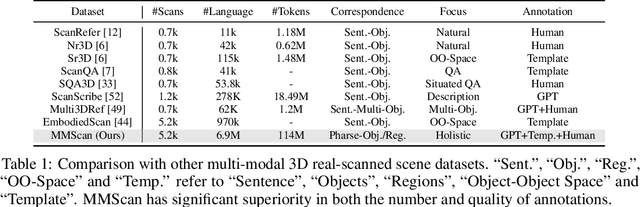

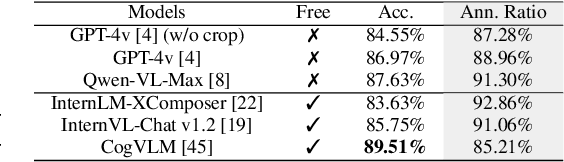
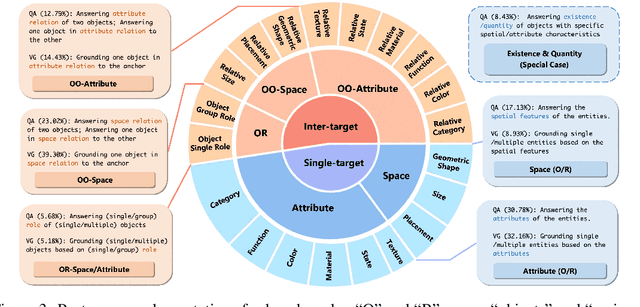
With the emergence of LLMs and their integration with other data modalities, multi-modal 3D perception attracts more attention due to its connectivity to the physical world and makes rapid progress. However, limited by existing datasets, previous works mainly focus on understanding object properties or inter-object spatial relationships in a 3D scene. To tackle this problem, this paper builds the first largest ever multi-modal 3D scene dataset and benchmark with hierarchical grounded language annotations, MMScan. It is constructed based on a top-down logic, from region to object level, from a single target to inter-target relationships, covering holistic aspects of spatial and attribute understanding. The overall pipeline incorporates powerful VLMs via carefully designed prompts to initialize the annotations efficiently and further involve humans' correction in the loop to ensure the annotations are natural, correct, and comprehensive. Built upon existing 3D scanning data, the resulting multi-modal 3D dataset encompasses 1.4M meta-annotated captions on 109k objects and 7.7k regions as well as over 3.04M diverse samples for 3D visual grounding and question-answering benchmarks. We evaluate representative baselines on our benchmarks, analyze their capabilities in different aspects, and showcase the key problems to be addressed in the future. Furthermore, we use this high-quality dataset to train state-of-the-art 3D visual grounding and LLMs and obtain remarkable performance improvement both on existing benchmarks and in-the-wild evaluation. Codes, datasets, and benchmarks will be available at https://github.com/OpenRobotLab/EmbodiedScan.
An Empirical Study of Training State-of-the-Art LiDAR Segmentation Models
May 23, 2024In the rapidly evolving field of autonomous driving, precise segmentation of LiDAR data is crucial for understanding complex 3D environments. Traditional approaches often rely on disparate, standalone codebases, hindering unified advancements and fair benchmarking across models. To address these challenges, we introduce MMDetection3D-lidarseg, a comprehensive toolbox designed for the efficient training and evaluation of state-of-the-art LiDAR segmentation models. We support a wide range of segmentation models and integrate advanced data augmentation techniques to enhance robustness and generalization. Additionally, the toolbox provides support for multiple leading sparse convolution backends, optimizing computational efficiency and performance. By fostering a unified framework, MMDetection3D-lidarseg streamlines development and benchmarking, setting new standards for research and application. Our extensive benchmark experiments on widely-used datasets demonstrate the effectiveness of the toolbox. The codebase and trained models have been publicly available, promoting further research and innovation in the field of LiDAR segmentation for autonomous driving.