 Add to Chrome
 Add to Firefox
 Add to Edge
NTIRE 2026 Challenge on Video Saliency Prediction: Methods and Results
Apr 16, 2026
This paper presents an overview of the NTIRE 2026 Challenge on Video Saliency Prediction. The goal of the challenge participants was to develop automatic saliency map prediction methods for the provided video sequences. The novel dataset of 2,000 diverse videos with an open license was prepared for this challenge. The fixations and corresponding saliency maps were collected using crowdsourced mouse tracking and contain viewing data from over 5,000 assessors. Evaluation was performed on a subset of 800 test videos using generally accepted quality metrics. The challenge attracted over 20 teams making submissions, and 7 teams passed the final phase with code review. All data used in this challenge is made publicly available - https://github.com/msu-video-group/NTIRE26_Saliency_Prediction.

CAAP: Capture-Aware Adversarial Patch Attacks on Palmprint Recognition Models
Apr 08, 2026Palmprint recognition is deployed in security-critical applications, including access control and palm-based payment, due to its contactless acquisition and highly discriminative ridge-and-crease textures. However, the robustness of deep palmprint recognition systems against physically realizable attacks remains insufficiently understood. Existing studies are largely confined to the digital setting and do not adequately account for the texture-dominant nature of palmprint recognition or the distortions introduced during physical acquisition. To address this gap, we propose CAAP, a capture-aware adversarial patch framework for palmprint recognition. CAAP learns a universal patch that can be reused across inputs while remaining effective under realistic acquisition variation. To match the structural characteristics of palmprints, the framework adopts a cross-shaped patch topology, which enlarges spatial coverage under a fixed pixel budget and more effectively disrupts long-range texture continuity. CAAP further integrates three modules: ASIT for input-conditioned patch rendering, RaS for stochastic capture-aware simulation, and MS-DIFE for feature-level identity-disruptive guidance. We evaluate CAAP on the Tongji, IITD, and AISEC datasets against generic CNN backbones and palmprint-specific recognition models. Experiments show that CAAP achieves strong untargeted and targeted attack performance with favorable cross-model and cross-dataset transferability. The results further show that, although adversarial training can partially reduce the attack success rate, substantial residual vulnerability remains. These findings indicate that deep palmprint recognition systems remain vulnerable to physically realizable, capture-aware adversarial patch attacks, underscoring the need for more effective defenses in practice. Code available at https://github.com/ryliu68/CAAP.
RECUR: Resource Exhaustion Attack via Recursive-Entropy Guided Counterfactual Utilization and Reflection
Feb 09, 2026Large Reasoning Models (LRMs) employ reasoning to address complex tasks. Such explicit reasoning requires extended context lengths, resulting in substantially higher resource consumption. Prior work has shown that adversarially crafted inputs can trigger redundant reasoning processes, exposing LRMs to resource-exhaustion vulnerabilities. However, the reasoning process itself, especially its reflective component, has received limited attention, even though it can lead to over-reflection and consume excessive computing power. In this paper, we introduce Recursive Entropy to quantify the risk of resource consumption in reflection, thereby revealing the safety issues inherent in inference itself. Based on Recursive Entropy, we introduce RECUR, a resource exhaustion attack via Recursive Entropy guided Counterfactual Utilization and Reflection. It constructs counterfactual questions to verify the inherent flaws and risks of LRMs. Extensive experiments demonstrate that, under benign inference, recursive entropy exhibits a pronounced decreasing trend. RECUR disrupts this trend, increasing the output length by up to 11x and decreasing throughput by 90%. Our work provides a new perspective on robust reasoning.
DP-TRAE: A Dual-Phase Merging Transferable Reversible Adversarial Example for Image Privacy Protection
May 11, 2025In the field of digital security, Reversible Adversarial Examples (RAE) combine adversarial attacks with reversible data hiding techniques to effectively protect sensitive data and prevent unauthorized analysis by malicious Deep Neural Networks (DNNs). However, existing RAE techniques primarily focus on white-box attacks, lacking a comprehensive evaluation of their effectiveness in black-box scenarios. This limitation impedes their broader deployment in complex, dynamic environments. Further more, traditional black-box attacks are often characterized by poor transferability and high query costs, significantly limiting their practical applicability. To address these challenges, we propose the Dual-Phase Merging Transferable Reversible Attack method, which generates highly transferable initial adversarial perturbations in a white-box model and employs a memory augmented black-box strategy to effectively mislead target mod els. Experimental results demonstrate the superiority of our approach, achieving a 99.0% attack success rate and 100% recovery rate in black-box scenarios, highlighting its robustness in privacy protection. Moreover, we successfully implemented a black-box attack on a commercial model, further substantiating the potential of this approach for practical use.
A Comprehensive Survey in LLM(-Agent) Full Stack Safety: Data, Training and Deployment
Apr 22, 2025The remarkable success of Large Language Models (LLMs) has illuminated a promising pathway toward achieving Artificial General Intelligence for both academic and industrial communities, owing to their unprecedented performance across various applications. As LLMs continue to gain prominence in both research and commercial domains, their security and safety implications have become a growing concern, not only for researchers and corporations but also for every nation. Currently, existing surveys on LLM safety primarily focus on specific stages of the LLM lifecycle, e.g., deployment phase or fine-tuning phase, lacking a comprehensive understanding of the entire "lifechain" of LLMs. To address this gap, this paper introduces, for the first time, the concept of "full-stack" safety to systematically consider safety issues throughout the entire process of LLM training, deployment, and eventual commercialization. Compared to the off-the-shelf LLM safety surveys, our work demonstrates several distinctive advantages: (I) Comprehensive Perspective. We define the complete LLM lifecycle as encompassing data preparation, pre-training, post-training, deployment and final commercialization. To our knowledge, this represents the first safety survey to encompass the entire lifecycle of LLMs. (II) Extensive Literature Support. Our research is grounded in an exhaustive review of over 800+ papers, ensuring comprehensive coverage and systematic organization of security issues within a more holistic understanding. (III) Unique Insights. Through systematic literature analysis, we have developed reliable roadmaps and perspectives for each chapter. Our work identifies promising research directions, including safety in data generation, alignment techniques, model editing, and LLM-based agent systems. These insights provide valuable guidance for researchers pursuing future work in this field.
PATFinger: Prompt-Adapted Transferable Fingerprinting against Unauthorized Multimodal Dataset Usage
Apr 15, 2025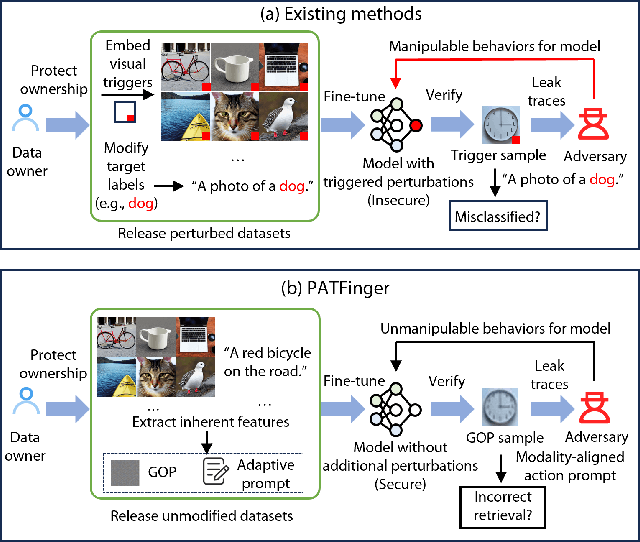
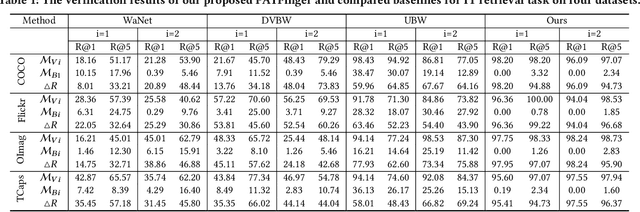
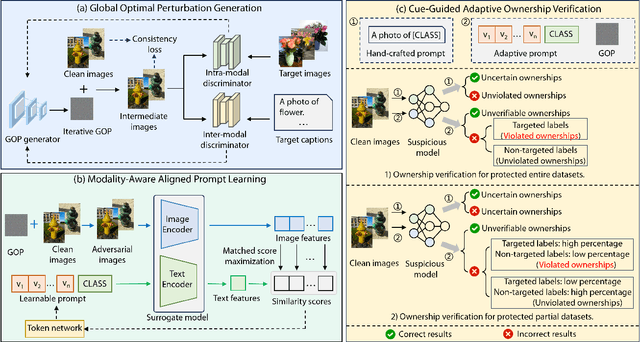
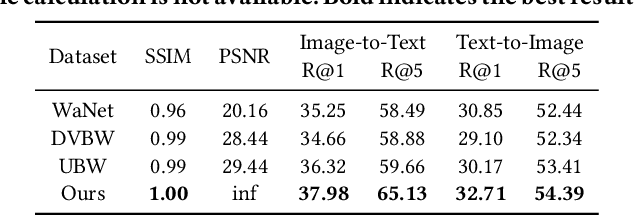
The multimodal datasets can be leveraged to pre-train large-scale vision-language models by providing cross-modal semantics. Current endeavors for determining the usage of datasets mainly focus on single-modal dataset ownership verification through intrusive methods and non-intrusive techniques, while cross-modal approaches remain under-explored. Intrusive methods can adapt to multimodal datasets but degrade model accuracy, while non-intrusive methods rely on label-driven decision boundaries that fail to guarantee stable behaviors for verification. To address these issues, we propose a novel prompt-adapted transferable fingerprinting scheme from a training-free perspective, called PATFinger, which incorporates the global optimal perturbation (GOP) and the adaptive prompts to capture dataset-specific distribution characteristics. Our scheme utilizes inherent dataset attributes as fingerprints instead of compelling the model to learn triggers. The GOP is derived from the sample distribution to maximize embedding drifts between different modalities. Subsequently, our PATFinger re-aligns the adaptive prompt with GOP samples to capture the cross-modal interactions on the carefully crafted surrogate model. This allows the dataset owner to check the usage of datasets by observing specific prediction behaviors linked to the PATFinger during retrieval queries. Extensive experiments demonstrate the effectiveness of our scheme against unauthorized multimodal dataset usage on various cross-modal retrieval architectures by 30% over state-of-the-art baselines.
Exploiting Vulnerabilities in Speech Translation Systems through Targeted Adversarial Attacks
Mar 05, 2025As speech translation (ST) systems become increasingly prevalent, understanding their vulnerabilities is crucial for ensuring robust and reliable communication. However, limited work has explored this issue in depth. This paper explores methods of compromising these systems through imperceptible audio manipulations. Specifically, we present two innovative approaches: (1) the injection of perturbation into source audio, and (2) the generation of adversarial music designed to guide targeted translation, while also conducting more practical over-the-air attacks in the physical world. Our experiments reveal that carefully crafted audio perturbations can mislead translation models to produce targeted, harmful outputs, while adversarial music achieve this goal more covertly, exploiting the natural imperceptibility of music. These attacks prove effective across multiple languages and translation models, highlighting a systemic vulnerability in current ST architectures. The implications of this research extend beyond immediate security concerns, shedding light on the interpretability and robustness of neural speech processing systems. Our findings underscore the need for advanced defense mechanisms and more resilient architectures in the realm of audio systems. More details and samples can be found at https://adv-st.github.io.
\textsc{Perseus}: Tracing the Masterminds Behind Cryptocurrency Pump-and-Dump Schemes
Mar 03, 2025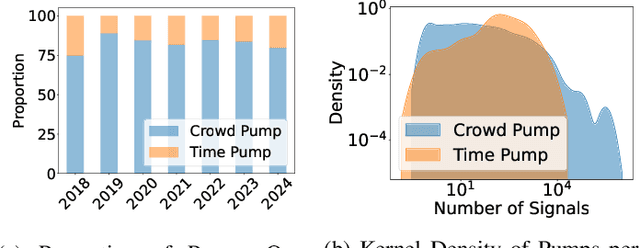
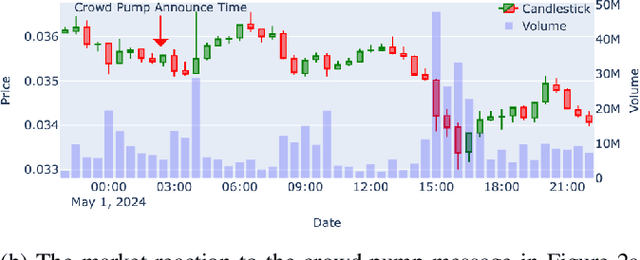
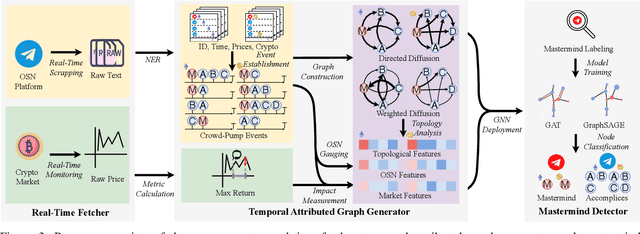
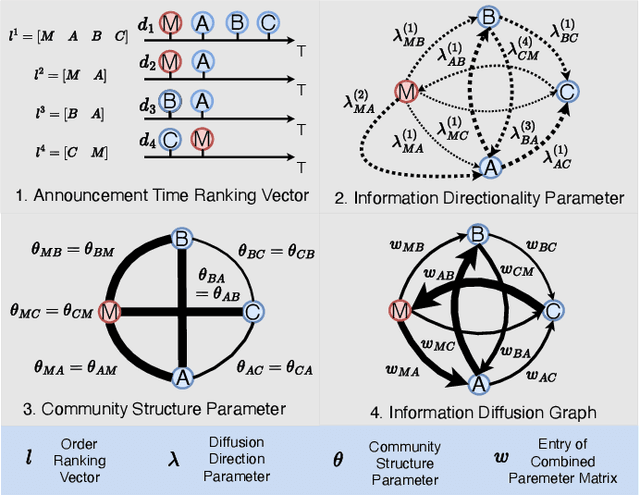
Masterminds are entities organizing, coordinating, and orchestrating cryptocurrency pump-and-dump schemes, a form of trade-based manipulation undermining market integrity and causing financial losses for unwitting investors. Previous research detects pump-and-dump activities in the market, predicts the target cryptocurrency, and examines investors and \ac{osn} entities. However, these solutions do not address the root cause of the problem. There is a critical gap in identifying and tracing the masterminds involved in these schemes. In this research, we develop a detection system \textsc{Perseus}, which collects real-time data from the \acs{osn} and cryptocurrency markets. \textsc{Perseus} then constructs temporal attributed graphs that preserve the direction of information diffusion and the structure of the community while leveraging \ac{gnn} to identify the masterminds behind pump-and-dump activities. Our design of \textsc{Perseus} leads to higher F1 scores and precision than the \ac{sota} fraud detection method, achieving fast training and inferring speeds. Deployed in the real world from February 16 to October 9 2024, \textsc{Perseus} successfully detects $438$ masterminds who are efficient in the pump-and-dump information diffusion networks. \textsc{Perseus} provides regulators with an explanation of the risks of masterminds and oversight capabilities to mitigate the pump-and-dump schemes of cryptocurrency.
Secure Resource Allocation via Constrained Deep Reinforcement Learning
Jan 20, 2025The proliferation of Internet of Things (IoT) devices and the advent of 6G technologies have introduced computationally intensive tasks that often surpass the processing capabilities of user devices. Efficient and secure resource allocation in serverless multi-cloud edge computing environments is essential for supporting these demands and advancing distributed computing. However, existing solutions frequently struggle with the complexity of multi-cloud infrastructures, robust security integration, and effective application of traditional deep reinforcement learning (DRL) techniques under system constraints. To address these challenges, we present SARMTO, a novel framework that integrates an action-constrained DRL model. SARMTO dynamically balances resource allocation, task offloading, security, and performance by utilizing a Markov decision process formulation, an adaptive security mechanism, and sophisticated optimization techniques. Extensive simulations across varying scenarios, including different task loads, data sizes, and MEC capacities, show that SARMTO consistently outperforms five baseline approaches, achieving up to a 40% reduction in system costs and a 41.5% improvement in energy efficiency over state-of-the-art methods. These enhancements highlight SARMTO's potential to revolutionize resource management in intricate distributed computing environments, opening the door to more efficient and secure IoT and edge computing applications.
Rethinking Membership Inference Attacks Against Transfer Learning
Jan 20, 2025Transfer learning, successful in knowledge translation across related tasks, faces a substantial privacy threat from membership inference attacks (MIAs). These attacks, despite posing significant risk to ML model's training data, remain limited-explored in transfer learning. The interaction between teacher and student models in transfer learning has not been thoroughly explored in MIAs, potentially resulting in an under-examined aspect of privacy vulnerabilities within transfer learning. In this paper, we propose a new MIA vector against transfer learning, to determine whether a specific data point was used to train the teacher model while only accessing the student model in a white-box setting. Our method delves into the intricate relationship between teacher and student models, analyzing the discrepancies in hidden layer representations between the student model and its shadow counterpart. These identified differences are then adeptly utilized to refine the shadow model's training process and to inform membership inference decisions effectively. Our method, evaluated across four datasets in diverse transfer learning tasks, reveals that even when an attacker only has access to the student model, the teacher model's training data remains susceptible to MIAs. We believe our work unveils the unexplored risk of membership inference in transfer learning.