 Add to Chrome
 Add to Firefox
 Add to Edge
TPCD: Tone-Pressure Contrastive Decoding and the Label-Free Gating Bottleneck in Vision-Language Models
Jul 29, 2026
High-pressure prompts can push vision-language models (VLMs) into unsupported commitments, such as reading illegible text, reporting indeterminate times, or affirming absent objects. This paper asks whether the pressure-induced distribution itself can serve as a contrastive-decoding negative branch. Tone-pressure contrastive decoding (TPCD) subtracts logits produced under a high-pressure instruction from logits produced under a safe neutral instruction. On the 800-example tone-matters benchmark, LLaVA-1.5-7B under pressure reaches 66.75% attack success rate (ASR); safe neutralization reduces ASR to 9.88%; full TPCD reaches 0.50% but collapses positives to 15.56%. A benchmark-specific task-prior/disagreement gate preserves measured positive accuracy (54.44%) while lowering ASR to 1.63% on LLaVA. Treating this LLaVA analysis as the design split, full $n=800$ negative and $n=780$ matched-positive held-out runs on GLM-4.6V and Llama-3.2-Vision show that simple gates can improve over safe neutralization, with sensitivity analyses bounding the weak time-positive subtask. A category-prior-free answer-disagreement router reduces held-out aggregate ASR to 6.93%, improving over both safe neutralization (10.98%) and branch disagreement (9.67%) while matching branch disagreement's 79.94% positive accuracy, although it remains post-hoc and surface-form based. We conclude that pressure is a useful probe of commitment bias and a viable mitigation signal, but the current gates are not yet independently validated grounding-aware detectors.

Artificial Intelligence Across the Cardiac Amyloidosis Diagnostic Pathway: From Single-Modality Detection to Multimodal Clinical Integration
Jul 10, 2026Cardiac amyloidosis (CA) is increasingly recognized but remains substantially underdiagnosed, because its clinical and imaging phenotype overlaps with more common cardiomyopathies. Definitive subtype assignment and management further require integration of multimodal evidence to distinguish transthyretin from light chain disease. Machine learning and deep learning have been applied across the diagnostic and management pathway. These applications span ECG, echocardiography, and health record-based case finding, as well as CMR and nuclear interpretation, including SPECT/CT biomarker quantification, prognostic modeling, and treatment response assessment. This narrative review synthesizes these studies by clinical tasks, namely screening, detection, quantification, prognosis, and treatment response monitoring, rather than by input modality. This task-based organization clarifies why apparently similar AI models require different cohorts, reference standards, evaluation metrics, and implementation thresholds. The evidence reveals a maturity gradient. Binary detection and AI assisted quantification on bone scintigraphy and SPECT/CT are closest to clinical translation. Detection is supported by large externally validated cohorts, and quantification by interpretable, outcome linked measurement of myocardial tracer burden. By contrast, subtype aware classification, prognostic risk stratification, and treatment response monitoring remain at an early stage. These tasks are limited by small cohorts, enriched retrospective designs, heterogeneous labels, incomplete external validation, and uncertain calibration in realistic prevalence settings. Across tasks, high discrimination alone is insufficient.
When Good Enough Is Optimal: Multiplication-Only Matrix Inversion Approximation for Quantized Gated DeltaNet
Jun 04, 2026Matrix inversion in chunk-wise parallel linear attention is a major bottleneck for long-context modeling, particularly on NPUs, where forward-substitution-based methods exhibit limited parallelism and poor hardware utilization. We propose a fast, Matrix Multiplication (MatMul)-based algorithm tailored for strictly lower-triangular matrices arising in chunk-wise linear attention. Motivated by the rapid growth of Neumann-series terms and the diagonal concentration of the inverse matrix, we employ a truncated Neumann expansion with structural masking and parallel residual correction to eliminate sequential dependencies. We further extend our method to low-bits INT by mitigating the dynamic range expansion arising from repeated matrix power operations, and adapt the approximation order and residual step to the chunk size to minimize computational cost while preserving the model's accuracy. Experiments on Qwen3.5-family models demonstrate up to 5$\times$ kernel-level speedup and a 20% reduction in decode-layer overhead, while preserving accuracy under both floating-point and low-precision inference. Our method offers an efficient and hardware-friendly solution for scalable linear attention.
DXA-Derived Skeletal Phenotypes and Hip Fracture Risk: A Backdoor-Adjusted Causal Analysis
May 29, 2026Purpose: To compare dual-energy X-ray absorptiometry (DXA)-derived hip skeletal phenotypes in relation to hip fracture risk using prespecified confounder adjustment and to assess whether phenotypes ranked by their backdoor-adjusted average treatment effects (ATEs) improve risk stratification. Methods: We analyzed 21,098 UK Biobank participants with linked health records, hip DXA-derived skeletal measures, and prespecified covariates. Sixteen phenotypes spanning bone mineral content (BMC), bone mineral density (BMD), and T-score across hip-related regions were evaluated. Confounder selection was guided by a prespecified directed acyclic graph (DAG). Backdoor-adjusted ATEs were estimated on the absolute risk-difference scale per standard deviation (SD) increase. Effect heterogeneity was evaluated for total femur BMD, and downstream prediction was assessed using clinical variables combined with phenotypes ranked by ATE magnitude. Results: Among 21,098 participants, 115 had hip fractures. All 16 phenotypes showed negative backdoor-adjusted ATEs per SD increase. The largest ATEs were observed for total femur BMC and total femur BMD, each with a risk difference of -0.0047, corresponding to approximately 4.7 fewer hip fractures per 1,000 participants per SD higher phenotype value. Conditional effects of total femur BMD were stronger among older participants and those with lower BMI. In prediction, clinical variables plus the top 11 ATE-ranked phenotypes achieved higher AUC than FRAX with femoral neck BMD (0.842 vs. 0.709), with higher sensitivity (0.748 vs. 0.443) and similar specificity (0.793 vs. 0.777). Conclusion: DXA-derived hip skeletal phenotypes differed in their backdoor-adjusted ATEs. Phenotype-level causal evaluation may help identify informative DXA measures for risk stratification.
Learning to Adapt SFT Data for Better Reasoning Generalization
May 26, 2026Large language models (LLMs) have achieved remarkable progress, with post-training playing a crucial role in enhancing their reasoning capabilities. Among post-training paradigms, supervised fine-tuning (SFT) is widely used: it leverages external data to provide dense supervision and enables efficient training. However, directly fine-tuning on expert data can hurt generalization when the data distribution is mismatched with the target model's own distribution. In this work, we propose Data Adaptation for Reasoning Tuning (DART), which formulates the use of a fixed, potentially distributionally misaligned SFT dataset as an optimization problem over demonstration transformations. DART trains a mapper model with reinforcement learning to convert original SFT data into model-adapted supervision that better matches the target model's distribution and learning preferences. The transformed data are then used for SFT, allowing the target model to better exploit external supervision. Experiments across multiple models and datasets show that DART improves generalization, achieves higher training efficiency than direct RL, and helps models surpass standard SFT. Our code is available at https://anonymous.4open.science/r/DART525E50D.
Reflect to Inform: Boosting Multimodal Reasoning via Information-Gain-Driven Verification
Mar 27, 2026Multimodal Large Language Models (MLLMs) achieve strong multimodal reasoning performance, yet we identify a recurring failure mode in long-form generation: as outputs grow longer, models progressively drift away from image evidence and fall back on textual priors, resulting in ungrounded reasoning and hallucinations. Interestingly, Based on attention analysis, we find that MLLMs have a latent capability for late-stage visual verification that is present but not consistently activated. Motivated by this observation, we propose Visual Re-Examination (VRE), a self-evolving training framework that enables MLLMs to autonomously perform visual introspection during reasoning without additional visual inputs. Rather than distilling visual capabilities from a stronger teacher, VRE promotes iterative self-improvement by leveraging the model itself to generate reflection traces, making visual information actionable through information gain. Extensive experiments across diverse multimodal benchmarks demonstrate that VRE consistently improves reasoning accuracy and perceptual reliability, while substantially reducing hallucinations, especially in long-chain settings. Code is available at https://github.com/Xiaobu-USTC/VRE.
TAMTRL: Teacher-Aligned Reward Reshaping for Multi-Turn Reinforcement Learning in Long-Context Compression
Mar 23, 2026The rapid progress of large language models (LLMs) has led to remarkable performance gains across a wide range of tasks. However, when handling long documents that exceed the model's context window limit, the entire context cannot be processed in a single pass, making chunk-wise processing necessary. This requires multiple turns to read different chunks and update memory. However, supervision is typically provided only by the final outcome, which makes it difficult to evaluate the quality of memory updates at each turn in the multi-turn training setting. This introduces a temporal credit assignment challenge. Existing approaches, such as LLM-as-a-judge or process reward models, incur substantial computational overhead and suffer from estimation noise. To better address the credit assignment problem in multi-turn memory training, we propose Teacher-Aligned Reward Reshaping for Multi-Turn Reinforcement Learning (TAMTRL). TAMTRL leverages relevant documents as teacher signals by aligning them with each turn of model input and assigns rewards through normalized probabilities in a self-supervised manner. This provides fine-grained learning signals for each memory update and improves long-context processing. Experiments with multiple models of varying scales across seven long-context benchmarks show that TAMTRL consistently outperforms strong baselines, demonstrating its effectiveness. Our code is available at https://anonymous.4open.science/r/TAMTRL-F1F8.
C2-Evo: Co-Evolving Multimodal Data and Model for Self-Improving Reasoning
Jul 22, 2025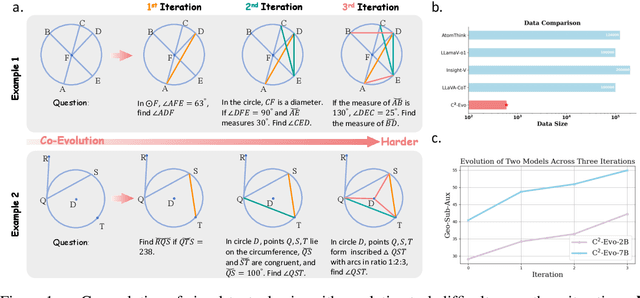
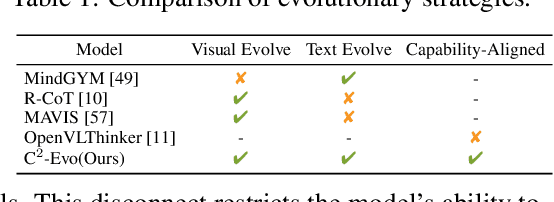
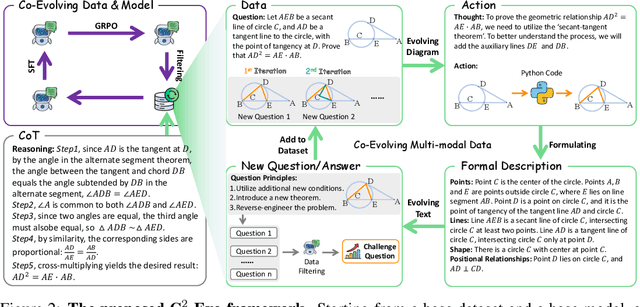
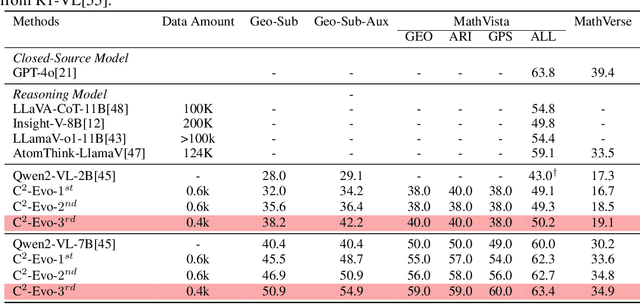
Recent advances in multimodal large language models (MLLMs) have shown impressive reasoning capabilities. However, further enhancing existing MLLMs necessitates high-quality vision-language datasets with carefully curated task complexities, which are both costly and challenging to scale. Although recent self-improving models that iteratively refine themselves offer a feasible solution, they still suffer from two core challenges: (i) most existing methods augment visual or textual data separately, resulting in discrepancies in data complexity (e.g., over-simplified diagrams paired with redundant textual descriptions); and (ii) the evolution of data and models is also separated, leading to scenarios where models are exposed to tasks with mismatched difficulty levels. To address these issues, we propose C2-Evo, an automatic, closed-loop self-improving framework that jointly evolves both training data and model capabilities. Specifically, given a base dataset and a base model, C2-Evo enhances them by a cross-modal data evolution loop and a data-model evolution loop. The former loop expands the base dataset by generating complex multimodal problems that combine structured textual sub-problems with iteratively specified geometric diagrams, while the latter loop adaptively selects the generated problems based on the performance of the base model, to conduct supervised fine-tuning and reinforcement learning alternately. Consequently, our method continuously refines its model and training data, and consistently obtains considerable performance gains across multiple mathematical reasoning benchmarks. Our code, models, and datasets will be released.
PaMi-VDPO: Mitigating Video Hallucinations by Prompt-Aware Multi-Instance Video Preference Learning
Apr 08, 2025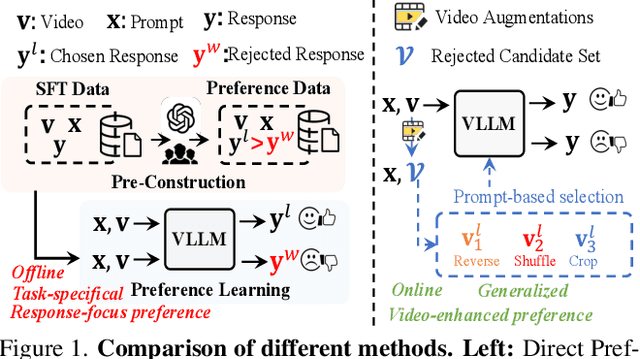
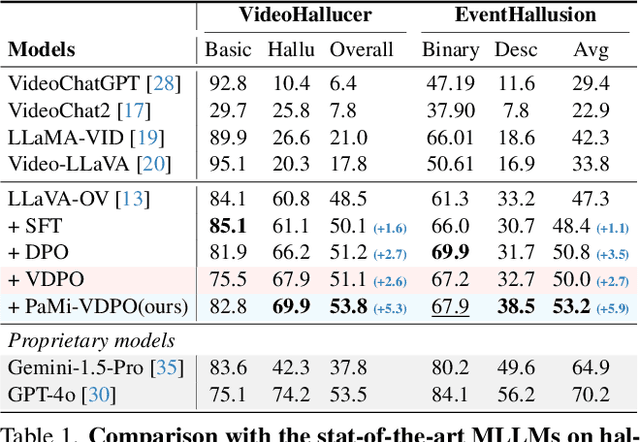
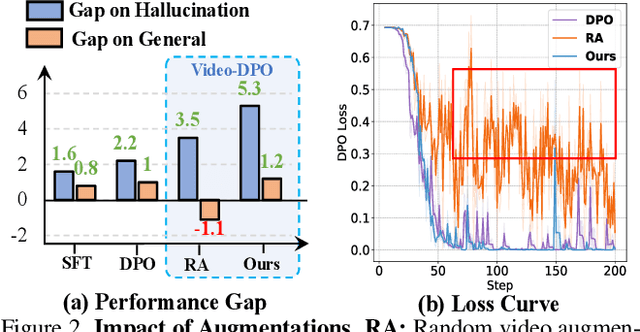
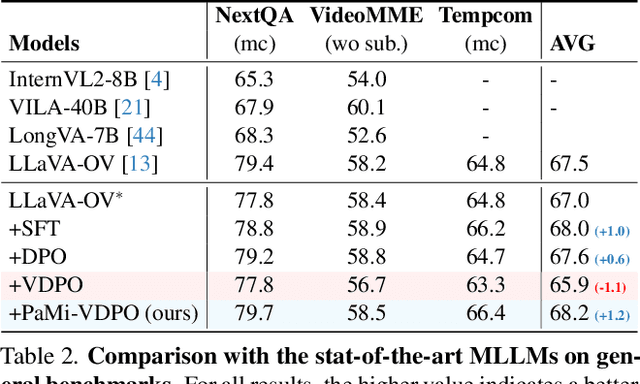
Direct Preference Optimization (DPO) helps reduce hallucinations in Video Multimodal Large Language Models (VLLMs), but its reliance on offline preference data limits adaptability and fails to capture true video-response misalignment. We propose Video Direct Preference Optimization (VDPO), an online preference learning framework that eliminates the need for preference annotation by leveraging video augmentations to generate rejected samples while keeping responses fixed. However, selecting effective augmentations is non-trivial, as some clips may be semantically identical to the original under specific prompts, leading to false rejections and disrupting alignment. To address this, we introduce Prompt-aware Multi-instance Learning VDPO (PaMi-VDPO), which selects augmentations based on prompt context. Instead of a single rejection, we construct a candidate set of augmented clips and apply a close-to-far selection strategy, initially ensuring all clips are semantically relevant while then prioritizing the most prompt-aware distinct clip. This allows the model to better capture meaningful visual differences, mitigating hallucinations, while avoiding false rejections, and improving alignment. PaMi-VDPOseamlessly integrates into existing VLLMs without additional parameters, GPT-4/human supervision. With only 10k SFT data, it improves the base model by 5.3% on VideoHallucer, surpassing GPT-4o, while maintaining stable performance on general video benchmarks.
Exploiting Vulnerabilities in Speech Translation Systems through Targeted Adversarial Attacks
Mar 05, 2025As speech translation (ST) systems become increasingly prevalent, understanding their vulnerabilities is crucial for ensuring robust and reliable communication. However, limited work has explored this issue in depth. This paper explores methods of compromising these systems through imperceptible audio manipulations. Specifically, we present two innovative approaches: (1) the injection of perturbation into source audio, and (2) the generation of adversarial music designed to guide targeted translation, while also conducting more practical over-the-air attacks in the physical world. Our experiments reveal that carefully crafted audio perturbations can mislead translation models to produce targeted, harmful outputs, while adversarial music achieve this goal more covertly, exploiting the natural imperceptibility of music. These attacks prove effective across multiple languages and translation models, highlighting a systemic vulnerability in current ST architectures. The implications of this research extend beyond immediate security concerns, shedding light on the interpretability and robustness of neural speech processing systems. Our findings underscore the need for advanced defense mechanisms and more resilient architectures in the realm of audio systems. More details and samples can be found at https://adv-st.github.io.