 Add to Chrome
 Add to Firefox
 Add to Edge
Mastermind: Strategy-grounded Learning for Repository-Scale Vulnerability Reproduction
Jul 02, 2026
Repository-level vulnerability reproduction is a demanding software engineering (SE) task: an agent must inspect a codebase, infer the input grammar that reaches a vulnerable path, construct a proof-of-conceptv(PoC), and verify that the crash disappears on the patched build. Recent LLM agents can often execute these steps when the approach is correct, yet they still fail by choosing the wrong strategy. This paper argues that strategy, rather than the full action trajectory, is the right learning unit for such SE agents: it is compact enough to optimize, concrete enough to guide execution, and stable enough to store and reuse across attempts. We present Mastermind, a dual-loop framework that separates transferable strategy learning from task-specific experience. A trainable planner learns reusable vulnerability-reproduction strategies through SFT and milestone-based GRPO, while an experience loop maintains task-local strategy records that guide subsequent attempts. The planner is trained independently of the executor, allowing strategy learning to improve multiple frozen executors without modifying their action-generation capability. We evaluate Mastermind on CyberGym using 260 training tasks and 200 held-out evaluation tasks. With GPT-5.5 as the frozen executor, Mastermind achieves an 84.5% pass rate, outperforming open-book PoC context (60.0%), Best-of-8 sampling (63.0%), and iterative improvement (77.0%). The same planner also improves GPT-5.4 mini and GLM~5.1 from 45.0% and 58.5% to 60.0% and 71.0%. These results demonstrate that learning high-level strategies is an effective and transferable mechanism for improving repository-scale SE agents.

SAGE: An LLM-driven Self Reflective Agentic Framework for Fraud Detection
Jun 06, 2026Fraud detection in payment, e-commerce, and telecommunications systems requires accuracy at the individual level, robustness under severe class imbalance, and ease of understanding for risk managers. Existing methods fall at least one of these requirements: automated machine learning systems search a fixed numerical space without semantic awareness of the dataset; graph neural network-based methods require pre-defined relational graphs and remain opaque at the individual-decision level; and the design of general-purpose large language model (LLM) agents does not consider the recall and precision constraints specific to real-world fraud detection. In this paper, we propose SAGE, the first end-to-end LLM-driven multi-agent framework for fraud detection. SAGE coordinates three dedicated agents that make decisions based on a six-layer Data Diagnostic Tree (DDT) and a Markov decision process guided by natural-language gradients, automatically optimizing the model under a fraud-specific reward. On five fraud datasets and five LLM backbones, SAGE wins $96.00\%$ of method--dataset comparisons and improves F1 by an average of $40.86\%$ over baselines. The code is available at https://github.com/yichenC1c/SAGE.
CAAP: Capture-Aware Adversarial Patch Attacks on Palmprint Recognition Models
Apr 08, 2026Palmprint recognition is deployed in security-critical applications, including access control and palm-based payment, due to its contactless acquisition and highly discriminative ridge-and-crease textures. However, the robustness of deep palmprint recognition systems against physically realizable attacks remains insufficiently understood. Existing studies are largely confined to the digital setting and do not adequately account for the texture-dominant nature of palmprint recognition or the distortions introduced during physical acquisition. To address this gap, we propose CAAP, a capture-aware adversarial patch framework for palmprint recognition. CAAP learns a universal patch that can be reused across inputs while remaining effective under realistic acquisition variation. To match the structural characteristics of palmprints, the framework adopts a cross-shaped patch topology, which enlarges spatial coverage under a fixed pixel budget and more effectively disrupts long-range texture continuity. CAAP further integrates three modules: ASIT for input-conditioned patch rendering, RaS for stochastic capture-aware simulation, and MS-DIFE for feature-level identity-disruptive guidance. We evaluate CAAP on the Tongji, IITD, and AISEC datasets against generic CNN backbones and palmprint-specific recognition models. Experiments show that CAAP achieves strong untargeted and targeted attack performance with favorable cross-model and cross-dataset transferability. The results further show that, although adversarial training can partially reduce the attack success rate, substantial residual vulnerability remains. These findings indicate that deep palmprint recognition systems remain vulnerable to physically realizable, capture-aware adversarial patch attacks, underscoring the need for more effective defenses in practice. Code available at https://github.com/ryliu68/CAAP.
Hackers or Hallucinators? A Comprehensive Analysis of LLM-Based Automated Penetration Testing
Apr 07, 2026The rapid advancement of Large Language Models (LLMs) has created new opportunities for Automated Penetration Testing (AutoPT), spawning numerous frameworks aimed at achieving end-to-end autonomous attacks. However, despite the proliferation of related studies, existing research generally lacks systematic architectural analysis and large-scale empirical comparisons under a unified benchmark. Therefore, this paper presents the first Systematization of Knowledge (SoK) focusing on the architectural design and comprehensive empirical evaluation of current LLM-based AutoPT frameworks. At systematization level, we comprehensively review existing framework designs across six dimensions: agent architecture, agent plan, agent memory, agent execution, external knowledge, and benchmarks. At empirical level, we conduct large-scale experiments on 13 representative open-source AutoPT frameworks and 2 baseline frameworks utilizing a unified benchmark. The experiments consumed over 10 billion tokens in total and generated more than 1,500 execution logs, which were manually reviewed and analyzed over four months by a panel of more than 15 researchers with expertise in cybersecurity. By investigating the latest progress in this rapidly developing field, we provide researchers with a structured taxonomy to understand existing LLM-based AutoPT frameworks and a large-scale empirical benchmark, along with promising directions for future research.
REFORGE: Multi-modal Attacks Reveal Vulnerable Concept Unlearning in Image Generation Models
Mar 17, 2026Recent progress in image generation models (IGMs) enables high-fidelity content creation but also amplifies risks, including the reproduction of copyrighted content and the generation of offensive content. Image Generation Model Unlearning (IGMU) mitigates these risks by removing harmful concepts without full retraining. Despite growing attention, the robustness under adversarial inputs, particularly image-side threats in black-box settings, remains underexplored. To bridge this gap, we present REFORGE, a black-box red-teaming framework that evaluates IGMU robustness via adversarial image prompts. REFORGE initializes stroke-based images and optimizes perturbations with a cross-attention-guided masking strategy that allocates noise to concept-relevant regions, balancing attack efficacy and visual fidelity. Extensive experiments across representative unlearning tasks and defenses demonstrate that REFORGE significantly improves attack success rate while achieving stronger semantic alignment and higher efficiency than involved baselines. These results expose persistent vulnerabilities in current IGMU methods and highlight the need for robustness-aware unlearning against multi-modal adversarial attacks. Our code is at: https://github.com/Imfatnoily/REFORGE.
PWAVEP: Purifying Imperceptible Adversarial Perturbations in 3D Point Clouds via Spectral Graph Wavelets
Feb 03, 2026Recent progress in adversarial attacks on 3D point clouds, particularly in achieving spatial imperceptibility and high attack performance, presents significant challenges for defenders. Current defensive approaches remain cumbersome, often requiring invasive model modifications, expensive training procedures or auxiliary data access. To address these threats, in this paper, we propose a plug-and-play and non-invasive defense mechanism in the spectral domain, grounded in a theoretical and empirical analysis of the relationship between imperceptible perturbations and high-frequency spectral components. Building upon these insights, we introduce a novel purification framework, termed PWAVEP, which begins by computing a spectral graph wavelet domain saliency score and local sparsity score for each point. Guided by these values, PWAVEP adopts a hierarchical strategy, it eliminates the most salient points, which are identified as hardly recoverable adversarial outliers. Simultaneously, it applies a spectral filtering process to a broader set of moderately salient points. This process leverages a graph wavelet transform to attenuate high-frequency coefficients associated with the targeted points, thereby effectively suppressing adversarial noise. Extensive evaluations demonstrate that the proposed PWAVEP achieves superior accuracy and robustness compared to existing approaches, advancing the state-of-the-art in 3D point cloud purification. Code and datasets are available at https://github.com/a772316182/pwavep
SafeRedir: Prompt Embedding Redirection for Robust Unlearning in Image Generation Models
Jan 13, 2026Image generation models (IGMs), while capable of producing impressive and creative content, often memorize a wide range of undesirable concepts from their training data, leading to the reproduction of unsafe content such as NSFW imagery and copyrighted artistic styles. Such behaviors pose persistent safety and compliance risks in real-world deployments and cannot be reliably mitigated by post-hoc filtering, owing to the limited robustness of such mechanisms and a lack of fine-grained semantic control. Recent unlearning methods seek to erase harmful concepts at the model level, which exhibit the limitations of requiring costly retraining, degrading the quality of benign generations, or failing to withstand prompt paraphrasing and adversarial attacks. To address these challenges, we introduce SafeRedir, a lightweight inference-time framework for robust unlearning via prompt embedding redirection. Without modifying the underlying IGMs, SafeRedir adaptively routes unsafe prompts toward safe semantic regions through token-level interventions in the embedding space. The framework comprises two core components: a latent-aware multi-modal safety classifier for identifying unsafe generation trajectories, and a token-level delta generator for precise semantic redirection, equipped with auxiliary predictors for token masking and adaptive scaling to localize and regulate the intervention. Empirical results across multiple representative unlearning tasks demonstrate that SafeRedir achieves effective unlearning capability, high semantic and perceptual preservation, robust image quality, and enhanced resistance to adversarial attacks. Furthermore, SafeRedir generalizes effectively across a variety of diffusion backbones and existing unlearned models, validating its plug-and-play compatibility and broad applicability. Code and data are available at https://github.com/ryliu68/SafeRedir.
FactGuard: Event-Centric and Commonsense-Guided Fake News Detection
Nov 13, 2025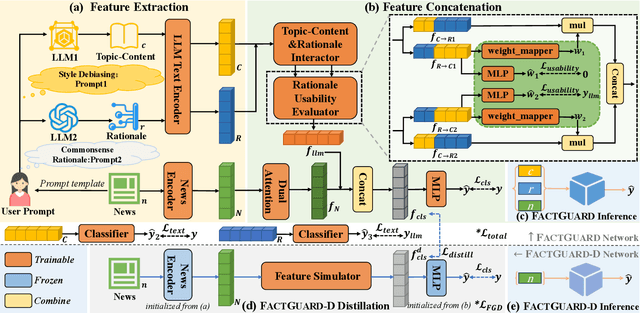
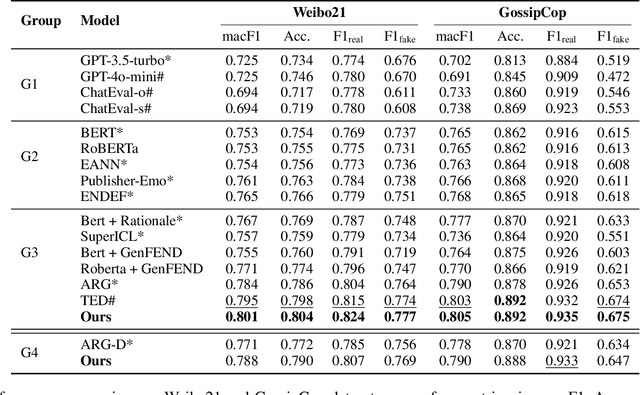
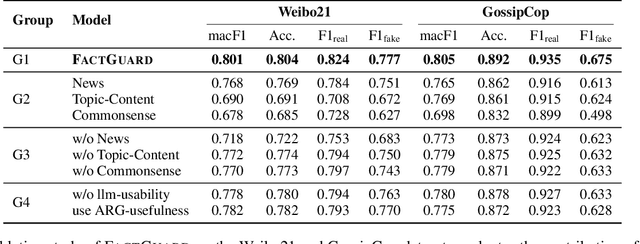
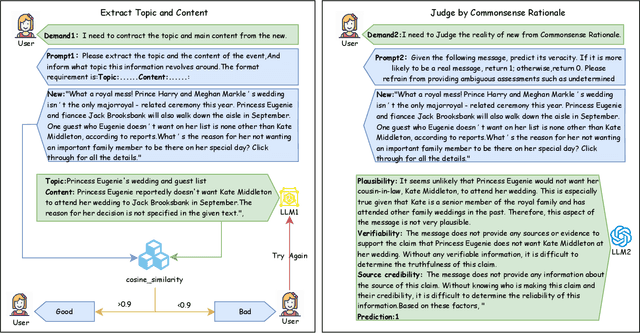
Fake news detection methods based on writing style have achieved remarkable progress. However, as adversaries increasingly imitate the style of authentic news, the effectiveness of such approaches is gradually diminishing. Recent research has explored incorporating large language models (LLMs) to enhance fake news detection. Yet, despite their transformative potential, LLMs remain an untapped goldmine for fake news detection, with their real-world adoption hampered by shallow functionality exploration, ambiguous usability, and prohibitive inference costs. In this paper, we propose a novel fake news detection framework, dubbed FactGuard, that leverages LLMs to extract event-centric content, thereby reducing the impact of writing style on detection performance. Furthermore, our approach introduces a dynamic usability mechanism that identifies contradictions and ambiguous cases in factual reasoning, adaptively incorporating LLM advice to improve decision reliability. To ensure efficiency and practical deployment, we employ knowledge distillation to derive FactGuard-D, enabling the framework to operate effectively in cold-start and resource-constrained scenarios. Comprehensive experiments on two benchmark datasets demonstrate that our approach consistently outperforms existing methods in both robustness and accuracy, effectively addressing the challenges of style sensitivity and LLM usability in fake news detection.
ANID: How Far Are We? Evaluating the Discrepancies Between AI-synthesized Images and Natural Images through Multimodal Guidance
Dec 23, 2024In the rapidly evolving field of Artificial Intelligence Generated Content (AIGC), one of the key challenges is distinguishing AI-synthesized images from natural images. Despite the remarkable capabilities of advanced AI generative models in producing visually compelling images, significant discrepancies remain when these images are compared to natural ones. To systematically investigate and quantify these discrepancies, we introduce an AI-Natural Image Discrepancy Evaluation benchmark aimed at addressing the critical question: \textit{how far are AI-generated images (AIGIs) from truly realistic images?} We have constructed a large-scale multimodal dataset, the Distinguishing Natural and AI-generated Images (DNAI) dataset, which includes over 440,000 AIGI samples generated by 8 representative models using both unimodal and multimodal prompts, such as Text-to-Image (T2I), Image-to-Image (I2I), and Text \textit{vs.} Image-to-Image (TI2I). Our fine-grained assessment framework provides a comprehensive evaluation of the DNAI dataset across five key dimensions: naive visual feature quality, semantic alignment in multimodal generation, aesthetic appeal, downstream task applicability, and coordinated human validation. Extensive evaluation results highlight significant discrepancies across these dimensions, underscoring the necessity of aligning quantitative metrics with human judgment to achieve a holistic understanding of AI-generated image quality. Code is available at \href{https://github.com/ryliu68/ANID}{https://github.com/ryliu68/ANID}.
STBA: Towards Evaluating the Robustness of DNNs for Query-Limited Black-box Scenario
Mar 30, 2024

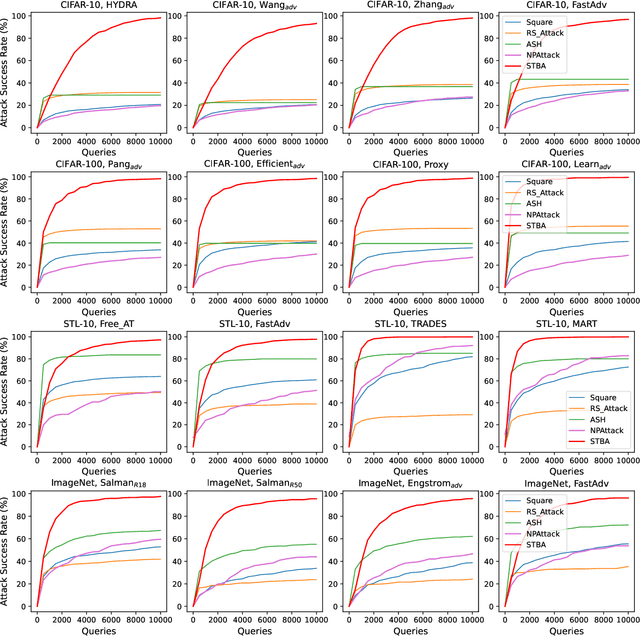
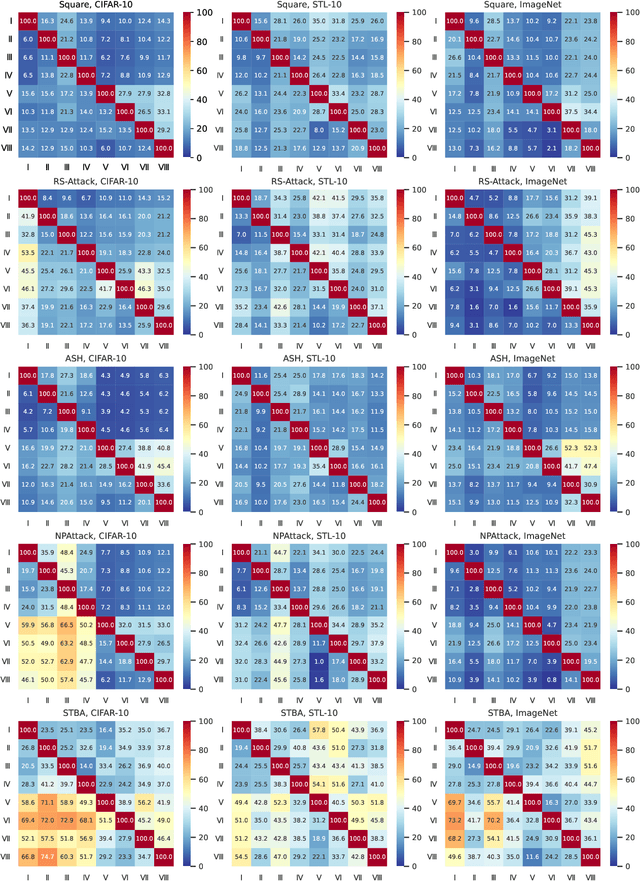
Many attack techniques have been proposed to explore the vulnerability of DNNs and further help to improve their robustness. Despite the significant progress made recently, existing black-box attack methods still suffer from unsatisfactory performance due to the vast number of queries needed to optimize desired perturbations. Besides, the other critical challenge is that adversarial examples built in a noise-adding manner are abnormal and struggle to successfully attack robust models, whose robustness is enhanced by adversarial training against small perturbations. There is no doubt that these two issues mentioned above will significantly increase the risk of exposure and result in a failure to dig deeply into the vulnerability of DNNs. Hence, it is necessary to evaluate DNNs' fragility sufficiently under query-limited settings in a non-additional way. In this paper, we propose the Spatial Transform Black-box Attack (STBA), a novel framework to craft formidable adversarial examples in the query-limited scenario. Specifically, STBA introduces a flow field to the high-frequency part of clean images to generate adversarial examples and adopts the following two processes to enhance their naturalness and significantly improve the query efficiency: a) we apply an estimated flow field to the high-frequency part of clean images to generate adversarial examples instead of introducing external noise to the benign image, and b) we leverage an efficient gradient estimation method based on a batch of samples to optimize such an ideal flow field under query-limited settings. Compared to existing score-based black-box baselines, extensive experiments indicated that STBA could effectively improve the imperceptibility of the adversarial examples and remarkably boost the attack success rate under query-limited settings.