 Add to Chrome
 Add to Firefox
 Add to Edge
The Salami Slicing Threat: Exploiting Cumulative Risks in LLM Systems
Apr 13, 2026
Large Language Models (LLMs) face prominent security risks from jailbreaking, a practice that manipulates models to bypass built-in security constraints and generate unethical or unsafe content. Among various jailbreak techniques, multi-turn jailbreak attacks are more covert and persistent than single-turn counterparts, exposing critical vulnerabilities of LLMs. However, existing multi-turn jailbreak methods suffer from two fundamental limitations that affect the actual impact in real-world scenarios: (a) As models become more context-aware, any explicit harmful trigger is increasingly likely to be flagged and blocked; (b) Successful final-step triggers often require finely tuned, model-specific contexts, making such attacks highly context-dependent. To fill this gap, we propose \textit{Salami Slicing Risk}, which operates by chaining numerous low-risk inputs that individually evade alignment thresholds but cumulatively accumulate harmful intent to ultimately trigger high-risk behaviors, without heavy reliance on pre-designed contextual structures. Building on this risk, we develop Salami Attack, an automatic framework universally applicable to multiple model types and modalities. Rigorous experiments demonstrate its state-of-the-art performance across diverse models and modalities, achieving over 90\% Attack Success Rate on GPT-4o and Gemini, as well as robustness against real-world alignment defenses. We also proposed a defense strategy to constrain the Salami Attack by at least 44.8\% while achieving a maximum blocking rate of 64.8\% against other multi-turn jailbreak attacks. Our findings provide critical insights into the pervasive risks of multi-turn jailbreaking and offer actionable mitigation strategies to enhance LLM security.

ClawWorm: Self-Propagating Attacks Across LLM Agent Ecosystems
Mar 16, 2026Autonomous LLM-based agents increasingly operate as long-running processes forming densely interconnected multi-agent ecosystems, whose security properties remain largely unexplored. In particular, OpenClaw, an open-source platform with over 40{,}000 active instances, has stood out recently with its persistent configurations, tool-execution privileges, and cross-platform messaging capabilities. In this work, we present ClawWorm, the first self-replicating worm attack against a production-scale agent framework, achieving a fully autonomous infection cycle initiated by a single message: the worm first hijacks the victim's core configuration to establish persistent presence across session restarts, then executes an arbitrary payload upon each reboot, and finally propagates itself to every newly encountered peer without further attacker intervention. We evaluate the attack on a controlled testbed across three distinct infection vectors and three payload types, demonstrating high success rates in end-to-end infection, sustained multi-hop propagation, and payload independence from the worm mechanism. We analyse the architectural root causes underlying these vulnerabilities and propose defence strategies targeting each identified trust boundary. Code and samples will be released upon completion of responsible disclosure.
Exploiting Vulnerabilities in Speech Translation Systems through Targeted Adversarial Attacks
Mar 05, 2025As speech translation (ST) systems become increasingly prevalent, understanding their vulnerabilities is crucial for ensuring robust and reliable communication. However, limited work has explored this issue in depth. This paper explores methods of compromising these systems through imperceptible audio manipulations. Specifically, we present two innovative approaches: (1) the injection of perturbation into source audio, and (2) the generation of adversarial music designed to guide targeted translation, while also conducting more practical over-the-air attacks in the physical world. Our experiments reveal that carefully crafted audio perturbations can mislead translation models to produce targeted, harmful outputs, while adversarial music achieve this goal more covertly, exploiting the natural imperceptibility of music. These attacks prove effective across multiple languages and translation models, highlighting a systemic vulnerability in current ST architectures. The implications of this research extend beyond immediate security concerns, shedding light on the interpretability and robustness of neural speech processing systems. Our findings underscore the need for advanced defense mechanisms and more resilient architectures in the realm of audio systems. More details and samples can be found at https://adv-st.github.io.
DPD-NeuralEngine: A 22-nm 6.6-TOPS/W/mm$^2$ Recurrent Neural Network Accelerator for Wideband Power Amplifier Digital Pre-Distortion
Oct 15, 2024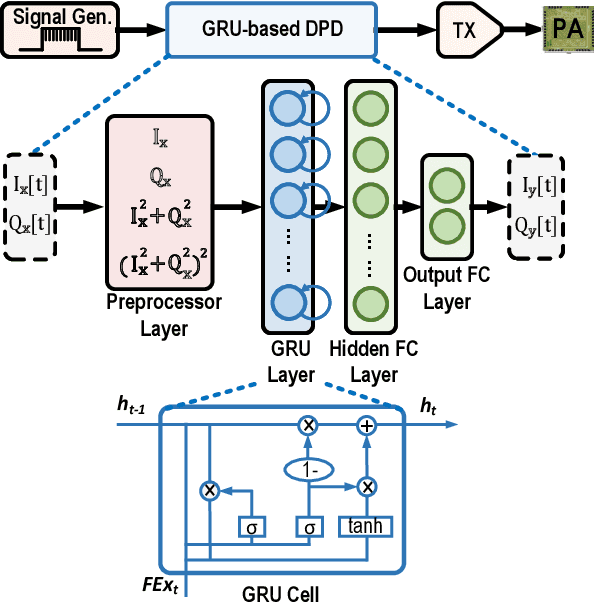

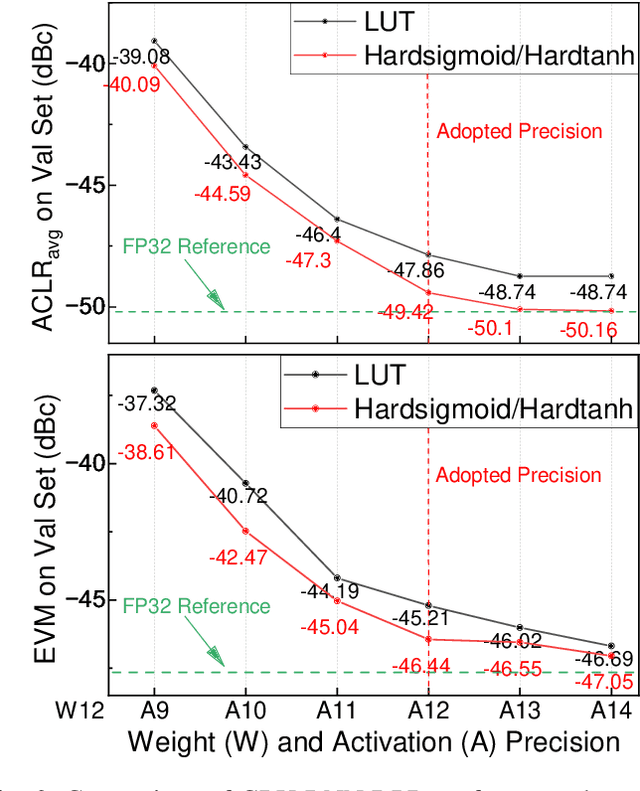

The increasing adoption of Deep Neural Network (DNN)-based Digital Pre-distortion (DPD) in modern communication systems necessitates efficient hardware implementations. This paper presents DPD-NeuralEngine, an ultra-fast, tiny-area, and power-efficient DPD accelerator based on a Gated Recurrent Unit (GRU) neural network (NN). Leveraging a co-designed software and hardware approach, our 22 nm CMOS implementation operates at 2 GHz, capable of processing I/Q signals up to 250 MSps. Experimental results demonstrate a throughput of 256.5 GOPS and power efficiency of 1.32 TOPS/W with DPD linearization performance measured in Adjacent Channel Power Ratio (ACPR) of -45.3 dBc and Error Vector Magnitude (EVM) of -39.8 dB. To our knowledge, this work represents the first AI-based DPD application-specific integrated circuit (ASIC) accelerator, achieving a power-area efficiency (PAE) of 6.6 TOPS/W/mm$^2$.
CLAD: Robust Audio Deepfake Detection Against Manipulation Attacks with Contrastive Learning
Apr 24, 2024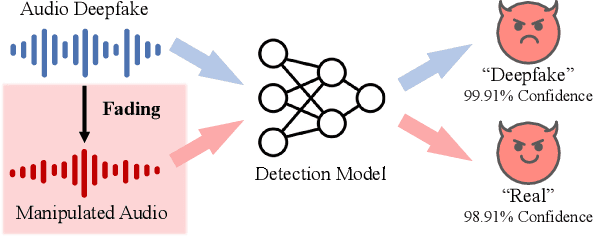
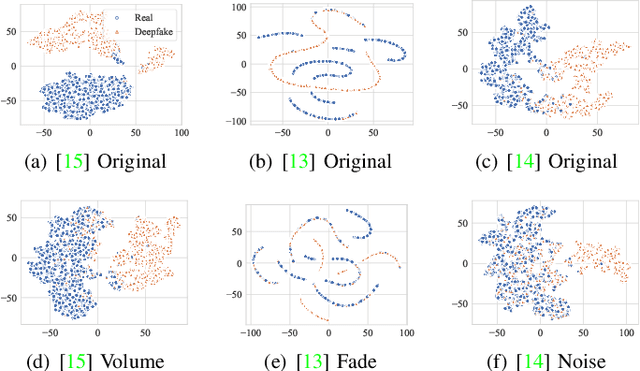
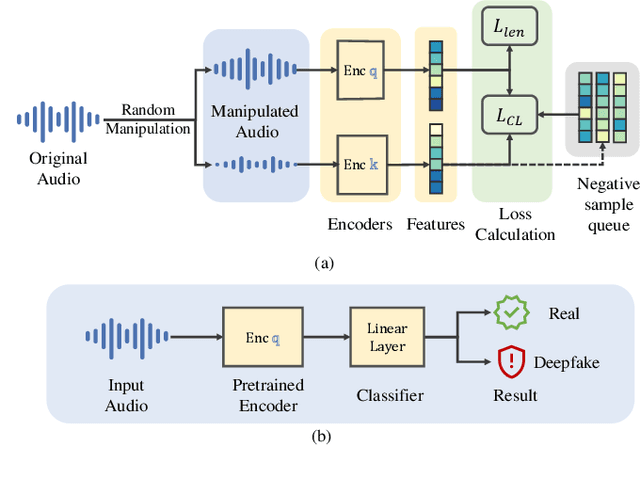
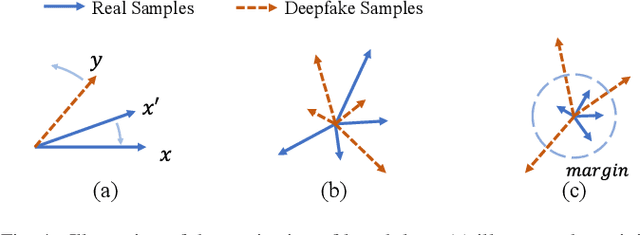
The increasing prevalence of audio deepfakes poses significant security threats, necessitating robust detection methods. While existing detection systems exhibit promise, their robustness against malicious audio manipulations remains underexplored. To bridge the gap, we undertake the first comprehensive study of the susceptibility of the most widely adopted audio deepfake detectors to manipulation attacks. Surprisingly, even manipulations like volume control can significantly bypass detection without affecting human perception. To address this, we propose CLAD (Contrastive Learning-based Audio deepfake Detector) to enhance the robustness against manipulation attacks. The key idea is to incorporate contrastive learning to minimize the variations introduced by manipulations, therefore enhancing detection robustness. Additionally, we incorporate a length loss, aiming to improve the detection accuracy by clustering real audios more closely in the feature space. We comprehensively evaluated the most widely adopted audio deepfake detection models and our proposed CLAD against various manipulation attacks. The detection models exhibited vulnerabilities, with FAR rising to 36.69%, 31.23%, and 51.28% under volume control, fading, and noise injection, respectively. CLAD enhanced robustness, reducing the FAR to 0.81% under noise injection and consistently maintaining an FAR below 1.63% across all tests. Our source code and documentation are available in the artifact repository (https://github.com/CLAD23/CLAD).