 Add to Chrome
 Add to Firefox
 Add to Edge
Ultra3D: Efficient and High-Fidelity 3D Generation with Part Attention
Jul 23, 2025
Recent advances in sparse voxel representations have significantly improved the quality of 3D content generation, enabling high-resolution modeling with fine-grained geometry. However, existing frameworks suffer from severe computational inefficiencies due to the quadratic complexity of attention mechanisms in their two-stage diffusion pipelines. In this work, we propose Ultra3D, an efficient 3D generation framework that significantly accelerates sparse voxel modeling without compromising quality. Our method leverages the compact VecSet representation to efficiently generate a coarse object layout in the first stage, reducing token count and accelerating voxel coordinate prediction. To refine per-voxel latent features in the second stage, we introduce Part Attention, a geometry-aware localized attention mechanism that restricts attention computation within semantically consistent part regions. This design preserves structural continuity while avoiding unnecessary global attention, achieving up to 6.7x speed-up in latent generation. To support this mechanism, we construct a scalable part annotation pipeline that converts raw meshes into part-labeled sparse voxels. Extensive experiments demonstrate that Ultra3D supports high-resolution 3D generation at 1024 resolution and achieves state-of-the-art performance in both visual fidelity and user preference.

Detail++: Training-Free Detail Enhancer for Text-to-Image Diffusion Models
Jul 23, 2025Recent advances in text-to-image (T2I) generation have led to impressive visual results. However, these models still face significant challenges when handling complex prompt, particularly those involving multiple subjects with distinct attributes. Inspired by the human drawing process, which first outlines the composition and then incrementally adds details, we propose Detail++, a training-free framework that introduces a novel Progressive Detail Injection (PDI) strategy to address this limitation. Specifically, we decompose a complex prompt into a sequence of simplified sub-prompts, guiding the generation process in stages. This staged generation leverages the inherent layout-controlling capacity of self-attention to first ensure global composition, followed by precise refinement. To achieve accurate binding between attributes and corresponding subjects, we exploit cross-attention mechanisms and further introduce a Centroid Alignment Loss at test time to reduce binding noise and enhance attribute consistency. Extensive experiments on T2I-CompBench and a newly constructed style composition benchmark demonstrate that Detail++ significantly outperforms existing methods, particularly in scenarios involving multiple objects and complex stylistic conditions.
Truncated Proximal Policy Optimization
Jun 18, 2025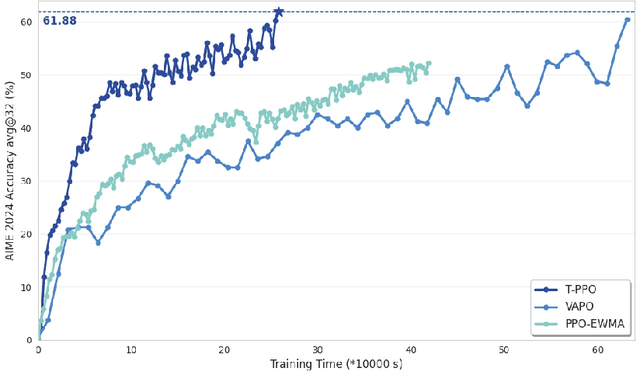
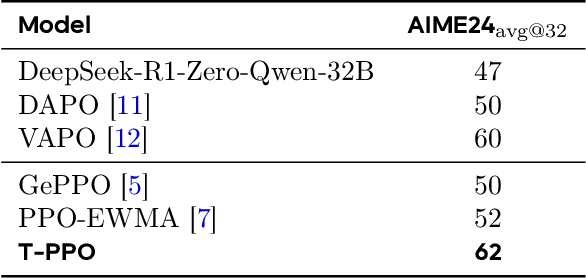
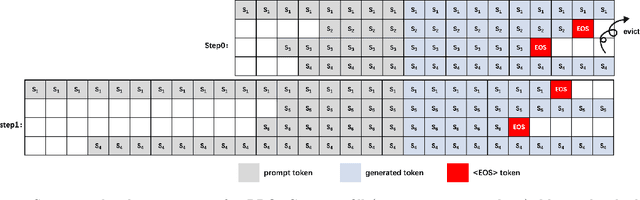
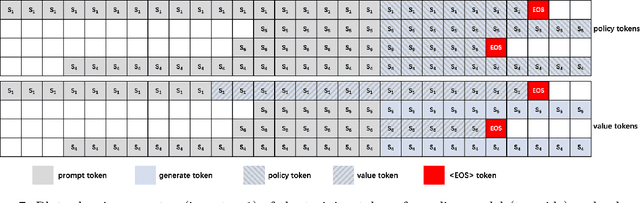
Recently, test-time scaling Large Language Models (LLMs) have demonstrated exceptional reasoning capabilities across scientific and professional tasks by generating long chains-of-thought (CoT). As a crucial component for developing these reasoning models, reinforcement learning (RL), exemplified by Proximal Policy Optimization (PPO) and its variants, allows models to learn through trial and error. However, PPO can be time-consuming due to its inherent on-policy nature, which is further exacerbated by increasing response lengths. In this work, we propose Truncated Proximal Policy Optimization (T-PPO), a novel extension to PPO that improves training efficiency by streamlining policy update and length-restricted response generation. T-PPO mitigates the issue of low hardware utilization, an inherent drawback of fully synchronized long-generation procedures, where resources often sit idle during the waiting periods for complete rollouts. Our contributions are two-folds. First, we propose Extended Generalized Advantage Estimation (EGAE) for advantage estimation derived from incomplete responses while maintaining the integrity of policy learning. Second, we devise a computationally optimized mechanism that allows for the independent optimization of the policy and value models. By selectively filtering prompt and truncated tokens, this mechanism reduces redundant computations and accelerates the training process without sacrificing convergence performance. We demonstrate the effectiveness and efficacy of T-PPO on AIME 2024 with a 32B base model. The experimental results show that T-PPO improves the training efficiency of reasoning LLMs by up to 2.5x and outperforms its existing competitors.
MiniMax-M1: Scaling Test-Time Compute Efficiently with Lightning Attention
Jun 16, 2025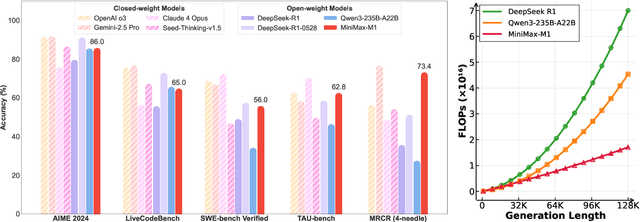

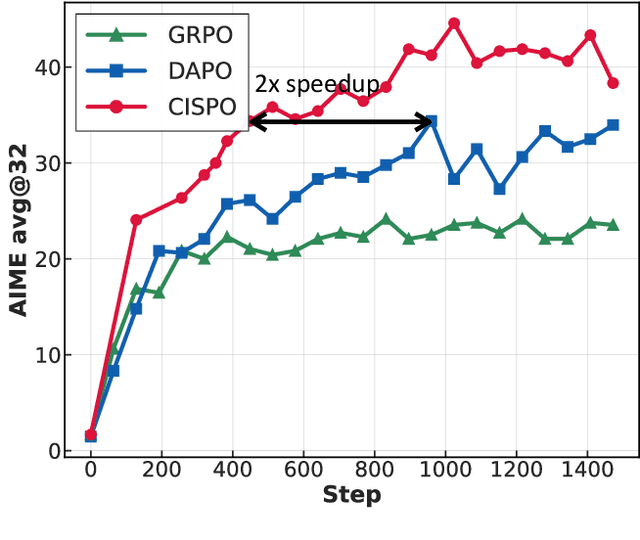
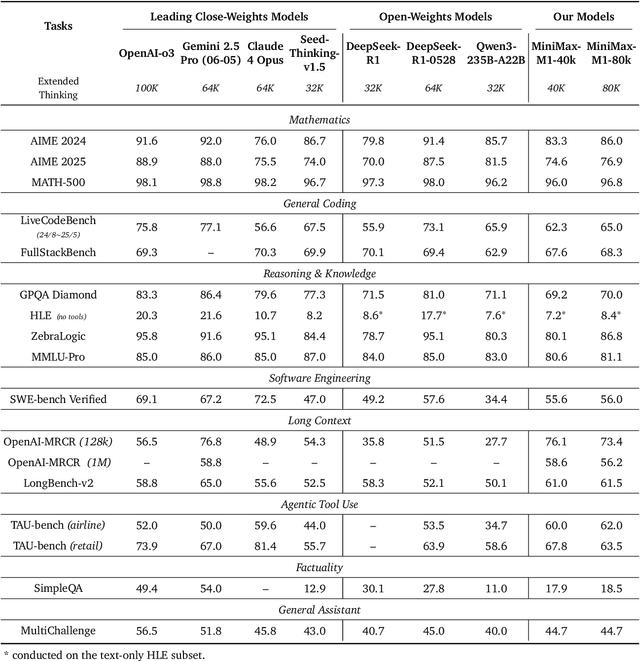
We introduce MiniMax-M1, the world's first open-weight, large-scale hybrid-attention reasoning model. MiniMax-M1 is powered by a hybrid Mixture-of-Experts (MoE) architecture combined with a lightning attention mechanism. The model is developed based on our previous MiniMax-Text-01 model, which contains a total of 456 billion parameters with 45.9 billion parameters activated per token. The M1 model natively supports a context length of 1 million tokens, 8x the context size of DeepSeek R1. Furthermore, the lightning attention mechanism in MiniMax-M1 enables efficient scaling of test-time compute. These properties make M1 particularly suitable for complex tasks that require processing long inputs and thinking extensively. MiniMax-M1 is trained using large-scale reinforcement learning (RL) on diverse problems including sandbox-based, real-world software engineering environments. In addition to M1's inherent efficiency advantage for RL training, we propose CISPO, a novel RL algorithm to further enhance RL efficiency. CISPO clips importance sampling weights rather than token updates, outperforming other competitive RL variants. Combining hybrid-attention and CISPO enables MiniMax-M1's full RL training on 512 H800 GPUs to complete in only three weeks, with a rental cost of just $534,700. We release two versions of MiniMax-M1 models with 40K and 80K thinking budgets respectively, where the 40K model represents an intermediate phase of the 80K training. Experiments on standard benchmarks show that our models are comparable or superior to strong open-weight models such as the original DeepSeek-R1 and Qwen3-235B, with particular strengths in complex software engineering, tool utilization, and long-context tasks. We publicly release MiniMax-M1 at https://github.com/MiniMax-AI/MiniMax-M1.
AI Flow: Perspectives, Scenarios, and Approaches
Jun 14, 2025Pioneered by the foundational information theory by Claude Shannon and the visionary framework of machine intelligence by Alan Turing, the convergent evolution of information and communication technologies (IT/CT) has created an unbroken wave of connectivity and computation. This synergy has sparked a technological revolution, now reaching its peak with large artificial intelligence (AI) models that are reshaping industries and redefining human-machine collaboration. However, the realization of ubiquitous intelligence faces considerable challenges due to substantial resource consumption in large models and high communication bandwidth demands. To address these challenges, AI Flow has been introduced as a multidisciplinary framework that integrates cutting-edge IT and CT advancements, with a particular emphasis on the following three key points. First, device-edge-cloud framework serves as the foundation, which integrates end devices, edge servers, and cloud clusters to optimize scalability and efficiency for low-latency model inference. Second, we introduce the concept of familial models, which refers to a series of different-sized models with aligned hidden features, enabling effective collaboration and the flexibility to adapt to varying resource constraints and dynamic scenarios. Third, connectivity- and interaction-based intelligence emergence is a novel paradigm of AI Flow. By leveraging communication networks to enhance connectivity, the collaboration among AI models across heterogeneous nodes achieves emergent intelligence that surpasses the capability of any single model. The innovations of AI Flow provide enhanced intelligence, timely responsiveness, and ubiquitous accessibility to AI services, paving the way for the tighter fusion of AI techniques and communication systems.
FinHEAR: Human Expertise and Adaptive Risk-Aware Temporal Reasoning for Financial Decision-Making
Jun 10, 2025Financial decision-making presents unique challenges for language models, demanding temporal reasoning, adaptive risk assessment, and responsiveness to dynamic events. While large language models (LLMs) show strong general reasoning capabilities, they often fail to capture behavioral patterns central to human financial decisions-such as expert reliance under information asymmetry, loss-averse sensitivity, and feedback-driven temporal adjustment. We propose FinHEAR, a multi-agent framework for Human Expertise and Adaptive Risk-aware reasoning. FinHEAR orchestrates specialized LLM-based agents to analyze historical trends, interpret current events, and retrieve expert-informed precedents within an event-centric pipeline. Grounded in behavioral economics, it incorporates expert-guided retrieval, confidence-adjusted position sizing, and outcome-based refinement to enhance interpretability and robustness. Empirical results on curated financial datasets show that FinHEAR consistently outperforms strong baselines across trend prediction and trading tasks, achieving higher accuracy and better risk-adjusted returns.
Astra: Toward General-Purpose Mobile Robots via Hierarchical Multimodal Learning
Jun 06, 2025Modern robot navigation systems encounter difficulties in diverse and complex indoor environments. Traditional approaches rely on multiple modules with small models or rule-based systems and thus lack adaptability to new environments. To address this, we developed Astra, a comprehensive dual-model architecture, Astra-Global and Astra-Local, for mobile robot navigation. Astra-Global, a multimodal LLM, processes vision and language inputs to perform self and goal localization using a hybrid topological-semantic graph as the global map, and outperforms traditional visual place recognition methods. Astra-Local, a multitask network, handles local path planning and odometry estimation. Its 4D spatial-temporal encoder, trained through self-supervised learning, generates robust 4D features for downstream tasks. The planning head utilizes flow matching and a novel masked ESDF loss to minimize collision risks for generating local trajectories, and the odometry head integrates multi-sensor inputs via a transformer encoder to predict the relative pose of the robot. Deployed on real in-house mobile robots, Astra achieves high end-to-end mission success rate across diverse indoor environments.
FlowDirector: Training-Free Flow Steering for Precise Text-to-Video Editing
Jun 05, 2025Text-driven video editing aims to modify video content according to natural language instructions. While recent training-free approaches have made progress by leveraging pre-trained diffusion models, they typically rely on inversion-based techniques that map input videos into the latent space, which often leads to temporal inconsistencies and degraded structural fidelity. To address this, we propose FlowDirector, a novel inversion-free video editing framework. Our framework models the editing process as a direct evolution in data space, guiding the video via an Ordinary Differential Equation (ODE) to smoothly transition along its inherent spatiotemporal manifold, thereby preserving temporal coherence and structural details. To achieve localized and controllable edits, we introduce an attention-guided masking mechanism that modulates the ODE velocity field, preserving non-target regions both spatially and temporally. Furthermore, to address incomplete edits and enhance semantic alignment with editing instructions, we present a guidance-enhanced editing strategy inspired by Classifier-Free Guidance, which leverages differential signals between multiple candidate flows to steer the editing trajectory toward stronger semantic alignment without compromising structural consistency. Extensive experiments across benchmarks demonstrate that FlowDirector achieves state-of-the-art performance in instruction adherence, temporal consistency, and background preservation, establishing a new paradigm for efficient and coherent video editing without inversion.
RoboRefer: Towards Spatial Referring with Reasoning in Vision-Language Models for Robotics
Jun 04, 2025Spatial referring is a fundamental capability of embodied robots to interact with the 3D physical world. However, even with the powerful pretrained vision language models (VLMs), recent approaches are still not qualified to accurately understand the complex 3D scenes and dynamically reason about the instruction-indicated locations for interaction. To this end, we propose RoboRefer, a 3D-aware VLM that can first achieve precise spatial understanding by integrating a disentangled but dedicated depth encoder via supervised fine-tuning (SFT). Moreover, RoboRefer advances generalized multi-step spatial reasoning via reinforcement fine-tuning (RFT), with metric-sensitive process reward functions tailored for spatial referring tasks. To support SFT and RFT training, we introduce RefSpatial, a large-scale dataset of 20M QA pairs (2x prior), covering 31 spatial relations (vs. 15 prior) and supporting complex reasoning processes (up to 5 steps). In addition, we introduce RefSpatial-Bench, a challenging benchmark filling the gap in evaluating spatial referring with multi-step reasoning. Experiments show that SFT-trained RoboRefer achieves state-of-the-art spatial understanding, with an average success rate of 89.6%. RFT-trained RoboRefer further outperforms all other baselines by a large margin, even surpassing Gemini-2.5-Pro by 17.4% in average accuracy on RefSpatial-Bench. Notably, RoboRefer can be integrated with various control policies to execute long-horizon, dynamic tasks across diverse robots (e,g., UR5, G1 humanoid) in cluttered real-world scenes.
Towards a Generalizable Bimanual Foundation Policy via Flow-based Video Prediction
May 30, 2025Learning a generalizable bimanual manipulation policy is extremely challenging for embodied agents due to the large action space and the need for coordinated arm movements. Existing approaches rely on Vision-Language-Action (VLA) models to acquire bimanual policies. However, transferring knowledge from single-arm datasets or pre-trained VLA models often fails to generalize effectively, primarily due to the scarcity of bimanual data and the fundamental differences between single-arm and bimanual manipulation. In this paper, we propose a novel bimanual foundation policy by fine-tuning the leading text-to-video models to predict robot trajectories and training a lightweight diffusion policy for action generation. Given the lack of embodied knowledge in text-to-video models, we introduce a two-stage paradigm that fine-tunes independent text-to-flow and flow-to-video models derived from a pre-trained text-to-video model. Specifically, optical flow serves as an intermediate variable, providing a concise representation of subtle movements between images. The text-to-flow model predicts optical flow to concretize the intent of language instructions, and the flow-to-video model leverages this flow for fine-grained video prediction. Our method mitigates the ambiguity of language in single-stage text-to-video prediction and significantly reduces the robot-data requirement by avoiding direct use of low-level actions. In experiments, we collect high-quality manipulation data for real dual-arm robot, and the results of simulation and real-world experiments demonstrate the effectiveness of our method.