 Add to Chrome
 Add to Firefox
 Add to Edge
PRM-as-a-Judge: A Dense Evaluation Paradigm for Fine-Grained Robotic Auditing
Mar 23, 2026
Current robotic evaluation is still largely dominated by binary success rates, which collapse rich execution processes into a single outcome and obscure critical qualities such as progress, efficiency, and stability. To address this limitation, we propose PRM-as-a-Judge, a dense evaluation paradigm that leverages Process Reward Models (PRMs) to audit policy execution directly from trajectory videos by estimating task progress from observation sequences. Central to this paradigm is the OPD (Outcome-Process-Diagnosis) metric system, which explicitly formalizes execution quality via a task-aligned progress potential. We characterize dense robotic evaluation through two axiomatic properties: macro-consistency, which requires additive and path-consistent aggregation, and micro-resolution, which requires sensitivity to fine-grained physical evolution. Under this formulation, potential-based PRM judges provide a natural instantiation of dense evaluation, with macro-consistency following directly from the induced scalar potential. We empirically validate the micro-resolution property using RoboPulse, a diagnostic benchmark specifically designed for probing micro-scale progress discrimination, where several trajectory-trained PRM judges outperform discriminative similarity-based methods and general-purpose foundation-model judges. Finally, leveraging PRM-as-a-Judge and the OPD metric system, we conduct a structured audit of mainstream policy paradigms across long-horizon tasks, revealing behavioral signatures and failure modes that are invisible to outcome-only metrics.

HomeGuard: VLM-based Embodied Safeguard for Identifying Contextual Risk in Household Task
Mar 15, 2026Vision-Language Models (VLMs) empower embodied agents to execute complex instructions, yet they remain vulnerable to contextual safety risks where benign commands become hazardous due to subtle environmental states. Existing safeguards often prove inadequate. Rule-based methods lack scalability in object-dense scenes, whereas model-based approaches relying on prompt engineering suffer from unfocused perception, resulting in missed risks or hallucinations. To address this, we propose an architecture-agnostic safeguard featuring Context-Guided Chain-of-Thought (CG-CoT). This mechanism decomposes risk assessment into active perception that sequentially anchors attention to interaction targets and relevant spatial neighborhoods, followed by semantic judgment based on this visual evidence. We support this approach with a curated grounding dataset and a two-stage training strategy utilizing Reinforcement Fine-Tuning (RFT) with process rewards to enforce precise intermediate grounding. Experiments demonstrate that our model HomeGuard significantly enhances safety, improving risk match rates by over 30% compared to base models while reducing oversafety. Beyond hazard detection, the generated visual anchors serve as actionable spatial constraints for downstream planners, facilitating explicit collision avoidance and safety trajectory generation. Code and data are released under https://github.com/AI45Lab/HomeGuard
SaPaVe: Towards Active Perception and Manipulation in Vision-Language-Action Models for Robotics
Mar 12, 2026Active perception and manipulation are crucial for robots to interact with complex scenes. Existing methods struggle to unify semantic-driven active perception with robust, viewpoint-invariant execution. We propose SaPaVe, an end-to-end framework that jointly learns these capabilities in a data-efficient manner. Our approach decouples camera and manipulation actions rather than placing them in a shared action space, and follows a bottom-up training strategy: we first train semantic camera control on a large-scale dataset, then jointly optimize both action types using hybrid data. To support this framework, we introduce ActiveViewPose-200K, a dataset of 200k image-language-camera movement pairs for semantic camera movement learning, and a 3D geometry-aware module that improves execution robustness under dynamic viewpoints. We also present ActiveManip-Bench, the first benchmark for evaluating active manipulation beyond fixed-view settings. Extensive experiments in both simulation and real-world environments show that SaPaVe outperforms recent vision-language-action models such as GR00T N1 and \(π_0\), achieving up to 31.25\% higher success rates in real-world tasks. These results show that tightly coupled perception and execution, when trained with decoupled yet coordinated strategies, enable efficient and generalizable active manipulation. Project page: https://lmzpai.github.io/SaPaVe
RoboBrain 2.5: Depth in Sight, Time in Mind
Jan 20, 2026We introduce RoboBrain 2.5, a next-generation embodied AI foundation model that advances general perception, spatial reasoning, and temporal modeling through extensive training on high-quality spatiotemporal supervision. Building upon its predecessor, RoboBrain 2.5 introduces two major capability upgrades. Specifically, it unlocks Precise 3D Spatial Reasoning by shifting from 2D pixel-relative grounding to depth-aware coordinate prediction and absolute metric constraint comprehension, generating complete 3D manipulation traces as ordered keypoint sequences under physical constraints. Complementing this spatial precision, the model establishes Dense Temporal Value Estimation that provides dense, step-aware progress prediction and execution state understanding across varying viewpoints, producing stable feedback signals for downstream learning. Together, these upgrades extend the framework toward more physically grounded and execution-aware embodied intelligence for complex, fine-grained manipulation. The code and checkpoints are available at project website: https://superrobobrain.github.io
RoboTracer: Mastering Spatial Trace with Reasoning in Vision-Language Models for Robotics
Dec 15, 2025Spatial tracing, as a fundamental embodied interaction ability for robots, is inherently challenging as it requires multi-step metric-grounded reasoning compounded with complex spatial referring and real-world metric measurement. However, existing methods struggle with this compositional task. To this end, we propose RoboTracer, a 3D-aware VLM that first achieves both 3D spatial referring and measuring via a universal spatial encoder and a regression-supervised decoder to enhance scale awareness during supervised fine-tuning (SFT). Moreover, RoboTracer advances multi-step metric-grounded reasoning via reinforcement fine-tuning (RFT) with metric-sensitive process rewards, supervising key intermediate perceptual cues to accurately generate spatial traces. To support SFT and RFT training, we introduce TraceSpatial, a large-scale dataset of 30M QA pairs, spanning outdoor/indoor/tabletop scenes and supporting complex reasoning processes (up to 9 steps). We further present TraceSpatial-Bench, a challenging benchmark filling the gap to evaluate spatial tracing. Experimental results show that RoboTracer surpasses baselines in spatial understanding, measuring, and referring, with an average success rate of 79.1%, and also achieves SOTA performance on TraceSpatial-Bench by a large margin, exceeding Gemini-2.5-Pro by 36% accuracy. Notably, RoboTracer can be integrated with various control policies to execute long-horizon, dynamic tasks across diverse robots (UR5, G1 humanoid) in cluttered real-world scenes.
RoboOS-NeXT: A Unified Memory-based Framework for Lifelong, Scalable, and Robust Multi-Robot Collaboration
Oct 30, 2025The proliferation of collaborative robots across diverse tasks and embodiments presents a central challenge: achieving lifelong adaptability, scalable coordination, and robust scheduling in multi-agent systems. Existing approaches, from vision-language-action (VLA) models to hierarchical frameworks, fall short due to their reliance on limited or dividual-agent memory. This fundamentally constrains their ability to learn over long horizons, scale to heterogeneous teams, or recover from failures, highlighting the need for a unified memory representation. To address these limitations, we introduce RoboOS-NeXT, a unified memory-based framework for lifelong, scalable, and robust multi-robot collaboration. At the core of RoboOS-NeXT is the novel Spatio-Temporal-Embodiment Memory (STEM), which integrates spatial scene geometry, temporal event history, and embodiment profiles into a shared representation. This memory-centric design is integrated into a brain-cerebellum framework, where a high-level brain model performs global planning by retrieving and updating STEM, while low-level controllers execute actions locally. This closed loop between cognition, memory, and execution enables dynamic task allocation, fault-tolerant collaboration, and consistent state synchronization. We conduct extensive experiments spanning complex coordination tasks in restaurants, supermarkets, and households. Our results demonstrate that RoboOS-NeXT achieves superior performance across heterogeneous embodiments, validating its effectiveness in enabling lifelong, scalable, and robust multi-robot collaboration. Project website: https://flagopen.github.io/RoboOS/
TIGeR: Tool-Integrated Geometric Reasoning in Vision-Language Models for Robotics
Oct 08, 2025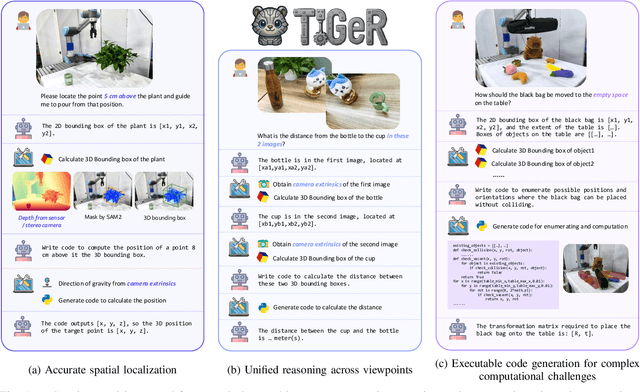
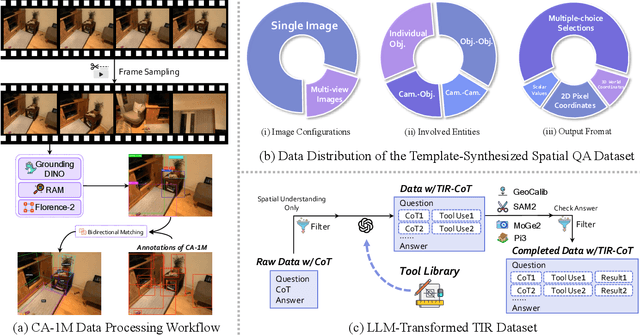
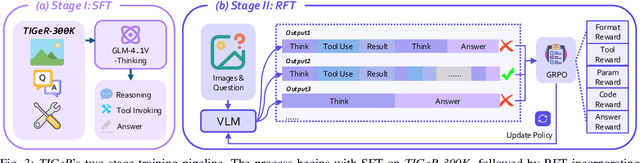
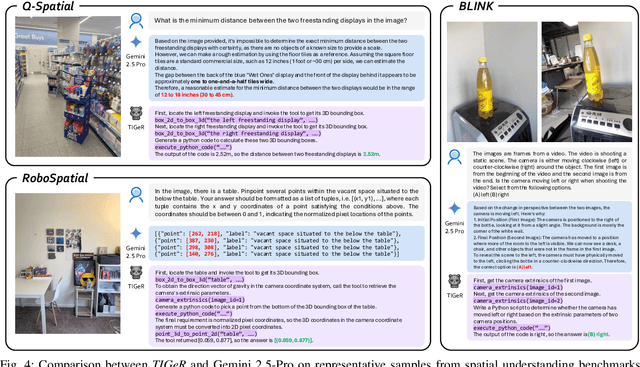
Vision-Language Models (VLMs) have shown remarkable capabilities in spatial reasoning, yet they remain fundamentally limited to qualitative precision and lack the computational precision required for real-world robotics. Current approaches fail to leverage metric cues from depth sensors and camera calibration, instead reducing geometric problems to pattern recognition tasks that cannot deliver the centimeter-level accuracy essential for robotic manipulation. We present TIGeR (Tool-Integrated Geometric Reasoning), a novel framework that transforms VLMs from perceptual estimators to geometric computers by enabling them to generate and execute precise geometric computations through external tools. Rather than attempting to internalize complex geometric operations within neural networks, TIGeR empowers models to recognize geometric reasoning requirements, synthesize appropriate computational code, and invoke specialized libraries for exact calculations. To support this paradigm, we introduce TIGeR-300K, a comprehensive tool-invocation-oriented dataset covering point transformations, pose estimation, trajectory generation, and spatial compatibility verification, complete with tool invocation sequences and intermediate computations. Through a two-stage training pipeline combining supervised fine-tuning (SFT) and reinforcement fine-tuning (RFT) with our proposed hierarchical reward design, TIGeR achieves SOTA performance on geometric reasoning benchmarks while demonstrating centimeter-level precision in real-world robotic manipulation tasks.
MathSticks: A Benchmark for Visual Symbolic Compositional Reasoning with Matchstick Puzzles
Oct 01, 2025We introduce \textsc{MathSticks}, a benchmark for Visual Symbolic Compositional Reasoning (VSCR), which unifies visual perception, symbolic manipulation, and arithmetic consistency. Each task presents an incorrect matchstick equation that must be corrected by moving one or two sticks under strict conservation rules. The benchmark includes both text-guided and purely visual settings, systematically covering digit scale, move complexity, solution multiplicity, and operator variation, with 1.4M generated instances and a curated test set. Evaluations of 14 vision--language models reveal substantial limitations: closed-source models succeed only on simple cases, open-source models fail in the visual regime, while humans exceed 90\% accuracy. These findings establish \textsc{MathSticks} as a rigorous testbed for advancing compositional reasoning across vision and symbols. Our code and dataset are publicly available at https://github.com/Yuheng2000/MathSticks.
RoboBrain 2.0 Technical Report
Jul 02, 2025We introduce RoboBrain 2.0, our latest generation of embodied vision-language foundation models, designed to unify perception, reasoning, and planning for complex embodied tasks in physical environments. It comes in two variants: a lightweight 7B model and a full-scale 32B model, featuring a heterogeneous architecture with a vision encoder and a language model. Despite its compact size, RoboBrain 2.0 achieves strong performance across a wide spectrum of embodied reasoning tasks. On both spatial and temporal benchmarks, the 32B variant achieves leading results, surpassing prior open-source and proprietary models. In particular, it supports key real-world embodied AI capabilities, including spatial understanding (e.g., affordance prediction, spatial referring, trajectory forecasting) and temporal decision-making (e.g., closed-loop interaction, multi-agent long-horizon planning, and scene graph updating). This report details the model architecture, data construction, multi-stage training strategies, infrastructure and practical applications. We hope RoboBrain 2.0 advances embodied AI research and serves as a practical step toward building generalist embodied agents. The code, checkpoint and benchmark are available at https://superrobobrain.github.io.
RoboRefer: Towards Spatial Referring with Reasoning in Vision-Language Models for Robotics
Jun 04, 2025Spatial referring is a fundamental capability of embodied robots to interact with the 3D physical world. However, even with the powerful pretrained vision language models (VLMs), recent approaches are still not qualified to accurately understand the complex 3D scenes and dynamically reason about the instruction-indicated locations for interaction. To this end, we propose RoboRefer, a 3D-aware VLM that can first achieve precise spatial understanding by integrating a disentangled but dedicated depth encoder via supervised fine-tuning (SFT). Moreover, RoboRefer advances generalized multi-step spatial reasoning via reinforcement fine-tuning (RFT), with metric-sensitive process reward functions tailored for spatial referring tasks. To support SFT and RFT training, we introduce RefSpatial, a large-scale dataset of 20M QA pairs (2x prior), covering 31 spatial relations (vs. 15 prior) and supporting complex reasoning processes (up to 5 steps). In addition, we introduce RefSpatial-Bench, a challenging benchmark filling the gap in evaluating spatial referring with multi-step reasoning. Experiments show that SFT-trained RoboRefer achieves state-of-the-art spatial understanding, with an average success rate of 89.6%. RFT-trained RoboRefer further outperforms all other baselines by a large margin, even surpassing Gemini-2.5-Pro by 17.4% in average accuracy on RefSpatial-Bench. Notably, RoboRefer can be integrated with various control policies to execute long-horizon, dynamic tasks across diverse robots (e,g., UR5, G1 humanoid) in cluttered real-world scenes.