 Add to Chrome
 Add to Firefox
 Add to Edge
Evaluating ChatGPT's Information Extraction Capabilities: An Assessment of Performance, Explainability, Calibration, and Faithfulness
Apr 23, 2023
The capability of Large Language Models (LLMs) like ChatGPT to comprehend user intent and provide reasonable responses has made them extremely popular lately. In this paper, we focus on assessing the overall ability of ChatGPT using 7 fine-grained information extraction (IE) tasks. Specially, we present the systematically analysis by measuring ChatGPT's performance, explainability, calibration, and faithfulness, and resulting in 15 keys from either the ChatGPT or domain experts. Our findings reveal that ChatGPT's performance in Standard-IE setting is poor, but it surprisingly exhibits excellent performance in the OpenIE setting, as evidenced by human evaluation. In addition, our research indicates that ChatGPT provides high-quality and trustworthy explanations for its decisions. However, there is an issue of ChatGPT being overconfident in its predictions, which resulting in low calibration. Furthermore, ChatGPT demonstrates a high level of faithfulness to the original text in the majority of cases. We manually annotate and release the test sets of 7 fine-grained IE tasks contains 14 datasets to further promote the research. The datasets and code are available at https://github.com/pkuserc/ChatGPT_for_IE.

Fast vehicle detection algorithm based on lightweight YOLO7-tiny
Apr 17, 2023The swift and precise detection of vehicles plays a significant role in intelligent transportation systems. Current vehicle detection algorithms encounter challenges of high computational complexity, low detection rate, and limited feasibility on mobile devices. To address these issues, this paper proposes a lightweight vehicle detection algorithm based on YOLOv7-tiny (You Only Look Once version seven) called Ghost-YOLOv7. The width of model is scaled to 0.5 and the standard convolution of the backbone network is replaced with Ghost convolution to achieve a lighter network and improve the detection speed; then a self-designed Ghost bi-directional feature pyramid network (Ghost-BiFPN) is embedded into the neck network to enhance feature extraction capability of the algorithm and enriches semantic information; and a Ghost Decouoled Head (GDH) is employed for accurate prediction of vehicle location and species; finally, a coordinate attention mechanism is introduced into the output layer to suppress environmental interference. The WIoU loss function is employed to further enhance the detection accuracy. Ablation experiments results on the PASCAL VOC dataset demonstrate that Ghost-YOLOv7 outperforms the original YOLOv7-tiny model. It achieving a 29.8% reduction in computation, 37.3% reduction in the number of parameters, 35.1% reduction in model weights, 1.1% higher mean average precision (mAP), the detection speed is higher 27FPS compared with the original algorithm. Ghost-YOLOv7 was also compared on KITTI and BIT-vehicle datasets as well, and the results show that this algorithm has the overall best performance.
Shall We Pretrain Autoregressive Language Models with Retrieval? A Comprehensive Study
Apr 13, 2023
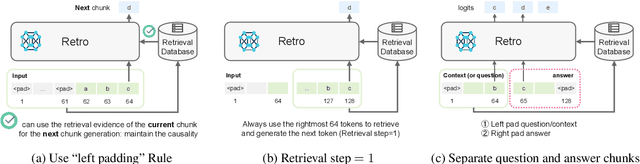


Large decoder-only language models (LMs) can be largely improved in terms of perplexity by retrieval (e.g., RETRO), but its impact on text generation quality and downstream task accuracy is unclear. Thus, it is still an open question: shall we pretrain large autoregressive LMs with retrieval? To answer it, we perform a comprehensive study on a scalable pre-trained retrieval-augmented LM (i.e., RETRO) compared with standard GPT and retrieval-augmented GPT incorporated at fine-tuning or inference stages. We first provide the recipe to reproduce RETRO up to 9.5B parameters while retrieving a text corpus with 330B tokens. Based on that, we have the following novel findings: i) RETRO outperforms GPT on text generation with much less degeneration (i.e., repetition), moderately higher factual accuracy, and slightly lower toxicity with a nontoxic retrieval database. ii) On the LM Evaluation Harness benchmark, RETRO largely outperforms GPT on knowledge-intensive tasks, but is on par with GPT on other tasks. Furthermore, we introduce a simple variant of the model, RETRO++, which largely improves open-domain QA results of original RETRO (e.g., EM score +8.6 on Natural Question) and significantly outperforms retrieval-augmented GPT across different model sizes. Our findings highlight the promising direction of pretraining autoregressive LMs with retrieval as future foundation models. We release our implementation at: https://github.com/NVIDIA/Megatron-LM#retro
Conditional Adapters: Parameter-efficient Transfer Learning with Fast Inference
Apr 11, 2023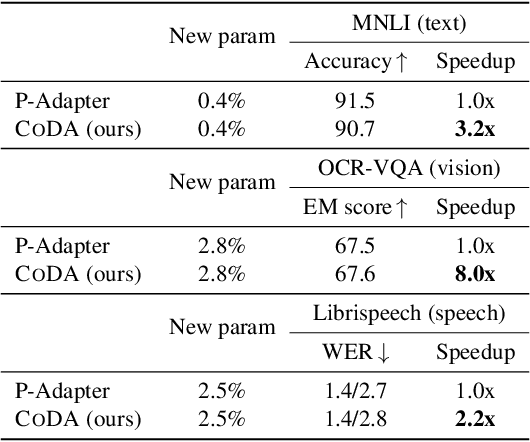
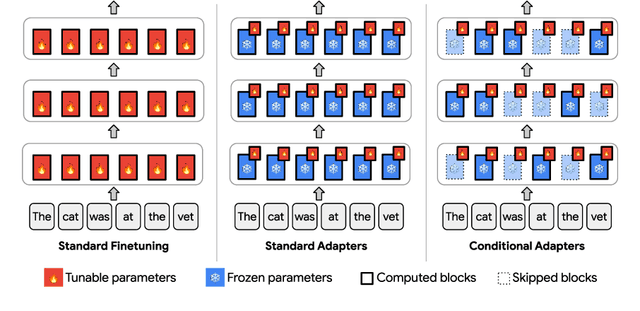
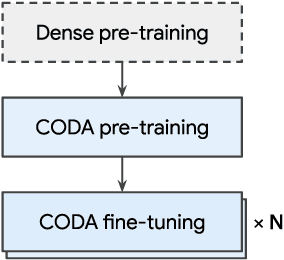
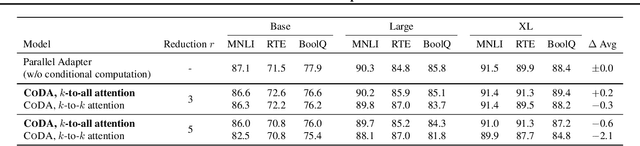
We propose Conditional Adapter (CoDA), a parameter-efficient transfer learning method that also improves inference efficiency. CoDA generalizes beyond standard adapter approaches to enable a new way of balancing speed and accuracy using conditional computation. Starting with an existing dense pretrained model, CoDA adds sparse activation together with a small number of new parameters and a light-weight training phase. Our experiments demonstrate that the CoDA approach provides an unexpectedly efficient way to transfer knowledge. Across a variety of language, vision, and speech tasks, CoDA achieves a 2x to 8x inference speed-up compared to the state-of-the-art Adapter approach with moderate to no accuracy loss and the same parameter efficiency.
Can SAM Segment Anything? When SAM Meets Camouflaged Object Detection
Apr 11, 2023SAM is a segmentation model recently released by Meta AI Research and has been gaining attention quickly due to its impressive performance in generic object segmentation. However, its ability to generalize to specific scenes such as camouflaged scenes is still unknown. Camouflaged object detection (COD) involves identifying objects that are seamlessly integrated into their surroundings and has numerous practical applications in fields such as medicine, art, and agriculture. In this study, we try to ask if SAM can address the COD task and evaluate the performance of SAM on the COD benchmark by employing maximum segmentation evaluation and camouflage location evaluation. We also compare SAM's performance with 22 state-of-the-art COD methods. Our results indicate that while SAM shows promise in generic object segmentation, its performance on the COD task is limited. This presents an opportunity for further research to explore how to build a stronger SAM that may address the COD task. The results of this paper are provided in \url{https://github.com/luckybird1994/SAMCOD}.
Predictive Heterogeneity: Measures and Applications
Apr 01, 2023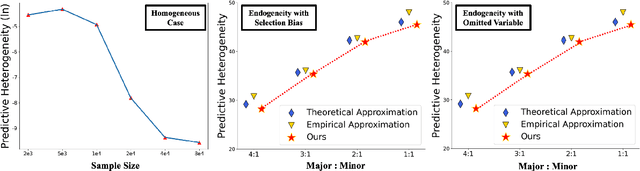

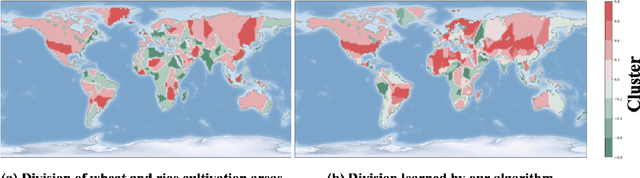
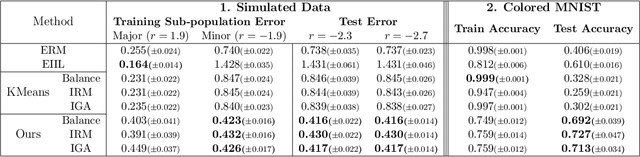
As an intrinsic and fundamental property of big data, data heterogeneity exists in a variety of real-world applications, such as precision medicine, autonomous driving, financial applications, etc. For machine learning algorithms, the ignorance of data heterogeneity will greatly hurt the generalization performance and the algorithmic fairness, since the prediction mechanisms among different sub-populations are likely to differ from each other. In this work, we focus on the data heterogeneity that affects the prediction of machine learning models, and firstly propose the \emph{usable predictive heterogeneity}, which takes into account the model capacity and computational constraints. We prove that it can be reliably estimated from finite data with probably approximately correct (PAC) bounds. Additionally, we design a bi-level optimization algorithm to explore the usable predictive heterogeneity from data. Empirically, the explored heterogeneity provides insights for sub-population divisions in income prediction, crop yield prediction and image classification tasks, and leveraging such heterogeneity benefits the out-of-distribution generalization performance.
Invertible Convolution with Symmetric Paddings
Mar 30, 2023We show that symmetrically padded convolution can be analytically inverted via DFT. We comprehensively analyze several different symmetric and anti-symmetric padding modes and show that multiple cases exist where the inversion can be achieved. The implementation is available at \url{https://github.com/prclibo/iconv_dft}.
Efficient Decision-based Black-box Patch Attacks on Video Recognition
Mar 21, 2023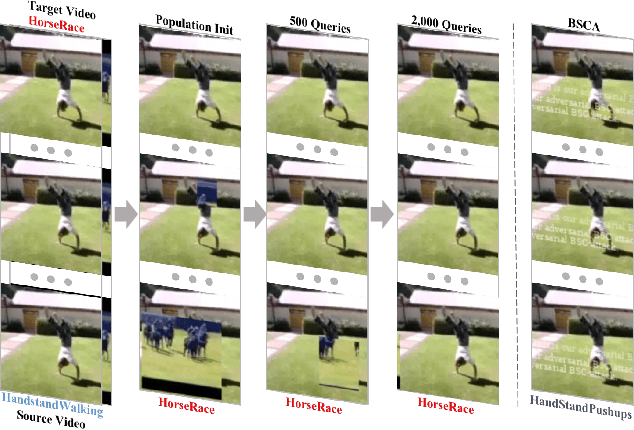
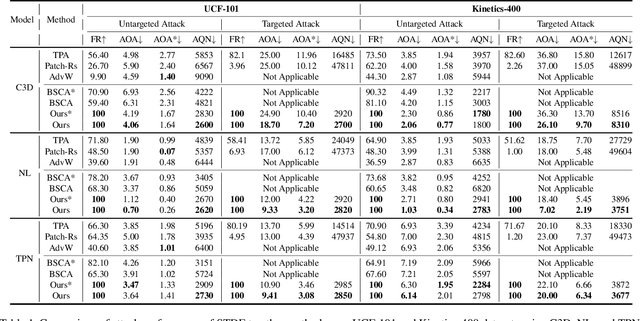
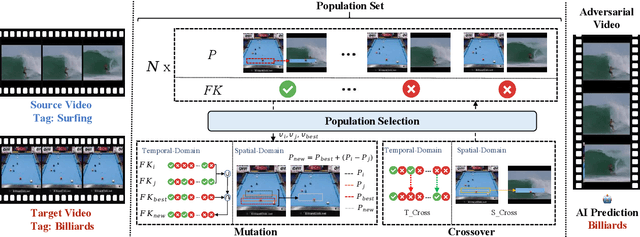
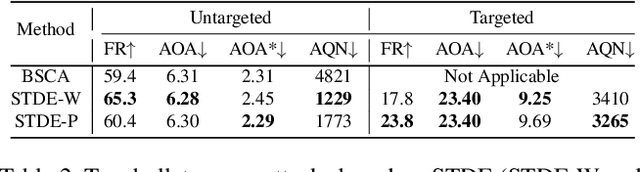
Although Deep Neural Networks (DNNs) have demonstrated excellent performance, they are vulnerable to adversarial patches that introduce perceptible and localized perturbations to the input. Generating adversarial patches on images has received much attention, while adversarial patches on videos have not been well investigated. Further, decision-based attacks, where attackers only access the predicted hard labels by querying threat models, have not been well explored on video models either, even if they are practical in real-world video recognition scenes. The absence of such studies leads to a huge gap in the robustness assessment for video models. To bridge this gap, this work first explores decision-based patch attacks on video models. We analyze that the huge parameter space brought by videos and the minimal information returned by decision-based models both greatly increase the attack difficulty and query burden. To achieve a query-efficient attack, we propose a spatial-temporal differential evolution (STDE) framework. First, STDE introduces target videos as patch textures and only adds patches on keyframes that are adaptively selected by temporal difference. Second, STDE takes minimizing the patch area as the optimization objective and adopts spatialtemporal mutation and crossover to search for the global optimum without falling into the local optimum. Experiments show STDE has demonstrated state-of-the-art performance in terms of threat, efficiency and imperceptibility. Hence, STDE has the potential to be a powerful tool for evaluating the robustness of video recognition models.
Graph Transformer GANs for Graph-Constrained House Generation
Mar 14, 2023We present a novel graph Transformer generative adversarial network (GTGAN) to learn effective graph node relations in an end-to-end fashion for the challenging graph-constrained house generation task. The proposed graph-Transformer-based generator includes a novel graph Transformer encoder that combines graph convolutions and self-attentions in a Transformer to model both local and global interactions across connected and non-connected graph nodes. Specifically, the proposed connected node attention (CNA) and non-connected node attention (NNA) aim to capture the global relations across connected nodes and non-connected nodes in the input graph, respectively. The proposed graph modeling block (GMB) aims to exploit local vertex interactions based on a house layout topology. Moreover, we propose a new node classification-based discriminator to preserve the high-level semantic and discriminative node features for different house components. Finally, we propose a novel graph-based cycle-consistency loss that aims at maintaining the relative spatial relationships between ground truth and predicted graphs. Experiments on two challenging graph-constrained house generation tasks (i.e., house layout and roof generation) with two public datasets demonstrate the effectiveness of GTGAN in terms of objective quantitative scores and subjective visual realism. New state-of-the-art results are established by large margins on both tasks.
TrojDiff: Trojan Attacks on Diffusion Models with Diverse Targets
Mar 10, 2023Diffusion models have achieved great success in a range of tasks, such as image synthesis and molecule design. As such successes hinge on large-scale training data collected from diverse sources, the trustworthiness of these collected data is hard to control or audit. In this work, we aim to explore the vulnerabilities of diffusion models under potential training data manipulations and try to answer: How hard is it to perform Trojan attacks on well-trained diffusion models? What are the adversarial targets that such Trojan attacks can achieve? To answer these questions, we propose an effective Trojan attack against diffusion models, TrojDiff, which optimizes the Trojan diffusion and generative processes during training. In particular, we design novel transitions during the Trojan diffusion process to diffuse adversarial targets into a biased Gaussian distribution and propose a new parameterization of the Trojan generative process that leads to an effective training objective for the attack. In addition, we consider three types of adversarial targets: the Trojaned diffusion models will always output instances belonging to a certain class from the in-domain distribution (In-D2D attack), out-of-domain distribution (Out-D2D-attack), and one specific instance (D2I attack). We evaluate TrojDiff on CIFAR-10 and CelebA datasets against both DDPM and DDIM diffusion models. We show that TrojDiff always achieves high attack performance under different adversarial targets using different types of triggers, while the performance in benign environments is preserved. The code is available at https://github.com/chenweixin107/TrojDiff.