 Add to Chrome
 Add to Firefox
 Add to Edge
Vlogger: Make Your Dream A Vlog
Jan 17, 2024
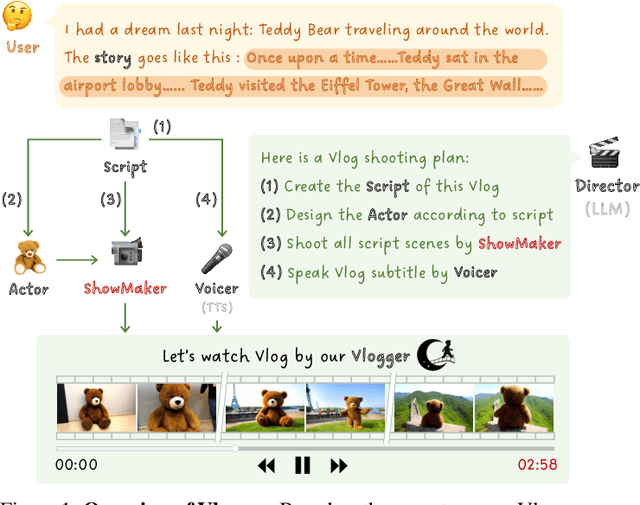
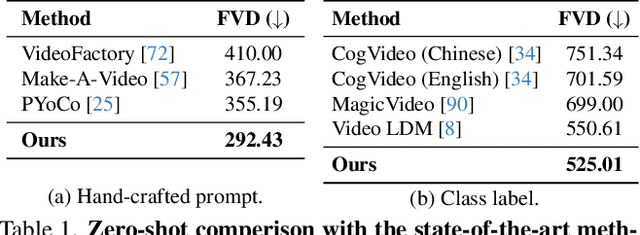


In this work, we present Vlogger, a generic AI system for generating a minute-level video blog (i.e., vlog) of user descriptions. Different from short videos with a few seconds, vlog often contains a complex storyline with diversified scenes, which is challenging for most existing video generation approaches. To break through this bottleneck, our Vlogger smartly leverages Large Language Model (LLM) as Director and decomposes a long video generation task of vlog into four key stages, where we invoke various foundation models to play the critical roles of vlog professionals, including (1) Script, (2) Actor, (3) ShowMaker, and (4) Voicer. With such a design of mimicking human beings, our Vlogger can generate vlogs through explainable cooperation of top-down planning and bottom-up shooting. Moreover, we introduce a novel video diffusion model, ShowMaker, which serves as a videographer in our Vlogger for generating the video snippet of each shooting scene. By incorporating Script and Actor attentively as textual and visual prompts, it can effectively enhance spatial-temporal coherence in the snippet. Besides, we design a concise mixed training paradigm for ShowMaker, boosting its capacity for both T2V generation and prediction. Finally, the extensive experiments show that our method achieves state-of-the-art performance on zero-shot T2V generation and prediction tasks. More importantly, Vlogger can generate over 5-minute vlogs from open-world descriptions, without loss of video coherence on script and actor. The code and model is all available at https://github.com/zhuangshaobin/Vlogger.

Exploiting Hierarchical Interactions for Protein Surface Learning
Jan 17, 2024Predicting interactions between proteins is one of the most important yet challenging problems in structural bioinformatics. Intrinsically, potential function sites in protein surfaces are determined by both geometric and chemical features. However, existing works only consider handcrafted or individually learned chemical features from the atom type and extract geometric features independently. Here, we identify two key properties of effective protein surface learning: 1) relationship among atoms: atoms are linked with each other by covalent bonds to form biomolecules instead of appearing alone, leading to the significance of modeling the relationship among atoms in chemical feature learning. 2) hierarchical feature interaction: the neighboring residue effect validates the significance of hierarchical feature interaction among atoms and between surface points and atoms (or residues). In this paper, we present a principled framework based on deep learning techniques, namely Hierarchical Chemical and Geometric Feature Interaction Network (HCGNet), for protein surface analysis by bridging chemical and geometric features with hierarchical interactions. Extensive experiments demonstrate that our method outperforms the prior state-of-the-art method by 2.3% in site prediction task and 3.2% in interaction matching task, respectively. Our code is available at https://github.com/xmed-lab/HCGNet.
Multi-scale 2D Temporal Map Diffusion Models for Natural Language Video Localization
Jan 16, 2024Natural Language Video Localization (NLVL), grounding phrases from natural language descriptions to corresponding video segments, is a complex yet critical task in video understanding. Despite ongoing advancements, many existing solutions lack the capability to globally capture temporal dynamics of the video data. In this study, we present a novel approach to NLVL that aims to address this issue. Our method involves the direct generation of a global 2D temporal map via a conditional denoising diffusion process, based on the input video and language query. The main challenges are the inherent sparsity and discontinuity of a 2D temporal map in devising the diffusion decoder. To address these challenges, we introduce a multi-scale technique and develop an innovative diffusion decoder. Our approach effectively encapsulates the interaction between the query and video data across various time scales. Experiments on the Charades and DiDeMo datasets underscore the potency of our design.
URHand: Universal Relightable Hands
Jan 10, 2024
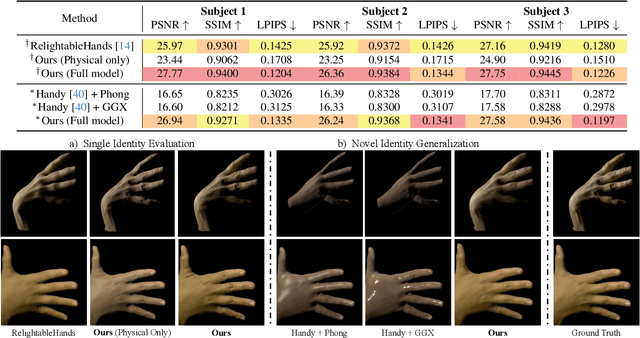
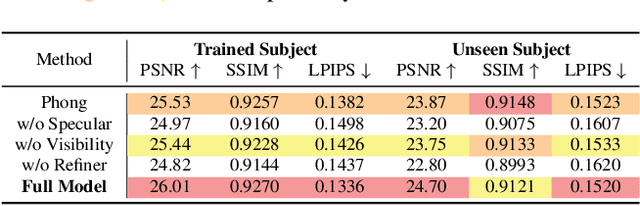
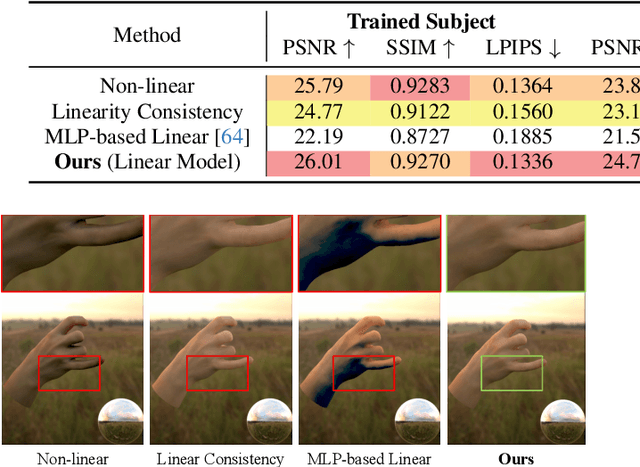
Existing photorealistic relightable hand models require extensive identity-specific observations in different views, poses, and illuminations, and face challenges in generalizing to natural illuminations and novel identities. To bridge this gap, we present URHand, the first universal relightable hand model that generalizes across viewpoints, poses, illuminations, and identities. Our model allows few-shot personalization using images captured with a mobile phone, and is ready to be photorealistically rendered under novel illuminations. To simplify the personalization process while retaining photorealism, we build a powerful universal relightable prior based on neural relighting from multi-view images of hands captured in a light stage with hundreds of identities. The key challenge is scaling the cross-identity training while maintaining personalized fidelity and sharp details without compromising generalization under natural illuminations. To this end, we propose a spatially varying linear lighting model as the neural renderer that takes physics-inspired shading as input feature. By removing non-linear activations and bias, our specifically designed lighting model explicitly keeps the linearity of light transport. This enables single-stage training from light-stage data while generalizing to real-time rendering under arbitrary continuous illuminations across diverse identities. In addition, we introduce the joint learning of a physically based model and our neural relighting model, which further improves fidelity and generalization. Extensive experiments show that our approach achieves superior performance over existing methods in terms of both quality and generalizability. We also demonstrate quick personalization of URHand from a short phone scan of an unseen identity.
GPT-4V is a Human-Aligned Evaluator for Text-to-3D Generation
Jan 09, 2024

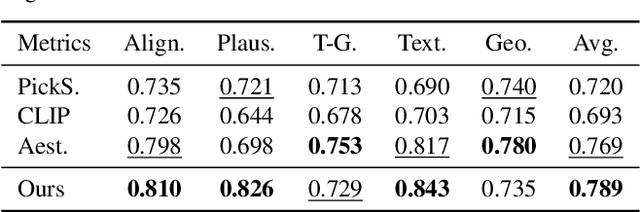

Despite recent advances in text-to-3D generative methods, there is a notable absence of reliable evaluation metrics. Existing metrics usually focus on a single criterion each, such as how well the asset aligned with the input text. These metrics lack the flexibility to generalize to different evaluation criteria and might not align well with human preferences. Conducting user preference studies is an alternative that offers both adaptability and human-aligned results. User studies, however, can be very expensive to scale. This paper presents an automatic, versatile, and human-aligned evaluation metric for text-to-3D generative models. To this end, we first develop a prompt generator using GPT-4V to generate evaluating prompts, which serve as input to compare text-to-3D models. We further design a method instructing GPT-4V to compare two 3D assets according to user-defined criteria. Finally, we use these pairwise comparison results to assign these models Elo ratings. Experimental results suggest our metric strongly align with human preference across different evaluation criteria.
Latte: Latent Diffusion Transformer for Video Generation
Jan 05, 2024
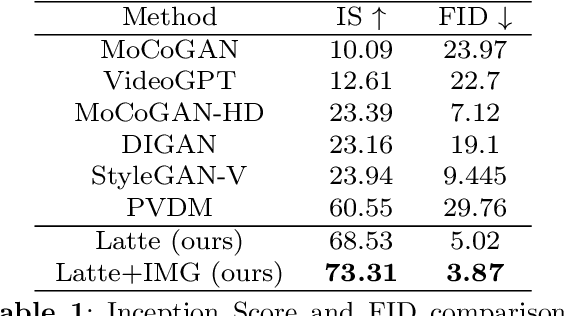

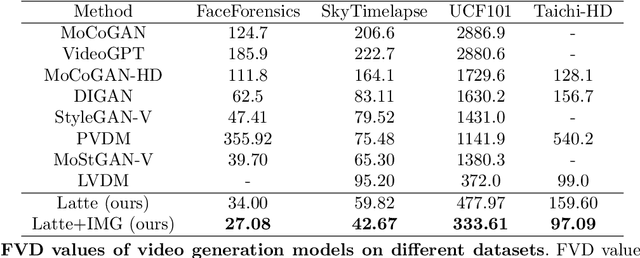
We propose a novel Latent Diffusion Transformer, namely Latte, for video generation. Latte first extracts spatio-temporal tokens from input videos and then adopts a series of Transformer blocks to model video distribution in the latent space. In order to model a substantial number of tokens extracted from videos, four efficient variants are introduced from the perspective of decomposing the spatial and temporal dimensions of input videos. To improve the quality of generated videos, we determine the best practices of Latte through rigorous experimental analysis, including video clip patch embedding, model variants, timestep-class information injection, temporal positional embedding, and learning strategies. Our comprehensive evaluation demonstrates that Latte achieves state-of-the-art performance across four standard video generation datasets, i.e., FaceForensics, SkyTimelapse, UCF101, and Taichi-HD. In addition, we extend Latte to text-to-video generation (T2V) task, where Latte achieves comparable results compared to recent T2V models. We strongly believe that Latte provides valuable insights for future research on incorporating Transformers into diffusion models for video generation.
DreamGaussian4D: Generative 4D Gaussian Splatting
Dec 29, 2023Remarkable progress has been made in 4D content generation recently. However, existing methods suffer from long optimization time, lack of motion controllability, and a low level of detail. In this paper, we introduce DreamGaussian4D, an efficient 4D generation framework that builds on 4D Gaussian Splatting representation. Our key insight is that the explicit modeling of spatial transformations in Gaussian Splatting makes it more suitable for the 4D generation setting compared with implicit representations. DreamGaussian4D reduces the optimization time from several hours to just a few minutes, allows flexible control of the generated 3D motion, and produces animated meshes that can be efficiently rendered in 3D engines.
InsActor: Instruction-driven Physics-based Characters
Dec 28, 2023
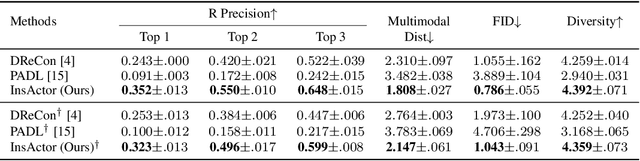


Generating animation of physics-based characters with intuitive control has long been a desirable task with numerous applications. However, generating physically simulated animations that reflect high-level human instructions remains a difficult problem due to the complexity of physical environments and the richness of human language. In this paper, we present InsActor, a principled generative framework that leverages recent advancements in diffusion-based human motion models to produce instruction-driven animations of physics-based characters. Our framework empowers InsActor to capture complex relationships between high-level human instructions and character motions by employing diffusion policies for flexibly conditioned motion planning. To overcome invalid states and infeasible state transitions in planned motions, InsActor discovers low-level skills and maps plans to latent skill sequences in a compact latent space. Extensive experiments demonstrate that InsActor achieves state-of-the-art results on various tasks, including instruction-driven motion generation and instruction-driven waypoint heading. Notably, the ability of InsActor to generate physically simulated animations using high-level human instructions makes it a valuable tool, particularly in executing long-horizon tasks with a rich set of instructions.
FineMoGen: Fine-Grained Spatio-Temporal Motion Generation and Editing
Dec 22, 2023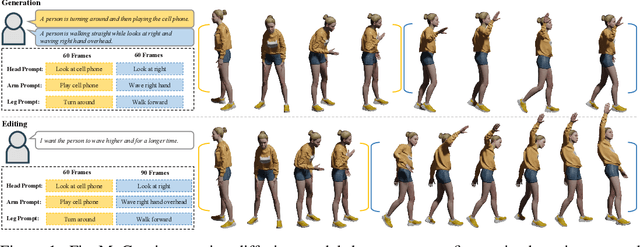
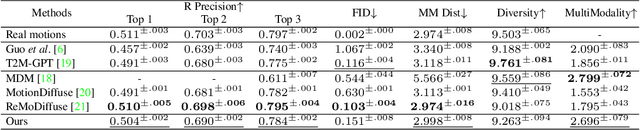
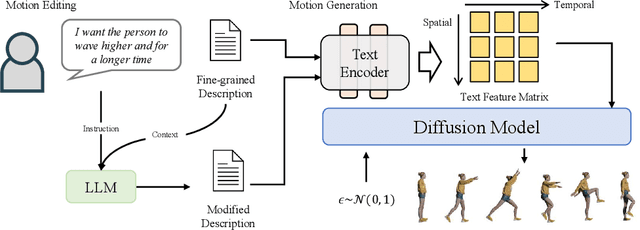
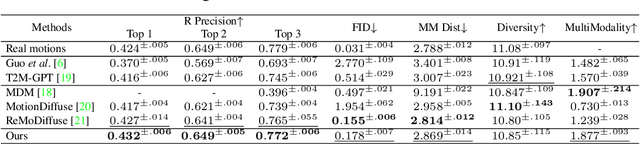
Text-driven motion generation has achieved substantial progress with the emergence of diffusion models. However, existing methods still struggle to generate complex motion sequences that correspond to fine-grained descriptions, depicting detailed and accurate spatio-temporal actions. This lack of fine controllability limits the usage of motion generation to a larger audience. To tackle these challenges, we present FineMoGen, a diffusion-based motion generation and editing framework that can synthesize fine-grained motions, with spatial-temporal composition to the user instructions. Specifically, FineMoGen builds upon diffusion model with a novel transformer architecture dubbed Spatio-Temporal Mixture Attention (SAMI). SAMI optimizes the generation of the global attention template from two perspectives: 1) explicitly modeling the constraints of spatio-temporal composition; and 2) utilizing sparsely-activated mixture-of-experts to adaptively extract fine-grained features. To facilitate a large-scale study on this new fine-grained motion generation task, we contribute the HuMMan-MoGen dataset, which consists of 2,968 videos and 102,336 fine-grained spatio-temporal descriptions. Extensive experiments validate that FineMoGen exhibits superior motion generation quality over state-of-the-art methods. Notably, FineMoGen further enables zero-shot motion editing capabilities with the aid of modern large language models (LLM), which faithfully manipulates motion sequences with fine-grained instructions. Project Page: https://mingyuan-zhang.github.io/projects/FineMoGen.html
Gemini vs GPT-4V: A Preliminary Comparison and Combination of Vision-Language Models Through Qualitative Cases
Dec 22, 2023The rapidly evolving sector of Multi-modal Large Language Models (MLLMs) is at the forefront of integrating linguistic and visual processing in artificial intelligence. This paper presents an in-depth comparative study of two pioneering models: Google's Gemini and OpenAI's GPT-4V(ision). Our study involves a multi-faceted evaluation of both models across key dimensions such as Vision-Language Capability, Interaction with Humans, Temporal Understanding, and assessments in both Intelligence and Emotional Quotients. The core of our analysis delves into the distinct visual comprehension abilities of each model. We conducted a series of structured experiments to evaluate their performance in various industrial application scenarios, offering a comprehensive perspective on their practical utility. We not only involve direct performance comparisons but also include adjustments in prompts and scenarios to ensure a balanced and fair analysis. Our findings illuminate the unique strengths and niches of both models. GPT-4V distinguishes itself with its precision and succinctness in responses, while Gemini excels in providing detailed, expansive answers accompanied by relevant imagery and links. These understandings not only shed light on the comparative merits of Gemini and GPT-4V but also underscore the evolving landscape of multimodal foundation models, paving the way for future advancements in this area. After the comparison, we attempted to achieve better results by combining the two models. Finally, We would like to express our profound gratitude to the teams behind GPT-4V and Gemini for their pioneering contributions to the field. Our acknowledgments are also extended to the comprehensive qualitative analysis presented in 'Dawn' by Yang et al. This work, with its extensive collection of image samples, prompts, and GPT-4V-related results, provided a foundational basis for our analysis.