 Add to Chrome
 Add to Firefox
 Add to Edge
MaskFuser: Masked Fusion of Joint Multi-Modal Tokenization for End-to-End Autonomous Driving
May 13, 2024
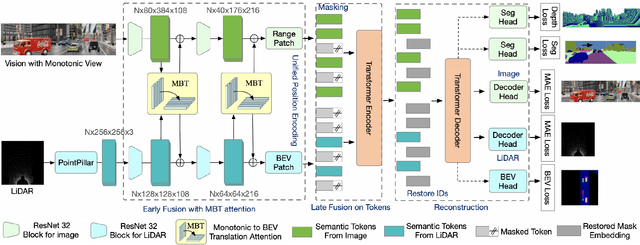
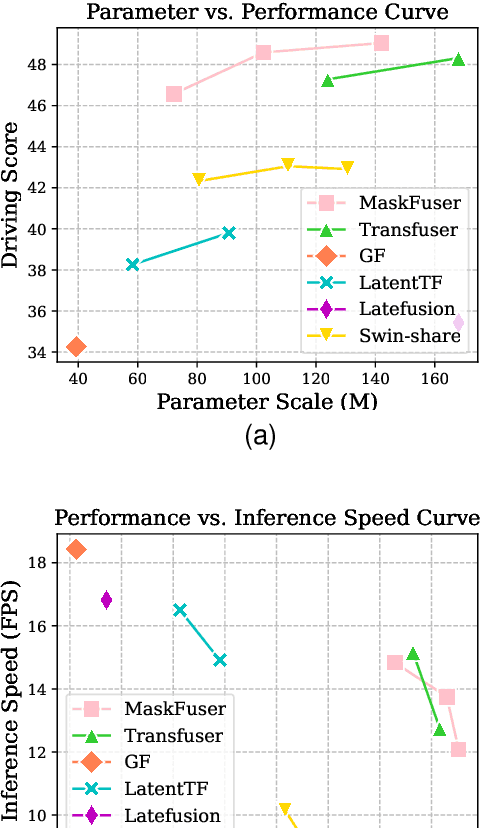
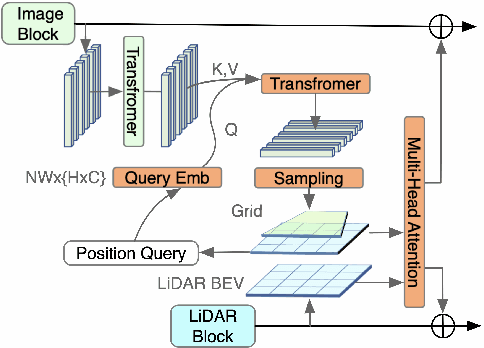
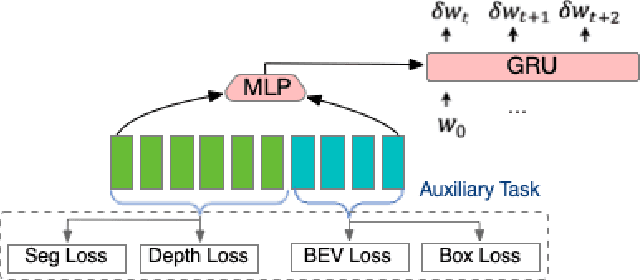
Current multi-modality driving frameworks normally fuse representation by utilizing attention between single-modality branches. However, the existing networks still suppress the driving performance as the Image and LiDAR branches are independent and lack a unified observation representation. Thus, this paper proposes MaskFuser, which tokenizes various modalities into a unified semantic feature space and provides a joint representation for further behavior cloning in driving contexts. Given the unified token representation, MaskFuser is the first work to introduce cross-modality masked auto-encoder training. The masked training enhances the fusion representation by reconstruction on masked tokens. Architecturally, a hybrid-fusion network is proposed to combine advantages from both early and late fusion: For the early fusion stage, modalities are fused by performing monotonic-to-BEV translation attention between branches; Late fusion is performed by tokenizing various modalities into a unified token space with shared encoding on it. MaskFuser respectively reaches a driving score of 49.05 and route completion of 92.85% on the CARLA LongSet6 benchmark evaluation, which improves the best of previous baselines by 1.74 and 3.21%. The introduced masked fusion increases driving stability under damaged sensory inputs. MaskFuser outperforms the best of previous baselines on driving score by 6.55 (27.8%), 1.53 (13.8%), 1.57 (30.9%), respectively given sensory masking ratios 25%, 50%, and 75%.

DriveWorld: 4D Pre-trained Scene Understanding via World Models for Autonomous Driving
May 07, 2024Vision-centric autonomous driving has recently raised wide attention due to its lower cost. Pre-training is essential for extracting a universal representation. However, current vision-centric pre-training typically relies on either 2D or 3D pre-text tasks, overlooking the temporal characteristics of autonomous driving as a 4D scene understanding task. In this paper, we address this challenge by introducing a world model-based autonomous driving 4D representation learning framework, dubbed \emph{DriveWorld}, which is capable of pre-training from multi-camera driving videos in a spatio-temporal fashion. Specifically, we propose a Memory State-Space Model for spatio-temporal modelling, which consists of a Dynamic Memory Bank module for learning temporal-aware latent dynamics to predict future changes and a Static Scene Propagation module for learning spatial-aware latent statics to offer comprehensive scene contexts. We additionally introduce a Task Prompt to decouple task-aware features for various downstream tasks. The experiments demonstrate that DriveWorld delivers promising results on various autonomous driving tasks. When pre-trained with the OpenScene dataset, DriveWorld achieves a 7.5% increase in mAP for 3D object detection, a 3.0% increase in IoU for online mapping, a 5.0% increase in AMOTA for multi-object tracking, a 0.1m decrease in minADE for motion forecasting, a 3.0% increase in IoU for occupancy prediction, and a 0.34m reduction in average L2 error for planning.
Is Sora a World Simulator? A Comprehensive Survey on General World Models and Beyond
May 06, 2024General world models represent a crucial pathway toward achieving Artificial General Intelligence (AGI), serving as the cornerstone for various applications ranging from virtual environments to decision-making systems. Recently, the emergence of the Sora model has attained significant attention due to its remarkable simulation capabilities, which exhibits an incipient comprehension of physical laws. In this survey, we embark on a comprehensive exploration of the latest advancements in world models. Our analysis navigates through the forefront of generative methodologies in video generation, where world models stand as pivotal constructs facilitating the synthesis of highly realistic visual content. Additionally, we scrutinize the burgeoning field of autonomous-driving world models, meticulously delineating their indispensable role in reshaping transportation and urban mobility. Furthermore, we delve into the intricacies inherent in world models deployed within autonomous agents, shedding light on their profound significance in enabling intelligent interactions within dynamic environmental contexts. At last, we examine challenges and limitations of world models, and discuss their potential future directions. We hope this survey can serve as a foundational reference for the research community and inspire continued innovation. This survey will be regularly updated at: https://github.com/GigaAI-research/General-World-Models-Survey.
Are We Ready for Planetary Exploration Robots? The TAIL-Plus Dataset for SLAM in Granular Environments
Apr 21, 2024So far, planetary surface exploration depends on various mobile robot platforms. The autonomous navigation and decision-making of these mobile robots in complex terrains largely rely on their terrain-aware perception, localization and mapping capabilities. In this paper we release the TAIL-Plus dataset, a new challenging dataset in deformable granular environments for planetary exploration robots, which is an extension to our previous work, TAIL (Terrain-Aware multI-modaL) dataset. We conducted field experiments on beaches that are considered as planetary surface analog environments for diverse sandy terrains. In TAIL-Plus dataset, we provide more sequences with multiple loops and expand the scene from day to night. Benefit from our sensor suite with modular design, we use both wheeled and quadruped robots for data collection. The sensors include a 3D LiDAR, three downward RGB-D cameras, a pair of global-shutter color cameras that can be used as a forward-looking stereo camera, an RTK-GPS device and an extra IMU. Our datasets are intended to help researchers developing multi-sensor simultaneous localization and mapping (SLAM) algorithms for robots in unstructured, deformable granular terrains. Our datasets and supplementary materials will be available at \url{https://tailrobot.github.io/}.
TAIL: A Terrain-Aware Multi-Modal SLAM Dataset for Robot Locomotion in Deformable Granular Environments
Mar 25, 2024Terrain-aware perception holds the potential to improve the robustness and accuracy of autonomous robot navigation in the wilds, thereby facilitating effective off-road traversals. However, the lack of multi-modal perception across various motion patterns hinders the solutions of Simultaneous Localization And Mapping (SLAM), especially when confronting non-geometric hazards in demanding landscapes. In this paper, we first propose a Terrain-Aware multI-modaL (TAIL) dataset tailored to deformable and sandy terrains. It incorporates various types of robotic proprioception and distinct ground interactions for the unique challenges and benchmark of multi-sensor fusion SLAM. The versatile sensor suite comprises stereo frame cameras, multiple ground-pointing RGB-D cameras, a rotating 3D LiDAR, an IMU, and an RTK device. This ensemble is hardware-synchronized, well-calibrated, and self-contained. Utilizing both wheeled and quadrupedal locomotion, we efficiently collect comprehensive sequences to capture rich unstructured scenarios. It spans the spectrum of scope, terrain interactions, scene changes, ground-level properties, and dynamic robot characteristics. We benchmark several state-of-the-art SLAM methods against ground truth and provide performance validations. Corresponding challenges and limitations are also reported. All associated resources are accessible upon request at \url{https://tailrobot.github.io/}.
DriveDreamer-2: LLM-Enhanced World Models for Diverse Driving Video Generation
Mar 11, 2024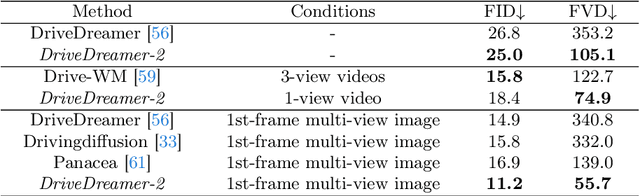
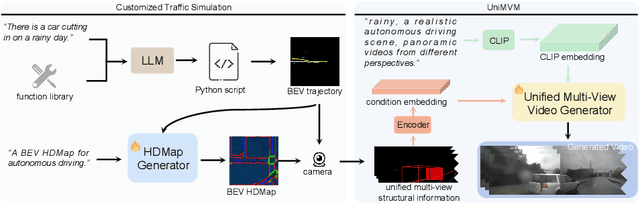

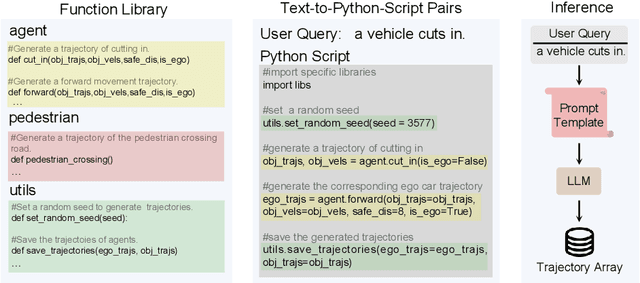
World models have demonstrated superiority in autonomous driving, particularly in the generation of multi-view driving videos. However, significant challenges still exist in generating customized driving videos. In this paper, we propose DriveDreamer-2, which builds upon the framework of DriveDreamer and incorporates a Large Language Model (LLM) to generate user-defined driving videos. Specifically, an LLM interface is initially incorporated to convert a user's query into agent trajectories. Subsequently, a HDMap, adhering to traffic regulations, is generated based on the trajectories. Ultimately, we propose the Unified Multi-View Model to enhance temporal and spatial coherence in the generated driving videos. DriveDreamer-2 is the first world model to generate customized driving videos, it can generate uncommon driving videos (e.g., vehicles abruptly cut in) in a user-friendly manner. Besides, experimental results demonstrate that the generated videos enhance the training of driving perception methods (e.g., 3D detection and tracking). Furthermore, video generation quality of DriveDreamer-2 surpasses other state-of-the-art methods, showcasing FID and FVD scores of 11.2 and 55.7, representing relative improvements of 30% and 50%.
WorldDreamer: Towards General World Models for Video Generation via Predicting Masked Tokens
Jan 18, 2024World models play a crucial role in understanding and predicting the dynamics of the world, which is essential for video generation. However, existing world models are confined to specific scenarios such as gaming or driving, limiting their ability to capture the complexity of general world dynamic environments. Therefore, we introduce WorldDreamer, a pioneering world model to foster a comprehensive comprehension of general world physics and motions, which significantly enhances the capabilities of video generation. Drawing inspiration from the success of large language models, WorldDreamer frames world modeling as an unsupervised visual sequence modeling challenge. This is achieved by mapping visual inputs to discrete tokens and predicting the masked ones. During this process, we incorporate multi-modal prompts to facilitate interaction within the world model. Our experiments show that WorldDreamer excels in generating videos across different scenarios, including natural scenes and driving environments. WorldDreamer showcases versatility in executing tasks such as text-to-video conversion, image-tovideo synthesis, and video editing. These results underscore WorldDreamer's effectiveness in capturing dynamic elements within diverse general world environments.
On the Identifiability from Modulo Measurements under DFT Sensing Matrix
Dec 30, 2023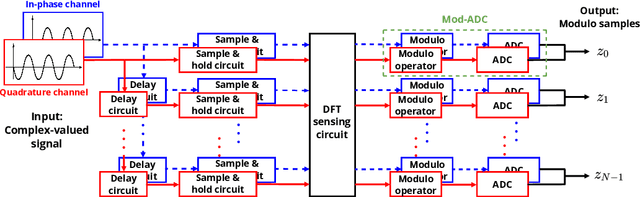
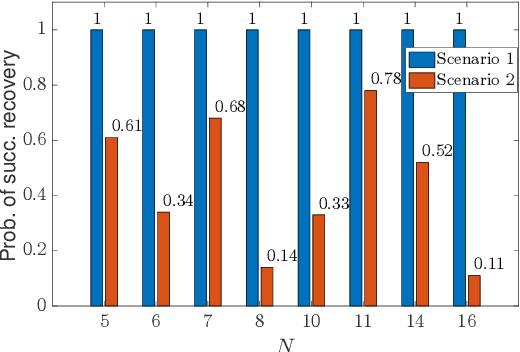
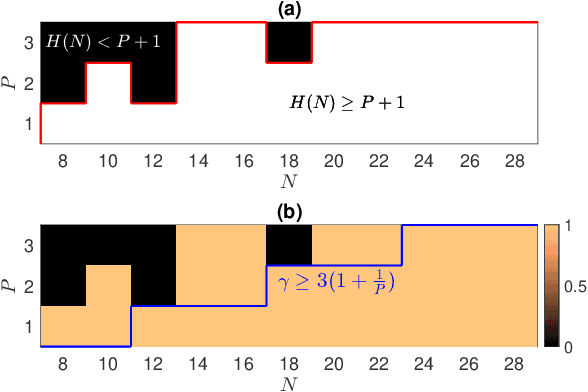

Unlimited sampling was recently introduced to deal with the clipping or saturation of measurements where a modulo operator is applied before sampling. In this paper, we investigate the identifiability of the model where measurements are acquired under a discrete Fourier transform (DFT) sensing matrix first followed by a modulo operator (modulo-DFT). Firstly, based on the theorems of cyclotomic polynomials, we derive a sufficient condition for uniquely identifying the original signal in modulo-DFT. Additionally, for periodic bandlimited signals (PBSs) under unlimited sampling which can be viewed as a special case of modulo-DFT, the necessary and sufficient condition for the unique recovery of the original signal are provided. Moreover, we show that when the oversampling factor exceeds $3(1+1/P)$, PBS is always identifiable from the modulo samples, where $P$ is the number of harmonics including the fundamental component in the positive frequency part.
Generative Pretraining at Scale: Transformer-Based Encoding of Transactional Behavior for Fraud Detection
Dec 22, 2023In this work, we introduce an innovative autoregressive model leveraging Generative Pretrained Transformer (GPT) architectures, tailored for fraud detection in payment systems. Our approach innovatively confronts token explosion and reconstructs behavioral sequences, providing a nuanced understanding of transactional behavior through temporal and contextual analysis. Utilizing unsupervised pretraining, our model excels in feature representation without the need for labeled data. Additionally, we integrate a differential convolutional approach to enhance anomaly detection, bolstering the security and efficacy of one of the largest online payment merchants in China. The scalability and adaptability of our model promise broad applicability in various transactional contexts.
OpenStereo: A Comprehensive Benchmark for Stereo Matching and Strong Baseline
Dec 01, 2023
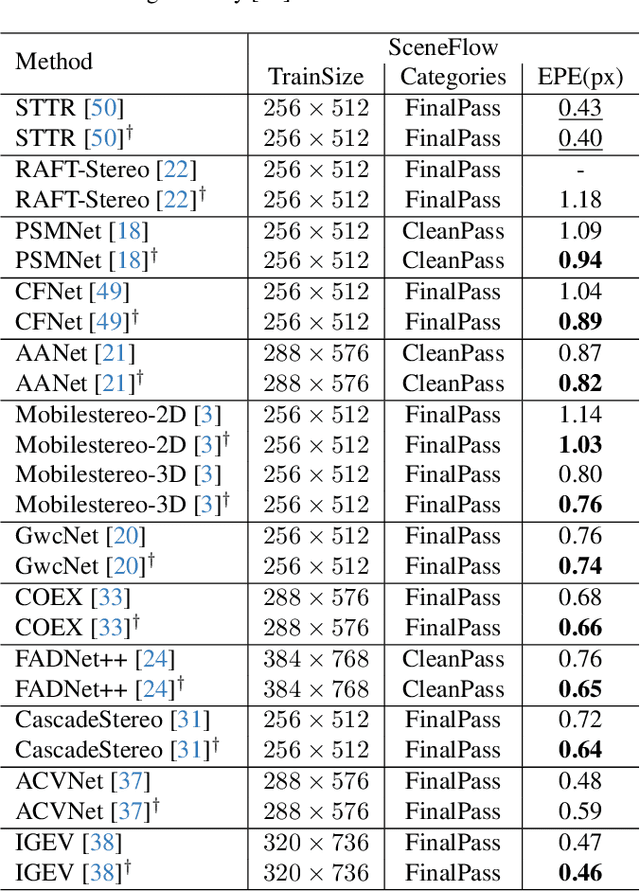
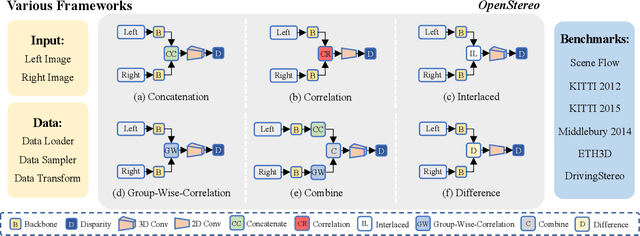
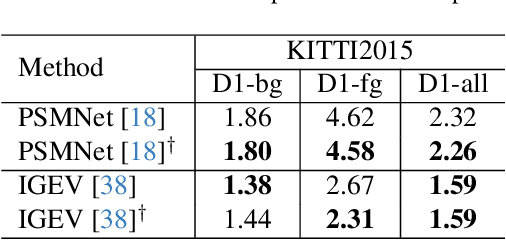
Stereo matching, a pivotal technique in computer vision, plays a crucial role in robotics, autonomous navigation, and augmented reality. Despite the development of numerous impressive methods in recent years, replicating their results and determining the most suitable architecture for practical application remains challenging. Addressing this gap, our paper introduces a comprehensive benchmark focusing on practical applicability rather than solely on performance enhancement. Specifically, we develop a flexible and efficient stereo matching codebase, called OpenStereo. OpenStereo includes training and inference codes of more than 12 network models, making it, to our knowledge, the most complete stereo matching toolbox available. Based on OpenStereo, we conducted experiments on the SceneFlow dataset and have achieved or surpassed the performance metrics reported in the original paper. Additionally, we conduct an in-depth revisitation of recent developments in stereo matching through ablative experiments. These investigations inspired the creation of StereoBase, a simple yet strong baseline model. Our extensive comparative analyses of StereoBase against numerous contemporary stereo matching methods on the SceneFlow dataset demonstrate its remarkably strong performance. The source code is available at https://github.com/XiandaGuo/OpenStereo.