 Add to Chrome
 Add to Firefox
 Add to Edge
Zero2Skill: Bootstrapping Robot Skills through Autonomous Data Collection, Training, and Deployment
Jul 16, 2026
Autonomous data collection governs the volume and quality of real-world trajectories for manipulation policy learning. Existing pipelines reduce human effort via self-resetting, VLM verification, or language-guided correction, yet episode-scoped fixes must be reissued whenever the same failure recurs, so oversight cost grows with session length rather than with the number of distinct problems. We present Zero2Skill, a human-robot symbiotic agentic system in which corrections are retained and reused across rounds. The collection loop collects, verifies, and resets autonomously, pausing for a remote operator only when a phase exhausts an explicit retry budget. An LLM parser maps each natural-language utterance to a structured adjustment stored in Corrective Memory, so addressed failure modes typically need not be corrected again under the same conditions. On a real-robot desktop-clearing testbed, Zero2Skill matches teleoperation episode success while reducing human working time to 16%. Language corrections improve verifier-human agreement in all four evaluated settings and raise average single-attempt success from 12.5% to 47.5% (arm-selection: 20.0% to 50.0%). Policies fine-tuned on Zero2Skill data match teleoperation-trained policy success at a fraction of collection human cost.

GigaWorld-Policy-0.5: A Faster and Stronger WAM Empowered by AutoResearch
Jul 16, 2026World Action Models (WAMs) improve robot policy learning by jointly modeling actions and future visual observations, using future scene evolution as dense supervision for physically grounded action generation. However, a common design in existing WAMs is to explicitly generate future videos at inference time, incurring substantial computational overhead and hindering real-time closed-loop deployment. GigaWorld-Policy addresses this issue with an action-centered formulation, where future visual dynamics are used during training while action-only decoding is used at inference time. Building upon this framework, we present GigaWorld-Policy-0.5, an enhanced action-centered WAM designed for more efficient robot control. During pretraining, GigaWorld-Policy-0.5 adopts a mixed Action-Conditioned World Modeling (AC-WM) and WAM training strategy. This strengthens the coupling between visual dynamics and robot actions and improves the transferability of action representations for downstream policy learning. For efficient inference, GigaWorld-Policy-0.5 introduces a Mixture-of-Transformers architecture that separates visual dynamics modeling and action generation into specialized experts, reducing active computation during action-only inference and achieving 85 ms inference latency on a local RTX 4090 setup. In addition, we employ an agent-based AutoResearch pipeline to systematically search training configurations, enabling more efficient identification of optimal experimental setups while reducing the time and manual intervention required for hyperparameter tuning. Experiments and ablations show that GigaWorld-Policy-0.5 preserves the training benefits of future visual dynamics while improving inference efficiency for robot control.
HALO-WA: Hybrid-Attention Latent-Guided Online Reinforcement Learning for World-Action Models
Jul 05, 2026World-action (WA) models can generate long-horizon action chunks for general-purpose robotic manipulation, but they remain vulnerable to calibration, perception, and contact-dynamics errors in real-world precision tasks, often failing in the final few millimeters of alignment or insertion. We propose HALO-WA, a hybrid-attention latent-guided online reinforcement learning (RL) framework for WA models, which leverages latent features and action priors from the WA generation process through a lightweight actor-critic adapter to enable fast online adaptation to real deployment errors. HALO-WA introduces a hybrid-attention structure that preserves the temporal consistency of action chunks while reading task-relevant information from WA latents conditioned on visual context and end-stage correction requirements, thereby producing refined action chunks. We validate HALO-WA on four real-world precision manipulation tasks, where it improves the average success rate from 26.4\% for WA-base to 87.1\%, outperforming the strongest baseline by 19.2 percentage points while requiring only 45--75 minutes of online training per task. To facilitate reproducibility, we further conduct supplementary simulation experiments in RoboTwin and release the code at https://github.com/YeanRoot/HALO-WA.
GigaWorld-1: A Roadmap to Build World Models for Robot Policy Evaluation
Jul 02, 2026Evaluating embodied robot foundation models remains a critical bottleneck; unlike large language models efficiently assessed via digital benchmarks, robotic policies require slow, costly real-world rollouts limited by hardware and human supervision, which has driven interest in world models as surrogate policy evaluators, yet the key properties that make a world model reliable for policy assessment remain poorly understood. This work presents a systematic study of world models for robotic policy evaluation and introduces WMBench, a benchmark constructed from real-robot teleoperation data and matched policy rollouts covering diverse manipulation tasks to enable controlled comparisons across model families, action encodings, rollout horizons, and evaluation metrics. Using WMBench, we analyze 7 video world models, 4 action representation schemes, and over 324,000 simulated policy rollouts paired with real robot executions, further enriching our analysis with large-scale community submissions from the CVPR 2026 GigaBrain Challenge, curated synthetic trajectories, and a training videos spanning more than 12,000 hours. Our experiments deliver three core insights: evaluator quality is dominated by long-horizon, action-faithful rollout consistency rather than short-term visual realism; pretraining gains stem not only from data scale but from balancing general world knowledge with robot-specific controllability; and architectural choices including action encoding, memory design, and evaluator-focused post-training strongly determine alignment with real-world robot behavior. Drawing on these results, we derive a practical design roadmap and realize it in \textit{GigaWorld-1}, a world model specially optimized for policy evaluation, and we fully release our code, models, datasets, and toolkits to advance scalable evaluation research for embodied foundation models.
ReconPhys: Reconstruct Appearance and Physical Attributes from Single Video
Apr 09, 2026Reconstructing non-rigid objects with physical plausibility remains a significant challenge. Existing approaches leverage differentiable rendering for per-scene optimization, recovering geometry and dynamics but requiring expensive tuning or manual annotation, which limits practicality and generalizability. To address this, we propose ReconPhys, the first feedforward framework that jointly learns physical attribute estimation and 3D Gaussian Splatting reconstruction from a single monocular video. Our method employs a dual-branch architecture trained via a self-supervised strategy, eliminating the need for ground-truth physics labels. Given a video sequence, ReconPhys simultaneously infers geometry, appearance, and physical attributes. Experiments on a large-scale synthetic dataset demonstrate superior performance: our method achieves 21.64 PSNR in future prediction compared to 13.27 by state-of-the-art optimization baselines, while reducing Chamfer Distance from 0.349 to 0.004. Crucially, ReconPhys enables fast inference (<1 second) versus hours required by existing methods, facilitating rapid generation of simulation-ready assets for robotics and graphics.
DriveDreamer-Policy: A Geometry-Grounded World-Action Model for Unified Generation and Planning
Apr 02, 2026Recently, world-action models (WAM) have emerged to bridge vision-language-action (VLA) models and world models, unifying their reasoning and instruction-following capabilities and spatio-temporal world modeling. However, existing WAM approaches often focus on modeling 2D appearance or latent representations, with limited geometric grounding-an essential element for embodied systems operating in the physical world. We present DriveDreamer-Policy, a unified driving world-action model that integrates depth generation, future video generation, and motion planning within a single modular architecture. The model employs a large language model to process language instructions, multi-view images, and actions, followed by three lightweight generators that produce depth, future video, and actions. By learning a geometry-aware world representation and using it to guide both future prediction and planning within a unified framework, the proposed model produces more coherent imagined futures and more informed driving actions, while maintaining modularity and controllable latency. Experiments on the Navsim v1 and v2 benchmarks demonstrate that DriveDreamer-Policy achieves strong performance on both closed-loop planning and world generation tasks. In particular, our model reaches 89.2 PDMS on Navsim v1 and 88.7 EPDMS on Navsim v2, outperforming existing world-model-based approaches while producing higher-quality future video and depth predictions. Ablation studies further show that explicit depth learning provides complementary benefits to video imagination and improves planning robustness.
GigaWorld-Policy: An Efficient Action-Centered World--Action Model
Mar 18, 2026World-Action Models (WAM) initialized from pre-trained video generation backbones have demonstrated remarkable potential for robot policy learning. However, existing approaches face two critical bottlenecks that hinder performance and deployment. First, jointly reasoning over future visual dynamics and corresponding actions incurs substantial inference overhead. Second, joint modeling often entangles visual and motion representations, making motion prediction accuracy heavily dependent on the quality of future video forecasts. To address these issues, we introduce GigaWorld-Policy, an action-centered WAM that learns 2D pixel-action dynamics while enabling efficient action decoding, with optional video generation. Specifically, we formulate policy training into two coupled components: the model predicts future action sequences conditioned on the current observation, and simultaneously generates future videos conditioned on the predicted actions and the same observation. The policy is supervised by both action prediction and video generation, providing richer learning signals and encouraging physically plausible actions through visual-dynamics constraints. With a causal design that prevents future-video tokens from influencing action tokens, explicit future-video generation is optional at inference time, allowing faster action prediction during deployment. To support this paradigm, we curate a diverse, large-scale robot dataset to pre-train an action-centered video generation model, which is then adapted as the backbone for robot policy learning. Experimental results on real-world robotic platforms show that GigaWorld-Policy runs 9x faster than the leading WAM baseline, Motus, while improving task success rates by 7%. Moreover, compared with pi-0.5, GigaWorld-Policy improves performance by 95% on RoboTwin 2.0.
GigaBrain-0.5M*: a VLA That Learns From World Model-Based Reinforcement Learning
Feb 12, 2026Vision-language-action (VLA) models that directly predict multi-step action chunks from current observations face inherent limitations due to constrained scene understanding and weak future anticipation capabilities. In contrast, video world models pre-trained on web-scale video corpora exhibit robust spatiotemporal reasoning and accurate future prediction, making them a natural foundation for enhancing VLA learning. Therefore, we propose \textit{GigaBrain-0.5M*}, a VLA model trained via world model-based reinforcement learning. Built upon \textit{GigaBrain-0.5}, which is pre-trained on over 10,000 hours of robotic manipulation data, whose intermediate version currently ranks first on the international RoboChallenge benchmark. \textit{GigaBrain-0.5M*} further integrates world model-based reinforcement learning via \textit{RAMP} (Reinforcement leArning via world Model-conditioned Policy) to enable robust cross-task adaptation. Empirical results demonstrate that \textit{RAMP} achieves substantial performance gains over the RECAP baseline, yielding improvements of approximately 30\% on challenging tasks including \texttt{Laundry Folding}, \texttt{Box Packing}, and \texttt{Espresso Preparation}. Critically, \textit{GigaBrain-0.5M$^*$} exhibits reliable long-horizon execution, consistently accomplishing complex manipulation tasks without failure as validated by real-world deployment videos on our \href{https://gigabrain05m.github.io}{project page}.
UniDriveDreamer: A Single-Stage Multimodal World Model for Autonomous Driving
Feb 02, 2026World models have demonstrated significant promise for data synthesis in autonomous driving. However, existing methods predominantly concentrate on single-modality generation, typically focusing on either multi-camera video or LiDAR sequence synthesis. In this paper, we propose UniDriveDreamer, a single-stage unified multimodal world model for autonomous driving, which directly generates multimodal future observations without relying on intermediate representations or cascaded modules. Our framework introduces a LiDAR-specific variational autoencoder (VAE) designed to encode input LiDAR sequences, alongside a video VAE for multi-camera images. To ensure cross-modal compatibility and training stability, we propose Unified Latent Anchoring (ULA), which explicitly aligns the latent distributions of the two modalities. The aligned features are fused and processed by a diffusion transformer that jointly models their geometric correspondence and temporal evolution. Additionally, structured scene layout information is projected per modality as a conditioning signal to guide the synthesis. Extensive experiments demonstrate that UniDriveDreamer outperforms previous state-of-the-art methods in both video and LiDAR generation, while also yielding measurable improvements in downstream
ReconDreamer-RL: Enhancing Reinforcement Learning via Diffusion-based Scene Reconstruction
Aug 11, 2025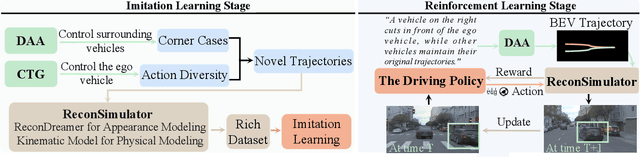

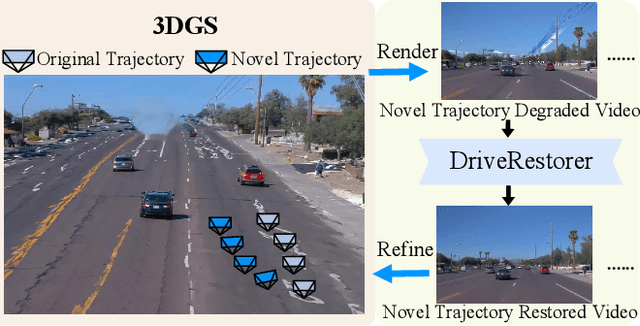
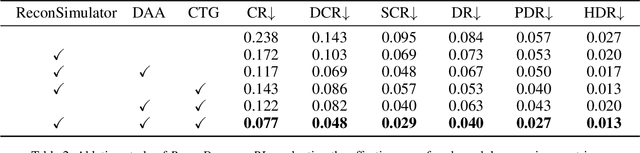
Reinforcement learning for training end-to-end autonomous driving models in closed-loop simulations is gaining growing attention. However, most simulation environments differ significantly from real-world conditions, creating a substantial simulation-to-reality (sim2real) gap. To bridge this gap, some approaches utilize scene reconstruction techniques to create photorealistic environments as a simulator. While this improves realistic sensor simulation, these methods are inherently constrained by the distribution of the training data, making it difficult to render high-quality sensor data for novel trajectories or corner case scenarios. Therefore, we propose ReconDreamer-RL, a framework designed to integrate video diffusion priors into scene reconstruction to aid reinforcement learning, thereby enhancing end-to-end autonomous driving training. Specifically, in ReconDreamer-RL, we introduce ReconSimulator, which combines the video diffusion prior for appearance modeling and incorporates a kinematic model for physical modeling, thereby reconstructing driving scenarios from real-world data. This narrows the sim2real gap for closed-loop evaluation and reinforcement learning. To cover more corner-case scenarios, we introduce the Dynamic Adversary Agent (DAA), which adjusts the trajectories of surrounding vehicles relative to the ego vehicle, autonomously generating corner-case traffic scenarios (e.g., cut-in). Finally, the Cousin Trajectory Generator (CTG) is proposed to address the issue of training data distribution, which is often biased toward simple straight-line movements. Experiments show that ReconDreamer-RL improves end-to-end autonomous driving training, outperforming imitation learning methods with a 5x reduction in the Collision Ratio.