 Add to Chrome
 Add to Firefox
 Add to Edge
StereoPilot: Learning Unified and Efficient Stereo Conversion via Generative Priors
Dec 18, 2025
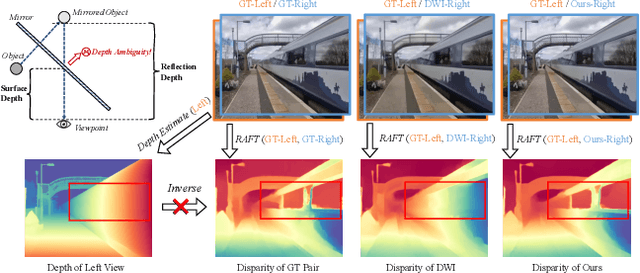

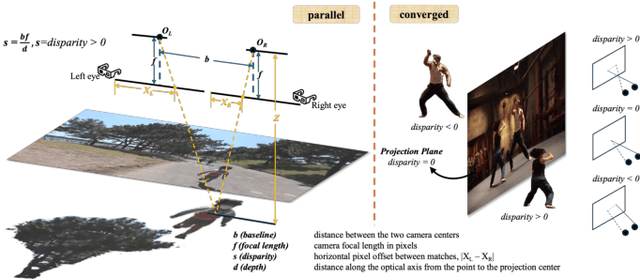
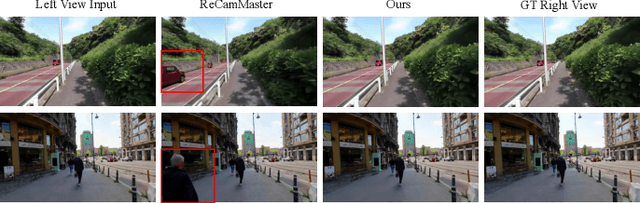
The rapid growth of stereoscopic displays, including VR headsets and 3D cinemas, has led to increasing demand for high-quality stereo video content. However, producing 3D videos remains costly and complex, while automatic Monocular-to-Stereo conversion is hindered by the limitations of the multi-stage ``Depth-Warp-Inpaint'' (DWI) pipeline. This paradigm suffers from error propagation, depth ambiguity, and format inconsistency between parallel and converged stereo configurations. To address these challenges, we introduce UniStereo, the first large-scale unified dataset for stereo video conversion, covering both stereo formats to enable fair benchmarking and robust model training. Building upon this dataset, we propose StereoPilot, an efficient feed-forward model that directly synthesizes the target view without relying on explicit depth maps or iterative diffusion sampling. Equipped with a learnable domain switcher and a cycle consistency loss, StereoPilot adapts seamlessly to different stereo formats and achieves improved consistency. Extensive experiments demonstrate that StereoPilot significantly outperforms state-of-the-art methods in both visual fidelity and computational efficiency. Project page: https://hit-perfect.github.io/StereoPilot/.

The FACTS Leaderboard: A Comprehensive Benchmark for Large Language Model Factuality
Dec 11, 2025We introduce The FACTS Leaderboard, an online leaderboard suite and associated set of benchmarks that comprehensively evaluates the ability of language models to generate factually accurate text across diverse scenarios. The suite provides a holistic measure of factuality by aggregating the performance of models on four distinct sub-leaderboards: (1) FACTS Multimodal, which measures the factuality of responses to image-based questions; (2) FACTS Parametric, which assesses models' world knowledge by answering closed-book factoid questions from internal parameters; (3) FACTS Search, which evaluates factuality in information-seeking scenarios, where the model must use a search API; and (4) FACTS Grounding (v2), which evaluates whether long-form responses are grounded in provided documents, featuring significantly improved judge models. Each sub-leaderboard employs automated judge models to score model responses, and the final suite score is an average of the four components, designed to provide a robust and balanced assessment of a model's overall factuality. The FACTS Leaderboard Suite will be actively maintained, containing both public and private splits to allow for external participation while guarding its integrity. It can be found at https://www.kaggle.com/benchmarks/google/facts .
RoboTidy : A 3D Gaussian Splatting Household Tidying Benchmark for Embodied Navigation and Action
Nov 19, 2025Household tidying is an important application area, yet current benchmarks neither model user preferences nor support mobility, and they generalize poorly, making it hard to comprehensively assess integrated language-to-action capabilities. To address this, we propose RoboTidy, a unified benchmark for language-guided household tidying that supports Vision-Language-Action (VLA) and Vision-Language-Navigation (VLN) training and evaluation. RoboTidy provides 500 photorealistic 3D Gaussian Splatting (3DGS) household scenes (covering 500 objects and containers) with collisions, formulates tidying as an "Action (Object, Container)" list, and supplies 6.4k high-quality manipulation demonstration trajectories and 1.5k naviagtion trajectories to support both few-shot and large-scale training. We also deploy RoboTidy in the real world for object tidying, establishing an end-to-end benchmark for household tidying. RoboTidy offers a scalable platform and bridges a key gap in embodied AI by enabling holistic and realistic evaluation of language-guided robots.
Beyond Flatlands: Unlocking Spatial Intelligence by Decoupling 3D Reasoning from Numerical Regression
Nov 18, 2025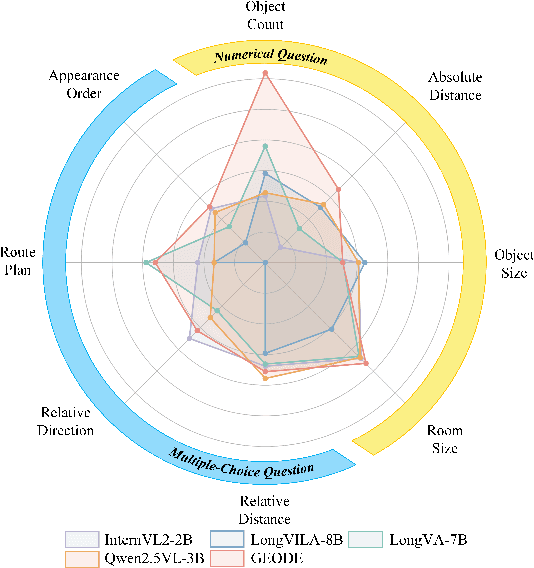
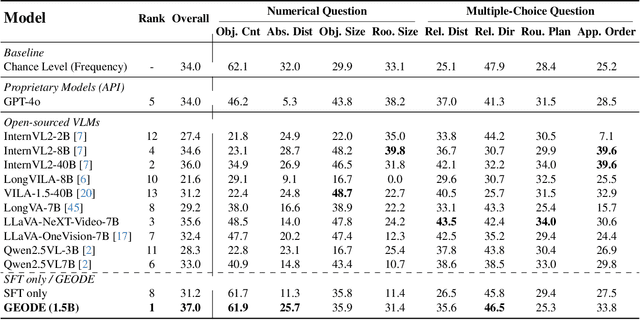
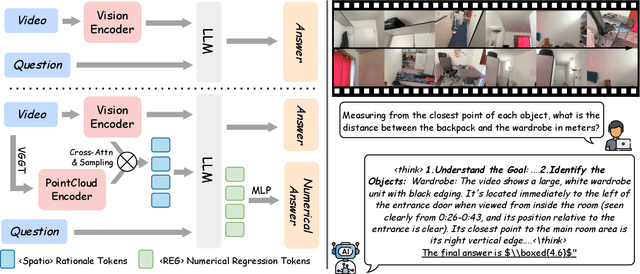
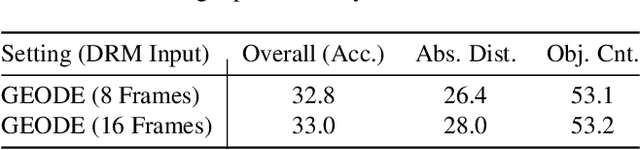
Existing Vision Language Models (VLMs) architecturally rooted in "flatland" perception, fundamentally struggle to comprehend real-world 3D spatial intelligence. This failure stems from a dual-bottleneck: input-stage conflict between computationally exorbitant geometric-aware encoders and superficial 2D-only features, and output-stage misalignment where discrete tokenizers are structurally incapable of producing precise, continuous numerical values. To break this impasse, we introduce GEODE (Geometric-Output and Decoupled-Input Engine), a novel architecture that resolves this dual-bottleneck by decoupling 3D reasoning from numerical generation. GEODE augments main VLM with two specialized, plug-and-play modules: Decoupled Rationale Module (DRM) that acts as spatial co-processor, aligning explicit 3D data with 2D visual features via cross-attention and distilling spatial Chain-of-Thought (CoT) logic into injectable Rationale Tokens; and Direct Regression Head (DRH), an "Embedding-as-Value" paradigm which routes specialized control tokens to a lightweight MLP for precise, continuous regression of scalars and 3D bounding boxes. The synergy of these modules allows our 1.5B parameter model to function as a high-level semantic dispatcher, achieving state-of-the-art spatial reasoning performance that rivals 7B+ models.
UI2Code^N: A Visual Language Model for Test-Time Scalable Interactive UI-to-Code Generation
Nov 14, 2025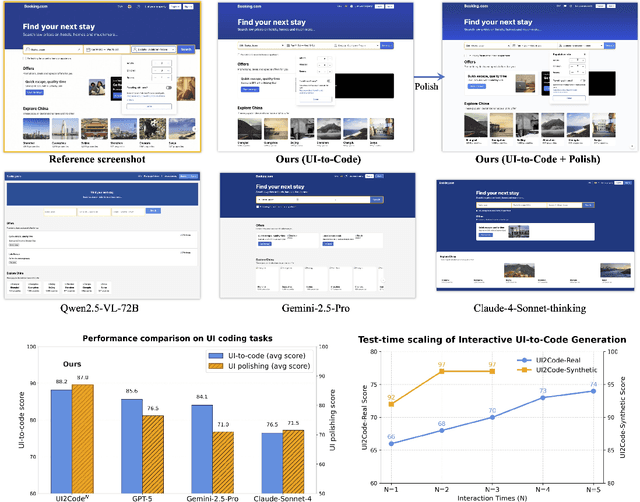
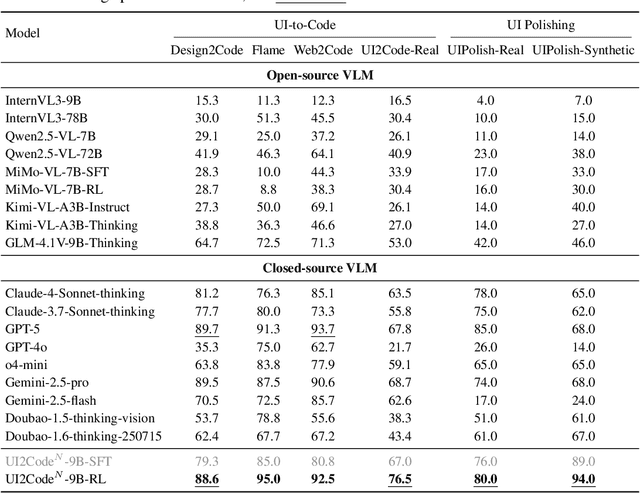
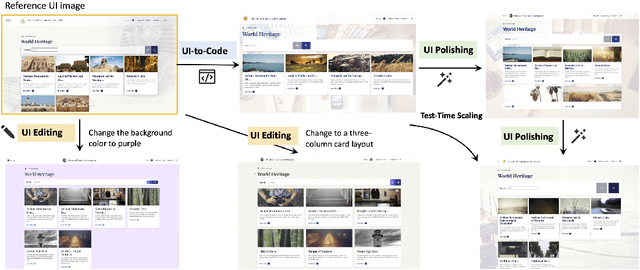

User interface (UI) programming is a core yet highly complex part of modern software development. Recent advances in visual language models (VLMs) highlight the potential of automatic UI coding, but current approaches face two key limitations: multimodal coding capabilities remain underdeveloped, and single-turn paradigms make little use of iterative visual feedback. We address these challenges with an interactive UI-to-code paradigm that better reflects real-world workflows and raises the upper bound of achievable performance. Under this paradigm, we present UI2Code$^\text{N}$, a visual language model trained through staged pretraining, fine-tuning, and reinforcement learning to achieve foundational improvements in multimodal coding. The model unifies three key capabilities: UI-to-code generation, UI editing, and UI polishing. We further explore test-time scaling for interactive generation, enabling systematic use of multi-turn feedback. Experiments on UI-to-code and UI polishing benchmarks show that UI2Code$^\text{N}$ establishes a new state of the art among open-source models and achieves performance comparable to leading closed-source models such as Claude-4-Sonnet and GPT-5. Our code and models are available at https://github.com/zai-org/UI2Code_N.
MathSE: Improving Multimodal Mathematical Reasoning via Self-Evolving Iterative Reflection and Reward-Guided Fine-Tuning
Nov 10, 2025Multimodal large language models (MLLMs) have demonstrated remarkable capabilities in vision-language answering tasks. Despite their strengths, these models often encounter challenges in achieving complex reasoning tasks such as mathematical problem-solving. Previous works have focused on fine-tuning on specialized mathematical datasets. However, these datasets are typically distilled directly from teacher models, which capture only static reasoning patterns and leaving substantial gaps compared to student models. This reliance on fixed teacher-derived datasets not only restricts the model's ability to adapt to novel or more intricate questions that extend beyond the confines of the training data, but also lacks the iterative depth needed for robust generalization. To overcome these limitations, we propose \textbf{\method}, a \textbf{Math}ematical \textbf{S}elf-\textbf{E}volving framework for MLLMs. In contrast to traditional one-shot fine-tuning paradigms, \method iteratively refines the model through cycles of inference, reflection, and reward-based feedback. Specifically, we leverage iterative fine-tuning by incorporating correct reasoning paths derived from previous-stage inference and integrating reflections from a specialized Outcome Reward Model (ORM). To verify the effectiveness of \method, we evaluate it on a suite of challenging benchmarks, demonstrating significant performance gains over backbone models. Notably, our experimental results on MathVL-test surpass the leading open-source multimodal mathematical reasoning model QVQ. Our code and models are available at \texttt{https://zheny2751\allowbreak-dotcom.github.io/\allowbreak MathSE.github.io/}.
WebVIA: A Web-based Vision-Language Agentic Framework for Interactive and Verifiable UI-to-Code Generation
Nov 09, 2025User interface (UI) development requires translating design mockups into functional code, a process that remains repetitive and labor-intensive. While recent Vision-Language Models (VLMs) automate UI-to-Code generation, they generate only static HTML/CSS/JavaScript layouts lacking interactivity. To address this, we propose WebVIA, the first agentic framework for interactive UI-to-Code generation and validation. The framework comprises three components: 1) an exploration agent to capture multi-state UI screenshots; 2) a UI2Code model that generates executable interactive code; 3) a validation module that verifies the interactivity. Experiments demonstrate that WebVIA-Agent achieves more stable and accurate UI exploration than general-purpose agents (e.g., Gemini-2.5-Pro). In addition, our fine-tuned WebVIA-UI2Code models exhibit substantial improvements in generating executable and interactive HTML/CSS/JavaScript code, outperforming their base counterparts across both interactive and static UI2Code benchmarks. Our code and models are available at \href{https://zheny2751-dotcom.github.io/webvia.github.io/}{\texttt{https://webvia.github.io}}.
WebSeer: Training Deeper Search Agents through Reinforcement Learning with Self-Reflection
Oct 21, 2025Search agents have achieved significant advancements in enabling intelligent information retrieval and decision-making within interactive environments. Although reinforcement learning has been employed to train agentic models capable of more dynamic interactive retrieval, existing methods are limited by shallow tool-use depth and the accumulation of errors over multiple iterative interactions. In this paper, we present WebSeer, a more intelligent search agent trained via reinforcement learning enhanced with a self-reflection mechanism. Specifically, we construct a large dataset annotated with reflection patterns and design a two-stage training framework that unifies cold start and reinforcement learning within the self-reflection paradigm for real-world web-based environments, which enables the model to generate longer and more reflective tool-use trajectories. Our approach substantially extends tool-use chains and improves answer accuracy. Using a single 14B model, we achieve state-of-the-art results on HotpotQA and SimpleQA, with accuracies of 72.3% and 90.0%, respectively, and demonstrate strong generalization to out-of-distribution datasets. The code is available at https://github.com/99hgz/WebSeer
Ferret-UI Lite: Lessons from Building Small On-Device GUI Agents
Sep 30, 2025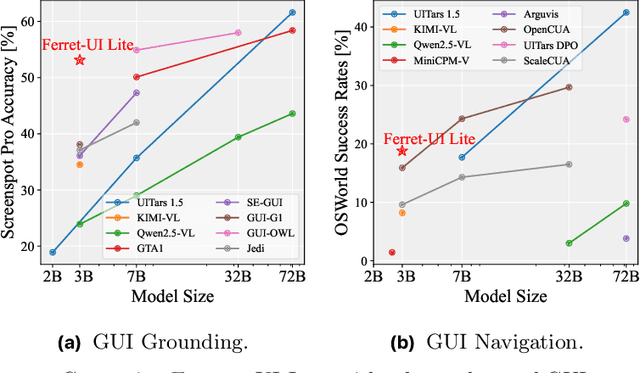
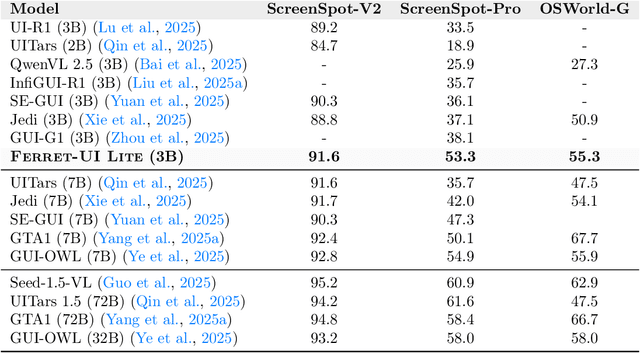
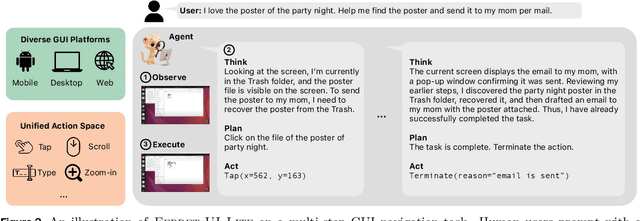
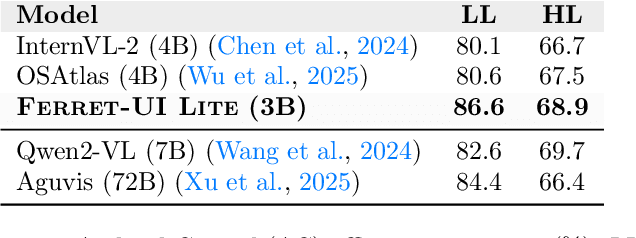
Developing autonomous agents that effectively interact with Graphic User Interfaces (GUIs) remains a challenging open problem, especially for small on-device models. In this paper, we present Ferret-UI Lite, a compact, end-to-end GUI agent that operates across diverse platforms, including mobile, web, and desktop. Utilizing techniques optimized for developing small models, we build our 3B Ferret-UI Lite agent through curating a diverse GUI data mixture from real and synthetic sources, strengthening inference-time performance through chain-of-thought reasoning and visual tool-use, and reinforcement learning with designed rewards. Ferret-UI Lite achieves competitive performance with other small-scale GUI agents. In GUI grounding, Ferret-UI Lite attains scores of $91.6\%$, $53.3\%$, and $61.2\%$ on the ScreenSpot-V2, ScreenSpot-Pro, and OSWorld-G benchmarks, respectively. For GUI navigation, Ferret-UI Lite achieves success rates of $28.0\%$ on AndroidWorld and $19.8\%$ on OSWorld. We share our methods and lessons learned from developing compact, on-device GUI agents.
GLM-4.5: Agentic, Reasoning, and Coding (ARC) Foundation Models
Aug 08, 2025We present GLM-4.5, an open-source Mixture-of-Experts (MoE) large language model with 355B total parameters and 32B activated parameters, featuring a hybrid reasoning method that supports both thinking and direct response modes. Through multi-stage training on 23T tokens and comprehensive post-training with expert model iteration and reinforcement learning, GLM-4.5 achieves strong performance across agentic, reasoning, and coding (ARC) tasks, scoring 70.1% on TAU-Bench, 91.0% on AIME 24, and 64.2% on SWE-bench Verified. With much fewer parameters than several competitors, GLM-4.5 ranks 3rd overall among all evaluated models and 2nd on agentic benchmarks. We release both GLM-4.5 (355B parameters) and a compact version, GLM-4.5-Air (106B parameters), to advance research in reasoning and agentic AI systems. Code, models, and more information are available at https://github.com/zai-org/GLM-4.5.